ஜிஹாத் அமைப்பும், முஸ்லிம் ஊர்காவல் படையினரும், வரலாற்று திரிபுகளும்.
முகம்மத் இக்பால்
சாய்ந்தமருது
கடந்த முப்பது ஆண்டுகளுக்குள் நாங்கள் நேரடியாக அறிந்துகொண்ட பல வரலாற்றுச் சம்பவங்களின் உண்மைகள் மறைக்கப்பட்டு, வரலாற்றுத் திரிபுகளாக சிலரது மனோ இச்சைக்கு ஏற்ப முகநூல்களில் பதிவிடுகின்றனர்.
இவ்வாறு சிலரது மனோநிலைக்கு ஏற்ப எழுதுகின்ற கற்பனைகளை இன்றைய இளைய சமுதாயத்தினர் உண்மை என்று நம்புகின்றனர்.
இன்றைய நாகரீகமான உலகில் நாங்கள் வாழும்போதும், பதிவு செய்யப்பட்ட ஆவணங்கள், அச்சு ஊடகங்கள் இருக்கின்ற காலத்திலேயே இவ்வாறான பொய்யான வரலாறுகளை பரப்ப முடியுமென்றால், பல நூறு அல்லது ஆயிரம் ஆண்டுகளுக்கு முன்பு நடைபெற்ற சம்பவங்களை, எந்தவித சந்தேகமுமின்றி துல்லியமாக உண்மையான வரலாறாக நம்பலாமா என்ற அச்சம் ஏற்படுகின்றது.
மனித நாகரீகங்கள், கண்டுபிடிப்புக்கள் எதுவும் இல்லாத பண்டைய காலத்து கதைகளில் எத்தனையோ திரிபுகளும், குளறுபடிகளும், கற்பனைகளும் ஊடுருவி இருக்கலாம் என்பது தற்போதைய வரலாற்று திரிபுகள் மூலம் எண்ணத் தோன்றுகிறது.
வரலாறு என்பது வரலாறுதான். நடந்தது நடந்ததுதான். வரலாற்று சம்பவங்களை எழுதுகின்றவர்கள், அவர்களது இனத்துக்காகவும், மதத்துக்காகவும், பக்கச்சார்பாக எதனையும் கூட்டவோ, குறைக்கவோ முடியாது. அவ்வாறு திரிபுபடுத்துவது பொய்யான வரலாறாகும் என்பதனை இன்றைய இளைய சமுதாயத்தினர் புரிந்துகொள்ள வேண்டும்.
முஸ்லிம் ஊர்காவல் படையினரும், ஜிஹாத் இயக்கத்தினரும் தமிழ் கிராமங்களுக்குள் புகுந்து ஏராளமான தமிழ் மக்களை கொலை செய்தார்கள் என்ற செய்தியை ஆரம்பத்தில் ஓரிரு ஊடகங்கள் பரப்பியது. பின்பு அந்த ஊடகச் செய்திகளை ஆதாராமாகக் கொண்டு கொலைப் பட்டியலையும், திரிபுக் கதைகளையும் பலர் எழுதி வருகின்றனர்.
கடந்தகால தமிழ் – முஸ்லிம் மக்களின் கசப்புணர்வுகளை அறிந்துகொள்ளாத இன்றைய இளைய சமுதாயத்தினர், இவைகளை உண்மை என்று நம்புகின்றனர்.
விடயங்களை அறிந்தவன் என்றரீதியில் மட்டுமல்லாது, வரலாறுகளை அலசி ஆராய்ந்து உண்மைகளை இன்றைய இளைய சமுதாயதினர்களுக்கு எத்திவைப்பது எனது கடமையாகும்.
Haunting Past becoming Visible: Chemmani Mass graves in Sri Lanka
Dr. Aparna Eswaran
July 6, 2025
11 min read
In the northern soil of Sri Lanka, the past refuses to stay buried. Chemmani, once whispered in fear, now speaks in bones and broken belongings—fragile remnants of lives erased by a war waged not just on the battlefield but on bodies, identities, and memory itself. As fresh graves reemerge decades later, they don’t merely indict individuals, they expose a state apparatus built on silence and denial. This is a story about the dead, and about the living who demand truth. Chemmani is a wound, a witness, and a test: of justice, of memory, and of global solidarity against impunity.
Child’s toy, a blue school satchel, entangled with these remnants of innocence were fragile skeletal bones of children- the horrifying testimony of the violent arc of impunity in Sri Lanka were unearthed recently in the Chemmani mass graves in Jaffna. Undeniable evidence that even children were not spared from the horrors of war, exposed the enormity of cruelty that Tamils had to endure through the war. Sri Lanka is dotted with mass graves where evidence of thousands of extra-judicial murders and disappearances lay buried without accountability. While official records identify over thirty mass graves, proper exhumations have happened only in few. The majority of exhumations so far have taken place only when mass grave sites were unintentionally discovered during constructions and in some rare instances, when individuals from the security forces disclosed information, Chemmani being such an exceptional instance.
Chemmani Mass Grave Discovery
Krishanthy Kumaraswamy
Krishanthy Kumaraswamy
Chemmani was seared into the conscience of the Lankan society with the brutal rape and murder of 18-year-old Krishanthy Kumaraswamy in 1992. A school girl, Krishanthy was on her way to give her exams, when she was stopped at the checkpoint, raped and killed. Her mother, brother and neighbour who went looking for her were also murdered by the army and their bodies were found in Chemmani. Poet Vinothini, a native of Jaffna, captures this horror in her poem “Krishanthi” from the collection Mukamoodi Seypaval
“Krishanthi”
As the birds sang
And the sun fell into the sea
Her death took place
in the open space of white sand,
No one knew about it.
When she was born a female child,
she wouldn’t have thought of such an end,
Her mother neither.
First their look pierced her like a thorn,
then their terrible hands seized her arms,
No sound arose.
She fell in a faint
they raped her senseless body
It happened
at the open space of white sand
She was buried
at the edge of the salty cremation ground
When she was born
Would she have thought of such an end?
(Trans. Prof. M.A Nuhman)
Mugamoodi Seipaval | By Poet Vinothini
Following investigations, five members of the Sri Lankan army were convicted and sentenced to death. One of whom, Army Lance Corporal Somaratne Rajapakse, denied involvement and said that the convicted soldiers didn’t rape or kill Krishanthy, but buried her and that there were many more buried by the army in Chemmani. In his disclosure from the docks of the Colombo High Court, he had said: “almost every evening, dead bodies were brought there and the soldiers were asked to bury them.” Following this unexpected confession, mass protests were organized by Tamils, and with international attention seeping in, the exhumations in Chemmani started. Around fifteen bodies were found, after which in the course of war, the exhumations stopped abruptly. In February this year, routine excavation work by the Nallur Pradeshiya Sabha in Jaffna led to the unexpected unearthing of skeletal remains, drawing fresh public attention.
Raj Somadeva | Senior Professor in Archaeology
This finding prompted a court-ordered forensic investigation led by archeologist Professor Raj Somadeva, which has since uncovered additional proof of mass burials and extrajudicial killings of Tamils during and in the aftermath of the civil war.
Mass Graves and Disappearances
Tamils being displaced by the Sri Lankan invasion of Jaffna, 1995. | Source: Tamil Guardian
Enforced disappearances were used extensively as an instrument of terror in Sri Lanka by state security forces with thousands of Sri Lankans forcibly disappeared, a majority being Tamil. In the immediate cessation of conflict, thousands vanished following their surrender to the state, while others were detained or abducted in the aftermath of the fighting due to alleged involvements with Tamil militancy, political activism, or criticism of the government, held under the Prevention of Terrorism Act (PTA) and various Emergency Regulations (ERs). An estimated 65,000 enforced disappearances have been reported since the early 1980s, the second-highest number globally (UNWGEID, 2016). Official truth-seeking mechanisms and official policies of transitional justice have also met with limited success in Sri Lanka. According to Prof. Vasuki Nesiah, the history of these commissions provides an indicator of how truth and reconciliation commissions can be manipulated to deflect dissent by channeling criticisms of human rights violations into institutions that the government uses as a shield against critique. The Office of Missing Persons (OMP) which was one of the outcomes of the transitional justice policy of post-war Sri Lanka is a case in point and largely been ineffective in spite of raising people’s hopes at its inception. As political analyst Nilanthan from Jaffna had said, there is no transitional justice in Sri Lanka, because there have been no transitions in devolution of power to the Tamil community nor distribution of justice.
A joint report by International Truth and Justice Project, Families of the Disappeared, Center for Human Rights and Development and the Journalists for Democracy in Sri Lanka titled ‘Mass Graves and Failed Exhumations in Sri Lanka’ has identified the lack of political will as the reason for the shortcomings in the exhumations of mass graves. Looking at the exhumations in Mannar and Matale, the report notes how Magistrates and forensic experts have been abruptly transferred, judicial orders delayed by the police, lawyers representing victims’ families denied access to excavation sites and how authorities have made little to no effort to locate living witnesses or gather ante mortem data essential for identification. Even in the exceedingly rare instances where convictions were secured, perpetrators were later granted pardons, underscoring a persistent culture of impunity.
Ruvin De Silva | Photographer and Filmmaker
Based on the ICES research report titled ‘Mass Grave Sites in Sri Lanka’ by Sophie Bisping, the documentary In Plain Sight by filmmaker and photographer Ruvin de Silva highlighted the inherent connections between enforced disappearances and mass graves as mass graves present a possibility of providing answers to what happened to the disappeared. Families and relatives spend their entire lives searching for information of their disappeared loved ones, their grief politicised by different political groups, but the waiting remains a lonely ordeal. Sri Lanka from 2015 is a party to the “International Convention for the Protection of All Persons from Enforced Disappearance,” which recognises the ‘Right to know’ as well as have strict provisions for political interference hindering investigations. But as the documentary notes, the mass graves exist as public secrets where influential politicians have actively interfered in tampering evidence without any accountability. Mass graves are also indexes of disrespect to the dead, placing the burden of reconciliation on the loved ones of the victims and not on the perpetrators of the violence. Families of the Disappeared, overwhelmingly women, have for years held public protests demanding information and accountability. In an absence of accountability in Sri Lanka, these protests have increasingly asked for international accountability and attention to their grief.
International Accountability
Following the recent exhumations in Chemmani, protests by families of the disappeared and civil society organizations started called the Anaya Vilakku (Eternal flame) protests, the demands of which include UN monitoring of the process of exhumation as well as referring Sri Lanka to the International Criminal Court. In response to the protests, UN High Commissioner for Human Rights, Volker Türk visited Chemmani and paid his respects. He said in his media statement “It is always very emotional to visit places where the haunting past becomes so visible” and “When you are at a mass grave site, the one thing that needs to be done is thorough investigations, robust investigations, by independent experts with forensic expertise who can bring out the truth and close the pain and suffering of family members whose loved ones were disappeared”. While Anura Dissanayake had earlier promised to set up a Truth and Reconciliation Commission, (there were widespread disappearances during the crackdown on JVP insurrections in 1980s), the Association of Relatives of Enforced Disappearances in North and East have expressed skepticism considering the past failures in exhumations in North. Volker Türk’s visit has once again rekindled hopes for the families of the disappeared and predictably ruffled feathers in the political echelons of Sri Lanka.
Volker Türk | Austrian lawyer and United Nations official
In an editorial by Shamindra Ferdinando in The Island, Türk’s visit was termed as the ‘Geneva Strategy’ and as ‘flogging a dead horse’ in Sri Lanka for publicity while an active genocide is happening in Palestine. There was also the routine criticism of LTTE’s recruitment of child soldiers as if all of this justifies children being killed and buried in Chemmani. Interestingly Eelam Tamils have been strong in denunciation of the violence committed in Palestine as they have recognised the pain from shared experiences of war and conflict. Instead of pitting these experiences of war against each other, it would be far more productive to think of the accountability we hold to children of Eelam as well as Palestine. Empathy clearly is not enough, actual actions of solidarity matter. In his Semmani series of poems written in 2010, poet Ahilan from Jaffna had written of the return of Mother Mary to Chemmani, ‘When she passed the blackened grass/on which the wind lingers/ the dead bloated moon /in tin coloured water/ a lament rose up/ splitting eons’. Chemmani is a testimony, a lament, but also a test of where we stand on political accountability to the dead, the disappeared and the children we hurt.
References
Ahilan, P. (2023). Semmani 01 (G. Sukumaran, Trans.). In Then there were no witnesses: Poems (p.19). Mawenzi House Publishers Ltd.
International Center for Transitional Justice. (2006). Truth commissions and gender: Principles, policies, and procedures (V. Nesiah et al.). New York, NY: International Center for Transitional Justice.
Calls Grow for Change as Sri Lanka's Dress Code Faces Criticism
By Humaira Riyas17/01/2026
https://www.slwebcast.com/
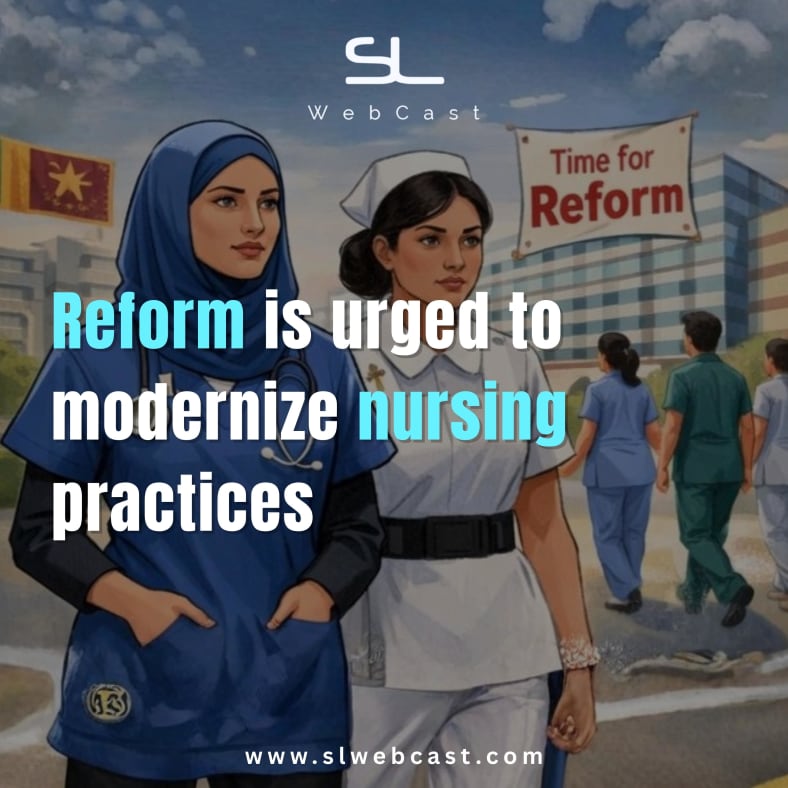
The debate over Sri Lanka’s nursing dress code has intensified as nurses, professional associations, and religious groups question whether the traditional uniform still reflects the needs of a modern healthcare system. The white frock with shoulder cross belts, apron, neck collar, black belt and cap with long socks and shoes- often described as “five pieces cloth” has remained unchanged since the colonial era, is increasingly criticized as outdated, impractical, and culturally restrictive particularly for Muslim female nurses who are wearing hijabs struggling to enter this profession. The number of Muslim female nurses are very low in Sri Lanka due to the restriction of wearing a head piece in to that uniform additionally.
Sri Lanka’s nursing uniform which was approved by SLNC, consisting of a five-piece set including a frock, apron, belt, collar, and cap, was introduced to mirror old British standards of discipline and neatness. While this attire once suited the slower-paced ward environment of the past, nurses argue that it no longer matches the realities of current clinical work. Many describe the uniform as physically limiting, making it difficult to bend, climb onto beds, or perform life-saving tasks such as CPR. Concerns have also been raised about the nursing cap, which is rarely washed due to its delicate structure, creating infection-control worries in high-risk units.
The issue recently entered the national spotlight when the Foreign Affairs, Foreign Employment and Tourism Minister Vijitha Herath, claimed that no legal barrier prevents nurses from wearing uniforms that reflect religious identity. The Sri Lanka Nursing Council President immediately rejected this statement, clarifying that no official circular authorizes deviations from the standard uniform. Reports in the Daily Mirror and The Morning underscored the growing tension between policy, professional expectations, and cultural rights, while Lanka Leader highlighted legal ambiguity regarding religious expression in healthcare attire.
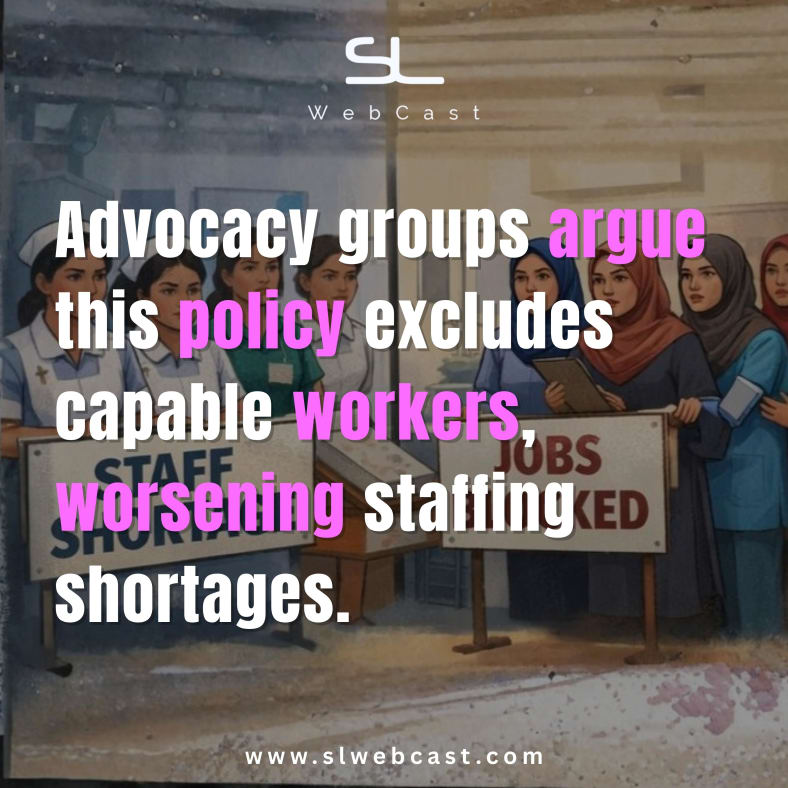
For many Muslim women, the uniform is more than a professional inconvenience it represents a structural obstacle to join the workforce. The frock design does not allow modest coverage such as loose trousers or long sleeves, and the mandatory cap interferes with wearing the hijab in a secure and dignified manner. Some Muslim nurses report discomfort, reduced confidence, and fear of violating religious guidelines during clinical duties. Families and community members have also expressed concern, discouraging young Muslim women from pursuing nursing due to the uniform’s incompatibility with cultural expectations. Advocacy groups argue that the current policy unintentionally excludes a segment of capable, willing female healthcare workers at a time when the country faces staffing shortages.
Amid these concerns, a social media movement has gathered momentum, with thousands of nurses joining Facebook groups started social media campaign a shift to scrubs. Supporters’ note that scrubs already standard in most global healthcare systems are safer, easier to clean, and allow modest adaptations such as long-sleeved undershirts and head coverings without compromising professionalism. Many Muslim nurses emphasize that scrubs would finally give them equal access to the profession without cultural or religious conflict.
As pressure builds, reform advocates say the uniform debate represents a larger question: should Sri Lanka continue enforcing a colonial-era dress code, or transition to a modern, inclusive standard aligned with global healthcare norms? With nurses forming the backbone of patient care, many argue that their attire should prioritize safety, dignity, mobility, and cultural inclusion. While the traditional uniform remains symbolic of Sri Lanka’s nursing heritage, rising voices insist the time has come for a practical alternative that reflects the diverse and demanding nature of today’s healthcare environment.
Note: While many Western countries are focusing on career growth, advanced education, and professional development for nurses, Sri Lankan nurses are still fighting for basic changes such as comfortable and practical uniforms. This contrast highlights how far the country is from adopting modern nursing practices seen elsewhere, underscoring the urgent need for reform.