SHARE

Sunday, April 20, 2025

Vice President JD Vance in New Delhi

Indian Prime Minister Narendra Modi, left, and Vice President JD Vance at an artificial intelligence summit in Paris on Feb. 11. (Leah Millis/Reuters/Pool/AP

 NEW DELHI — Vice President JD Vance and his wife, Usha, are set to arrive in New Delhi on Monday as U.S.-India relations enjoy a period of relative calm.

The Washington Post 20-04-2025

The Trump administration has so far appeared less concerned than its predecessors about India’s close ties with Russia, allegations of Indian involvement in an assassination plot on American soil or accusations of fraud against billionaire Gautam Adani, a close ally to Prime Minister Narendra Modi.

As the country prepares to receive an American vice president for the first time in more than a decade, the mood in New Delhi has been markedly optimistic.

“On the larger ideological plan, we are closer than we were with the previous administration,” said Harsh Shringla, a former Indian foreign secretary. “There is a fair amount of confidence.”

Vance is set to meet with Modi and other Indian leaders. Some in New Delhi, like Shringla, have noted that Usha Vance, whose parents are from India, is making the effort to come to the country, while Vice President Kamala Harris — who had an Indian mother — never visited.

Discussions are expected to focus on trade liberalization, defense cooperation, civil nuclear agreements and boosting Indian investment in the United States — priorities the Trump administration has stressed in its engagement with New Delhi.

Second lady Usha Vance with her husband and their daughter, Mirabel, as they arrive in Rome on Friday. (Kenny Holston/Pool/New York Times/AP)
“The vice presidency has become more significant than in the recent past,” Shringla said. “It is critical we establish a separate and close line of engagement with him. He is able to articulate the vision and the point of view of the administration very well.”

A bygone bear hug

The Biden administration tried to strengthen relations with New Delhi, largely as a counterweight to China. But several incidents complicated the effort.

As NATO leaders were to gather in Europe in July to mark the alliance’s 75th anniversary, senior Biden administration officials, including Deputy Secretary of State Kurt Campbell, scrambled to dissuade Modi from visiting Moscow the same week.

The Indians didn’t listen.

Modi’s trip, which included a warm embrace with Russian President Vladimir Putin hours after Russian missiles struck a children’s hospital in Kyiv, was viewed in Washington as an affront. India had already been reluctant to side with Ukraine and was increasingly purchasing Russian oil at discounted prices because of U.S. sanctions.

Russian President Vladimir Putin hugs Modi before a 2021 meeting in New Delhi. (Manish Swarup/AP)

“It was a slap in the face,” said a former senior Biden administration official, who spoke on the condition of anonymity to describe the sensitive discussion.

But those concerns have little relevance in Washington today.


“India can now inject some warmth into their relationship with Russia,” said Nandan Unnikrishnan, who studies Indian-Russian relations at the Observer Research Foundation.

Some Indians argue that New Delhi’s ties to Moscow help keep the Kremlin at a distance from Beijing.

“The Biden administration did not buy into that argument,” Unnikrishnan said. “Life was becoming difficult. But luckily, because of [President Donald] Trump, there is a certain buy-in to that argument now.”

Sanctions that targeted the flow of technology to Russia under the Biden administration also ensnared some Indian entities.

But Trump announced in February plans to “pave the way” for India to acquire F-35 stealth fighters. Previous administrations hesitated to share such technology, citing the risk that it could be exposed to adversaries. India already uses Russian-made S-400 missile systems.

The breathing room could allow India to continue some long-standing collaborations with Russia, including on civilian nuclear energy. “It is better to have a bird in hand than a pie in the sky,” Unnikrishnan said.

But some warn that inattention to India’s ties with Russia could have consequences. “We invariably lose an opportunity to bring India closer into the fold of like-minded countries,” said Siddharth Iyer, a former Defense Department director for South Asia policy and special adviser to Harris for Indo-Pacific affairs in the Biden administration.

From espionage charges to economics

In 2023, the Justice Department charged an Indian government official with orchestrating a murder-for-hire plot on American soil against a U.S. citizen and Sikh man. The plot was foiled, but the incident became the most serious test of relations between the Biden and Modi administrations.

“We should assume the public attention around that caused some hard thinking in their system,” Iyer said.

In a sign of the lingering sensitivity, Indian national security adviser Ajit Doval, who frequently travels with Modi, was absent from the prime minister’s visit with Biden in Washington in September. In a civil case, the Sikh man has accused Doval directly.

The Washington Post reported last April that U.S. spy agencies tentatively assessed that Doval was probably aware of the attempted murder, but they had found no proof.

After Trump’s election, Doval joined Modi on his February visit to Washington. Attempts to serve him with a legal summons in the civil case on that trip were unsuccessful, court records show.

Sikh separatist leader Gurpatwant Singh Pannun in his New York City office in 2023. (Ted Shaffrey/AP)

In another hit to relations under Biden, Adani was indicted in November on charges of fraud and bribery, drawing scrutiny to a tycoon whose financial rise has paralleled Modi’s political ascent.


The charges briefly cast a shadow over U.S.-Indian relations — Adani withdrew a loan request from the U.S. government for a port terminal in Sri Lanka — but it was short-lived. Adani’s firms are now preparing to invest heavily in American infrastructure.

“The issue is not a top priority for this administration and is unlikely to be discussed in any conversations,” said Aparna Pande, a research fellow at the Hudson Institute. “It will not, however, disappear completely as it will stay in a file and may come up, when the administration changes or some incident occurs.”

Once sensitive issues under Trump have also withered away for now. Indians are the third-largest group of undocumented immigrants in the U.S., the Pew Research Center estimated for 2022.

The Trump administration’s deportation flights carrying shackled Indian citizens drew some anger in India, but they have not caused significant friction between the administrations. Many of the foreign students whose visas are now being revoked are Indian, but the Modi administration has chosen to remain silent.

Billionaire Trump aide Elon Musk meets with Modi in Washington in February. (@narendramodi via X/Reuters)

Meanwhile, Trump and his allies’ commercial links to the country are steadily growing. Trump Towers has announced at least two new real estate projects. Companies run by top Trump aide Elon Musk, including Tesla and Starlink, are making inroads into sales and government permissions in the country. After a phone call with Modi, Musk announced on Saturday a trip to India later in the year.

Some former Biden officials and analysts stress his administration’s effort to keep frictions from getting in the way of the broader strategic convergence against China. But despite that effort, they acknowledge, Indian officials have displayed greater comfort with Republican administrations.

Now some worry that strategic concerns are being overshadowed by a more transactional relationship.

“The center of gravity in the relationship has moved to trade, which has never really been a strong suit in the U.S.-India relationship,” said Anthony Renzulli, a former director for India at the National Security Council. “You have moved from defense technology to something that is on thinner ice.”

Indian officials appear unfazed. From immigration enforcement to energy purchases, New Delhi has signaled a proactive compliance with the Trump administration’s demands.

“There is no alternative for India’s development project without the United States,” Unnikrishnan said. “And at the highest levels, we determined that if this means there are some unpleasant compromises, they will be made.”

That posture has led to greater confidence. “I know, today, a lot of countries are nervous about the U.S.,” Indian Foreign Minister S. Jaishankar told reporters after Trump defeated Harris in November. “Let’s be honest about it: We are not one of them.”🔺

Sri Lanka-India MoUs and their implications

மோடியின் இலங்கை விஜயத்தில் அனுரா அணிவித்த நவரத்தின விருது.

Sri Lanka-India MoUs and their implications

The Island 2025/04/18

Of the several MOUs signed by the President of Sri Lanka during Prime Minister Modi’s visit to Sri Lanka, the most consequential in respect of implications to Sri Lanka is the one associated with the Defence Cooperation.  Neither the public nor the Parliament is aware of its contents. What the public could glean about the scope of this vital MOU are from articles written by concerned citizens, like the one by Dr. Dayan Jayatilleka in the Daily FT of April 10, 2025. The source of his material is from statements made by the President during political rallies relating to the Defence Cooperation MOU. One such statement is cited below. This reflects a seismic shift in respect of Sri Lanka’s relations not only with India, but also with other Nation-States, that is disturbing to say the least, because of its implications on Sri Lanka’s autonomy to act independently as a sovereign Nation-State and define its own destiny; a status Sri Lanka defended for nearly 2500 years despite repeated interruptions over the years.

SECURING ASSISTANCE

Justifying the need for Defence Cooperation with India, President Dissanayake is reported to have stated the following at an election meeting in Galle:

“We need security in this region.  We need to safeguard the security of this region. We should secure the assistance of those who have greater technological capacities in defence, greater skills in defence. If not, how can a country move forward? …. For 76 years the world developed rapidly in science and technology. The world developed rapidly in military science.  Now, what should we do? We must secure the assistance of those states which have accepted new science and technology. Don’t we have to do that”? (Ibid).

There are two pivotal issues that arise from the President’s comments. The first is discarding the principle of SELF-RELIANCE (SR). SR is the bedrock of Sri Lanka’s civilizational values. The inspiration to rely on one’s SELF to evolve answers to inscrutable questions or to challenges that present themselves as insurmountable comes from the single-minded approach adopted by Lord Buddha in his search for liberation. His attempts to seek the assistance of others failed him. It was the relentless determination to find the answers himself to what he was looking for, that enabled him to realise his goal; a goal that has benefited mankind.

The role model set by him was what inspired the spirit of SELF RELIANCE that enabled Sri Lanka to create a civilisation that was unique over millennia. It was not created by military conquest. It was not created by developing “military science”. The monuments left behind are a testimony to the ingenuity and skills of the People of Sri Lanka. It was they, who developed the technologies needed for the Sri Lankan nation to lead a life of peace and contentment.

Throughout Sri Lanka’s history, its sovereignty has been repeatedly violated and its territory vandalised by invading armies. Whenever such invasions occurred, liberation and freedom came from military strategies developed and adopted by those within by relying on SR. They did not go running to sign MOUs seeking assistance from militarily powerful nations. On the other hand, whenever our Rulers sought the assistance of external powers, such as the Dutch, to get rid of the Portuguese who had invaded the country, the Dutch ended up colonising the whole country for nearly 150 years until they lost it to the British, who in turn colonised for a further 150 years. The Defence Cooperation MOU with India has the potential to repeat that history.

SAFEGUARDING REGIONAL SECURITY

The President has stated: “We need security in this region. We need to safeguard the security of this region”. If this is a policy of this government, in what way could Sri Lanka contribute towards the “security of this region”? Is there a clear understanding as to how Sri Lanka and India are going to undertake safeguarding the security of the region?  Whatever it may be, there is no doubt that the contribution Sri Lanka can afford to make is insignificant compared with what India would be making because it is in India’s self-interest as an aspiring Global Power to make the region secure. Furthermore, because of this disparity, the MOU would entitle India to enforce its will as to how regional security is exercised. Does this not amount to sacrificing Sri Lanka’s strategic autonomy?

If it did, would it not compel Sri Lanka to be under the hegemony of India; a condition that would only bolster the security of India based on India’s notion that the security of India depends on the security of Sri Lanka, meaning a weakened Sri Lanka under the control of India? On the other hand, if Sri Lanka exercises its independence and acts in pursuit of its own self-interests, and such actions do not mesh with that of India in its pursuit of becoming a global power, there would be consequences.

Therefore, any arrangement that compromises the independence of Sri Lanka and its ability to exercise its Self- Reliance has to be mindful of India’s interests.  This does not mean that Sri Lanka should not heed India’s concerns and interests.  Instead, it only means pursuing Sri Lanka’s interests while being conscious of India’s sensibilities, as it was with the Chinese “research vessel”. However, under a Defence Cooperation MOU, it would be India that would decide the parameters as to whether to permit entry of foreign vessels or not; a constraint that would compromise Sri Lanka autonomy to pursue its self-interests.

IMPACT on FOREIGN POLICY

An alignment with a power that the President describes as: “We sincerely applaud the way India has positioned itself not only as a regional power, but also as global power” (Ibid), means Sri Lanka has decided to disassociate itself with its long cherished position of being Non-Aligned as a founding member of Non-Aligned Movement, that morphed recently into being Neutral in the context of emerging Great Power rivalries in this region.    By aligning exclusively with a country that is positioning itself to be a global power and at the cost of distancing itself in its relations with other Global Powers, comes not only at a cost that Sri Lanka cannot afford to bear in the background of overdue debt to them, but also a degree of dependence that is unknown and unfamiliar to independent Sri Lanka.

The need to seek exclusive relations with India is in the hope that India would assist Sri Lanka in case such a need arises because Sri Lanka does not have the needed “military science” to defend itself, not realising that there is no free lunch; a fact attested by Sri Lanka’s own history.  The President and this Government must accept the hard reality that Sri Lanka or any other small country can ever hope to match the degree of “military science” capabilities that Global Powers possess. At the end of the day, it is a smart strategy that matters more than the stacks of military hardware by countries such as Sri Lanka; a fact demonstrated by David’s sling shot against the might of Goliath.

For instance, Sun Tzu, in “The Art of War”, states: “What is essential for leaders, generals, and ministers in running countries and governing armies is no more than … peak efficiency of knowledge and strategy is to make conflict altogether unnecessary. To overcome others’ armies without fighting is the best of skills”. It is clear from the wisdom of the ages that effective intelligence gathering and appropriate strategy is far more relevant for the security of a Nation such as Sri Lanka than relying on the unrealistic notion of military science to ensure its security.

CONCLUSION

During an election rally, the President is reported to have stated that there is a need not only to “safeguard security for the region”, but also that Sri Lanka “must secure the assistance of those states which have accepted this new military science technology” if Sri Lanka is to move forward. These objectives are to be incorporated in a Defence Cooperation MOU with India.

How Sri Lanka is to contribute to “safeguarding the security of the region”, or what form and type of the assistance Sri Lanka expects from India, is not made public. Despite such lacunae, the implication of any form of Defence Cooperation exclusively with a country such as India that is “positioning” itself to be a global Power or one that is already recognised as a Global Power, is bound to affect Sri Lanka’s relations not only with other Global Powers but also with other countries as well.

Furthermore, exclusive alignment with one Power means that Sri Lanka has decided to ditch not only the principle of Non-Alignment and its concepts that it championed for decades, but also, more appropriately, Neutrality, in the emerging context of Great Power rivalries in the region. Such exclusive arrangements for assistance with one country compel Sri Lanka to be in the vortex of India and its interests, the consequence of which for Sri Lanka is to be a vassal State of India.

The nearly 2,500-year old history of Sri Lanka has been to resist and defend such attempts. Throughout its history Sri Lanka has relied on its own strengths and abilities and created the spirit of Self-Reliance modeled on the example set by the founder of the religion of the majority of Sri Lanka. That is to develop its own strategies to create a unique civilization in which its People enjoyed peace and contentment. However, there were occasions when weak leaders abandoned the rewards of Self-Reliance and sought the assistance of the Dutch to overcome the threat of Portuguese occupation, and ended up being colonized for over nearly 150 years. The planned Defence Cooperation MOU with India could very well be a repeat of that history; an outcome that would permanently ensure India’s security.

The attempt to seek external assistance to “move forward” is founded on the misguided concept that without the military and technological strength of external agents, Sri Lanka cannot move forward. In view of the fact that countries such as Sri Lanka cannot ever hope to match the capabilities of those who have advanced military technologies, the choice left to Sri Lanka is to be guided by the wisdom of the ages cited above, and develop “efficiency of knowledge and strategy”.

That means, the compelling need for Sri Lanka to develop its Intelligence and strategic capabilities to a very much higher level than what exists today so that Sri Lanka is in a position to make conflict both internal or external unnecessary. The importance of strategy over Military capabilities is starkly made evident by the experience of the US in Vietnam. Notwithstanding the fact that the US possesses the most advanced military hardware in the world, the US lost the war in Vietnam because of a wrong strategy. The US relied totally on the capabilities of their military hardware and forgot the strategy of David’s slingshot. The hope is that the President is made aware of these lessons of history.🔺

by Neville Ladduwahetty

Saturday, April 19, 2025

Easter attack mastermind claims: Govt. contradicts

Easter attack mastermind claims: Govt. contradicts FBI and Australian police findings

  • In reply to letters from Sri Lanka’s police chief, US and Australian authorities state no further investigation is needed into the Easter attacks
  • Public Security Minister Wijepala refers to Pillayan in Easter Sunday investigation
  • In his book, Pillayan explains rise of extremism and ideology of terrorists behind the attacks

By Our Political Editor (ST lk 20-04-2025)

Sri Lanka today commemorates the sixth anniversary of the Easter Sunday massacres, a tragedy that claimed 269 lives, including men, women, and children, many of whom were attending worship.

This year, the memory is overshadowed by explosive new claims suggesting fresh investigations have unearthed previously unknown masterminds. This controversy has deepened after Public Security and Parliamentary Affairs Minister Ananda Wijepala made a startling disclosure in Parliament on April 10. He charged that Sivanesathurai Chandrakanthan, widely known as Pillayan—a former guerrilla leader turned politician— has been arrested by the Criminal Investigation Department (CID). He said lots of information about his involvement in the Easter Sunday attacks have been revealed. “We will not allow any crime to be swept under the carpet,” Wijepala declared, vowing “to restore law and order.” Yet, his statement lacked substantive details, leaving the public grappling with unanswered questions. The events that followed made it worse.

President Anura Kumara Dissanayake, campaigning for the May 6 local council elections, hinted at new developments in the investigations but refrained from disclosing specifics. The silence from other NPP-JVP leaders has only fuelled scepticism, raising doubts about the authenticity and timing of these revelations. Questions have arisen on whether the new developments will end up as an attempt to rewrite history — a phenomenon all too common in the country’s recent past, including the military defeat of Tiger guerrillas. More so when a deadline imposed by Cardinal Malcolm Ranjith for a government response on new findings before the sixth anniversary hangs in the air. Thus, it is not immediately clear whether a CID team with orders to brief him regularly has given reasons or whether he would go ahead with the protest march from Colombo to Katuwapitiya church, one of those attacked, to express dissatisfaction. It covers over 37 kilometres.

Pillayan presenting copies of his book, Easter Padukolai, to religious leaders from the Eastern Province at a ceremony held last year

In a new development on Thursday night, CID detectives arrested K. Jeyakishan, alias Jeyanthan, a resident of Valachchenai, and brought him to Colombo. He is a close associate of Pillayan and worked at the Tamil Makkal Viduthalai Pulikal (TMVP) office in Batticaloa. They said his arrest was related to the ongoing probe into the 2006 disappearance of Subramaniam Raveendranath, once Vice Chancellor of the Eastern University. Another arrested on Friday was Deva Sugath alias Kanth, a private bus driver. He had served as driver to Jeyakishan.

According to an official announcement by Police Headquarters, Pillayan was arrested on April 8 also in connection with the abduction of Professor Raveendranath. The academic’s whereabouts are not known thereafter. Pillayan is now being detained at the Criminal Investigation Department (CID) on a detention order for three months under the Prevention of Terrorism Act (PTA). As Defence Minister President Anura Kumara Dissanayake has signed the order. This will no doubt give time for the investigators to question him and cross-check the “fresh evidence” they may gather. Minister Wijepala’s disclosure about Pillayan’s link to the Easter Sunday attacks gives reason for the long detention.

This year’s claims collide with earlier international investigations, conducted by teams from the Federal Bureau of Investigation (FBI) from the United States and the Australian Federal Police. They had the largest teams and their probes were intensive. A team from Israel’s Mossad provided them with detailed technical assistance and advice. Other police teams were from Scotland Yard in the United Kingdom, the New Zealand Police, Danish Police, Dutch Police, and Interpol top officials from their headquarters in Lyon, France. All probe teams worked in close corroboration with the Criminal Investigation Department (CID) and were working from their fourth-floor headquarters at the New Secretariat building. Senior DIG Ravi Seneviratne headed the CID whose director then was Shani Abeysekera, SSP. The probes ended in the separate investigators coming to a single conclusion—that the massacres were orchestrated by “ISIS in Sri Lanka”, an affiliate recognised by ISIS leadership then rooted in Syria. The attacker’s allegiance to ISIS, their direct communication with Syria, and their training—all solidify this narrative.

Last week’s issue of the Sunday Times (April 14), released on April 11 on account of the Avurudu holidays, revealed highlights of a 71-page affidavit filed in a Los Angeles court by the head of the FBI investigation team. Merrilee R. Godwin, a special agent who led the team of around 33 to Sri Lanka. He forwarded the affidavit in support of a criminal case against and arrest warrants for Mohamed Naufer, Mohamed Answer Mohamed Riskan and Ahmed Milhan Hayathu Mohamed before US courts. This is over the killing of five US nationals during Easter Sunday attacks.

The affidavit, dated November 12, 2020, noted that “the attackers and their co-conspirators were members and supporters of ISIS and created a group, ‘ISIS in Sri Lanka.” They claimed responsibility for the attacks via their news agency, declaring that “Islamic State fighters” had “targeted citizens of coalition states and Christians in Sri Lanka”. ISIS also posted a picture and video of the attackers swearing allegiance (“bayat”) to ISIS’s then leader, Abu Bakr al-Baghdadi (“al-Baghdadi”). Before detonating an IED that killed himself and scores of victims, Jahran Mohamed Cassim, also known as (“aka”) Mohamad Cassim Mohamad Zahran, aka Zahran Hashim (“Zahran”), was the mastermind behind the Easter Attacks and the self-proclaimed leader of ISIS in Sri Lanka. Zahran claimed to have communicated directly with ISIS leadership in Syria and obtained approval to operate as an ISIS affiliate. The group member swore bayat and trained and recruited new members using ISIS instruction materials that ISIS provided.”

The new assertions contradict the findings of international investigators and those from Sri Lanka too. This adds an overly complex web of uncertainty. From legal affidavits filed in the US courts to evidence collected from crime scenes, the international investigation tied key conspirators like Zahran Hashim and Mohamed Naufer to the attacks. With such opposing narratives, the truth behind the Easter Sunday tragedies continues to elude justice.

Details of Pillayan’s alleged involvement in the Easter Sunday massacres have not yet been made public. A onetime minister, now a member of the Mawbima Janatha Party (MJP) and lawyer, Udaya Gammanpila, declared at a news conference last Monday that Pillayan had told him that he has still not been questioned on the Easter Sunday attacks. This was during a meeting he held with him at the CID headquarters where he is being detained.

Gammanpila had been given permission to meet Pillayan as a lawyer representing him. However, he had complained that four staffers in the CID remained with him throughout his meeting and alleged this violated his lawyer-client privileges. Pillayan has also denied any involvement in the Easter Sunday incidents, he declared, adding that he remains in custody for the alleged abduction of the then Vice Chancellor of the Eastern University.  He said that the Detention Order served on Pillayan did not refer to the Easter Sunday incidents.

Since the Easter Sunday attacks in 2019, Pillayan has faced allegations from some quarters over his reported association with alleged attackers who were imprisoned in Batticaloa alongside him, albeit under different circumstances. Among them were his former battlefield adversaries. Pillayan’s history as a Tiger guerrilla, marked by episodes of violence and murders, lent weight to these claims. However, no concrete evidence emerged to substantiate his direct involvement in specific incidents or in any other activity. His name did not surface in international investigations or the probes earlier by CID. So much so, he denied involvement in a 329-page Tamil book titled Easter Padukolai or Easter suicide. A section of the Buddhist, Muslim and Hindu clergy took part in the launch from the Kanchana Mandapam in Batticaloa in March 2024. A Sinhala translation was released thereafter. He said that the Easter Sunday attacks came when he was completing his book.

He declared that it “took place at a time when I was in remand prison. I do not have any involvement in these incidents. I wish to categorically state that this is a baseless and fraudulent act linking me to this horrendous crime. It has been committed with an ulterior political motive. If anyone has any doubts about the attacks, they need to watch the full video of Zahran and his followers just prior to the suicide attack where they declare their allegiance/oaths.”

Among the highlights of the book:

Pillayan traces the roots of Islamist extremism in the Eastern Province, attributing its rise to increased connectivity with Middle Eastern countries, job opportunities abroad, and the establishment of Islamic teaching institutions. He argues these factors led to the spread of Wahhabism, particularly among the youth. Founded in the 18th century by Muhammad ibn Abd al-Wahhab in present-day Saudi Arabia, it advocates for the rejection of innovations (bid’a) and practices that it considers to be deviations from the original teachings of Islam.

He emphasises the importance of understanding history to foster reconciliation among Sri Lanka’s ethnic communities.

He recounts his interactions with Islamic radicals during his time in remand custody in 2017. He describes receiving a book on Islamic thinking from Zain Moulavi, a senior member of the group, during discussions about their radical behaviour.

The book also reveals shocking claims about Zahran Hashim training 15 women for suicide missions in December 2018. Pillayan cites intelligence reports and testimonies from arrested individuals to support this assertion.

Increased job opportunities in the Middle East, establishment of Islamic teaching institutions and other connectivity to those countries have resulted in the systematic ‘arabisation’ of the east. (Note: Intelligence channels have reported to government of the emergence of a group called “Super Muslims” in an eastern town. It is still in its infancy)

These developments paved the way for spreading “Wahhabism” particularly among the youth in the area which led to the Easter Sunday attacks.

He noted that without understanding and discussing history, it would be impossible to talk about reconciliation among ethnic communities in the country.

He reveals that he met a group of Islamic radicals a few times whilst he was in remand custody in Batticaloa in 2017. Zain Moulavi, the seniormost of this group has given a book on Islamic thinking to him. This was when the latter questioned him about reasons for their radical behaviour.

These followers of Zahran have been arrested by Police over a clash with Sufi Muslims in 2017 and were in the remand prison for approximately eight months. Sufism, a mystical branch of Islam focuses on inner spiritual purification and seeking direct knowledge of Allah. Later, two youth out of this group committed suicide during Police/Army raids on their safehouse in Sainthamaruthu (Batticaloa district) on April 26, 2019.

These revelations add layers to the ongoing discourse around the attacks, highlighting the interplay of ideology, radicalization, and political narratives. Pillayan’s denial of involvement and his focus on historical and ideological analysis make his book a significant, albeit highly controversial, contribution to understanding the tragedy.

Findings of investigations by foreign teams were conveyed to then Inspector General of Police, Chandana Wickremeratne, from time to time. This is in addition to his own CID teams reporting to him regularly. In a bid to ensure more persons responsible were brought to courts, he sought further help of both the FBI and the Australian Federal Police (AFP). He wanted to know whether further investigations were being conducted. To both the FBI and the AFP the greater interest was the ISIS links to Sri Lankans. This is particularly in view of their presence in the two countries.

The letter to the Director of the FBI in Washington D.C. highlights that the then Police Chief Wickremeratne had not only accepted the findings of foreign investigators but also wanted more information. It was transmitted through Sri Lanka’s Ambassador to the United States, Mahinda Samarasinghe. He in turn had to route it through the Department of State. This process lays bare an important message to the Ministry of Foreign Affairs. Often, those in Colombo-based diplomatic missions do not follow the protocol of directing their queries or meetings to this ministry. They deal with the government body directly responsible, sometimes without the knowledge of the ministry itself.

In a letter dated March 29, 2022, IGP Wickremeratne said, “The Sri Lanka Police extends its heartfelt gratitude towards the Federal Bureau of Investigation (FBI) for the unhesitating support it renders by way of making parallel investigations over the Easter Sunday brutal suicide bombings carried out in Sri Lanka on 21st April 2019 by the later identified Muslim extremist group.

“The initial investigation into these suicide bombings especially conducted by the FBI in collaboration with the Criminal Investigation Department (CID) to which I command as the Head of the CID, was able to find many evidentiary valued materials which are in support of the ongoing courts’ proceedings pertinent to this attack.

“Upon tendering the progress of the investigation with the findings of the FBI made in its initial investigation to the competent courts of Sri Lanka, it has been directed the CID by that courts to tender further findings of the FBI investigation apart from its initial findings which have already been tendered to the courts. (Sic)

“With the view of adhering to the directions of the courts, the CID is in high necessity of obtaining relevant material/evidence, if any, gathered through the subsequent stages of the investigation which is being conducted by the FBI.

“Since the CID has to tender to the courts within a short period of time the further findings of the FBI’s investigation relating to this suicide attack, if any, in order to allow the courts to be proceeded with, your early reply into this highly essential in nature. (Sic)

“Whilst thanking you in advance, your co-operation in this regard is greatly appreciated.”

Ambassador Samarasinghe received a reply from Christopher A. Landberg, then Acting Principal Deputy Co-ordinator, Bureau of Counterterrorism, US Department of State. This is what he said in an email on April 7, 2022: “Thank you for raising with us Sri Lanka’s request for an independent investigation into the Easter Sunday attacks. The bombings that took place on April 21, 2019 were both shocking and horrific, tragically claiming the lives of 269 people, including five US citizens, and injuring hundreds of other innocent people. In the immediate aftermath of the attacks, and continuing to the present day, the US Government provided assistance in the investigation and prosecution of those responsible—to the point that the Department of Justice filed a criminal complaint in January 2021 against those deemed responsible for the deaths of US citizens. In light of that, even as we stand ready to continue providing support to your government, it would not make sense for the United States to continue to conduct an additional investigation into the attacks.

“In terms of our co-operation on this case, I would like to highlight that the US Federal Bureau of Investigation (FBI) has worked closely with the Sri Lankan law enforcement, and in the week after the attack, deployed approximately 33 personnel to Colombo to assist Sri Lanka’s Criminal Investigation Department with all aspects of their investigation. These efforts included evidence collection, witness and victim interviews, and exploitation of digital devices. In the months following the April 21 2019 attacks, the US Ambassador and the FBI’s Legal Attache regularly briefed the then President, Prime Minister and Defence Minister on the ongoing investigation. The joint work culminated in the US Department of Justice charging three suspects in the United States in January 2021, as noted above.

“In addition to support for the 2019 investigation into the Easter attacks, the US government—through the Department of Justice and Department of State’s Bureau of Counterterrorism—has provided ongoing case-based mentoring and training to Sri Lankan prosecutors pursuing counterterrorism cases. The Department of State’s Bureau of International Narcotics and Law Enforcement has also provided general judicial and prosecutorial assistance and training over several years. After the attacks, the Department of State also developed a proposal for broader counterterrorism co-operation, included in the non-paper we shared with you and your team on February 8, 2022.

“Our team would be happy to facilitate additional briefings on our support for the investigation and our ongoing and potential counterterrorism assistance to your government. We also pledge to consider any additional requests from the Attorney General for support from US prosecutors two of whom are currently on the ground in Colombo. We look forward to continued collaboration to bring the perpetrators of the Easter Sunday bombings to justice and to further strengthening our counterterrorism co-operation.”

There are important takeaways from the US State Department message above. Sri Lanka, most pointedly, sought a second FBI investigation. Quite clearly, the CID was unable to cope on its own with the enormity of the probe. They also did not possess the technical resources. The other is the fact that the US government’s official position on the initiatives they have taken is all based on the findings of the Federal Bureau of Investigation (FBI). That is how their Justice Department resorted to court action and extended a series of other counterterrorism assistance to Sri Lanka. For five long years, this position has not been challenged. In the sixth year, with the advent of the NPP-JVP government, its Public Security Minister Wijepala has now claimed there are new findings. He has declared that Pillayan is implicated—a fact that has not been found during international investigations. Sri Lankans are yet to be told what they are. That naturally begs the answer to the question, why did the CID not come by any trace of Pillayan’s alleged involvement then?

Then Police Chief Wickremeratne wrote to the Australian Federal Police on March 29, 2022. The letter was on the same line as the one addressed to the Director of the FBI. He thanked the Australian Federal Police for their “unhesitating support” in making “parallel investigations of the Easter Sunday brutal suicide bombings carried out in Sri Lanka on April 21, 2019 later identified as a Muslim extremist group.” He said that “the CID I command was able to find many evidentiary valued materials which are in support of the ongoing court proceedings pertinent to this attack.” Wickremaratchchige Thilakaratna, later Director of the Criminal Investigation Department (CID), also wrote to the Australian Federal Police. Among other matters, he told them, “Some of the investigations have been completed, and the extracts were forwarded to the Hon. Attorney General for his advice in this backdrop; kindly request to inform us whether you have any production, pending reports, or conclusions to submit to our investigation authorities which will help us to finalise matters at this end.”

During interaction with IGP Wickremeratne and those at the CID, the Australian Federal Police (AFP) investigators led by Detective Superintendent Robert Wilson told his Sri Lankan counterparts that their findings were identical to the revelations unearthed by the FBI. Excerpts from a letter Mark McIntyre, Commander, Counterterrorism Investigations South, wrote to IGP Wickremeratne on April 21, 2022: “The Australian Federal Police (AFP) extends its regards to the Sri Lanka Police (SLP) and the Criminal Investigation Department for the ongoing co-operation into matters of National Security.

“Following the tragic terrorist attacks that occurred in Colombo on 21 April 2019, the AFP deployed investigations, intelligence and Forensics members to provide capability advice and assistance to the Sri Lanka Police, with an additional 33 devices taken to Australia for additional examination to extract the data. Three devices were unable to be examined by the AFP and were provided to the FBI for further examination. All devices and the contents extracted from those devices were provided to Sri Lankan Police upon completion of examination.

“There are no ongoing investigations by the AFP into the 2019 Easter Sunday terrorist attack.”

The irony is unmistakable. Leading the renewed investigations are Ravi Seneviratne, now Secretary to the Ministry of Public Security, and Shani Abeysekera, Director of the Central Crime Investigation Bureau and the Bureau of Central Criminal Intelligence Analysis. Both, after their retirement, campaigned on NPP-JVP platforms during presidential and parliamentary elections, only to be reinstated to the police. SSP Abeysekera, soon to be promoted DIG, is operating from Police Headquarters, making periodic visits to the CID to monitor ‘progress in fresh investigations.’ Both held sway at the CID when the Easter Sunday attacks took place.

With Pillayan—a man notorious for orchestrating violence in the east—now identified as being involved, they must unearth compelling evidence. For this, they have three months. This is not merely to challenge international investigations that missed these findings but to address a looming foreign policy dilemma for the NPP-JVP government, particularly with the United States and Australia.


The arrest warrant issued on Zaharan

An open warrant for the arrest of Mohamed Zaharan, the self-styled leader of the National Thowheed Jamath (NTJ), had been issued by a Colombo magistrate back in August last year, but the wanted man had gone into hiding by then, and the search for him had dissipated with the arrest of the then Terrorism Investigations Division (TID) chief DIG Nalaka Silva shortly thereafter, it has now been revealed.

The open warrant had been issued after the Police TID filed a ‘B’ report dated July 2, 2018, before the Colombo Magistrate’s Court, citing Mohamed Cassim Mohamed Zaharan by name and stating that he was using the internet to spread disaffection among communities and for proposed terrorist activities.

The report filed in court referred to Zaharan’s clash with Isthihadi Ahlul Sunnathul Wal Jamath (IASWJ) members in March 2017 in Kattankudy and ten persons being produced by the Kattankudy Police before the Batticaloa Courts. They were later bailed out while Zaharan had fled the area and gone into hiding.

This means that, at least since last year, the TID had been hot on the trail of Zaharan, believed to be the mastermind of the Easter Sunday multiple bombings that killed 258 people. But the trail dissipated even after an open warrant for his arrest was granted in August last year, as the TID DIG was arrested in September 2018 on charges relating to an attempt to assassinate President Maithripala Sirisena.

The TID had also asked court for Interpol to be requested to issue a “blue notice’ – a notice that alerts police and immigration officials worldwide for additional information on the person’s identity, location or activities in relation to a crime as there was a likelihood that he could travel overseas, or was already abroad.

The “B’ report submitted to court stated that Zaharan was suspected of wanting to create divisions between communities, especially among the Sinhala and Muslim communities with the aim of causing communal violence.

It added that his name was being included in the Police Gazette as a wanted man.

In an affidavit filed by the TID investigating officer, court was informed that Zaharan was using a video to disseminate radical views that were reaching a number of youths and causing animosity even within his religious community.

The TID officer said they had been monitoring his speeches exhorting violence. His signed affidavit was dated June 29, 2018. The court order was dated August 8, 2018.

DIG Nalaka Silva was released on bail this week. He was interdicted in October, 2018.

A chronology of terror attacks on April 21, 2019

Here is a brief chronology of the incidents that occurred on Easter Sunday April 21, 2019, over which the Criminal Investigation Department (CID) is now probing for new masterminds. These incidents occurred in the morning.

  • A suicide bomber detonates an Improvised Explosive Device (IED) inside the most venerated St Anthony’s Church. The attacker was later identified as Ahamed Muaath Alaudeen (Muaath).
  • A suicide bomber detonates an IED inside the Kingsbury Hotel. The attacker was identified as Mohamed Azam Mohamed Mubarak. Police find video footage of the attacker from surveillance cameras.
  • A suicide bomber detonates an IED inside St Sebastian’s Church in Negombo. He was later identified as Achchi Mohamed Hasthun. Police obtain video footage from surveillance cameras before the explosion that show Hasthun’s movements.
  • A suicide bomber detonates an IED inside Cinnamon Grand Hotel. The attacker is identified as Mohamed Ibrahim Inshaf Ahmad. Police obtain video footage of his movements inside before the explosion. Five US citizens were killed here. That included a US Commerce Department official who was on a business mission.
  • A suicide bomber attempts to explode an IED inside Hotel Taj Samudra. He left the hotel after the explosive device trigger mechanism failed. Video footage of surveillance cameras shows him attempting to trigger the IED without success.
  • Two attackers – leader Zahran and Ilham Mohamed Mohamed Ibrahim, (Ilham) detonated IEDs inside the Shangri La Hotel. Police obtained video footage from surveillance cameras about the duo’s movements before the explosion.
  • A suicide bomber explodes an IED inside the Zion Roman Catholic Church in Batticaloa. Mohamed Nazar Mohamed Azath is identified as the attacker.
  • In the afternoon, a suicide bomber, who failed to detonate the IED at Hotel Taj Samudra detonated an IED inside the New Tropical Inn in Dehiwala. He was identified as Abdul Latheef Mohamed Jameel.

Late afternoon, Fathima Jiffry, the wife of Ilham (one of the Shangri La hotel bomber) detonated an IED at a housing complex in Dematagoda. This was after a Police Special Task Force team arrived. The blast killed Fathima, three STF personnel and her two sons. She was pregnant at the time of the incident.

Five days later, on April 26, 2019, during early night, the Army raided a house in Sainthamaruthu together with the Police. This was identified as a safe house of “ISIS in Sri Lanka.” One of the occupants detonated an IED killing six men, three women, and six children. Immediately after troops made their presence known, there was a shootout. Among those killed were Zahran’s father Mohamed Hashim, his brothers Zainee and Rilwan Cassim.

The IEDs used in the Easter attacks, the FBI probe revealed, consisted of nitrate-based explosive materials, an electrical fusing system and a metal container concealed within a cloth backpack. They recovered nine-volt batteries and distinct green and white electrical wires from Panadura and Dematagoda safe houses that were consistent with the wire remnants found at Cinnamon Grand Hotel, St Anthony’s church, and the Hotel Kingsbury sites. Similarly, the FB I and Sri Lankan authorities recovered rolls of black electrical tape at the Panadura and Sainthamaruthu safe houses “that were consistent with electrical tape fragments recovered from Hotel Shangri La and Cinnamon Grand blast sites.”🔺

Friday, April 18, 2025

Sri Lanka and India on a transformative path: President

 Sri Lanka and India on a transformative path: President AKD

FT lk Monday, 7 April 2025


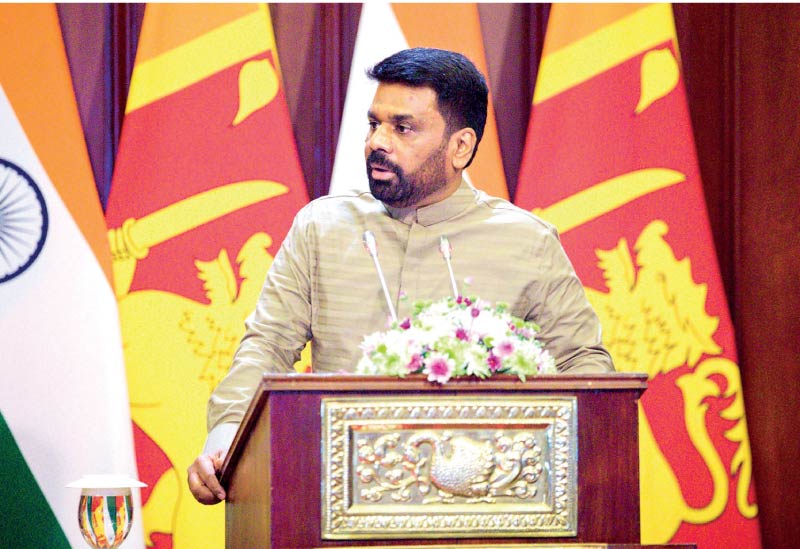
President Anura Kumara Disanayake 


Statement by the President to the media on Saturday during the joint press conference on the occasion of the State visit of the Indian Prime Minister to Sri Lanka.

I warmly welcome the Prime Minister of India, Shri Narendra Modi, and the distinguished delegation, as the first Head of State to visit Sri Lanka since the formation of our Government. I consider it as a historic occasion to recognise the achievements of Prime Minister Shri Narendra Modi, who assumed office with a strong public mandate to transform the political culture and overcome long-standing prejudices that had hindered his country’s progress toward becoming a modern, developed nation.

A testament to enduring bonds between Sri Lanka and India

This visit reflects the deep-rooted closeness and friendship that have existed between Sri Lanka and India for ages. It is worth noting that the bond between our two countries separated by a narrow stretch of ocean less than 50 km wide, is even closer than this physical proximity suggests.

India, a land of rich diversity, has made significant contributions to the world’s cultural and spiritual heritage throughout history, and it continues to play a prominent role on the global stage today.

We have witnessed India’s remarkable rise and success. We sincerely applaud the way India has positioned itself not only as a regional power but also as a global leader. It is important to emphasise that our admiration is genuine and heartfelt. Like India, Sri Lanka firmly believes in the potential of South Asia to rise and shine on the world stage, a goal that we must strive to achieve together.

A partnership that spans millennia

Sri Lanka and India share far more than geographical proximity. We are neighbours bound by deep historical, religious, and cultural ties that span over two thousand five hundred years. Our enduring relationship that has withstood the test of time is founded on shared values, mutual respect, and common aspirations. As civilizational partners, Sri Lanka and India have grown close across every sphere, including history, language, religion, ethics, art, culture, architecture, and beyond, reflecting the richness and dynamism of our two nations.

One of the closest and most enduring examples of friendship that we fondly recall is India’s gesture during the 1996 Cricket World Cup, when India joined Sri Lanka in an exhibition match after two teams declined to tour our country due to security concerns. We take this opportunity to once again express our heartfelt gratitude for that act of solidarity.


Sri Lanka’s foreign policy and bilateral commitment

Sri Lanka’s foreign policy is firmly guided by national interests, with a focus on promoting peace and respecting the sovereignty of all nations, principles that form the foundation of our diplomatic roadmap. Just prior to this event, Prime Minister Modi and our delegation held bilateral discussions.

We conducted a broad review of the current state of our bilateral cooperation and exchanged views on ways to further strengthen our relations in areas of mutual interest.

Recalling my successful visit to New Delhi, I conveyed to Prime Minister Modi Sri Lanka’s firm commitment to implementing the actions outlined in the India-Sri Lanka Joint Declaration titled “Fostering Partnerships for a Shared Future,” which was adopted during that visit.

I expressed my gratitude to Prime Minister Modi and the Government of India for their steadfast support in the recovery, growth, and stability of our country’s economy.


Collectively advancing economic recovery and development

Prime Minister Modi’s leadership and transformative initiatives, which have elevated India to the global stage, along with his personal friendship with Sri Lanka, have brought immense benefits to us in the areas of economic reforms, infrastructure development, and social empowerment.

I am deeply grateful to Prime Minister Modi for his unwavering commitment and support to our country’s economic recovery process and sustainable development, in alignment with India’s foreign policy framework of “Neighbourhood First.”

I briefed Prime Minister Modi on the success of our debt restructuring program and provided an update on our current economic situation, which is progressing towards stability. I am deeply grateful for the support of the Government of India throughout the debt restructuring process

Enhancing defence and maritime security collaboration

We had detailed discussions on the further development of the already existing defence cooperation between our two countries. I reaffirmed our commitment that Sri Lankan territory will not be used for any purpose that could undermine India’s security or regional stability.

I requested Prime Minister Modi’s intervention to urgently initiate bilateral technical discussions regarding Sri Lanka’s claim to the United Nations Commission on the Limits of the Continental Shelf, with the aim of establishing the outer limits of the continental shelf beyond the mutually exclusive economic zone.

Digital transformation and India’s support for SLUDI

Sri Lanka recognises the importance of developing a digital economy to drive growth, innovation, and efficiency. We discussed the potential for digitalisation cooperation across several key areas. I am deeply grateful to the Government of India for their financial contribution of INR 300 million towards the implementation of the Sri Lanka Digital Identity (SLUDI) project.

Infrastructure and energy partnerships of the past, present, and future

We also acknowledged that the partnership between our two countries plays a crucial role in strengthening both our economic and people-to-people ties. I extended my thanks to Prime Minister Modi for converting the $ 14.9 million line of credit provided for the construction of the Maho-Omanthai railway line into a grant for the installation of the signalling system on the Maho-Anuradhapura railway line.

Prime Minister Modi and I are pleased to announce that we will inaugurate these two projects in Anuradhapura tomorrow. We discussed in detail our Government’s priority to ensure reliable, affordable, and timely access to energy resources to meet the needs of the people. We also explored further cooperation in this area to achieve energy security and meet the growing demands of our population.

Boosting trade, investment, and agriculture

Additionally, we exchanged views on development cooperation, particularly in agriculture. Prime Minister Modi and I also addressed trade and investment cooperation between our two countries. We sought the support of the Government of India and Prime Minister Modi to encourage increased Indian investments in Sri Lanka, particularly in key areas of mutual interest.

Our discussions also covered cooperation in the tourism sector. India has consistently been the largest source of tourists visiting Sri Lanka, and we agreed to enhance cooperation to fully realise the potential of this sector.

Expanding Tourism and Social Security Cooperation

Lastly, we requested Prime Minister Modi’s intervention to expedite the conclusion of the social security agreement between our two countries, which will benefit our expatriate workers.

We discussed the need for a cooperative approach to providing a sustainable solution to the fisheries issue. Recognising the serious environmental damage caused by bottom trawling, a prohibited practice in both our countries, we called for decisive measures to halt this activity and to address illegal, unreported, and unregulated fishing.

A historic partnership followed by a shared vision, for a thriving future together

Today, we are pleased to participate in the exchange of several important bilateral agreements between Sri Lanka and India, covering areas such as energy, security cooperation, health sector collaboration, infrastructure projects, and debt restructuring.

This marks another significant step forward in our relationship. I am particularly pleased to join the virtual ceremony with Prime Minister Modi to lay the foundation stone for the Sampur Solar Power Plant, which will contribute 120 MW to our national grid. Additionally, we are launching the project to provide solar power systems to 5,000 religious sites across Sri Lanka, and inaugurating the Dambulla Temperature and Humidity Controlled Agro Cold Storage complex, the only temperature-controlled agricultural warehouse in Sri Lanka. We are deeply grateful to the Government of India for its generous cooperation and support in realising these people-centric projects.

I am also pleased to announce that Prime Minister Modi and his delegation will visit Anuradhapura tomorrow, which stands as a symbol of the great civilization that emerged in our country following the arrival of Buddhism, the greatest gift we have received from India. Prime Minister Modi will also pay homage to the sacred Jaya Sri Maha Bodhi in Anuradhapura.

During the recent economic crisis, Prime Minister Modi announced that India would continue to support Sri Lanka in strengthening its democracy, stability, and economic recovery. It must be emphasised that India’s support, as a partner and friend, played a crucial role in Sri Lanka’s resilience. The people of both our nations must be given the opportunity to embrace a common path forward, through partnership in development, innovation, security, stability, peace in the Indian Ocean region, and the prosperity of our people.

India and Sri Lanka are not merely two countries on a map. It is essential to recognise that they are two nations deeply connected by history, strongly united by trade, and bound by friendship. I would also like to commend Prime Minister Modi’s concept of “Sabka Saath, Sabka Vikas” (together with all, development for all), which is a timely and pragmatic vision.

I am pleased to announce that the Government of Sri Lanka has decided to confer upon Prime Minister Shri Narendra Modi the highest Sri Lankan honour, the “Sri Lanka Mitra Vibhushana” as a symbol of the enduring friendship and unwavering, multifaceted support that he has consistently extended to Sri Lanka and its people. This prestigious honour is reserved for foreign Heads of State in recognition of their friendship and cooperation with the people of Sri Lanka. We firmly believe that Prime Minister Modi, who has always stood by Sri Lanka, is most deserving of this distinction.

In Sri Lanka, we too are on a transformative path, which we call the “A Thriving Nation and a Beautiful Life” National Policy. This policy is designed to pave the way for economic progress, social justice, and to provide every citizen with the opportunity to prosper, regardless of their background.

As neighbours, partners, and long-standing friends, let us resolve, at this moment, to build a future filled with shared development. Once again, I express my sincere gratitude to Prime Minister Shri Narendra Modi and his delegation for visiting Sri Lanka at this crucial time, when a people-centred political transformation is underway.🔺

காலநிலை அறிவிப்பு-பேராசிரியர் நா.பிரதீபராஜா

https://www.facebook.com/Piratheeparajah 03.12.2025 புதன்கிழமை பிற்பகல் 3.30 மணி விழிப்பூட்டும் முன்னறிவிப்பு இன்று வடக்கு மற்றும் கிழக்கு ம...