SHARE

Saturday, September 12, 2026

The Outlook Is Getting Grimmer By The Day For Oil Exports From The Red Sea

The Outlook Is Getting Grimmer By The Day For Oil Exports From The Red Sea
Iraqi militias strike a pipeline that's the remaining lifeline to Middle East oil and the Houthis move into a better position to control the Bab al-Mandab Strait than ever.
Howard Altman  Published Sep 11, 2026 8:37 PM ED

Houthi spokesman Brig. Gen. Yahya Saree. (Houthi Telegram)


Saudi Arabia on Friday announced it had to temporarily shut down the key east-west pipeline after drone attacks on Thursday from an Iranian-backed militia group in Iraq. As we have explained in the past, the Kingdom has diverted millions of barrels of oil per day through pipelines to its Yanbu port on the Red Sea in an effort to minimize the energy shortages due to hostilities near the Persian Gulf that have closed the Strait of Hormuz. 

The pipeline was shut down a day after the Houthi rebels of Yemen increased their control over the crucial Bab al-Mandab Strait (BAM), a narrow body of water separating the Red Sea from the Gulf of Aden. Combined with Iran vastly curtailing shipping through the Strait of Hormuz, this gives Tehran significant control over two of the world’s most crucial passageways for the flow of oil.


2. The Houthis launched an offensive on ROYG-aligned forces on the coastal plain overnight between September 9 and 10, likely in order to eliminate the ROYG counteroffensive’s threat to Houthi positions and ports on the coastal plain. Local sources in Sanaa City, which is Yemen’s Houthi-controlled capital, told Saudi media on September 9 that the Houthis deployed a significant number of fighters from the capital to support fronts in southwestern Yemen. Houthi reinforcements from central Yemen reportedly arrived at positions west of Taiz and on the coastal plain. The Red Sea coastal plain’s flat terrain likely hindered ROYG efforts to mount an effective defense against reinforced Houthi assaults from the north and east. The Houthis’ assault from elevated terrain east of the coastal plain also reportedly compelled ROYG forces to withdraw from the salient in southern Hudaydah Governorate to avoid encirclement by Houthi forces, according to an Israeli geospatial analyst. The Houthis continued their advance south along the coastal plain on the morning of September 10 and captured the ROYG-held port at Mokha.[40] Mokha was, until its capture by the Houthis, the ROYG’s only major Red Sea port and the NRF’s operational and logistical headquarters. It is unclear how far past Mokha the Houthis have advanced as of this writing. The Houthis reportedly advanced further south of Mokha before the Houthis announced that their forces ceased combat operations on the coastal plain in the late morning on September 10.


3. The Houthis have reportedly attempted to seize ROYG-controlled islands in the Red Sea from which Houthi fighters could launch attacks on international shipping. Houthi forces reportedly landed on the Hanish Islands in the southern Red Sea on the morning of September 10 after conducting attacks over several weeks to isolate ROYG forces on the islands, according to international media and a US-based Yemen analyst. ROYG political and military sources told international media on September 10 that ROYG forces have withdrawn from at least two of the three main islands in the Hanish Archipelago amid Houthi forces’ landings on the islands. Regional media also reported on the afternoon of September 10 that Houthi forces captured Perim Island, which is in the middle of the Bab al Mandeb Strait off the Yemeni coast’s southwestern-most headland at Ras Menheli. Control over the Hanish Islands and Perim Island would offer the Houthis favorable positions from which to launch fast attack craft and projectile attacks on international civilian vessels at close range, provided that the Houthis develop secure logistics lines to transport weapons and supplies from the Yemeni mainland.

“The East-West pipeline, in the regions of Riyadh and Medina, was subjected to several attacks on Thursday morning, September 10, 2026,” Saudi Arabia’s Energy Ministry posted on X. “The line was shut down as a precaution. The attacks resulted in some injuries, and medical care has been provided to those injured.”

“Emergency teams and specialized technical teams began work immediately after the attacks occurred, and took the necessary measures to secure the line and verify its safety, in accordance with approved safety procedures and emergency plans, and in coordination with relevant authorities,” the ministry added. “Any updates will be announced in due course.”

Showing the complexity of this situation and the high degree of coordination among various Iranian-backed proxies, the Saudi Ministry of Foreign Affairs accused Iranian proxies in Iraq of carrying out the attack. The Kingdom subsequently said it would hold off on responding to “give the brotherly Iraqi government an opportunity to take the necessary measures to prevent attacks launched from Iraqi territory against the Kingdom and neighboring countries,” according to the Arab News.

Officials in Baghdad quickly responded to that request, firing a regional commander overseeing operations where the attack was launched from.

“The Prime Minister, the Commander-in-Chief of the Armed Forces, Mr. Ali Falih Al-Zaidi, directed the formation of an investigative committee regarding the Maysan Operations Command,” the Iraqi Prime Minister’s Office announced on X. “His Excellency ordered the dismissal of the Operations Commander from his position, following confirmation that the attacks targeting the brothers in the Kingdom of Saudi Arabia were launched from one of the sites within the province.”

On Friday, the Houthis acknowledged that they captured new stretches of Red Sea coast from the Saudi-backed factions they’ve been battling. This includes the port of Mokha and the key islands of Perim (also known as Mayun) and Zuqar.

The Bab al-Mandab Strait and the islands of Perim (Mayun) and Zuqar. (Google Earth)

In a quick recap of what’s changed, the port provides a potential new surveillance and launching point for the Houthis. From here they can deploy mines, standoff weapons, as well as uncrewed surface vessels (USVs) that can be used to attack shipping. The islands give the Houthis a presence in the middle of shipping lanes. This is especially true for Perim, which sits in the narrowest part of the BAM, less than two miles west of Yemen and about 13 miles east of Djibouti, giving the Houthis a commanding presence at the mouth of the Red Sea. Its position could even allow Houthis to launch attacks on shipping using lower-end munitions, such as anti-tank guided missiles and even rocket artillery.

PHOTO © 2025 PLANET LABS INC. ALL RIGHTS RESERVED. REPRINTED BY PERMISSION)

However, maintaining a major military presence on these islands would be a challenge logistically, especially should the U.S. or its allies attack positions there. You can read more about how the fall of the islands unfolded in our report here.

As they swept through the coastal region, the Houthis captured a treasure trove of U.S.-made Oshkosh M-ATV mine-resistant vehicles, pickup trucks mounted with heavy weapons, artillery pieces, and large quantities of ammunition and small arms abandoned by retreating National Resistance and Giants Brigade forces.

Iran, which has held off on getting the Houthis directly involved during Epic Fury, has now played its hand and is putting the Houthis in a better position to close the strait than ever before. This was always a ‘sum of all fears’ scenario for oil exports from the Middle East and now Iran could put maximum pressure on the United States and the world to end the conflict in their favor, with oil potentially being cut off from both the Red Sea and the Persian Gulf.

Still, on Friday, the Houthis tried to allay those concerns, promising they would limit their control of the BAM to just Saudi vessels. 

“The Yemeni armed forces confirm that maritime navigation is safe for all companies, except for Saudi Arabian ships, which have previously been placed under a ban,” Houthi spokesman Brig. Gen. Yahya Saree proclaimed. “We are continuing to uphold the equation of blockade with blockade, striking enemy Saudi Arabian troop concentrations, and escalating in response to their actions, until the aggression ceases and the blockade is lifted from our dear people.”

Their rationale is that this campaign is all about defending against attacks by the Saudis and their proxies.

The conflict between Saudi Arabia and the Houthis grew out of a civil war in Yemen that erupted in 2014. It expanded a year later when a Saudi-led coalition joined forces with the government ousted by the Houthis and raged on until the parties reached a tenuous ceasefire in 2022. Tensions, however, reignited after that conflict ended when the Houthis joined the U.S.-Iran conflict on the side of their major supporter. In addition to a blockade on Saudi shipping, the Houthis began striking Saudi refineries and other oil infrastructure, including pipelines near the coast.

Houthi assurances about their intentions have meant little in the past. In 2023, when they launched their earlier campaign against Red Sea shipping, the Houthis also claimed a narrow rationale. They said they were doing so on behalf of Palestinians being killed during the Israel-Hamas war. The reality turned out to be that the Houthis were striking even ships not connected to Israel. This ultimately led to the U.S. and allies deploying warships to protect commercial vessels, battles with the rebel group on the water and a campaign of airstrikes on Houthi land targets.

It should be noted that the Saudis held off on getting involved that fight.
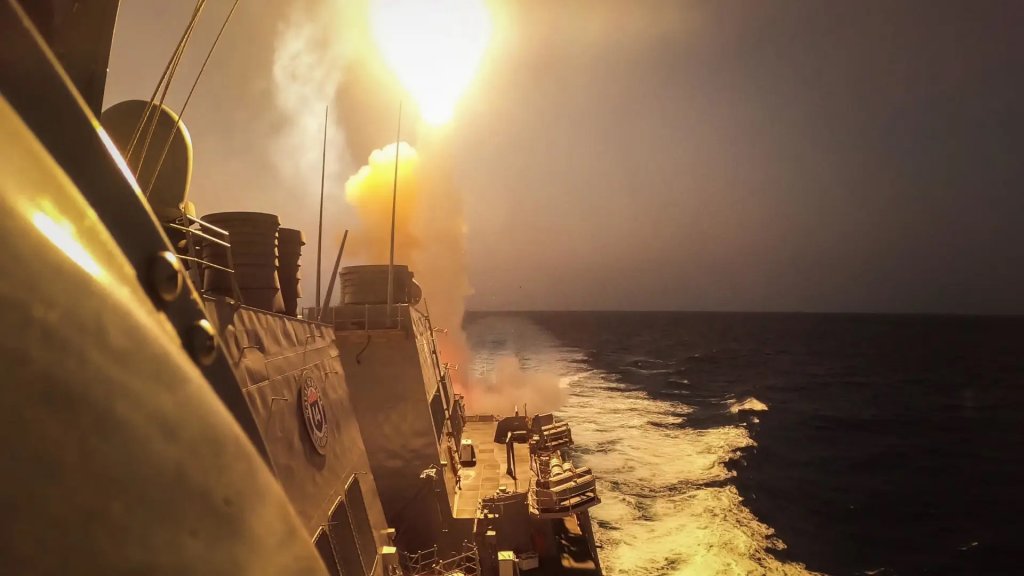
The Arleigh Burke class destroyer USS Carney fires a surface-to-air missile at Houthi threats on October 19, 2023. U.S. Navy

Amid all this, the per-barrel price of Brent crude rose to more than $109 yesterday, but was back down to $104 today, according to OilPrice.com.

We have long suggested that the U.S. could get pulled back into a new conflict with the Houthis. Now the rebel group’s rapid defeat of the Saudi-backed forces has reportedly already led to an American role in that fight.

“More than 100 US military advisers are on the ground in Saudi Arabia providing intelligence and targeting support to the Kingdom in its military campaign against the Iran-backed Houthis in Yemen,” CNN reported on Thursday, citing multiple sources familiar with the effort. “The US military personnel are working as part of a newly-established joint forces command, which was formed in recent weeks amid signs Iran was ramping up its own efforts to aid Houthi attacks against Saudi Arabia, one of the sources, a US official, said. That official put the total at roughly 200 troops.”

Still, there are limits on the U.S. role.

“The US is sharing intelligence with Saudi Arabia — as it routinely does already — but it is not participating directly in strikes,” CNN noted. “The US is also not helping refuel Saudi warplanes or providing other operational support, as it has in past fighting with the Houthis.”

Then-Defense Secretary James Mattis ended that in 2018 during the first Trump presidency after growing concerns over the large number of civilian casualties being inflicted. The Saudi coalition’s fight against the Houthis also complicated the U.S. counterterrorism campaign against Al-Qaida in the Arabian Peninsula (AQAP).

CENTCOM commander Adm. Brad Cooper “flew to the kingdom overnight Thursday as Yemen’s Riyadh-backed forces crumbled in the face of a lightning Houthi offensive southward along Yemen’s western coast this week,” Al-Monitor reported. “He was expected to meet with top Saudi officials as they seek to consolidate the battered military effort by forces aligned with Yemen’s government.”

Trump, as we noted at the top of this story, has already declined to intervene kinetically.

“Saudi Crown Prince Mohammed bin Salman (MBS) called President Trump twice Thursday, urging him to launch strikes against the Houthis as the Iran-backed group closed in on a vital Red Sea chokepoint,” Axios reported, citing two U.S. officials. “Trump declined, and U.S. officials stressed the administration has no plans to intervene directly against the Houthis for now.”

WASHINGTON, DC - NOVEMBER 18: U.S. President Donald Trump (R) meets with Crown Prince and Prime Minister Mohammed bin Salman of Saudi Arabia during a bilateral meeting in the Oval Office of the White House on November 18, 2025 in Washington, DC. Trump is hosting the crown prince for meetings aimed at strengthening economic and defense ties, including the U.S. sale of F-35 fighter jets to Saudi Arabia. (Photo by Win McNamee/Getty Images)
U.S. President Donald Trump (R) meets with Crown Prince and Prime Minister Mohammed bin Salman of Saudi Arabia during a bilateral meeting in the Oval Office of the White House on November 18, 2025 in Washington, DC. (Photo by Win McNamee/Getty Images) Win McNamee


Asked if the U.S. would take direct military action against the Houthis, a senior White House official didn’t rule it out but said it is currently relying on regional partners to carry the burden. 

“The United States is focused on protecting our core national security interests—such as ensuring freedom of navigation in the Red Sea—while empowering our regional partners to take the lead in managing and resolving regional security challenges,” the senior official told us. “We are in continuous dialogue with Saudi Arabia and the Republic of Yemen Government regarding regional stability.”

The war against Iran and the ongoing mission to try to protect freedom of navigation in the Strait of Hormuz have already strained the U.S. military. There have been 18 troops killed, more than 800 wounded and wide scale destruction of U.S. bases and equipment. U.S. commanders have warned that the ongoing conflict is unsustainable without deeply degrading America’s ability to respond to other contingencies. How much the U.S. could commit to a fight against the Houthis is an open question, especially if the Iran war spun-up again. During the Red Sea operation, at times two carrier strike groups and many other assets in the air and on the sea, were needed to sustain that operation.

“A second front potentially adds more U.S. military risk as we try to sustain a military that has been involved in a protracted deployment to support our economic pressure-focused strategy,” former CENTCOM commander Joseph Votel told us on Friday. “The U.S. can do just about anything, but it will be a choice that will impact sustainment, create longer-term deployments and impact other national security priorities.”

Contact the author: howard@twz.com 

Howard Altman Avatar

Howard Altman

Senior Staff Writer

Howard is a Senior Staff Writer for TWZ. He writes frequently about conflict, focusing heavily on the Middle East and Ukraine, and interviews with military and intelligence officials and industry leaders from around the globe. He lives near Tampa, Florida, home of U.S. Central Command, U.S. Special Operations Command.

Friday, September 11, 2026

The Quad in the Indo-Pacific: What to Know


The Quad in the Indo-Pacific: What to Know

The Quad, composed of the United States, Australia, India, and Japan, is not a formal alliance. Still, the group has intensified its security and economic ties as tensions with China rise.

By experts and staff

Sheila A. Smith

CFR Expert

John E. Merow Senior Fellow for Asia-Pacific Studies

Published  May 27, 2021 

What does the Quad do?

The Quad, officially the Quadrilateral Security Dialogue, is a group of four countries: the United States, Australia, India, and Japan. Maritime cooperation among them began after the Indian Ocean tsunami of 2004. But today the countries—all democracies and vibrant economies—work on a far broader agenda, which includes tackling security, economic, and health issues.

Over the years, the Quad’s diplomacy has waxed and waned. It is a loose grouping rather than a formal alliance. Japan initially emphasized the democratic identity of the four nations, whereas India seemed more comfortable emphasizing functional cooperation. Australian leaders have been reluctant about creating the impression that the group is a formal alliance.

As of 2021, leaders in all four countries have become more aligned in their shared concerns about China’s increasingly assertive behavior in the region and are more willing to define a constructive agenda of cooperation. All four navies participated in their first joint exercise in over a decade in November 2020. And in March 2021, U.S. President Joe Biden convened a virtual Quad meeting attended by Australian Prime Minister Scott Morrison, Indian Prime Minister Narendra Modi, and Japanese Prime Minister Yoshihide Suga. They formed working groups on COVID-19 vaccines, climate change, and technological innovation and supply-chain resilience.

What are U.S. interests in the Quad?

Working closely with these countries is natural for the United States. Australia and Japan are U.S. treaty allies, and India is an important strategic partner. The Donald Trump administration worked closely with these countries, and the Biden administration is expanding the Quad’s agenda.

The Indo-Pacific spans two oceans and several continents, making it important to U.S. maritime interests. In 2019, $1.9 trillion [PDF] worth of U.S. trade passed through the region. This year, 42 percent of the world’s exports and 38 percent of global imports are expected to pass through, according to a UN report.

China’s growing willingness to challenge the regional status quo worries Washington, and Beijing’s challenging of democratic values over the past year has deepened other Quad partners’ concerns as well. China’s pursuit of its regional interests—including its crackdown on Hong Kong’s freedoms and criticism of nations that take issue with its actions—has not been slowed by the COVID-19 pandemic. However, the Quad’s agenda is not all about China. Leaders of the four nations also see a need for a more proactive approach to solving humanitarian and economic challenges caused by COVID-19.

What are Japan’s aims for the Quad?

Former Japanese Prime Minister Shinzo Abe was a strong believer in the Quad’s power to ensure a “free and open Indo-Pacific.” Abe worked to persuade the Trump administration of the value of this coalition approach across the Indo-Pacific. 

Japan depends heavily on open sea lanes for its trade with the world. The U.S. and Japanese militaries already work closely across the region, and Japan’s Self-Defense Forces have slowly built relationships [PDF] with their Australian and Indian counterparts. Similarly, Japan has played an important role in supporting investment [PDF] in manufacturing, trade, and infrastructure development across the region. 

Japan and its Quad partners share concerns about China’s role in the region and Beijing’s challenges to the rule of law. Beijing’s assertion of its sovereignty in the South China Sea, as well as Chinese provocations toward islands China and Japan both claim in the East China Sea, has made Tokyo wary of China’s military build-up. Strategic consultations with other Quad partners are vital.

Similarly, Japan is watching carefully as China imposes economic conditionality on countries in the Indo-Pacific, and it wants to offer Southeast Asian countries alternative sources of assistance and commerce to offset China’s growing influence. Tokyo has joined with Washington and Canberra to deepen the funds available for quality infrastructure. Bolstering the resilience of the Quad nations, especially for critical supply chains for goods such as semiconductors, will also be a Japanese priority.

How has China responded?

China’s relations with each of the Quad members have become more tense during the pandemic. U.S.-China tensions remain high; Beijing’s frustration was conspicuous when the new Biden foreign policy team had its first meeting with its Chinese counterpart in Alaska in March. Australia continues to bear the brunt of Chinese economic sanctions after suggesting a World Health Organization investigation into the origins of COVID-19 last year. India and Japan have clashed with China over territorial disputes. China’s ambassador to Tokyo has publicly criticized Prime Minister Suga, claiming that the new Quad diplomacy reflects a “Cold War mentality” and that it is “100 percent outdated.” In addition, recent polls have shown negative views of China have soared among publics across the region.

Yet, few policymakers in the Quad countries see an advantage in trying to contain Chinese influence militarily. Instead, the Quad leaders have emphasized cooperation across areas of shared interest to bolster confidence in the democracies’ ability to counter China’s assertion of regional influence. As long as tensions with China remain, the Quad’s agenda is likely to expand as the democracies of the Indo-Pacific seek to balance China’s growing power.

Source: https://www.cfr.org/articles/quad-indo-pacific-what-know

BEFORE INDIA SPEAKS OF SECURITY, LET SRI LANKA SPEAK OF SOVEREIGNTY

 RAJNATH SINGH IS IN SRI LANKA – BEFORE INDIA SPEAKS OF SECURITY, LET SRI LANKA SPEAK OF SOVEREIGNTY

Posted on September 9th, 2026

Shenali D Waduge

Rajnath Singh’s visit comes 38 years after the previous official visit by an Indian Defence Minister. The visit is described in terms of defence cooperation, maritime security, connectivity and economic partnership. But this visit cannot be discussed without examining India’s historical and growing influence over Sri Lanka — military, political, constitutional, economic, cultural and strategic. Before India speaks of Sri Lanka’s security, Sri Lanka must first ask whether India’s actions have respected Sri Lanka’s sovereignty.

  1. 1987 — INDIA CROSSED SRI LANKAN AIRSPACE

On 4 June 1987, India launched Operation Poomalai, dropping supplies over Jaffna while Sri Lankan forces were conducting operations against the LTTE.

Indian aircraft entered Sri Lankan airspace without Sri Lanka’s consent.

It was a direct assertion of Indian power over Sri Lankan territory.

India whisked Prabakaran & family to Delhi & kept him there until the Indo-Lanka Accord was signed.

If Sri Lanka had entered Indian airspace during an Indian military operation, would India have called that respect for sovereignty?

  • 1987–1990 — INDIA SENT ITS ARMY INTO SRI LANKA

The Indo-Lanka Accord was followed by the deployment of the Indian Peace Keeping Force.

The IPKF eventually fought the LTTE.

India’s own External Affairs Minister later described the episode as an IPKF misadventure in Sri Lanka.” Indian armed forces are accused of committing mass murder & rape.

  • INDIA ITSELF SAYS IT WILL INTERVENE WHEN ITS INTERESTS ARE AT STAKE

India officially speaks of non-interference.

But India’s own foreign-policy literature says that when another country’s actions have the potential to affect India’s national interests, India does not hesitate to intervene.

India’s security interests cannot automatically become Sri Lanka’s obligations.

Where does India’s security interest end and Sri Lanka’s sovereignty begin?

And who decides?

  • INDIA SEEKS TO INFLUENCE SRI LANKA’S CONSTITUTION

India openly states that it engages Sri Lanka at the highest levels on implementation of the 13th Amendment and beyond, including meaningful devolution.

Should a foreign government have a say in determining the constitutional structure of a sovereign country?

  • INDIA WANTS TO CHECK SRI LANKA’S RELATIONSHIP WITH CHINA

India’s own policy documents acknowledge its concern over Sri Lanka’s growing relationship with China and its desire to check Sri Lanka’s drift towards China.

But Sri Lanka is not an Indian state.

Sri Lanka must be free to choose India, China, Japan, America, Russia — or anyone else.

Friendship cannot mean permission.

  • INDIA AND CHINA — SRI LANKA BECOMES THE BATTLEGROUND

Reuters described India as muscling into port and other projects” as China expanded its
presence in Sri Lanka.

While India expands its dealings with China – India deems Sri Lanka must seek its permission to deal with China.

Sri Lanka’s ports, energy and infrastructure must serve Sri Lanka’s national interest.

They cannot become prizes in a contest between New Delhi and Beijing.

Sri Lanka must not become the battlefield on which other powers compete for strategic control.

  • INDIA’S PUSH FOR STRATEGIC PORT ASSETS

India sought participation in Colombo’s strategic port infrastructure, including the East Container Terminal.

The formal Sri Lanka–India MOU of 2017 did not specifically name ECT; the Sri Lanka–India–Japan ECT arrangement came later.

The issue, however, is larger than one terminal.

Ports are not ordinary real estate.

They determine trade, shipping and strategic access.

How much strategic infrastructure should any one external power be able to influence and how will it impact Sri Lanka if India becomes hostile?

  • COLOMBO DOCKYARD — FROM JAPANESE TO INDIAN CONTROL

India’s state-owned Mazagon Dock acquired the Japanese stake and secured 51% control of Colombo Dockyard.

When a foreign defence company gains control of a strategically located Sri Lankan shipyard, the question is no longer simply investment — it is who gains strategic maritime influence over Sri Lanka.

  • TRINCOMALEE — STRATEGIC ENERGY

India’s involvement in Trincomalee’s strategic oil infrastructure has been controversial for decades.

Whoever controls critical energy infrastructure gains leverage over a country’s economy, transport and national security. Sri Lanka cannot afford strategic dependence for its energy security.

  1. THE NORTH — A CHANGING STRATEGIC FOOTPRINT

As Sri Lanka’s own strategic presence in the North changes, India’s involvement in connectivity, ports, airports and investment is increasing.

The question is what this means for the long-term balance of strategic influence in the North.

If Sri Lanka withdraws its own strategic presence while another power expands its footprint, the long-term question is: who will have greater strategic influence over Sri Lanka’s North?

  1. KANKESANTHURAI — INDIA’S GATEWAY TO THE NORTH

India is funding the rehabilitation of Kankesanthurai Port and strengthening maritime links with India.

A port is more than infrastructure. A permanent foreign strategic presence at Sri Lanka’s northern gateway can alter the balance of influence in one of the country’s most sensitive regions.

  1. PALALY — CONNECTIVITY OR STRATEGIC ACCESS?

Palaly is being developed for greater connectivity with India.

When an airport in Sri Lanka’s strategic North becomes increasingly connected to India, connectivity can also create access — and access can become influence.

  1. DIGITAL IDENTITY — WHO CONTROLS THE DATA?

Sri Lanka’s digital identity system is being developed with Indian assistance.

A nation’s identity database is part of its sovereign infrastructure. Sri Lanka must ensure that no foreign power can obtain access, influence or control over the personal and biometric information of its citizens.

  1. SRI LANKA’S MINERALS — THE NEXT STRATEGIC FRONTIER

India is seeking cooperation in Sri Lanka’s critical minerals, graphite and beach-sand resources, including exploration and investment.

Strategic minerals are national assets. If their exploration, extraction or export becomes externally controlled, Sri Lanka risks surrendering wealth that could determine its future
economic independence.

  1. ADANI — WHEN BUSINESS AND GEOPOLITICS MEET

Adani-linked investment now extends across ports and energy in Sri Lanka.

The danger is not Indian investment itself — it is excessive concentration of strategic assets in companies linked to one external power, creating economic leverage that can eventually become political leverage.

  1. TRANSSHIPMENT — SRI LANKA’S HIDDEN VULNERABILITY

Colombo’s transshipment economy depends heavily on Indian-linked cargo.

Sri Lanka may own its ports, but if another country can significantly affect the cargo flowing through them, it can exert economic pressure without owning the port itself.

  1. YUAN WANG 5 — WHEN INDIA’S SECURITY CONCERNS ENTER SRI LANKA’S PORTS

When the Chinese Yuan Wang 5 headed for Hambantota, India said it was protecting its security and economic interests.

India has security concerns. Sri Lanka has sovereignty. India’s security interests cannot become a veto over Sri Lanka’s independent decisions about its own ports and foreign relations.

  1. THE LAND BRIDGE QUESTION

A physical connection with India would transform movement of people, goods, capital and potentially security risks between the two countries.

Once physical separation disappears, Sri Lanka’s ability to independently control borders, migration, customs and security could become far more difficult.

  1. KATCHATHEEVU — WILL SETTLED AGREEMENTS REMAIN SETTLED?

The 1974 and 1976 maritime agreements settled the India–Sri Lanka boundary, yet Katchatheevu has been revived politically in India. Why is India not respecting what it originally signed?

If territorial settlements can be reopened for domestic politics, Sri Lanka cannot assume that agreements defining its sovereignty will remain permanently respected.

  • FISHING — SRI LANKA’S WATERS ARE SRI LANKAN

Indian fishermen entering Sri Lankan waters are subject to Sri Lankan law.

If Sri Lanka cannot enforce its own laws in its own territorial waters without external political pressure, sovereignty exists on paper but not in practice.

  • THE 1980s — THE COVERT QUESTION

India’s historical involvement with Tamil militant groups must be examined through documented evidence and clearly identified allegations.

The danger is not merely historical: foreign intervention in internal conflicts can create forces that eventually threaten the very country that intervened.

INDIA’S FOOTPRINT IS NO LONGER ONLY ON THE COAST

India’s influence in Sri Lanka is not confined to ports and maritime security.

It is increasingly present inside the country — through housing, education, healthcare, cultural institutions, community programmes, loans/grants/currency swaps, banking,
investment and economic assistance.

The Indian Housing Project alone has reached 60,000 houses, with major programmes specifically targeting plantation regions. India’s current Phase IV includes another 10,000 houses, including projects in the Central Province.

India is also supporting 60 smart classrooms in plantation schools in Nuwara Eliya, Kandy and Badulla, while providing assistance to educational institutions and communities in the Central Province. India has openly described the Indian-Origin Tamil community as a living bridge” between India and Sri Lanka, and has expanded programmes covering housing, healthcare, education and community development.

At what point does development assistance become a permanent external footprint inside another country’s social, cultural and economic space?

India is also using its loans/grants to try to forward a shared history using invader Cholas. This is the newest narrative being promoted.

INDIA’S FOOTPRINT — AROUND, INSIDE, ABOVE AND BELOW SRI LANKA (INDIA’S FOUR-DIRECTIONAL FOOTPRINT)

AROUND SRI LANKA

Maritime security, shipping, ports, transshipment, Katchatheevu, fishing and India’s strategic presence across the Indian Ocean.

INSIDE SRI LANKA

Housing, education, healthcare, cultural institutions, community development, investment, energy, infrastructure and connectivity.

ABOVE SRI LANKA

Air connectivity, aviation links, telecommunications, digital systems, satellite/space cooperation and the growing technological relationship.

BELOW SRI LANKA

The mineral and resource base — graphite, ilmenite, rutile, zircon, phosphate, beach sand and other critical minerals.

India itself has identified Sri Lankan graphite, ilmenite, rutile, zircon and phosphate as minerals important to India’s critical-mineral requirements and has been pursuing cooperation in exploration and mining.

India’s footprint is no longer simply at Sri Lanka’s ports.

It is around Sri Lanka.

It is inside Sri Lanka.

It is above Sri Lanka.

It is beneath Sri Lanka.

And increasingly, it is within the systems on which Sri Lanka’s economy, security and society depend.

The question is what happens when all these projects, dependencies and relationships are viewed together.

But sovereignty is not lost only through one agreement. It can also be weakened when too many critical sectors become dependent upon one external power.

The question Sri Lanka must therefore ask is

Can Sri Lanka still say NO to India — without suffering unacceptable economic, political or strategic consequences?”

INDIA’S COMMUNITY FOOTPRINT IS ALSO EXPANDING

The Indian-Origin Tamil plantation programmes, the wider Indian-origin community including Malayalis, and the education/housing/cultural/economic initiatives.

India’s own High Commission currently describes the Indian-origin population in Sri Lanka as including Sindhis, Bohras, Gujaratis, Memons, Parsis, Malayalis and Telugu-speaking people, while separately identifying the much larger Indian-Origin Tamil plantation community.

India’s influence is not one-dimensional. It operates through COMMUNITY, CULTURE, EDUCATION, ECONOMICS, INFRASTRUCTURE, ENERGY, DIGITAL SYSTEMS, MINERALS,
MARITIME SECURITY AND DIPLOMACY.

The issue is not Indian friendship.

The issue is whether friendship is gradually becoming dependence.

And that fits extremely well with your final FRIENDSHIP —
YES. COOPERATION — YES. DEPENDENCE — NO.” ending.

Connectivity cannot mean strategic dependence.

And regional partnership cannot mean that Sri Lanka must choose its foreign relations according to another country’s interests.

THE PRINCIPLE IS SIMPLE:

INDIA CAN ADVISE.

INDIA CAN INVEST.

INDIA CAN COMPETE.

INDIA CAN COOPERATE.

BUT SRI LANKA MUST DECIDE.

THE QUESTION RAJNATH SINGH SHOULD HEAR

India’s Defence Minister has come to Sri Lanka to discuss security.

So perhaps Sri Lanka should ask one question first:

WHO DEFINES SRI LANKA’S SECURITY?

India?

China?

America?

Or Sri Lanka?

Because Sri Lanka can be:

A FRIEND OF INDIA.

A PARTNER OF INDIA.

A TRADING PARTNER OF INDIA.

A DEFENCE PARTNER OF INDIA.

But Sri Lanka must never become:

DEPENDENT ON INDIA.

FRIENDSHIP WITH INDIA — YES.

COOPERATION WITH INDIA — YES.

DEPENDENCE ON INDIA — NO.

SRI LANKA’S SOVEREIGNTY MUST REMAIN SRI LANKA’S.

Shenali D Waduge

https://www.lankaweb.com/news/items/2026/09/09/rajnath-singh-is-in-sri-lanka-before-india-speaks-of-security-let-sri-lanka-speak-of-sovereignty/

Trump at UN