SHARE

Friday, April 18, 2025

Sri Lanka and India on a transformative path: President

 Sri Lanka and India on a transformative path: President AKD

FT lk Monday, 7 April 2025
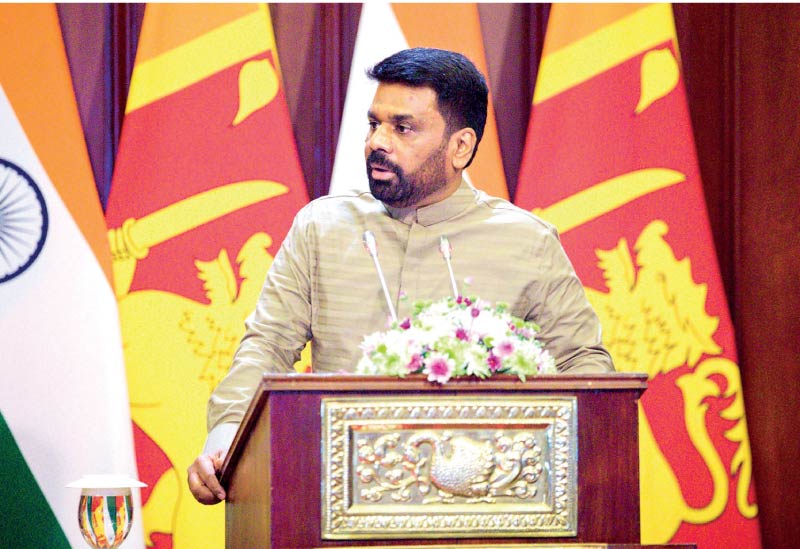

President Anura Kumara Disanayake 


Statement by the President to the media on Saturday during the joint press conference on the occasion of the State visit of the Indian Prime Minister to Sri Lanka.

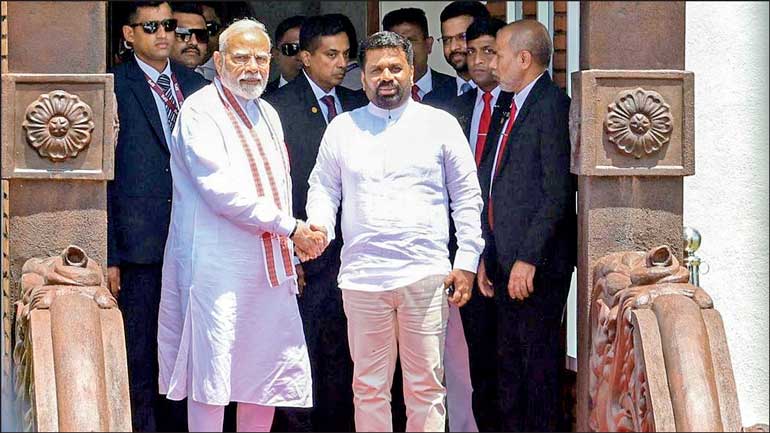
I warmly welcome the Prime Minister of India, Shri Narendra Modi, and the distinguished delegation, as the first Head of State to visit Sri Lanka since the formation of our Government. I consider it as a historic occasion to recognise the achievements of Prime Minister Shri Narendra Modi, who assumed office with a strong public mandate to transform the political culture and overcome long-standing prejudices that had hindered his country’s progress toward becoming a modern, developed nation.

A testament to enduring bonds between Sri Lanka and India

This visit reflects the deep-rooted closeness and friendship that have existed between Sri Lanka and India for ages. It is worth noting that the bond between our two countries separated by a narrow stretch of ocean less than 50 km wide, is even closer than this physical proximity suggests.

India, a land of rich diversity, has made significant contributions to the world’s cultural and spiritual heritage throughout history, and it continues to play a prominent role on the global stage today.

We have witnessed India’s remarkable rise and success. We sincerely applaud the way India has positioned itself not only as a regional power but also as a global leader. It is important to emphasise that our admiration is genuine and heartfelt. Like India, Sri Lanka firmly believes in the potential of South Asia to rise and shine on the world stage, a goal that we must strive to achieve together.

A partnership that spans millennia

Sri Lanka and India share far more than geographical proximity. We are neighbours bound by deep historical, religious, and cultural ties that span over two thousand five hundred years. Our enduring relationship that has withstood the test of time is founded on shared values, mutual respect, and common aspirations. As civilizational partners, Sri Lanka and India have grown close across every sphere, including history, language, religion, ethics, art, culture, architecture, and beyond, reflecting the richness and dynamism of our two nations.

One of the closest and most enduring examples of friendship that we fondly recall is India’s gesture during the 1996 Cricket World Cup, when India joined Sri Lanka in an exhibition match after two teams declined to tour our country due to security concerns. We take this opportunity to once again express our heartfelt gratitude for that act of solidarity.


Sri Lanka’s foreign policy and bilateral commitment

Sri Lanka’s foreign policy is firmly guided by national interests, with a focus on promoting peace and respecting the sovereignty of all nations, principles that form the foundation of our diplomatic roadmap. Just prior to this event, Prime Minister Modi and our delegation held bilateral discussions.

We conducted a broad review of the current state of our bilateral cooperation and exchanged views on ways to further strengthen our relations in areas of mutual interest.

Recalling my successful visit to New Delhi, I conveyed to Prime Minister Modi Sri Lanka’s firm commitment to implementing the actions outlined in the India-Sri Lanka Joint Declaration titled “Fostering Partnerships for a Shared Future,” which was adopted during that visit.

I expressed my gratitude to Prime Minister Modi and the Government of India for their steadfast support in the recovery, growth, and stability of our country’s economy.


Collectively advancing economic recovery and development

Prime Minister Modi’s leadership and transformative initiatives, which have elevated India to the global stage, along with his personal friendship with Sri Lanka, have brought immense benefits to us in the areas of economic reforms, infrastructure development, and social empowerment.

I am deeply grateful to Prime Minister Modi for his unwavering commitment and support to our country’s economic recovery process and sustainable development, in alignment with India’s foreign policy framework of “Neighbourhood First.”

I briefed Prime Minister Modi on the success of our debt restructuring program and provided an update on our current economic situation, which is progressing towards stability. I am deeply grateful for the support of the Government of India throughout the debt restructuring process

Enhancing defence and maritime security collaboration

We had detailed discussions on the further development of the already existing defence cooperation between our two countries. I reaffirmed our commitment that Sri Lankan territory will not be used for any purpose that could undermine India’s security or regional stability.

I requested Prime Minister Modi’s intervention to urgently initiate bilateral technical discussions regarding Sri Lanka’s claim to the United Nations Commission on the Limits of the Continental Shelf, with the aim of establishing the outer limits of the continental shelf beyond the mutually exclusive economic zone.

Digital transformation and India’s support for SLUDI

Sri Lanka recognises the importance of developing a digital economy to drive growth, innovation, and efficiency. We discussed the potential for digitalisation cooperation across several key areas. I am deeply grateful to the Government of India for their financial contribution of INR 300 million towards the implementation of the Sri Lanka Digital Identity (SLUDI) project.

Infrastructure and energy partnerships of the past, present, and future

We also acknowledged that the partnership between our two countries plays a crucial role in strengthening both our economic and people-to-people ties. I extended my thanks to Prime Minister Modi for converting the $ 14.9 million line of credit provided for the construction of the Maho-Omanthai railway line into a grant for the installation of the signalling system on the Maho-Anuradhapura railway line.

Prime Minister Modi and I are pleased to announce that we will inaugurate these two projects in Anuradhapura tomorrow. We discussed in detail our Government’s priority to ensure reliable, affordable, and timely access to energy resources to meet the needs of the people. We also explored further cooperation in this area to achieve energy security and meet the growing demands of our population.

Boosting trade, investment, and agriculture

Additionally, we exchanged views on development cooperation, particularly in agriculture. Prime Minister Modi and I also addressed trade and investment cooperation between our two countries. We sought the support of the Government of India and Prime Minister Modi to encourage increased Indian investments in Sri Lanka, particularly in key areas of mutual interest.

Our discussions also covered cooperation in the tourism sector. India has consistently been the largest source of tourists visiting Sri Lanka, and we agreed to enhance cooperation to fully realise the potential of this sector.

Expanding Tourism and Social Security Cooperation

Lastly, we requested Prime Minister Modi’s intervention to expedite the conclusion of the social security agreement between our two countries, which will benefit our expatriate workers.

We discussed the need for a cooperative approach to providing a sustainable solution to the fisheries issue. Recognising the serious environmental damage caused by bottom trawling, a prohibited practice in both our countries, we called for decisive measures to halt this activity and to address illegal, unreported, and unregulated fishing.

A historic partnership followed by a shared vision, for a thriving future together

Today, we are pleased to participate in the exchange of several important bilateral agreements between Sri Lanka and India, covering areas such as energy, security cooperation, health sector collaboration, infrastructure projects, and debt restructuring.

This marks another significant step forward in our relationship. I am particularly pleased to join the virtual ceremony with Prime Minister Modi to lay the foundation stone for the Sampur Solar Power Plant, which will contribute 120 MW to our national grid. Additionally, we are launching the project to provide solar power systems to 5,000 religious sites across Sri Lanka, and inaugurating the Dambulla Temperature and Humidity Controlled Agro Cold Storage complex, the only temperature-controlled agricultural warehouse in Sri Lanka. We are deeply grateful to the Government of India for its generous cooperation and support in realising these people-centric projects.

I am also pleased to announce that Prime Minister Modi and his delegation will visit Anuradhapura tomorrow, which stands as a symbol of the great civilization that emerged in our country following the arrival of Buddhism, the greatest gift we have received from India. Prime Minister Modi will also pay homage to the sacred Jaya Sri Maha Bodhi in Anuradhapura.

During the recent economic crisis, Prime Minister Modi announced that India would continue to support Sri Lanka in strengthening its democracy, stability, and economic recovery. It must be emphasised that India’s support, as a partner and friend, played a crucial role in Sri Lanka’s resilience. The people of both our nations must be given the opportunity to embrace a common path forward, through partnership in development, innovation, security, stability, peace in the Indian Ocean region, and the prosperity of our people.

India and Sri Lanka are not merely two countries on a map. It is essential to recognise that they are two nations deeply connected by history, strongly united by trade, and bound by friendship. I would also like to commend Prime Minister Modi’s concept of “Sabka Saath, Sabka Vikas” (together with all, development for all), which is a timely and pragmatic vision.

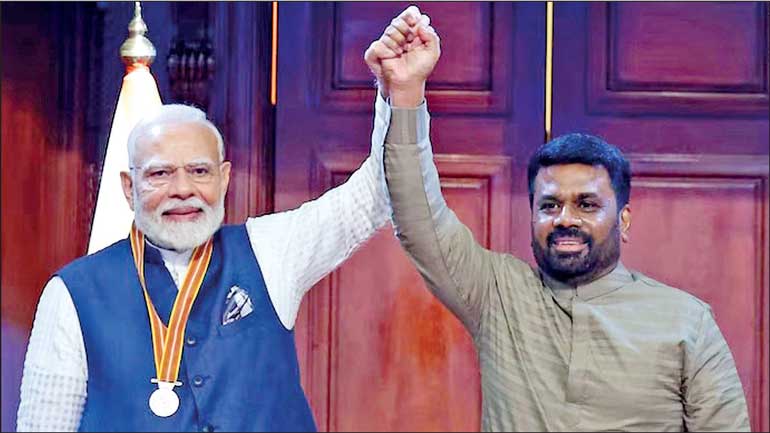
I am pleased to announce that the Government of Sri Lanka has decided to confer upon Prime Minister Shri Narendra Modi the highest Sri Lankan honour, the “Sri Lanka Mitra Vibhushana” as a symbol of the enduring friendship and unwavering, multifaceted support that he has consistently extended to Sri Lanka and its people. This prestigious honour is reserved for foreign Heads of State in recognition of their friendship and cooperation with the people of Sri Lanka. We firmly believe that Prime Minister Modi, who has always stood by Sri Lanka, is most deserving of this distinction.

In Sri Lanka, we too are on a transformative path, which we call the “A Thriving Nation and a Beautiful Life” National Policy. This policy is designed to pave the way for economic progress, social justice, and to provide every citizen with the opportunity to prosper, regardless of their background.

As neighbours, partners, and long-standing friends, let us resolve, at this moment, to build a future filled with shared development. Once again, I express my sincere gratitude to Prime Minister Shri Narendra Modi and his delegation for visiting Sri Lanka at this crucial time, when a people-centred political transformation is underway.🔺

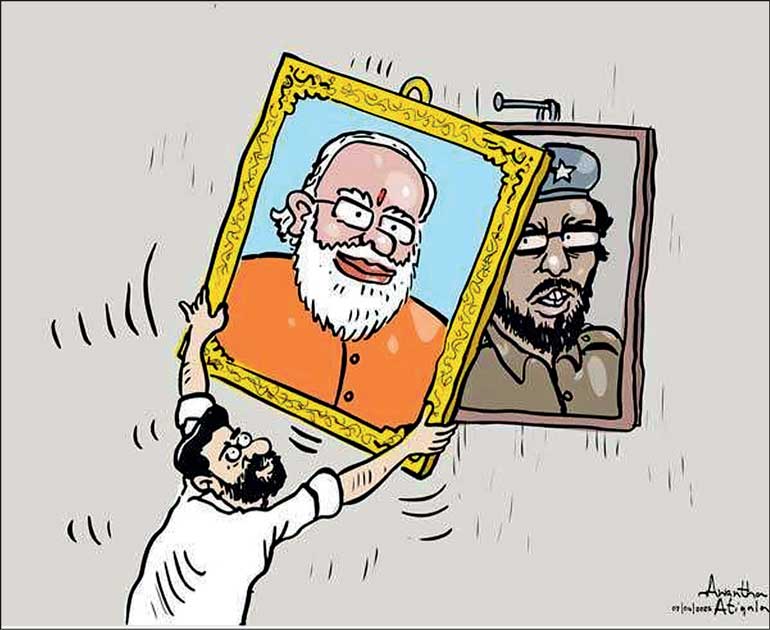
Decoding the AKD-Modi pact

Decoding the AKD-Modi pact: Geopolitical logic, military alignment, existential danger

Daily FT LK Thursday, 10 April 2025 


Quite a conversion


Gotcha!

Au Revoir at Anuradhapura


“…We sincerely applaud the way India has positioned itself not only as a regional power, but also as a global leader…India and Sri Lanka are not merely two countries on a map. It is essential to recognise that they are two nations deeply connected by history, strongly united by trade, and bound by friendship…” 

- President Anura Kumara Dissanayake -

(https://www.ft.lk/news/Sri-Lanka-and-India-on-a-transformative-path-President-AKD/56-775274


Indian defence analysts speak of a Defence Pact or Defence Cooperation Pact with Sri Lanka. 


(https://youtu.be/XIfLDI5VP5A?si=PsxPKtfYKne9mdGF

Officials on both sides say it was a ‘formalization’, an ‘umbrella’ over the existing agreements. But why an ‘umbrella’ --or ‘chapeau’ (hat) as the French call it? Why ‘formalization’? Because it takes things to the next level. What’s that level? 

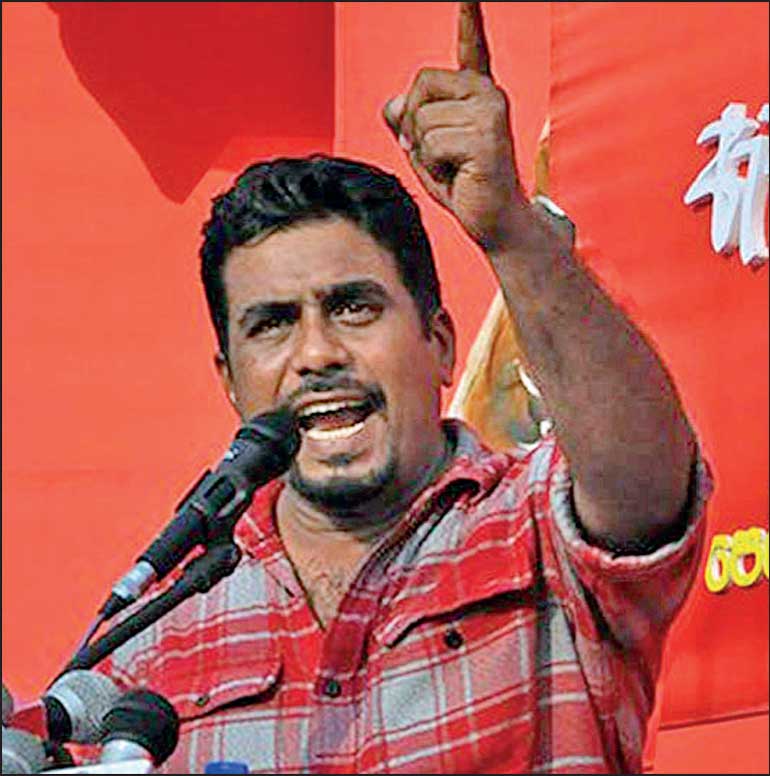
Addressing an election meeting in Galle, President Anura Kumara Dissanayake clarified matters:

“We need security in this region. We need to safeguard the security of this region. We should secure the assistance of those who have greater technological capacities in defence, greater skills in defence. If not how can a country move forward? We could have done so, if for 76 years our rulers had succeeded in bringing us to a higher rung in technology. We could have gone[forward]. But what happened? For 76 years the world developed rapidly in science and technology. The world developed rapidly in military science (“Yudha Vidyaava”) …Now what should we do? We must secure the assistance of those states which have accepted this new science and technology…Don’t we have to do that? Shouldn’t we do that? We are doing that!...” 


(https://www.youtube.com/watch?v=6NSOwMSfaac&t=199s

Connect the dots. With this Defense Cooperation pact with India (“there’s nothing there” says AKD reassuringly in this speech), Anura is dragging us into an amended role in providing regional security; a role that is hardly even-handed or equidistant; balanced or omni-directional. A role that is hardly nonaligned. How is the region (“kalaapaya”) defined? If it is South Asia, what about the other countries of the region, including our staunch friend Pakistan? If it is the Indo-Pacific or Asia-Pacific region, what about our friend China? 

What’s all this about “military science” and technology anyway? How is that a priority for us, and at this time of economic crisis and falling living standards? 

Anura is plugging us as a peripheral unit into India’s security architecture which includes strategic alignment with the USA against China. Under AKD, Sri Lanka is now part of that. We have taken sides. 

As for ‘military science and technology’, it seems from Indian media reports that we shall have on Sri Lanka’s soil, Indian weapons manufacturing and stockpiling facilities. Where will they be located? Who will maintain, service and guard these? Indian military units—again? Having elements of India’s defence industry and warehousing on our soil will place them and therefore our island, on someone’s target menu.    

FSP’s Duminda Nagamuwa: Left Resistance


Symbolism shouts 

Symbolism speaks louder than words. Ceylon/Sri Lanka has hosted a great many foreign leaders. India’s Prime Minister Narendra Modi was the first ever visiting leader/head of government to be welcomed at a ceremony at Independence Square. This includes Premier Zhou Enlai (1957) and President Xi Jinping. 

The uniqueness of Modi’s reception at our Independence Square instead of the Presidential Secretariat with the usual gun salute on Galle Face Green facing the Indian Ocean, resides in the uniqueness of his host, President Anura Kumar Dissanayake. No other Ceylonese/Sri Lankan leader did or would have done this. Perhaps AKD confused ‘Independence Square’ with ‘In Dependence Square’? 

Sri Lanka’s highest award for a foreigner, Sri Lanka Mithra Vibhushana was awarded to Mahmoud Abbas and posthumously to Yasser Arafat by Mahinda Rajapaksa in 2014. That was a moral gesture of solidarity. It was never awarded by Mahinda to Xi Jinping. Anura awarded it to Narendra Modi.

Also symbolic was the unequal treatment of Sri Lankan and Indian journalists throughout the visit. Sri Lankan journalists were treated as second class citizens. This is symbolic of the new reality after the AKD-Modi equation was codified in seven agreements. Sri Lanka has a subaltern status and therefore, so do Sri Lankans. 

Finally, there is the symbolism of Modi’s return home. He left from Anuradhapura (in the ‘Sinhala heartland’) in an Indian Air Force chopper, then flew over the ‘Ram Sethu’-- the ‘Hanuman bridge’—between Mannar and Rameshwaram. It is the site of a proposed bridge across the Palk Straits to establish contiguity between Sri Lanka’s North and India’s Tamil Nadu. The view from Prime Minister Modi’s seat was videoed, and featured on Sri Lankan television news.  

Decoding AKD-Modi

Prime Minister Modi visited a traditional Sinhala puppet show on the precincts of the Taj Samudra hotel. Hours later he participated in a larger puppet show, this time with him as a puppeteer, at the Presidential Secretariat where seven agreements were signed. 

His visit to Sri Lanka is best summed up as ‘power projection by invitation’. The crux of Anura’s package of agreements with Modi, especially of the defence agreement, is that Sri Lanka is now a strategic ally and subordinate partner of India. It is premised on Anura’s acceptance of the identity – not merely the overlap and intersection -- of India’s and Sri Lanka’s strategic/security interests. 

No previous Sri Lankan leader or administration took that position. Sri Lanka’s position was that we have our own distinct strategic and security interests as befits our distinctive, independent identity, and these may or may not intersect with those of India or any other country, given the specific situation. Whether or not they do so depend on Sri Lanka’s national interests. Thus, Prime Minister Sirimavo Bandaranaike exercised the right to allow Pakistani planes flying from West to East Pakistan during the Bangladesh War. 

Anura Dissanayake has accepted a doctrine that Sri Lanka has no interests independent and separate from India’s. Once that is conceded, the implication is that Sri Lanka has no identity separate from and independent of India. 

The Sri Lanka visit was a triumph for Prime Minister Modi in terms of outcome. I cannot think of a single visit to any country in the South Asian region, or the Asian continent, or indeed in the world, in which Modi secured for India, a greater footprint, a greater chunk from/of the country he was visiting. He has never returned home with a greater share of and a greater say over a country he was visiting—anywhere.  

No other country and no other leader have ever given Prime Minister Modi or India a larger share of itself and a greater say in its destiny as has Sri Lanka under AKD. There’s never been a greater integration with India of anyone’s country, or a bigger sellout of anyone’s country to India under Modi or any of his predecessors, than Anura has just perpetrated. 

President Dissanayake failed even to secure an agreement which safeguards Sri Lanka’s Northern waters from flotillas of predatory, piratical fishermen from Tamil Nadu. Needless to add, he failed to signal, still less reinforce, the status quo over Kachchatheevu which Madam Bandaranaike secured for Sri Lanka. 

With the seven pacts, Sri Lanka is now transitioning into a peripheral unit of Akhand Bharat, as no other South Asian country has consented to be. Anura Kumara Dissanayake has been the first leader in South Asia to sign up in effect, to Modi’s expansionist Akhand Bharat project. 

Anura Dissanayake’s accords with Modi have actually placed Sri Lanka not merely within India’s informal sphere of influence, but within India’s strategic space. A sphere of influence is a sphere of preponderance, not a sphere of ownership. But Anura Dissanayake has made Modi’s India, co-owner and co-ruler of Sri Lanka.

If in ancient mythology, Lanka’s Ravana abducted India’s Sita and brought her back to the island, AKD has more than compensated by reversing the process: gifting Modi as modern-day Ram, a Sri Lankan Sita—the sovereignty of Lanka and strategic control over the island. Anura’s role model isn’t Modi but the mythical Vibheeshana who betrayed his country to Rama. 

Not ‘Civilizational Twins’

Prime Minister Modi’s doctrine declared at AKD’s official dinner, that “India and Sri Lanka are civilizational twins” is manifestly NOT true. If that were the case, there should be a Sinhala community of considerable size and antiquity in India, but there isn’t even a small one. And there are few Buddhists. 

Our island was so recognizably distinctive and autonomous that even during the British empire, Ceylon was not governed from Delhi as part of the British Raj. It was governed instead, directly from Whitehall, London. After Independence, we governed ourselves. President Anura Dissanayake’s seven agreements with Prime Minister Modi are changing that. AKD has transferred our destiny to Delhi.  

Sri Lanka and its majority community the Sinhala people have a long-chronicled distinctive history. The Lankan story is one of a complex, contradictory, dialectical relationship with India. The primary aspect of that dialectical dynamic has been the constant existential struggle to assert itself as autonomous from India; to keep the island’s identity distinct from and independent of the vast, teeming, caste-ridden landmass of India, especially South India. What President Anura Dissanayake has done is to go against our long history, its logic, its ethos, its grain. 

A space between this island and the subcontinental landmass, is what preserves the essential identity of our country. The narrower that space becomes, the more difficult to maintain that distinct identity. What Anura has either proposed or acceded to is to narrow the distance functionally, almost to the degree that there is none. His seven agreements integrate Sri Lanka with India, especially Tamil Nadu. He is trying to move counter-clockwise to our historical project of long duration, that of demarcation and independent national assertion from India and a hostile Tamil Nadu. 

Anura has therefore betrayed the most fundamental duty of any Sri Lankan leader over millennia, up to, including, and most especially in the post-Independence period: to preserve and protect the distinctive identity and interests of the island of Sri Lanka as a separate country, an independent, sovereign state. 

He has now made Sri Lanka more dependent and more subordinate than it has ever been, to India. He has accepted the overlordship of India’s ruler, Narendra Modi. He has rendered Sri Lanka part of the Modi Raj. In effect, he is a Chief Minister of a quasi-state of India and the JVP-NPP is its governing party. 

AKD’s discourse

For 60+ years, I have been keenly aware of the behaviour and discourse of Ceylonese/Sri Lanka leaders in their interactions with foreign counterparts. Aged seven, I was with my parents while my father covered the 2nd Non-Aligned Summit Conference in Cairo in October 1964 attended by Sirimavo Bandaranaike. 

My parents were guests of the Cuban govt at the 6th Nonaligned Conference in Havana in September 1979 and my father wrote in his Lanka Guardian about the JR Jayewardene-Fidel Castro chemistry. 

Let’s fast forward. I was working with President Premadasa when he chaired the SAARC summit. In 2007, I accompanied President Rajapaksa who had arrived in Geneva to address the ILO, at meetings with formidable international personalities who grilled him about the war. In 2019, I was a few feet away in the same room as President Sirisena, President Putin, President Xi Jinping and Foreign Minister Jaishankar.

I have never once seen, heard or read of a Ceylonese/Sri Lankan leader speak as fawningly as I saw President Anura Kumara Dissanayake did on live TV, addressing Prime Minister Narendra Modi. JR maintained his dignity even with an Indian gun pointed figuratively at his head. Anura came out as a huge Modi follower and fan. British Prime Minister Tony Blair was dubbed a ‘poodle’ for signing up with US President George W Bush, but even he never sounded as cringe-worthy. 

The leader of a party founded 60 years ago as a Marxist-Leninist party, Anura Dissanayake wasn’t moved on his presidential visit to Beijing to make remarks even remotely as enthusiastic as those he made about Modi, about Mao Zedong, Zhou Enlai, Zhu De, Deng Xiaoping, Xi Jinping, the Communist Party of China, the People’s Liberation Army, the Chinese Revolution, or China’s development miracle (which surpasses India’s).  

Not 1987

In 1987, The Financial Times (UK) had a world exclusive on the text of the Indo-Sri Lanka Accord. It’s Colombo correspondent Mervyn de Silva who had begun his illustrious career as a reporter, had lost none of his instincts and skills, and had scooped the story. 

Prime Minister Premadasa read the newspaper in Tokyo, was livid that he had not been shown the text beforehand by President Jayewardene, and knew nothing of it. He phoned Mervyn for an in-depth chat (as was his habit from Opposition MP through his Presidency). When Premadasa returned to Colombo it was clear to the public from his absence at the official signing ceremony and attendant receptions that President Jayewardene’s Prime Minister was a dissenter. So was National Security Minister Athulathmudali.

President Dissanayake has no such problems. There’s no dissent either in his ranks or from the leadership of the main Opposition.  

Over a year before the Accord/IPKF, Prime Minister Premadasa was author of the patriotic novel ‘Golu Muhuda’/‘The Silent Sea’ (Dayawansa Jayakody, January 1986, Colombo). The title phrase was from a discomfited Prince Dutugemunu’s reply to his mother. As President, Premadasa was the only Lankan leader to build a statue of Ravana -- having sent back the Indian Peacekeeping Force. However, his son attended the presidential banquet AKD hosted in honour of the visiting Indian PM, despite the manifest discourtesy of not being briefed as Opposition Leader, on the details of the pacts that had been signed. 

Sharks and Black Swans 

President AKD and his administration will be undone in one term by a convergence of five ‘sharks’: 

 The Trump tariffs which the Anura administration was warned about repeatedly by Opposition leader Sajith Premadasa but chose to ignore. 

The IMF agreement AKD chose not to renegotiate and readjust.

The repayments due in the debt restructuring agreement he chose not to bargain hard over.

Convulsive global economic and military volatility (trade and tariff wars, US-Israeli strike on Iran, with retaliatory impacts on oil prices) which will be the equivalent of the 1973 OPEC oil price shock that hit the Sirima Bandaranaike-led SLFP-Left coalition government. 

Public disaffection with the ubiquitous Indianization of Sri Lankan affairs, percolating through. 

In world history, when conventional parties and personalities representing the old elites and Establishment have been irresolute or tepid in the struggle to defend the country, the task of resistance to foreign expansionism devolves on the radicals, revolutionaries, the Left—or the extreme nationalist Right. I prefer the non-racist Left. 

In today’s Sri Lanka, it is the Frontline Socialist Party-People’s Struggle Alliance (FSP-PSA) constellation, the real motor-force and spearhead of Aragalaya 2022, that displays fire in the belly, backbone, critical intellect, fidelity to principles, and collective conscience, to resist Anura’s abject acceptance of satellite status for Sri Lanka. 

As the Aragalaya was in 2022, and Anura and the JVP-NPP were in 2023-2024, could the FSP-PSA possibly be the next ‘Black Swan’? 🔺

Thursday, April 17, 2025

பலஸ்தீனர்களின் பாரிய மனிதப் புதைகுழியாக மாறியுள்ள காசா


🟠பலஸ்தீனர்களின் பாரிய மனிதப் புதைகுழியாக மாறியுள்ள காசா
இஸ்ரேலின் தொடரும் தாக்குதல்களில் மேலும் 23 பேர் பலி; உயிரிழப்பு 51,000 ஆக அதிகரிப்பு

தினகரன் April 17, 2025 

காசா பகுதி பலஸ்தீனர்கள் மற்றும் அவர்களுக்கு உதவுபவர்களுக்கான ‘பாரிய மனிதப் புதைகுழியாக’ மாறியுள்ளது என்று மருத்துவ தொண்டு அமைப்பான எல்லைகளற்ற மருத்துவர்கள் அமைப்பு குறிப்பிட்டுள்ளது. காசாவில் இஸ்ரேல் தொடர்ந்து நடத்தும் தாக்குதல்களில் நேற்று (16) காலை மேலும் 23 பேர் வரை கொல்லப்பட்டிருக்கும் நிலையில் இந்த அறிவிப்பு வெளியாகியுள்ளது.

காசாவின் தெற்கு நகரான ரபாவில் இஸ்ரேலியப் படை வீடுகளை தகர்த்து வருவதோடு இஸ்ரேல் நடத்திய நேரடி தாக்குதல் ஒன்றில் காசாவில் தடுத்து வைக்கப்பட்டிருக்கும் பணயக்கைதி ஒருவரான அமெரிக்க படை வீரர் ஈடன் அலெக்சாண்டர் உடனான தொடர்பை இழந்ததாக ஹமாஸ் ஆயுதப் பிரிவு தெரிவித்துள்ளது.

இதில் இஸ்ரேலிய வான் தாக்குதல் ஒன்றில் 13 பேர் கொல்லப்பட்டிருப்பதாக பலஸ்தீன மருத்துவ வட்டாரம் தெரிவித்துள்ளது. இவ்வாறு கொல்லப்பட்டவர்களில் நன்கு அறியப்பட்ட எழுத்தாளர் மற்றும் புகைப்படப்பிடிப்பாளர் ஒருவரான பட்மா ஹசுனாவும் இருப்பதாக அங்கிருந்து வரும் செய்திகள் தெரிவிக்கின்றன. இவர் காசா போரில் மக்கள் படும் வேதனைகளை புகைப்படங்களாக வெளியிட்டு வந்தவராவார்.

Interactive_Gaza_foodaid_timeline-1742987531

காசா நகரில் இருக்கும் மேலும் பல வீடுகளையும் இஸ்ரேலிய இராணுவம் இடித்துத் தகர்த்ததாக அங்குள்ள குடியிருப்பாளர்கள் தெரிவித்துள்ளர். கடந்த சில நாட்களில் இஸ்ரேலின் கட்டுப்பாட்டில் வந்த பகுதிகளிலேயே அது இவ்வாறு செய்துள்ளது. எஞ்சிய பணயக்கைதிகளை விடுவிப்பதற்கு ஹமாஸ் அமைப்புக்கு அழுத்தம் கொடுக்கும் வகையில் பாதுகாப்பு வலயங்களின் விரிவாக்கமாக இது உள்ளது என்று இஸ்ரேலிய தலைவர்கள் தெரிவித்துள்ளனர்.

‘காசா பலஸ்தீனர்கள் மற்றும் அவர்களுக்கு உதவ வருபவர்களுக்கு பாரிய மனிதப் புதைகுழியாக மாறியுள்ளது. நாம் நேரடியாக அழிவுகள் மற்றும் காசாவில் உள்ள ஒட்டுமொத்த மக்களும் வலுக்கட்டாயமாக வெளியேற்றப்படுவதை பார்த்து வருகிறோம்’ என்று எல்லைகளற்ற மருத்துவர்கள் அமைப்பின் காசாவுக்கான அவசர ஒருங்கிணைப்பாளர் அமன்டே பசெரோல் வெளியிட்ட அறிவிப்பில் குறிப்பிட்டுள்ளார்.

இஸ்ரேலின் சரமாரி தாக்குதல்களுக்கு மத்தியில் ஹமாஸ் போராளிகளின் பிடியில் இருந்த இஸ்ரேலிய அமெரிக்க பணயக்கைதியான 21 வயது ஈடன் அலெக்சாண்டர் உடனான தொடர்பை இழந்திருப்பதாக ஹமாஸ் அமைப்பு தெரிவித்துள்ளது. அவர் இருந்த இடத்தின் மீது இஸ்ரேல் நேரடி தாக்குதல்களை நடத்தியதாக அந்த அமைப்பு குறிப்பிட்டது.

2023 இல் இஸ்ரேல் மீது ஹமாஸ் நடத்திய தாக்குதலில் கடத்தப்பட்ட 251 பணயக்கைதிகளில் தொடர்ந்து 59 பேர் காசாவில் தடுத்து வைக்கப்பட்டிருப்பதாக நம்பப்படுகிறது. இவர்களில் 24 பேர் தொடர்ந்து உயிருடன் இருப்பதாக நம்பப்படுகிறது. அவர்களில் ஐந்து அமெரிக்க பிரஜைகள் இருப்பதாகவும் அவர்களில் அலெக்சாண்டர் மாத்திரமே உயிருடன் இருப்பதாகவும் நம்பப்படுகிறது.

இந்நிலையில் ஹமாஸ் அமைப்பு நேற்று முன்தினம் (15) பணயக்கைதிகளின் குடுபத்தினருக்கு விடுத்த எச்சரிக்கையில், இஸ்ரேல் தாக்குதல்களை தொடர்ந்தால் எஞ்சியுள்ள பணயக்கைதிகள் சவப்பெட்டியிலேயே திரும்புவார்கள் என்று குறிப்பிட்டுள்ளது.

கடந்த ஒன்றரை ஆண்டுகளுக்கு மேலாக காசா மீது இஸ்ரேல் நடத்தும் தாக்குதல்களில் உயிரிழந்தவர்கள் எண்ணிக்கை தற்போது 51,000 ஐ தொட்டுள்ளது. இவர்களில் பெரும்பாலானவர்கள் சிறுவர்கள் மற்றும் பெண்கள் என்பதோடு இடிபாடுகளில் சிக்கிய நிலையில் மேலும் பலர் காணாமல் போயுள்ளன. குறிப்பாக இரண்டு மாதங்கள் நீடித்த போர் நிறுத்தத்தின் பின் கடந்த மார்ச் 18 ஆம் திகதி காசா மீது இஸ்ரேல் மீண்டும் தாக்குதல்களை ஆரம்பித்தது தொடக்கம் கொல்லப்பட்ட மற்றும் காயமடைந்த பலஸ்தீனர்கள் எண்ணிக்கை 4,302 ஆக அதிகரித்துள்ளது.

கடந்த மார்ச் ஆரம்பம் தொடக்கம் காசாவுக்கான எரிபொருள், மருந்து மற்றும் உணவு விநியோகத்தை இஸ்ரேல் முடக்கி இருக்கும் சூழலில் காசாவில் தொடர்ந்து செயற்பட்டு வரும் ஒருசில மருத்துவமனைகளில் மருந்து விநியோகங்கள் தீர்ந்து பணிகளில் இடையூறு ஏற்பட்டிருப்பதாக காசா சுகாதார அமைச்சு தெரிவித்துள்ளது.

‘நூற்றுக்கணக்கான நோயாளிகள் மற்றும் காயமடைந்தவர்கள் அத்தியாவசிய மருந்துகள் இல்லாமல் தவிக்கின்றனர், மேலும் எல்லைக் கடவைகள் மூடப்பட்டதால் அவர்களின் துன்பம் மோசமடைந்து வருகிறது’ என்று அமைச்சு குறிப்பிட்டுள்ளது. எனினும், இஸ்ரேல் பாதுகாப்பு அமைச்சர் இஸ்ராயேல் காட்ஸ் எக்ஸ் சமூகதளத்தில் வெளியிட்டிருக்கும் அறிவிப்பில், ‘இஸ்ரேலின் கொள்கை தெளிவானது என்பதோடு காசாவுக்கு எந்த மனிதாபிமான உதவியும் அனுமதிக்கப்படாமாட்டாது’ என்றார். ஹமாஸ் அமைப்புக்கு அழுத்தம் கொடுக்க இந்த நடவடிக்கை எடுக்கப்பட்டிருப்பதாக அவர் குறிப்பிட்டுள்ளார்.

காசாவில் போர் நிறுத்தத்தை மீண்டும் எட்டும் முயற்சியில் கட்டார், எகிப்துடன் அமெரிக்காவும் மத்தியஸ்த பணியில் ஈடுபட்டு வருகின்றன. எனினும் இந்த பேச்சுவார்த்தையில் எந்த முன்னேற்றமும் எட்டப்படவில்லை.

இதில் இஸ்ரேல் பரிந்துரைத்திருக்கும் ஆறு வார போர் நிறுத்தத்தில் ஆயுதங்களை களைவதற்கு விடுத்த அழைப்பை ஹமாஸ் அமைப்பு நிராகரித்துள்ளது. இந்தப் பரிந்துரையில் போரை முடிவுக்குக் கொண்டுவருவது அல்லது இஸ்ரேலிய துருப்புகள் வாபஸ் பெறுவது பற்றி எதுவும் கூறப்படவில்லை என்று மூத்த பலஸ்தீன அதிகாரி ஒருவர் குறிப்பிட்டுள்ளார். எனினும் எகிப்து ஊடாக முன்வைக்கப்பட்டிருக்கும் இந்த போர் நிறுத்த பரிந்துரை தொடர்பில் பரிசீலிக்கப்பட்டு வருவதாகவும் ஹமாஸ் தரப்பை மேற்கோள்காட்டி செய்தி வெளியாகியுள்ளது. 🔺 

Govt. to send high-level delegation to US over tariff talks


Govt. to send high-level delegation to US over tariff talks

Thursday, 17 April 2025 Daily FT LK

A high-level delegation will travel to the US next week to hold direct discussions with the US Trade Representative following Trump administration’s decision to impose a steep 44% tariff on Sri Lankan exports.

The move comes after a series of virtual meetings with US authorities and a detailed review of the crisis, which threatens Sri Lanka’s single largest export market.

Export Development Board (EDB) Chairman Mangala Wijesinghe confirmed the trip to the Daily FT, noting that the final composition of the delegation is still being finalised. 

“The delegation will present our concerns directly and see a path forward that projects Sri Lanka’s exports, jobs and economic stability,” he said.

Wijesinghe said the move comes after President Anura Kumara Disanayake-appointed special committee was formed to examine the full implications of the US tariff decision and propose urgent countermeasures.

He said the discussions so far have covered both the economic reasoning behind the US tariff move and the wider implications for developing countries like Sri Lanka.

The US accounts to about 25% of Sri Lanka’s total exports. The apparel and textile industry in particular faces significant risk.

The delegation is expected to push for continued tariff relief beyond the 90-day reduction to 10% while also exploring long-term solutions such as expanded trade cooperation, regulatory alignment and targeted US market engagement strategies.

The President appointed special committee comprised Senior Economic Adviser to the President Duminda Hulugamuwa, Central Bank Governor Dr. Nandalal Weerasinghe, Finance Secretary Mahinda Siriwardana, Trade Secretary A. Wimalaneththiraja, Foreign Affairs Ministry’s Senior Director General Dharshana Perera and EDB Chairman Wijesinghe, Brandix CEO Ashroff Omar, MAS Co-Founder Sharad Amalean, Lanka Garments MD Saif Jafferjee, and Michelin Lanka’s Head of Legal and Public Affairs Nilanthi Weliwe, Labour Minister Dr. Anil Jayanta Fernando and Deputy Finance Minister Dr. Harshana Suriyapperuma.🔺

Ranil warns of massive job losses over US tariffs


Ranil warns of massive job losses over US tariffs

Thursday, 17 April 2025


  • Describes situation as an ‘economic emergency’
  • Calls on Govt. to act swiftly and inform public about measures taken

Former President Ranil Wickremesinghe yesterday warned over the serious economic threat posed by the US’s new reciprocal tariff policy on Sri Lankan exports, cautioning that over 100,000 jobs could be lost if urgent action is not taken.

In a special statement, Wickremesinghe called the situation an ‘economic emergency’; urging the Government to act swiftly and inform the public about its response.

“As tariffs increase, consumer demand for goods declines. This is not a hypothetical situation, it is already unfolding. One direct consequence of this will be job losses. Some estimate over 100,000 jobs are at risk, whether the number is exactly that or slightly lower, the figure is set to rise,” he added.

Wickremesinghe warned that the impact would not be limited to factory workers or export companies alone. “People running boarding houses, shops and other support services will also see their income affected. This will in turn, hurt our overall economy,” he added.

He also raised concerns about wider economic effects. He noted that a sharp drop in export earnings could worsen the country’s balance of payments (BoP) leading to further depreciation of the rupee and slow down growth.

“As our earnings decline, our borrowings needs will increase. The economy may slow down further and the rupee could depreciate even more,” he cautioned.

Calling for immediate diplomatic engagement with the US, Wickremesinghe stressed the need for open and honest communication with the public. 

“The Government must treat this as an emergency and clearly communicate what measures are being taken locally. Otherwise, one problem will follow another,” he added.🔺

Tuesday, April 15, 2025

பயங்கரவாத எதிர்ப்பு சட்டத்தை இரத்துச் செய்வதை ஆராய விசேட குழு


பயங்கரவாத எதிர்ப்பு சட்டத்தை இரத்துச் செய்வதை ஆராய விசேட குழு
மே முற்பகுதியில் பொதுமக்கள், சிவில் அமைப்புகளிடம் கருத்து

April 14, 2025 தினகரன் லோரன்ஸ் செல்வநாயகம் 

பயங்கரவாத எதிர்ப்புச் சட்டத்தை (PTI) இரத்துச் செய்வது தொடர்பில் ஆராய, அரசாங்கம் விசேட குழுவொன்றை நியமித்துள்ளது.

இக்குழுவின் தலைவராக ஜனாதிபதி சட்டத்தரணி றியன்சி அர்சகுலரத்ன நியமிக்கப்பட்டுள்ளதாக நீதியமைச்சு தெரிவித்துள்ளது.

அதற்கிணங்க எதிர்வரும் மே மாத முற்பகுதியில் பொதுமக்கள் மற்றும் சிவில் சமூக அமைப்புகளிடமிருந்து கருத்துகளையும் பெற்றுக் கொள்ள நடவடிக்கை எடுக்கப்பட்டுள்ளது.

அத்துடன் சர்வதேச நிறுவனங்கள் மற்றும் சமூகங்களின் கருத்துக்களைப் பெற்றுக்கொள்ளவும் மேற்படி குழுவிற்கு அறிவுறுத்தப்பட்டுள்ளது.

பயங்கரவாத எதிர்ப்புச் சட்டத்தை இரத்துச் செய்வது தொடர்பான முதற்கட்ட கலந்துரையாடல் நீதி மற்றும் தேசிய ஒருங்கிணைப்பு அமைச்சர் சட்டத்தரணி ஹர்ஷண நாணயக்கார தலைமையில் கடந்த 11 ஆம் திகதி நீதி யமைச்சில் நடைபெற்றுள்ளது.

தற்போதுள்ள பயங்கரவாத எதிர்ப்புச் சட்டத்தை இரத்துச் செய்வதே தற்போதைய அரசாங்கத்தின் கொள்கை என இந்தக் கலந்துரையாடலின் போது நீதி யமைச்சர் தெரிவித்துள்ளார்.

புதிய சட்ட முன்வரைவு உலகளாவிய பயங்கரவாதத்தையும் சவால்களையும் எதிர்கொள்ளக்கூடிய ஒரு மசோதாவாக இருக்க வேண்டும் என்றும், இந்த நாட்டின் சர்வதேச அளவில் அங்கீகரிக்கப்பட்ட அரசியலமைப்பால் உத்தரவாதமளிக்கப்பட்ட கருத்துச் சுதந்திரத்திற்கான மனித உரிமைகளை மீறக்கூடாது என்றும் அமைச்சர் வலியுறுத்தினார்.

இந்தத் திருத்தச் சட்டங்களைக் கொண்டுவருவதற்கு முந்தைய அரசாங்கங்கள் உரிய முறையில் செயற்படவில்லை எனவும், தற்போது நியமிக்கப்பட்ட குழு, இந்தச் சட்டத்தை இரத்து செய்வது தொடர்பான பொருத்தமான விடயங்களை மிகக் குறுகிய காலத்திற்குள் வழங்க நடவடிக்கை மேற்கொள்ள வேண்டுமெனவும் நீதியமைச்சர் மேற்படி குழுவின் உறுப்பினர்களுக்கு அறிவுறுத்தியுள்ளதாக நீதியமைச்சு குறிப்பிட்டுள்ளது.

Monday, April 14, 2025

China ready to work with EU


Chinese Foreign Ministry Spokesperson Lin Jian 

China ready to work with EU to safeguard global trade rules and justice: FM
By Global Times
Published: Apr 14, 2025 

In response to a question about the China-EU dialogue on US tariff issues, Chinese FM spokesperson Lin Jian said on Monday that the US using tariffs as a weapon for seeking selfish gains is a typical example of unilateralism and protectionism, which damages the interests of economies around the world, including China and the EU.

Lin said China and the EU are the world's second and third largest economies, their combined economic output exceeds one third of the global economy, their trade volume accounts for one fourth of global trade, and both China and the EU are advocates of economic globalization and trade liberalization, and defenders and supporters of the WTO.

The EU and China are committed to safeguarding the fair and free multilateral trading system with the WTO at its core as well as stable development of global economic and trade relations, said Lin, noting that China has taken and will continue to take resolute measures to safeguard its legitimate interests, and is ready to work with the international community, including the EU, to enhance communication and coordination, share development opportunities, expand open cooperation, and achieve mutual benefit and win-win results, jointly defending the rules of international trade, fairness and justice.🔺

Global Times

Saturday, April 12, 2025

Lanka moves to reduce its trade surplus with US

Lanka moves to reduce its trade surplus with US
By Sunimalee Dias and Tharushi Weerasinghe
Sunday Times LK 13-04-2025

Govt. explores plans to minimise tariffs’ impact on economy; looks for new markets; exporters welcome 90-day pause

Sri Lanka is among the countries currently facing a 90-day pause on the new tariffs—as announced by US President Donald Trump on Wednesday—and is trying to work out a plan to reduce the trade surplus in its favour by increasing imports from the US amidst possible duty cuts.

The government will also look for new markets in India, China, Europe and several other countries as a way to circumvent the newly imposed US tariffs on Sri Lankan exports, a Finance Ministry source said.

This will be in addition to talks with US authorities to reduce the 44% tariff on Sri Lanka’s exports while also exploring ways in which the government can help exporters to ease the tariff burden on them.

Sri Lanka also plans to appeal to the US government to extend the 90-day pause for six months while sending a delegation for talks. President Trump announced on Wednesday a 90-day pause for countries hit by US tariffs, except China, but the universal reciprocal tariff of 10%” will continue on all countries, including Sri Lanka.

“We have a short period to take measures to offset the impact of the tariff hike of 44%, but we will have to deal with the impact of this in the long run, so we are looking at several options,” the official said.

Among the alternate markets for Sri Lankan exports that are being looked at are India, China, Malaysia, Indonesia and EU nations, the official said.

This would be in addition to discussion with the US to see how the tariffs could be slashed further, he added.

Most exports, including garments, tea and gems, will be impacted by the tariffs, he added.

At present Sri Lanka imports animal feed, pharmaceutical products, electrical and electronic products, yarn, plastic products, chemical products, meat/fish and dairy products, telephone sets, audio-video equipment and parts, woven fabrics, paper and paper products, motor vehicles and parts, cereals and its products, automatic data processing machines, switches, boards and panels, unmanufactured tobacco, aircraft and parts, soap, washing preparations, waxes, candles, base metal products, and paints, varnishes and dyeing extracts, among others.

According to trade officials, the highest duties imposed on US goods are vegetables, fruits and nuts (38.3%); food products (35.9%); leather producers (32.6%); rubber and plastic goods (28.8%); and vegetable oils and fats (25.8%). Soybean meal as animal feed was the largest import, worth US$140.66 million in 2024, according to official data, while the second largest import from the US was pharmaceutical products, which incidentally is a tax-free import.

Officials said that while Sri Lanka imports stocks of animal feed from the US, local authorities are looking at improving local production and finding other cheaper sources. There is no impact on pharmaceutical imports from the US, as they are duty-free, but the pharmaceutical industry has been trying to increase local production, thereby reducing imports and saving foreign exchange.

The trade volume between the two countries was estimated at $3.4 billion in 2024, with US exports to Sri Lanka reaching $368.2 million, while Sri Lanka’s exports to the US reached $3 billion, with the surplus of $2.6 billion in favour of Sri Lanka. The US is the largest export market for Sri Lanka, accounting for 27% ($3.0 billion) of the country’s total exports ($12.8 billion) in 2024.

The Institute of Policy Studies, an independent think tank, in a recent report says if one ignores VAT, subsidies, and exchange rate interventions, reciprocity can be simplified to import tariffs and para-tariffs. Sri Lanka has general customs duties, an Export Development Board CESS, excise duty, Port and Airport Development (PAL), and a Social Security Contribution Levy (SSCL). Once the product-level tariff rates are calculated on an ad valorem basis, Sri Lanka has a higher tariff rate than the US for almost all sectors. It suggested phasing out para-tariffs and tightening trade relations as one of the measures to overcome the crisis.

Meanwhile, the US pause was welcomed by industry leaders.

The Joint Apparel Association Forum (JAAF) commended the government for swift negotiations with the US. JAAF credited the administration’s efforts for likely securing Sri Lanka’s inclusion in the 90-day reprieve.

“This pause provides critical breathing space,” a JAAF spokesperson noted, emphasising the importance of sustained engagement to secure longer-term trade concessions.

Central Bank officials said the committee tasked with managing the fallout from the tariffs had yet to finalise recommendations. As talks continue, the government is expected to intensify efforts to solidify a permanent, favourable trade arrangement with Washington.

Meanwhile, a previously called all-party conference went ahead as planned on Thursday, chaired by President Dissanayake. It was held following a request made by 12 opposition party leaders to meet the president for a discussion on the matter.🔺

Modi’s Colombo Mission: Security, Energy, and a Strategic Reset


Modi’s Colombo Mission: Security, Energy, and a Strategic Reset

Ceylon Today -April 11, 2025 

By Sulochana Ramiah Mohan

Indian Prime Minister Modi’s fourth visit last week expressed his commitment to safeguarding the national interests of both India and Sri Lanka, particularly in the security and energy sectors. This agreement comes after nearly four decades of strained relations, stemming from India’s intervention during Sri Lanka’s civil war in the late 80s. The visit showcased India’s concerted efforts to reset its strategic influence in Sri Lanka, a country whose leadership, until recently, had shown resentment towards India.

Modi arrived in Colombo directly from Thailand, accompanied by senior officials, including Minister of External Affairs S. Jaishankar, National Security Adviser Ajit Doval, the Foreign Secretary, and other key government representatives. Modi’s arrival marked a shift, with the NPP Leader offering India what it sought, while securing Sri Lanka’s own priorities, and ultimately concluding as strategic partners.

Indian security takes charge of PM Modi’s safety

Prime Minister Modi came to ink strong defence and bilateral agreements with Sri Lanka, accompanied by prominent members of his Office, which he always used to do. But the large Indian security contingent is particularly noteworthy this time. The security detail, which accompanied him throughout his stay and ensured his protection until his departure on Sunday, evoked strong memories of previous Indian leaders’ visits to Sri Lanka that took place some decades ago. The heightened security measures were most noticeable in Colombo and along the routes leading to Anuradhapura, with widespread road closures and a considerable deployment of personnel, including Indian commandos, members of the Tri-Forces and several intelligence officers who had arrived ahead of his visit.

The unprecedented security measures sent a clear message. The scale of the security presence was crucial for Modi, given his prominent role in global politics and his importance as a regional leader. At the same time, the Janatha Vimukthi Peramuna (JVP), a party rooted in leftist ideology that had historically struggled to gain popular support and once maintained a contentious stance towards India, may have contributed to the heightened security, suggesting a lingering trust deficit that India has towards the current ruling party. However, defying expectations, the Dissanayake-led Government redefined its relationship with India over the two-day visit and expressed its commitment to embracing closer ties with New Delhi.

The chemistry between the two leaders were indeed good, creating a positive atmosphere. Modi, with his father-figure persona, has attracted many leaders, including US President Donald Trump. This bond with Sri Lanka marks a new chapter in Sri Lanka-India ties, one better defined by strategic alignment rather than ideological division or past discord.

The Indian security presence in Sri Lanka under Modi’s leadership can also be attributed to escalating gun violence, a series of murders—some involving Army deserters—brutal attacks by gangsters, and ongoing security lapses related to the 2019 Easter Sunday attacks, which Sri Lanka is still struggling to resolve. India, which had tipped off Sri Lanka about the attacks, has yet to see the culprits brought to justice, as sought by the victims’ families. This may have prompted India to adopt a calculated and cautious approach too.

Several regional leaders have visited Sri Lanka in the past, but the level of intense security surrounding Prime Minister Modi’s visit was unprecedented. Even during Sri Lankan President Anura Kumara Dissanayake’s visit to India last December, security arrangements were far more routine and low-key in comparison. Modi’s two-day visit to Sri Lanka was widely discussed, particularly for the heavily guarded motorcade, which included Indian commandos and personal security officers, all managed by India’s own security command.

Notably, factions such as the Janatha Vimukthi Peramuna (JVP), historically opposed to Indian involvement in Sri Lanka, have been a concern for Indian security agencies till late. The JVP’s past confrontations with Indian forces and its alignment with Chinese interests could have also added to this Indian security dynamics.

In light of these complexities, India also deployed four Mi-17 helicopters as part of the Prime Minister’s convoy in Sri Lanka, accompanied by about 100 Indian Air Force personnel. Additionally, the Indian Naval Ship (INS) Sahyadri, a 143-metre frigate manned by a crew of 320, was docked in Colombo, coinciding with Modi’s State visit. During their visit, the crew of INS Sahyadri participated in events hosted by the Sri Lanka Navy aimed at strengthening bilateral ties, the Indian Government said.

Strict security measures were in place in both Colombo and Anuradhapura. A large contingent of Police and STF personnel was deployed for security and traffic control.  

Anti-India sentiments

It’s important to draw a parallel to a significant incident in 1987, when the late Prime Minister of India, Rajiv Gandhi, visited Sri Lanka. During that visit, Sri Lanka Navy sailor Vijitha Rohana Wijemuni attempted to strike Gandhi with a Lee–Enfield rifle during a guard of honour. Although Gandhi ducked and the rifle made contact, he was not seriously injured. This incident became a major diplomatic embarrassment for both Sri Lanka and India, leaving a lasting stain on Indo-Sri Lankan relations. In contrast, Modi’s visit was carefully orchestrated—he was kept at a distance during the guards of honour, meeting only the Army and Air Force guards in Colombo and Anuradhapura, while the Sri Lanka Navy was notably absent. This absence is significant, especially considering the ongoing confrontations between the Sri Lanka Navy and Indian fishermen at sea, which have repeatedly angered the Indian Government. Alleged assaults have prompted India to summon the Sri Lankan Envoy in New Delhi in the recent past to express its displeasure.

In light of such past events, Modi’s security detail in Sri Lanka was exceptionally stringent. Reports indicate that nearly 6,000 Sri Lanka Police officers, including specialised units, were deployed to ensure his safety during the visit. 

NPP aligning as a strategic partner of India

Perhaps most striking was the NPP Government’s apparent shift in stance, as it extended a warm welcome to the Indian Prime Minister. This gesture is particularly significant given the JVP’s historical opposition to India’s involvement in Sri Lanka’s internal affairs. In the 1980s, the JVP-led campaigns against the Indo-Lanka Accord, which led to the deployment of the Indian Peace Keeping Force (IPKF) in Sri Lanka. Their past actions included anti-India propaganda, strikes, and boycotts of Indian goods, all of which reflected deep-seated nationalist sentiments.

This shift in the JVP’s approach has contributed to a broader political realignment, with many local political parties now viewing ties with India as crucial for Sri Lanka’s growth. Recently, the JVP has moderated its previous anti-India rhetoric, adapting to changing regional dynamics. Under Dissanayake’s leadership, the Party has softened its stance, recognising the need to adjust to the prevailing geopolitical landscape.

Resetting friendship

The warm reception extended to Modi and his team not only reflects the JVP’s evolving political strategy but also highlights the changing landscape of Sri Lanka’s foreign policy, gearing for cooperation and engagement with neighbouring countries.

In an interview with Ceylon Today prior to their victory in both the Presidential and General Elections last year, NPP’s Vijitha Herath, then campaigning for election, made a strong statement: “Without India’s support, or bypassing India politically or economically, little can be achieved by Sri Lanka,” he added.

President Dissanayake had to reset his relationship with India, and he successfully aligned with Modi and his team, overcoming past tensions. The message was clear when he spoke at the official dinner reception held at the President’s official residence in Colombo for the Indian leader. He said Modi has demonstrated his recognition of Sri Lanka’s deep-rooted connection with India, highlighting the strong ties between the two nations over the past four years. He also praised Modi not only as a regional leader but also as a major player in global geopolitics.  

Further emphasising the importance of India’s rise as a global power, President Dissanayake stated that Sri Lanka wholeheartedly welcomes this development. “We always offer a warm welcome to guests visiting Sri Lanka, and our friends across the Palk Strait are particularly close to our hearts,” the President recalled. He added that Sri Lanka, with its warm and welcoming people, looks forward to even more visits from India, affirming that the country is always eager to say, “Come again.”

Defence pacts

Before Modi’s departure, both leaders signed an MoU on defence cooperation, marking a major step in strengthening bilateral ties. The agreement outlined key areas of defence collaboration, starting with an institutionalised defence pact. It establishes a structured framework for military engagements, which includes joint exercises, maritime surveillance, capacity building, and humanitarian assistance operations. This structured approach ensures ongoing collaboration and helps maintain a robust defence relationship between the two countries. It was stated that the defence pact is valid for five years and can be terminated at any time with three months’ notice. The Sri Lankan Cabinet has given its approval.

Another significant aspect of the MoU is Defence industry collaboration, which opens avenues for cooperation in the defence industrial sector. This includes support for defence equipment and training opportunities for Sri Lankan officers at Indian institutions. Such collaboration is expected to enhance Sri Lanka’s defence capabilities while further strengthening ties between the two nations.

The pact also emphasises port calls and maritime security, highlighting increased Naval port calls and enhanced cooperation in maritime security. India will monitor Sri Lanka’s Exclusive Economic Zone (EEZ) as China competes for mineral resources, as noted by senior defence journalist Ajay Banerjee, who spoke on Modi’s visit to Sri Lanka and the security pact. He also mentioned that, following the 2008 Mumbai attacks, India installed a coastal chain of radars in Sri Lanka, which is linked to India’s network to monitor the Indian Navy’s activities in the Indian Ocean. This system provides real-time information to India, enabling a rapid response in times of crisis. With the new security pact, India has stated that it will send any number of Naval ships to Sri Lanka and its EEZ.

Additionally, there is a maritime rescue centre in Colombo, funded by the Indian Government. In 2023, the last Chinese research ship docked in Colombo, prompting vehement protests from India, leading to a ban on such vessels entering Sri Lanka. India also converted loans into grants to assist Sri Lanka during its financial instability.

When asked about a potential shift in foreign policy under the Dissanayake Government, Banerjee acknowledged that such a shift is indeed taking place. Given the strategic importance of the Indian Ocean for regional stability, both countries recognised the necessity of strengthening their maritime security cooperation to address shared concerns.

Moreover, President Dissanayake reassured India that Sri Lanka’s territory would not be used in ways that could undermine India’s security.

The defence agreement is also viewed as a strategic move to counter China’s influence in Sri Lanka. India aims to balance this influence while ensuring regional stability. The defence pact also covers energy, digital infrastructure, and economic collaboration. Notably, a trilateral agreement between India, Sri Lanka, and the UAE seeks to develop Trincomalee as an energy hub. Additionally, the two countries have agreed to undertake renewable energy projects, including solar plants and rooftop systems for religious centres.

Partners in the end

Modi’s visit is seen as a necessity for the NPP to align with India, as well as a continuation of diplomatic ties and the strengthening of relations under India’s ‘Neighbourhood First’ policy. Sri Lanka awarded India’s highest civilian honour, the Mitra Vibhushana medal, in recognition of Modi’s contributions to bilateral relations.

During Modi’s last visit, he visited the Nallur Temple in Jaffna to seek blessings, and this time, he paid a visit to the Anuradhapura Sri Maha Bodhi. He also announced that India would assist in the renovation of the highly revered Thirukoneswaram Temple in Trincomalee. This gesture of respect seems to strike a well-balanced tone that both Buddhism and Hinduism have their roots in India. Additionally, the Ram Setu (Rama’s Bridge) holds religious significance in both countries.

After concluding his Sri Lanka visit, Modi flew to Tamil Nadu from the Anuradhapura Air Force Base to inaugurate the highly advanced, AI-operated Pamban Bridge. He praised the strong historical and cultural connection between Sri Lanka and India, especially the Ram Setu. The Sri Lankan Government gazetted the Anuradhapura Air Force Base—a domestic airport—as an international airport for a single day, Saturday, 5 April, to facilitate the departure of Indian Prime Minister Modi in a helicopter along with three other helicopters carrying Indian security personnel.

Upon his arrival in Tamil Nadu, an impressive security detail of 3,500 Police personnel was deployed for Modi’s protection on land. Additionally, 300 Tamil Nadu Coastal Police officers were stationed on boats offshore, along with two outer layers of security provided by the Coast Guard and the Indian Navy.

So, the JVP-led NPP Government seems to have learned—perhaps at the right time—what psychologists might call a “Freudian slip” in the realm of politics: they went full-scale with anti-Indian rhetoric during their campaign for power, failing to distinguish between local politics aimed at the gallery and broader geopolitical realities. While the anti-India campaign may have helped them gain victory, Modi ‘changed the course of action’.

The final shot couldn’t have been called by India alone—not when the US, the IMF, and like-minded governments are also in the picture. Together, they appear to have tamed the NPP, nudging it away from its confrontational stance. In many ways, it’s a calculated effort to preserve the traditional style of politics and ensure regional stability. However, the true test will be how long the NPP continues to align with India, as the ‘dragon’ remains ever-present, ready to slither in.ℹ

காலநிலை அறிவிப்பு-பேராசிரியர் நா.பிரதீபராஜா

https://www.facebook.com/Piratheeparajah 03.12.2025 புதன்கிழமை பிற்பகல் 3.30 மணி விழிப்பூட்டும் முன்னறிவிப்பு இன்று வடக்கு மற்றும் கிழக்கு ம...