SHARE

Monday, October 17, 2016

காவிரி- கழக ரயில் மறியப் போராட்டம்


காவிரியில் தமிழகத்தின் உரிமையை நிலை நாட்ட கழகம் தொடர்ந்து போராடிவருகின்றது. மன்மோகன் ஆட்சிக் காலத்தில்  `முல்லைப் பெரியாற்றில் தமிழகத்தின் உரிமையைப் பாதுகாப்போம்`! என்கிற நூலை வெளியிட்டது. இந்நூலானது காவிரி நதி நீர்ப் பிரச்சனையை இயங்கியல் பொருள்முதல்வாத மார்க்சிய நோக்கு நிலையில் ஆய்வு செய்த நூலாகும்.
 
இந்நூல் பின்வரும் கேள்விகளை எழுப்பி;

``முல்லைப் பெரியாற்று நீரைப் பகிர்ந்து கொள்வது தொடர்பாக கடந்த முப்பது ஆண்டுகளுக்கு மேலாக, தமிழகத்திற்கும் கேரளத்திற்கும் இடையில் சிக்கல் நீடித்து வருகிறது. இவ்வாறு சிக்கல் நிலவுவதற்கான காரணம் என்ன? ஆங்கிலேயே ஏகாதிபத்தியவாதிகளால் இந்த அணை எவ்வாறு கட்டப்பட்டது? முல்லை பெரியாறு அணைக்கான ஒப்பந்தம் தமிழர்களின் நலன்களுக்காக போடப்பட்டதா அல்லது காலனிய ஏகாதிபத்தியவாதிகளின் சுரண்டல் நலன்களுக்காக போடப்பட்டதா? இந்த ஆறு இரண்டு தேசிய இனங்களுக்கு சொந்தமானதா அல்லது ஒரே இனத்திற்கு சொந்தமானதா? ஆற்றில் தமிழகத்தின் உரிமையை எவ்வாறு பாதுகாப்பது? நீர்ப் பற்றாக்குறை மாநிலமான தமிழகத்திற்கு நீர் மிகையாக உள்ள கேரளாவிலிருந்து நீரை பெறுவதற்கான சிக்கலுக்கு எவ்வாறு தீர்வுகாண்பது? மேற்கண்ட அனைத்துப் பிரச்சினைகளுக்கும் விடைகாண முல்லைப் பெரியாறு அணை கட்டப்பட்ட வரலாற்றையும், ஆங்கிலேய ஏகாதிபத்தியவாதிகளால் போடப்பட்ட ஒப்பந்தத்தின் தன்மை பற்றியும், தற்போது ஏற்பட்டிருக்கும் சிக்கல்களுக்கு தீர்வு காண்பது குறித்தும் பரிசீலனை செய்வோம்!`` இந்த முழுவிரிவான பரிசீலணையை கீழ்க்கண்ட நூலில் வாசகர்கள் கற்றறியலாம்.
 
`முல்லைப் பெரியாற்றில் தமிழகத்தின் உரிமையைப் பாதுகாப்போம்` நூலில் இருந்து 
 
உச்ச நீதிமன்ற தீர்ப்பையேற்று மேலாண்மை ஆணையம் அமைப்பதையும்,மேலதிக நீர் வழங்குவதையும் கர்நாடக அரசு மறுத்த சூழலில் மீண்டும் பிரச்சனை தோன்றியது.
 
இச் சூழலை ஒட்டி கழகம் பின் வரும் முழகக்கங்களை முன் வைத்து அரசியல் பிரச்சாரம் செய்தது.


என முழங்கி சுவரொட்டி இயக்கம் நடத்தியது. இதன் தொடர்ச்சியாக 25-10-2016 செவ்வாய் மாலை 4.00 மணியளவில் சென்னை மத்திய (சென்ரல்) இரயில் நிலையத்தில் இரயில் மறிப்புப் போராட்டத்துக்கு  அறைகூவல் விடுத்துள்ளது


 கழக காவேரி, சென்னை ரயில் மறியல் போராட்டம் வெல்க!
 

Kashmir uprising completes 100 days

16-10-2016
Kashmir uprising completes 100 days
===========
Kashmir uprising enters 100th day today

Srinagar, October 16 (KMS): In occupied Kashmir, the ongoing intifada marked by cold-blooded killings, crippling injuries, curfew and restrictions completed 100 days, today, while anti-India protest rallies and shutdown continue across the territory.

The uprising that was triggered by the killing of Hizbul Mujahideen commander Burhan Wani by Indian forces on July 8 has left 110 people dead and several thousand injured, so far. More than 800 people sustained pellet injuries in their eyes with majority of them on the verge of losing eyesight partially or fully.

The Valley is also witnessing continued shutdown for the past 100 days. The authorities imposed curfew and restrictions for most of the period during these days. Mobile Internet services continued to remain suspended across the Kashmir Valley.

Meanwhile, protests and clashes broke out in various parts of the Valley including Srinagar, Shopian, Baramulla, Pulwama and Islamabad districts. The men in uniform barged into houses, damaged properties worth millions, vandalized household goods and subjected the inmates to brute torture in many areas.

All social and religious organisations like Jamaat-i-Islami, Jamiat-i-Ahle Hadees, Tehreek-e-Sawtul Awliya, Karwaan-i-Islami, Ummat-i-Islami, Anjuman-i-Tableeghul Islam and others launched a door-to-door campaign to raise funds for the support of curfew-hit transporters in the territory. Call for the drive was given by the joint Hurriyet leadership.

Protesters took to the streets after Zuhr prayers at Eidgah in Baramulla, today, and waved flags of Pakistan. They chanted pro-freedom and anti-India slogans.

The post-Ashura procession attended by thousands of people in Sankoo near Kargil turned into an anti-India protest demonstration. The participants raised slogans against the recent killings of Muslims in the Kashmir valley.

Around 100 houses were destroyed when they caught fire under mysterious circumstances in Kishtwar area of Jammu region.

A special police officer was stoned to death by two Hindu men in a remote village of Kathua district in Jammu region.

Kashmir uprising completes 100 days

ABID BASHIR
Srinagar, Publish Date: Oct 16 2016 11:17PM | Updated Date: Oct 16 2016 11:17PM GK

Fresh clashes erupted in some Kashmir areas on Sunday as the anti-India uprising completed 100 days which were marked by civilian killings, blinding of children and youth due to pellets, and massive repression on people by forces. At least 94 people have been killed and more than 15,000 injured in action by forces during this period, and at least 780 people were hit by pellets in eyes and a vast majority of them are on the verge of losing their vision, partially of fully. Even on the 100th day of the uprising on Sunday, reports of clashes and pro-freedom protests poured in from various areas, including Srinagar, even as police continued with the arrest youth and said 62 more were arrested on charges of “disrupting normal life” in the past 24 hours.

‘LONGEST SHUDOWN’

Kashmir has registered longest-ever continuous shutdown of 100 days on the call of joint resistance leadership including Syed Ali Geelani, Mirwaiz Umar Farooq and Muhammad Yasin Malik. Majority of historians and authors have agreed that the region has never seen a continuous shutdown for over three months. Noted poet and social activist, Zareef Ahmed Zareef, said this is for the first time in Kashmir’s history that people have themselves observed strike for 100 days.

SEPARATISTS CAGED

Police sources said over 150 separatist leaders/activists have been detained or arrested so far in the past more than three months. While Hurriyat Conference (G) chairman Syed Ali Geelani continues to remain under house arrest at his Hyderpora residence, Chairman of Hurriyat Conference (M) Miwaiz Umar Farooq is languishing in sub-jail at Chesmashahi, while JKLF chief Muhammad Yasin Malik has been lodged in Central Jail Srinagar. He was first lodged in police station Kothibagh on July 8, and then taken to Central Jail Srinagar where from he was shifted to police station Humhama. He was recently shifted back to Central Jail.

NO PRAYERS AT JAMIA MASJID FOR 14 WEEKS

The J&K government disallowed congregational Friday prayers at historic Jamia Masjid continuously for the past 14 weeks.

‘DEADLIEST DAY’

According to figures available with Greater Kashmir, at least 12 protestors died on July 9, the day after the killing of Burhan Wani in southern Kokernag village.

PELLETS KILL 14, BLIND HUNDREDS

The use of pellet guns proved lethal in Kashmir as at least 14 youth including two teenagers died of pellets in the past three months.

SITUATION ON SUNDAY

While markets across Kashmir, including Srinagar, opened after 5 pm on the relaxation call given by the joint resistance leadership, massive clashes broke out at Sonwar area in Srinagar after youth and women blocked the main road to stage a protest against the detention of a local Imam, Hafiz Riyaz Ahmed. The road witnessed massive traffic jam for nearly an hour after police resorted to heavy teargas shelling to disperse the protestors. Two people including a woman sustained injury in the police action. Locals said the Imam was called to police station Ram Munshibagh and later detained “without any reason.”

“The situation in the area had been relatively peaceful, but the unjustified actions by police, like the Imam’s detention, trigger protests in the area,” a group of protestors said. Earlier, locals said, two youth including a 12-year-old boy were detained by the police. Reports from north Kashmir’s Baramulla said clashes broke out this afternoon in old town Baramulla after police foiled a pro-freedom protest march in the area. According to reports, joint afternoon prayers were offered in Jamia Masjid. Soon after the conclusion of the prayers, a pro-freedom protest march was taken out but police from across the river Jhelum lobbed scores of teargas shells towards the protesters, triggering clashes which continued till evening. Meanwhile, the residents of Bunglowbagh, in old town alleged that police after entering the area resorted to ransacking of some residential houses. They said some persons suffered injuries during the police action. Reports from Sopore said people staged protests at Batpora and Sher Colony against the alleged vandalism by forces. Reports said pro-freedom protests were held in Ruhumoo. Locals of Kakapora, Pulwama alleged that forces ransacked houses there, triggering massive protests and clashes.

Reports from Central Kashmir’s Budgam district said at Gowharpora Chowk, clashes broke out after youth threw stones at forces’ vehicles. Forces fired tear-smoke shells to disperse the protestors. Meanwhile, reports said forces conducted nocturnal raids at Huproo, Batpora in Chadoora village, last night, where they allegedly beat up a few inmates too.

POLICE VERSION

According to a statement issued by the Zonal Police Headquarters Kashmir, situation across Kashmir remained normal and no untoward incident was reported from anywhere. “During the day normal life was observed across the valley as normal flow of vehicular traffic including the public transport was seen on the city roads as also in the main towns and inter-district roads of the valley,” it said.  “Sunday market in Srinagar witnessed a huge rush of shoppers as people from different parts of the city and elsewhere thronged it to purchase different articles.”

The statement said in its sustained action to “curb the activities of miscreants”, police arrested 62 such individuals “involved in disrupting the public order in different parts of the valley during past 24 hours.”

(With inputs Altaf Baba, Khalid Gul, Gulam Muhammad, M A Dar)
==========
Shutdown continues in Kashmir as uprising completes 100 days 09:41 pm UTC 16 Oct, 2016

Over 90 killed, thousands injured, arrested; hundreds blinded
Kashmir Press Service   Kashmir Age


Srinagar: The ongoing unrest in Kashmir, triggered by the killing of Hizbul Mujahideen militant Burhan Wani in an encounter with forces, today completed 100 days even as the Valley remained curfew-free in view of the improvement in the situation.

 The unrest, which began a day after Wani was killed in an encounter in south Kashmir on July 8, has left 98 people dead including two cops and several thousand injured.

 The Valley has witnessed continuous shutdown for the past 100 days with periodic relaxation as announced by the separatists who are spearheading the current agitation.

 Reports say, that in last 100 days more than 15,000 were injured. Of the 4500 who received pellet injuries, the statement said 1000 received eye injuries. It put detentions at eight thousand of whom 450 were booked under Public Safety Act.

 The strike has crippled normal life in the Valley as shops, business establishments and petrol pumps have remained closed except for the relaxation period.

The shutdown has affected the education of the children as schools, colleges and other educational institutions have been shut in the Valley.

 Authorities also imposed curfew and restrictions on most of these 100 days, throwing normal life out of gear in the Valley.

 However, there was no curfew anywhere in Kashmir today, a police official said, adding restrictions on the assembly of people under Section 144 CrPc were in force throughout the Valley as a precautionary measure to maintain law and order.

 He said there was improvement in the situation with each passing day as more people were defying the Hurriyat-sponsored strike and coming out to carry their day-to-day activities.

 There is increased movement of public transport, except buses, on the days when there are no restrictions.

 Some shops also opened in some areas in the civil lines and outskirts of the city, the official said.

 He said forces have been deployed in sensitive areas to maintain law and order.


 The authorities had on Friday night restored outgoing call facility on prepaid mobile phone connections after three months in view of the improving situation.

 However, mobile Internet services continued to remain suspended across Kashmir.

 The situation across the Kashmir valley remained normal and no untoward incident was reported from anywhere, police said.

“During the day normal life was observed across the valley as normal flow of vehicular traffic including the public transport was seen on the city roads as also in the main towns and inter-district roads of the valley,” it said.

 According to the statement, Sunday market in Srinagar witnessed a huge rush of shoppers as people from different parts of the city and elsewhere thronged it to purchase different articles.

 The statement said that in its “sustained action to curb the activities of miscreants, police arrested 62 such individual involved in disrupting the public order in different parts of the valley during past 24 hours.”

Meanwhile, police on Sunday detained an Imam of a mosque from Srinagar’s Sonawar area.
 Locals said that Riyaz Ahmed, who hails from north Kashmir’s Kupwara district, has been leading prayers at the masjid from past many years.


 They said that a police party asked Ahmad to present himself at Ram Munshi Bagh police station in the afternoon. “He was detained there without any reason,” they said.

“He led Zuhr prayers at the masjid after which he told us that police has called him to Ram Munshibagh police station. We thought he will be back soon but we came to know that he has been detained,” said a group of locals.

 They threatened to block the Srinagar-Jammu highway if the Imam was not released before Magrib (evening) prayers.

 A group of youth appeared on Srinagar-Muzaffarabad highway near Lawaypora area of Srinagar today and smashed dozens of vehicles “for defying strike call of separatists”.

The Youth with masked faces threw stones on vehicles and damaged many of them near Ziarat Syed Ahmad Shah Kirmani (RA), at Lawaypora.

 They also smashed window panes of the vehicles plying on the highway.

 Pertinently, private transport has started moving on roads after many days despite the strike calls of separatists.

 The crackdown also witnessed a ban on the newspapers, mobile internet has been snapped along with partial communication blockade and the approximate business losses have been estimated at more than Rs 10,000 crore.
 

ஈழத்தில் ஒரு கவியரங்கு


Saturday, October 15, 2016

Sirisena displeasure and disgust at the dragging of the former defence secretary


President hits out
2016-10-12 23:15:13

 President Maithripala Sirisena expressed his extreme displeasure and disgust today at the dragging to court of the former defence secretary and three former commanders of the Navy, in a case filed by the Bribery Commission.

He said lawyers who appeared in the case had alleged that he was behind these actions. He said he did not know about them until later.

“I knew only that morning that there was such a case,” he said.

“There are objectives and a policy in establishing independent commissions. Those who are in these commissions should know their subject areas. Those who are not aware of national security, military administration and management are taking various wrong decisions without thinking,” he said.

President Sirisena said the top officials of the respective institutions had a right and a responsibility to inform him and the Defence Minister of these matters.

“Some people may say that it should not be so as these are independent commissions. Even though commissioners were appointed by the constitutional council, it is I, the President, who appoint the Chairman and the Director General of these commissions,” he said.

He expressed these views at a function, “Sathviru Urumaya” held at the Foundation Institute to hand over the deeds of houses and lands to military officers.

He said if there was an issue with regard to the Defence Ministry and Avant Garde, there were a procedure and methodology to investigate it.

He said some people, including former president Mahinda Rajapaksa, took political advantage when they were taken to court.

“I was not elected President to intervene in judicial matters or influence independent commissions or pressure the Attorney General to release rapists. I was elected to carry out political reforms and uphold democracy, judicial independence and law and order. I will not surrender to anyone when meeting my responsibilities. I will not act to weaken the security forces nor allow others to do so,” he said.

Commenting on the remanding of some army intelligence officers in the Ekneligoda case, he said he had advised the relevant officials to take action against them if they had done wrong, grant them bail and hear the case -- or release them if they were not guilty.

“I did not talk about these matters in public earlier, but I have to do so now and take action,” he said.
He said that he had raised the matter at a special meeting with the Prime Minister and the Cabinet and pointed out that he would have to take action if the CID, FCID and Bribery Commission were acting according to some political agenda.

“These institutions cannot function according to a political agenda. The law should be the same for everyone. People allege that I was behind these things. I do not want to remand or imprison  anyone. I want to tell you this today, if not I will be blamed,” he said.

He said his government had been able to mitigate the allegations of human rights violations and settle proposals for hybrid courts and international judges.

He said that, despite this, some were accusing him of betraying and weakening the security forces and destroying the country for his political advantage.

“Anyone can come and discuss these matters with me, “he said.

(Ajith Siriwardana)

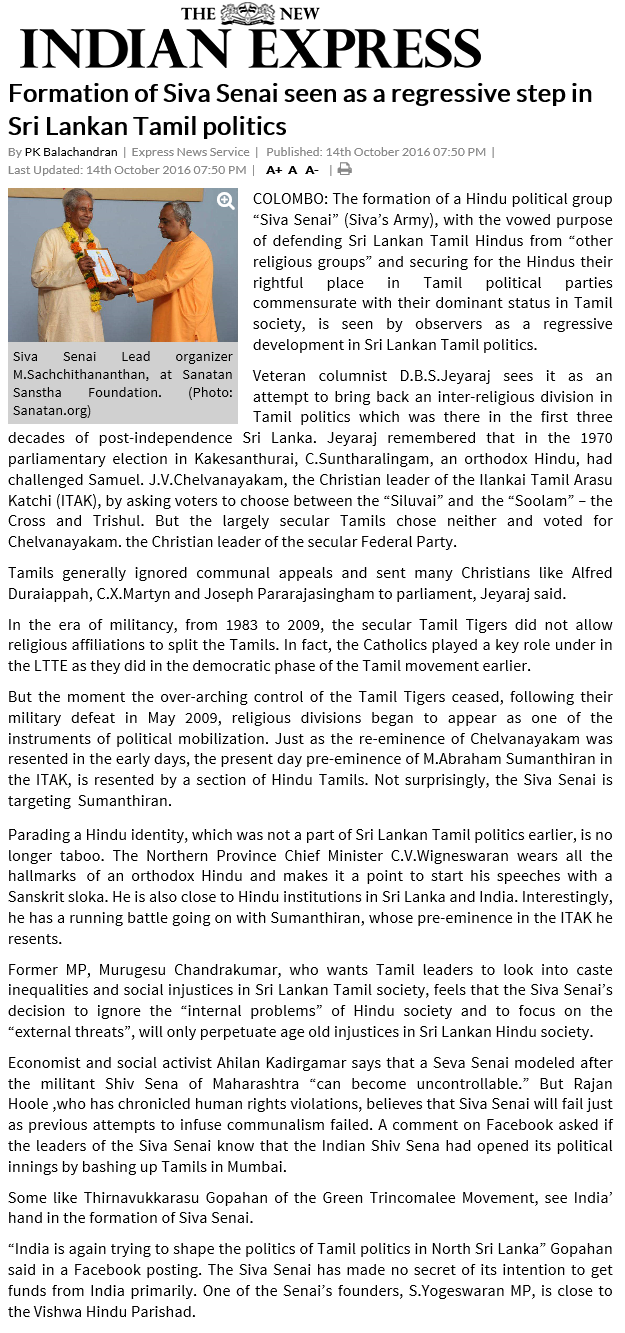
`சிவசேனை` பின்னோக்கிச் சாய்த்தல்!


Thursday, October 13, 2016

சச்சிதானந்தனின் அருள்பாலிப்பில் இலங்கை இந்துக்களுக்கு சிவ சேனை உதயம்!

அரோகரா! உடை தேங்காய்! உருளு பிரதட்டை!``எழுக தமிழ்`` !

மறவன்புலவு க.சச்சிதானந்தன்:
தமிழ் ஊடகங்கள் அளித்தருளிய அறிமுகம்
 
``மறவன்புலவு க.சச்சிதானந்தன் பல்துறை வித்தகர். பதிப்புத் துறையிலும் சைவத் திருமுறைகளிலும் ஆழ்ந்து தோய்ந்தவர். அதே நேரம், கடலியல் துறையில் பழுத்த அனுபவம் வாய்ந்த வல்லுநர். கொழும்பு கடற்றொழில் ஆராய்ச்சி நிலையத்தின்
 
ஆய்வு அலுவலராக 11 ஆண்டுகள் பணியாற்றியவர். யாழ்ப்பாணப் பல்கலைக் கழகத்தில் 2 ஆண்டுகள் பேராசிரியர் பணியாற்றியவர். 23 நாடுகளில் ஐ.நா. உணவு வேளாண் நிறுவன ஆலோசகராகச் சுமார் 7 ஆண்டுகள் பணியாற்றியவர். கருவாடுகளைக் காயவைத்தல் தொடர்பாகப் புதிய முறைகளை உருவாக்கியவர். சேதுக் கால்வாய்த் திட்டம் தொடர்பான புரிதலைப் பல நிலைகளில் உருவாக்க முனைந்தவர். கூர்மையான நோக்கும் அறிவியல்பூர்வமான அணுகுமுறையும் கொண்டவர்.``
-----------
தங்கள் அறிமுகத்துக்கு நன்றி, ஆனால் சவுக்கடிக்கு தயாராகுங்கள்


US weighs response to attack on Navy ships by Yemen rebels


US weighs response to attack on Navy ships by Yemen rebels

Published October 11, 2016  Associated Press

WASHINGTON –  The U.S. is weighing what military response it should take against Yemen-based Houthi rebels, who U.S. officials say launched two missiles at American warships in the Red Sea on Sunday, the Pentagon said Tuesday.

Navy Capt. Jeff Davis, a Pentagon spokesman, said the U.S. is still investigating the unprecedented incident, including the exact location of the missile launches. Asked if the U.S. was developing targets for a possible retaliatory strike, he said he could not confirm that.

"Those things are things that we're looking at," Davis told Pentagon reporters. "We want very much to get to the bottom of what happened. We're going to find out who did this and we'll take action accordingly."

He added that "we will make sure that anybody who interferes with freedom of navigation or anybody who puts U.S. Navy ships at risk understands that they do so at their own peril."

U.S. officials believe Iranian-backed Shiite rebels, known as Houthis, launched variants of the so-called Silkworm missile at the USS Mason and the USS Ponce. Both missiles fell harmlessly into the water. The Silkworm is a type of coastal defense cruise missile that Iran has been known to use.

Davis said the missiles were fired from Houthi-held territory on the Yemen coast.

This was the first time that U.S. ships were targeted by a missile launch from Yemen. Last week, an Emirati-leased Swift boat came under rocket fire near the same area and sustained serious damage. The United Arab Emirates described the vessel as carrying humanitarian aid and having a crew of civilians, while the Houthis called the boat a warship.

Davis said the commander of the USS Mason, an Arleigh Burke class of guided missile destroyer, believed the initial missile was a threat to his ship or to the USS Ponce, an amphibious warship accompanying the USS Mason. The USS Mason took defensive action against the first missile, but Davis would not say exactly what countermeasure or weapon was used.

It wasn't clear if the ship's defensive attack took down the missile or if it simply fell into the water. The second missile fell into the water before any countermeasures were used.

Davis said the USS Mason didn't launch a counteroffensive against the Houthis, but he would not go into a detailed explanation, saying that military rules of engagement are classified. The U.S., however, requires significant analysis before launching strikes on a location where there could be innocent civilians.

The Houthi-controlled SABA news agency of Yemen quoted an anonymous army official denying its forces fired on the USS Mason, without elaborating.

The missile attacks came on the heels of two other attacks against Saudi sites. A ballistic missile fired from Yemen apparently targeted a Saudi air base near the Muslim holy city of Mecca, the deepest strike yet into the kingdom by Shiite rebels and their allies. The rebels fired another two missiles into the Saudi Jizan region along the border on Monday, wounding two foreigners who worked there, the local civil defense said in a statement.

The Houthis and their allies have offered no reason for the launches, though they came after a Saudi-led airstrike targeting a funeral in Yemen's capital killed more than 140 people and wounded 525 on Saturday.

 The deliberations about how to retaliate to the missile launches come as the U.S. considers withdrawing its support for the Saudi-led coalition fighting the Houthis following Saturday's airstrike on the funeral and other troubling incidents of civilian casualties as a result of the Saudi bombing campaign.

Human rights groups have expressed outrage over the deaths and accused the U.S. of complicity, leading the White House to say it was conducting a "review" to ensure U.S. cooperation with longtime partner Saudi Arabia is in line with "U.S. principles, values and interests."


Wednesday, October 12, 2016

Read in full: Theresa May's Conservative conference speech

Read in full: Theresa May's Conservative conference speech on Brexit
Written by: Josh May Posted On: 2nd October 2016


Read the full transcript of Theresa May's speech on 'Britain after Brexit: A Vision of a Global Britain' to the Conservative conference. 
======================================

81 days ago, I stood in front of Ten Downing Street for the first time as Prime Minister, and I made a promise to the country.

I said that the Government I lead will be driven not by the interests of a privileged few, but by the interests of ordinary, working-class families.  People who have a job, but don’t always have job security.  People who own their own home, but worry about paying the mortgage.  People who can just about manage, but worry about the cost of living and getting their kids into a good school. And this week, we’re going to show the country that we mean business. 

 Britain is going to leave the European Union But first, today, we’re going to talk about Global Britain, our ambitious vision for Britain after Brexit.  Because 100 days ago, that is what the country voted for.  We’re going to talk about Britain in which we are close friends, allies and trading partners with our European neighbours.  But a Britain in which we pass our own laws and govern ourselves.  In which we look beyond our continent and to the opportunities in the wider world.  In which we win trade agreements with old friends and new partners.  In which Britain is always the most passionate, most consistent, most convincing advocate for free trade.  In which we play our full part in promoting peace and prosperity around the world.  And in which we – with our brilliant armed forces and intelligence services – protect our national interests, our national security, and the security of our allies. 

So today we’re going to be hearing from David Davis, Priti Patel and Boris Johnson as we start to explain our plan for Brexit.  And the country will see that the Conservative Party is united in our determination to deliver that plan.

Because even now, some politicians – democratically-elected politicians – say that the referendum isn’t valid, that we need to have a second vote.

Others say they don’t like the result, and they’ll challenge any attempt to leave the European Union through the courts.

But come on.  The referendum result was clear.  It was legitimate.  It was the biggest vote for change this country has ever known.  Brexit means Brexit – and we’re going to make a success of it.

Now of course, we wouldn’t have had a referendum at all had it not been for the Conservative Party – and had it not been for David Cameron.  And I want to take a moment to pay tribute to David.

I served in his Shadow Cabinet for nearly five years, and in his Cabinet for six more.  I saw first-hand his commitment to public service, to social justice, and his deep love for our country.  He led the rescue mission that brought confidence back to the British economy.  He made sure that people on the lowest wages paid no income tax at all.  And he won the right for two people who love one another – regardless of their sexuality – to marry.  He has a legacy of which he – and our whole Party – can be proud.  And to those who claim he was mistaken in calling the referendum, we know there is no finer accolade than to say David Cameron put his trust in the British people.

And trust the people we will.  Because Britain is going to leave the European Union. 

Now I know there is a lot of speculation about what that is going to mean, about the nature of our relationship with Europe in future, and about the terms on which British and European businesses will trade with one another.  I understand that.  And we will give clarity – as we did with farm payments and university funding – whenever possible and as quickly as possible.

But we will not be able to give a running commentary or a blow-by-blow account of the negotiations.  Because we all know that isn’t how they work.  But history is littered with negotiations that failed when the interlocutors predicted the outcome in detail and in advance. 

Every stray word and every hyped up media report is going to make it harder for us to get the right deal for Britain.  So we have to stay patient.  But when there are things to say – as there are today – we will keep the public informed and up to date.

So I want to use today to tell you more about the Government’s plan for Brexit, and in particular I want to tell you about three important things.  The timing, the process – and the Government’s vision for Britain after Brexit.

 The timing for triggering Article Fifty

First, everything we do as we leave the EU will be consistent with the law and our treaty obligations, and we must give as much certainty as possible to employers and investors.  That means there can be no sudden and unilateral withdrawal: we must leave in the way agreed in law by Britain and other member states, and that means invoking Article Fifty of the Lisbon Treaty.

There was a good reason why I said – immediately after the referendum – that we should not invoke Article Fifty before the end of this year.  That decision means we have the time to develop our negotiating strategy and avoid setting the clock ticking until our objectives are clear and agreed.  And it has also meant that we have given some certainty to businesses and investors.  Consumer confidence has remained steady.  Foreign investment in Britain has continued.  Employment is at a record high, and wages are on the up.  There is still some uncertainty, but the sky has not fallen in, as some predicted it would: our economy remains strong.

So it was right to wait before triggering Article Fifty.  But it is also right that we should not let things drag on too long.  Having voted to leave, I know that the public will soon expect to see, on the horizon, the point at which Britain does formally leave the European Union.  So let me be absolutely clear.  There will be no unnecessary delays in invoking Article Fifty.  

We will invoke it when we are ready.  And we will be ready soon.  We will invoke Article Fifty no later than the end of March next year.

 The process for triggering Article Fifty

Now I want to tell you a little more about the process for triggering Article Fifty.

The first thing to say is that it is not up to the House of Commons to invoke Article Fifty, and it is not up to the House of Lords.  It is up to the Government to trigger Article Fifty and the Government alone. 

When it legislated to establish the referendum, Parliament put the decision to leave or remain inside the EU in the hands of the people.  And the people gave their answer with emphatic clarity.  So now it is up to the Government not to question, quibble or backslide on what we have been instructed to do, but to get on with the job. 

Because those people who argue that Article Fifty can only be triggered after agreement in both Houses of Parliament are not standing up for democracy, they’re trying to subvert it.  

They’re not trying to get Brexit right, they’re trying to kill it by delaying it.  They are insulting the intelligence of the British people.  That is why, next week, I can tell you that the Attorney General himself, Jeremy Wright, will act for the Government and resist them in the courts.

Likewise, the negotiations between the United Kingdom and the European Union are the responsibility of the Government and nobody else.  I have already said that we will consult and work with the devolved administrations for Scotland, Wales and Northern Ireland, because we want Brexit to work in the interests of the whole country.  And we will do the same with business and municipal leaders across the land.  

But the job of negotiating our new relationship is the job of the Government.  Because we voted in the referendum as one United Kingdom, we will negotiate as one United Kingdom, and we will leave the European Union as one United Kingdom.  There is no opt-out from Brexit.  And I will never allow divisive nationalists to undermine the precious Union between the four nations of our United Kingdom.

The final thing I want to say about the process of withdrawal is the most important.  And that is that we will soon put before Parliament a Great Repeal Bill, which will remove from the statute book – once and for all – the European Communities Act.

This historic Bill – which will be included in the next Queen’s Speech – will mean that the 1972 Act, the legislation that gives direct effect to all EU law in Britain, will no longer apply from the date upon which we formally leave the European Union.  And its effect will be clear.  Our laws will be made not in Brussels but in Westminster.  The judges interpreting those laws will sit not in Luxembourg but in courts in this country.  The authority of EU law in Britain will end. 

As we repeal the European Communities Act, we will convert the ‘acquis’ – that is, the body of existing EU law – into British law.  When the Great Repeal Bill is given Royal Assent, Parliament will be free – subject to international agreements and treaties with other countries and the EU on matters such as trade – to amend, repeal and improve any law it chooses.  

But by converting the acquis into British law, we will give businesses and workers maximum certainty as we leave the European Union.  The same rules and laws will apply to them after Brexit as they did before.  Any changes in the law will have to be subject to full scrutiny and proper Parliamentary debate.  And let me be absolutely clear: existing workers’ legal rights will continue to be guaranteed in law – and they will be guaranteed as long as I am Prime Minister. 

And in fact, as we announced yesterday, under this Government, we’re going see workers’ rights not eroded, and not just protected, but enhanced under this Government.  Because the Conservative Party is the true workers’ party, the only party dedicated to making Britain a country that works, not just for the privileged few, but for every single one of us.

Our vision for Britain after Brexit

So that is what I want to say about the process.  But I want to talk to you about the Government’s vision of Britain after Brexit, our vision of a truly Global Britain.  And I want to start with our vision for the future relationship we will have with the European Union. 

Because, in this respect, I believe there is a lot of muddled thinking and several arguments about the future that need to be laid to rest.  For example, there is no such thing as a choice between “soft Brexit” and “hard Brexit”.  This line of argument – in which “soft Brexit” amounts to some form of continued EU membership and “hard Brexit” is a conscious decision to reject trade with Europe – is simply a false dichotomy.  And it is one that is too often propagated by people who, I am afraid to say, have still not accepted the result of the referendum.

Because the truth is that too many people are letting their thinking about our future relationship with the EU be defined by the way the relationship has worked in the past.  That is understandable.  We have been members of the EU for more than forty years.  We have just been through a renegotiation, during which we remained members of the EU and the Government sought to keep us members of the EU. 

But what we are now talking about is very different.  Whether people like it or not, the country voted to leave the EU.  And that means we are going to leave the EU.  We are going to be a fully-independent, sovereign country, a country that is no longer part of a political union with supranational institutions that can override national parliaments and courts.  And that means we are going, once more, to have the freedom to make our own decisions on a whole host of different matters, from how we label our food to the way in which we choose to control immigration.

So the process we are about to begin is not about negotiating all of our sovereignty away again.  It is not going to be about any of those matters over which the country has just voted to regain control.  It is not, therefore, a negotiation to establish a relationship anything like the one we have had for the last forty years or more.  So it is not going to a “Norway model”.  It’s not going to be a “Switzerland model”.  It is going to be an agreement between an independent, sovereign United Kingdom and the European Union. 

I know some people ask about the “trade-off” between controlling immigration and trading with Europe.  But that is the wrong way of looking at things.  We have voted to leave the European Union and become a fully-independent, sovereign country.  We will do what independent, sovereign countries do.  We will decide for ourselves how we control immigration.  

And we will be free to pass our own laws. 

But we will seek the best deal possible as we negotiate a new agreement with the European Union.  I want that deal to reflect the kind of mature, cooperative relationship that close friends and allies enjoy.  I want it to include cooperation on law enforcement and counter-terrorism work.  I want it to involve free trade, in goods and services.  I want it to give British companies the maximum freedom to trade with and operate in the Single Market – and let European businesses do the same here.  But let me be clear.  We are not leaving the European Union only to give up control of immigration again.  And we are not leaving only to return to the jurisdiction of the European Court of Justice.

As ever with international talks, it will be a negotiation, it will require some give and take, and while there will always be pressure to give a running commentary on the state of the talks, it will not be in our best interests as a country to do that.  But make no mistake: this is going to be a deal that works for Britain.

 Global Britain is in sight

But Brexit should not just prompt us to think about our new relationship with the European Union.  It should make us think about our role in the wider world.  It should make us think of Global Britain, a country with the self-confidence and the freedom to look beyond the continent of Europe and to the economic and diplomatic opportunities of the wider world.  Because we know that the referendum was not a vote to turn in ourselves, to cut ourselves off from the world.  It was a vote for Britain to stand tall, to believe in ourselves, to forge an ambitious and optimistic new role in the world.

And there is already abundant evidence that we will be able to do just that.  Important foreign businesses – like Siemens and Apple – have committed to long-term investments in this country.  With the Japanese purchase of ARM for £24 billion, we have seen the biggest-ever Asian investment in Britain.  Countries including Canada, China, India, Mexico, Singapore and South Korea have already told us they would welcome talks on future free trade agreements.  And we have already agreed to start scoping discussions on trade agreements with Australia and New Zealand.

A truly Global Britain is possible, and it is in sight.  And it should be no surprise that it is.  Because we are the fifth biggest economy in the world.  Since 2010 we have grown faster than any economy in the G7.  And we attract a fifth of all foreign investment in the EU.  We are the biggest foreign investor in the United States.  We have more Nobel Laureates than any country outside America.  We have the best intelligence services in the world, a military that can project its power around the globe, and friendships, partnerships and alliances in every continent.  We have the greatest soft power in the world, we sit in exactly the right time zone for global trade, and our language is the language of the world. 

We don’t need – as I sometimes hear people say – to “punch above our weight”.  Because our weight is substantial enough already.  So let’s ignore the pessimists, let’s have the confidence in ourselves to go out into the world, securing trade deals, winning contracts, generating wealth and creating jobs.  And let’s get behind the team of ministers – David Davis, Liam Fox, Priti Patel and Boris Johnson – who are working on our plan for Brexit, who know we’re going to make a success of it and who will make a reality of Global Britain.

So let’s have a great week here in Birmingham this conference.  Let’s get this plan for Brexit right.  Let’s show the country we mean business.  And let’s keep working to make Britain a country that works not for a privileged few but for everyone in this great country.


https://www.politicshome.com/news/uk/political-parties/conservative-party/news/79517/read-full-theresa-mays-conservative

Theresa May addressing the 2016 Conservative conference


Tuesday, October 11, 2016

U.S. war games 'the last one' - Philippine President

Duterte declares upcoming Philippines-U.S. war games 'the last one'  By Martin Petty | HANOI


Philippine President Rodrigo Duterte arrives at the military's Camp Tecson to talk to soldiers in San Miguel, Bulacan in northern Philippines September 15, 2016. REUTERS/Erik De Castro

Philippine President Rodrigo Duterte plunged one of the United States' most important Asian alliances deeper into uncertainty on Wednesday by declaring upcoming U.S.-Philippines military exercises "the last," and ruling out any joint navy patrols.

The firebrand Duterte pledged to honor a longstanding security treaty with the United States, but said China opposed joint marine drills in the Philippines starting next week and there would be no more war games with Washington after that.
"I am serving notice now to the Americans, this will be the last military exercise," Duterte said during a visit to Vietnam.
 "Jointly, Philippines-U.S.: the last one."


Duterte's remarks gave one of the strongest signs yet of fissures in a historic alliance that Washington has relied upon as it tries to cement its influence in Asia to counterbalance China's rapid rise. Duterte's foreign minister later said his comments had been taken out of context.

State Department spokesman John Kirby said he was not aware of any official notification from the Philippines about ending joint exercises.

"Our focus is on the relationship today and moving it forward," Kirby told a regular news briefing. "We continue to believe that that's possible. ... (W)e have significant security commitments with the Philippines. We're committed to meeting those commitments and to furthering this relationship."

The Philippines military and U.S. Marines are to hold annual amphibious landing exercises from Oct. 4 to 12. Military leaders from the countries have also started preparing for a new set of exercises next year.


Duterte said he would establish "new alliances for trade and commerce" with Russia and China, but would maintain security agreements with Washington.

His near-daily outbursts against the United States began in earnest last month, when he spoke of alleged atrocities a century ago by the United States when it was the Philippines' colonial ruler.

He has called President Barack Obama a "son of a bitch" and said he would order the pullout of the remaining U.S. special forces stationed in the Philippines' restive south.

Duterte told a gathering of the Filipino community in Hanoi there would be no chance of naval patrols with Washington because they risked dragging the Philippines into conflict with China.

The Philippines and China have long sparred over sovereignty in the South China Sea, and Manila and Washington have shared concerns about China's military clout and pursuit of broad maritime claims.

WHAT DUTERTE "CLEARLY MEANT"

Asked if Duterte was serious about ending military exercises with the United States, Foreign Secretary Perfecto Yasay said he was misunderstood and his remarks taken out of context.

The only thing Duterte had ruled out were joint patrols beyond the Philippines' 12-nautical mile territorial waters, Yasay said.

"Our agreement, that will be respected and this is what the president clearly meant," Yasay told a scrum of reporters, referring to a 1951 Mutual Defence Treaty.

Despite Yasay's words, Duterte's latest comments add to uncertainty about what his end game is and whether Manila's next moves could complicate regional diplomacy or alter the status quo in the South China Sea.

A U.S. defense official said he had not seen the Philippines make a formal request to stop sea patrols and added that the bar for a "joint patrol" with the Philippines was low.

"If the joint patrols stop, will this have any sort of major impact on the situation in the South China Sea? Most likely not," the official said, speaking on condition of anonymity. He added that in a sign things were continuing as usual, the landing ship USS Germantown would be making a port call in Manila from Wednesday.

Richard Jacobson, an American security expert, said Duterte's posturing could embolden China to exploit a testy relationship between two old allies.

"The U.S.-Philippines relationship might become strained and even shaken," Jacobson said.

"The U.S. geopolitical stakes in the region are much too high to react to his hyperbole. The current attitude in Washington is mature - more of patience than feeling provoked."

The Philippines has not formally committed to joining the United States in patrols beyond its territorial waters in the South China Sea. It has carried out at least two patrols with the United States this year that remained within 12 nautical miles of the Philippine coast.

(Additional reporting by Karen Lema and Manuel Mogato in Manila and David Brunnstrom and Idrees Ali in Washington; Editing by Alex Richardson and Leslie Adler)

காலநிலை அறிவிப்பு-பேராசிரியர் நா.பிரதீபராஜா

https://www.facebook.com/Piratheeparajah 03.12.2025 புதன்கிழமை பிற்பகல் 3.30 மணி விழிப்பூட்டும் முன்னறிவிப்பு இன்று வடக்கு மற்றும் கிழக்கு ம...