
Iran Update Special Report, March 26, 2026
March 26, 2026
The Institute for the Study of War (ISW)
Key Takeaways
- The combined force conducted strikes around Mashhad, Khorasan Razavi Province, on March 25 and 26, marking the northeastern-most strikes conducted so far in the war. The combined force has slowly swept across Iran west to east and is now getting to some of the furthest targets of the campaign.
- The IDF has continued targeting senior Iranian commanders to disrupt Iranian command and control and operations broadly. The IDF announced on March 26 that it killed Islamic Revolutionary Guards Corps (IRGC) Navy Commander Rear Admiral Alireza Tangsiri in Bandar Abbas, Hormozgan Province.
- An IRGC cultural official told state media that the IRGC has lowered the minimum recruitment age to 12. This decision follows reports that the IRGC is facing difficulties with recruiting new personnel and managing broader operational disruptions.
- Hezbollah continues to claim a high rate of attacks against Israeli targets in northern Israel and southern Lebanon. Hezbollah claimed to conduct 73 attacks targeting Israeli forces in northern Israel and southern Lebanon, as well as northern Israeli towns, between 2:00 PM ET on March 25 and 2:00 PM ET on March 26.
Toplines
The combined force conducted strikes around Mashhad, Khorasan Razavi Province, on March 25 and 26, marking the northeastern-most strikes conducted so far in the war. The combined force has slowly swept across Iran west to east and is now getting to some of the furthest targets of the campaign. An Iranian OSINT account and anti-regime media footage of strikes near Mashhad International Airport on March 25.[1] The 14th Artesh Air Force Tactical Airbase and 5th Artesh Ground Forces Aviation Base are co-located at the Mashhad International Airport.[2] The IDF previously struck an Iranian refueling aircraft at Mashhad International Airport during the 12-Day War.[3] Anti-regime media also posted footage of smoke plumes rising in Mashhad, suggesting that the combined force may have struck additional targets in the area.[4] Mashhad is the second most-populated city in Iran.[5]
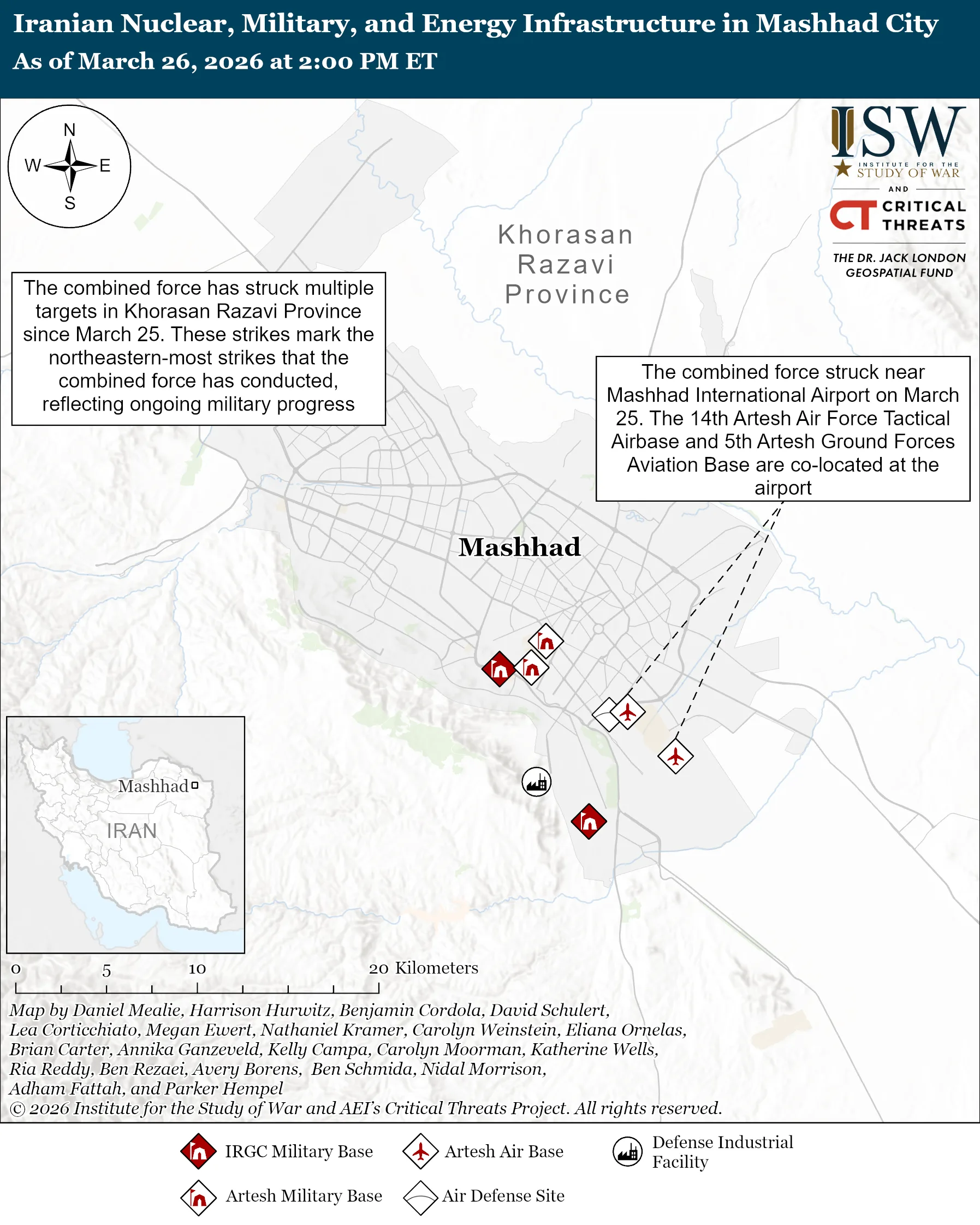
The combined force likely struck additional targets in Khorasan Razavi Province on March 25 and 26.[6] Two OSINT accounts published footage of likely combined force strikes around Neyshabour Industrial Town, Khorasan Razavi Province.[7] An Iranian OSINT account published footage on March 25 purportedly showing Iranian air defenses engaging unknown targets, presumably combined force aircraft, over Taybad, Khorasan Razavi Province.[8]
US Central Command (CENTCOM) Commander Admiral Brad Cooper said on March 25 that the combined force has struck over 10,000 sites across Iran since the war began.[9] The combined force has concentrated strikes around Tehran as well as western and central Iran.[10]
The IDF has continued targeting senior Iranian commanders to disrupt Iranian command and control and operations broadly. The IDF announced on March 26 that it killed Islamic Revolutionary Guards Corps (IRGC) Navy Commander Rear Admiral Alireza Tangsiri in Bandar Abbas, Hormozgan Province.[11] Tangsiri had served as IRGC Navy commander since August 2018.[12] Tangsiri previously served as IRGC Navy deputy commander from 2010 to 2018 and the Bandar Abbas-based IRGC 1st Saheb ol Zaman Naval District commander.[13] The Saheb ol Zaman Naval District has the central mission of controlling the Strait of Hormuz.[14] Its area of operations includes the IRGC Navy headquarters and command center as well as the 2nd Imam Sajjad Special Forces Brigade, the 16th Assef Coastal Missile Group, the 112th Zolfaghar Surface Combat Brigade, and underground fortifications on Abu Musa.[15] The IDF also killed IRGC Navy Intelligence Deputy Behnam Rezaei in Bandar Abbas, Hormozgan Province.[16] Rezaei reportedly was responsible for regional intelligence collection and coordination.[17] Tangsiri oversaw IRGC Navy operations, including attacks on international shipping and threats to US forces in the region.[18] The United States sanctioned Tangsiri in June 2019 for acting on behalf of the IRGC and his role in threatening to close the Strait of Hormuz and overseeing IRGC Navy activities responsible for the sabotage of vessels in international waters.[19]
The IRGC has reportedly continued to consolidate power within the Iranian regime and play an increasingly central role in key leadership decisions. Anti-regime media reported on March 26 that the IRGC pressured Iranian President Masoud Pezeshkian to appoint Mohammad Bagher Zolghadr as the Supreme National Security Council (SNSC) secretary, citing unspecified sources.[20] Zolghadr is a hardline figure with deep ties to Iranian military and judicial establishments.[21] The sources said that IRGC Commander Brigadier General Ahmad Vahidi was among the IRGC officers who pressured Pezeshkian.[22] The sources also said that there are no clear signs that Supreme Leader Mojtaba Khamenei influenced the decision to appoint Zolghadr, raising continued questions about how involved Mojtaba is in key decisions.[23] The sources added that Pezeshkian and other senior officials opposed Zolghadr’s appointment.[24] The reported IRGC role in Zolghadr’s appointment comes after a small group of IRGC officer intervened aggressively in the supreme leader succession process to ensure that Mojtaba replaced his father.[25] Statements from US and Israeli security officials indicate that this group of IRGC officers have gained significant influence since Mojtaba became supreme leader.[26]
An IRGC cultural official told state media that the IRGC has lowered the minimum recruitment age to 12.[27] This decision follows reports that the IRGC is facing difficulties with recruiting new personnel and managing broader operational disruptions. The official said that the IRGC is recruiting individuals to support patrols, checkpoints, and logistics.[28] Unspecified informed sources told anti-regime media on March 12 that IRGC efforts to mobilize reserve forces failed because many individuals did not report to military centers.[29] CTP-ISW assessed on March 19 that Israeli strikes on Iranian internal security forces, including decapitation strikes, have likely caused shock and confusion within the internal security apparatus and disrupted operations to some extent.[30]
Reuters reported on March 26 that Iranian hardliners have intensified calls to develop a nuclear weapon, citing unspecified sources in Iran.[31] Some hardliners have urged Iranian leadership to revise the nuclear doctrine, meaning pursue a nuclear weapon, to restore deterrence since October 2024. Iranian parliamentarians signed separate letters in October 2024—after the April and October Iranian missile attacks on Israel—and in September 2025—after the June 2025 Israel-Iran war—urging a revision of Iranian defensive doctrine.[32] They called on the SNSC to authorize and support nuclear weapons production.
IRGC-affiliated Tasnim News Agency published an op-ed on March 26 that urged Iran to withdraw from the Nuclear Non-Proliferation Treaty (NPT).[33] The Tasnim op-ed emphasized that Iran is committed to a peaceful nuclear program, however.[34] Iranian officials have threatened to withdraw from the NPT previously to deter Western action against Iran.[35]
Iranian state media reported that Iran officially sent its response rejecting the 15-point US proposal and is awaiting the US response.[36] The United States presented the proposal to Iran via Pakistan on March 24.[37] The proposal reportedly includes provisions requiring Iran to dismantle its nuclear program, end uranium enrichment, hand over its enriched uranium stockpile, grant full International Atomic Energy Agency (IAEA) access to Iranian nuclear facilities, limit its missile capabilities, cease support for the Axis of Resistance, and ensure freedom of navigation through the Strait of Hormuz.[38] The informed source added that Iran’s response reiterated its demands for a ceasefire which include the complete cessation of US and Israeli attacks, the establishment of a mechanism to prevent renewed conflict, compensation for wartime damages, an end to attacks on the Axis of Resistance, and international recognition of Iran’s “sovereignty” over the Strait of Hormuz.[39] A senior Iranian official speaking to Reuters confirmed that unspecified senior Iranian officials and a representative of Iranian Supreme Leader Mojtaba Khamenei reviewed the US proposal.[40] The senior Iranian official added that the proposal asks Iran to forgo its ability to defend itself in turn for a promise to lift sanctions.[41] The official reiterated that the United States and Iran have not arranged negotiations and that negotiations do not seem realistic at this stage of the conflict.[42]
NOTE: A version of the following text will also appear in the Institute for the Study of War’s March 26 Russian Offensive Campaign Assessment:
Russia continues to expand its military cooperation with Iran to facilitate Iranian strikes on US and Israeli forces in the Middle East. The Financial Times (FT) reported on March 25, citing Western intelligence reports, that Russia is close to completing a phased shipment of unspecified drones, medicine, and food to Iran.[43] Two officials briefed on the intelligence told FT that Russia and Iran began discussing drone delivering soon after the US-Israeli campaign began and that subsequent deliveries processing started in early March. The officials stated that they expect Russia to complete the deliveries by the end of March. A Western security official told FT that the specific drone type that Russia agreed to send to Iran is unclear, but that Russia is likely only in a position to deliver models such as the Geran-2. Current and former Western officials told FT that Russia denied Iran’s request for S-400 air defense systems. Russia has reportedly already been providing Iran with modified Shahed drone components and satellite imagery to assist recent Iranian strikes on US forces in the Middle East and US allies in the region.[44] ISW continues to assess that Russia sees aiding Iran’s strike campaign as an effort to weaken the United States, as Russia has self-defined the United States as one of its primary geopolitical adversaries.[45]
US and Israeli Air Campaign
The combined force has continued to strike Iranian missile forces and launchers as well as missile storage and production facilities. The IDF conducted multiple waves of airstrikes on March 26, using over 60 fighter jets and over 150 munitions against weapons production infrastructure across Tehran Province and central Iran.[46] The IDF struck key facilities at the Parchin military complex, including sites used to produce air defense systems, cast and fill explosive warheads, produce ballistic missile engines, and manufacture critical components for solid-fuel ballistic missiles.[47] CENTCOM Commander Admiral Brad Cooper said on March 25 that the combined force has destroyed over two-thirds of Iran’s missile, drone, and naval production facilities.[48]
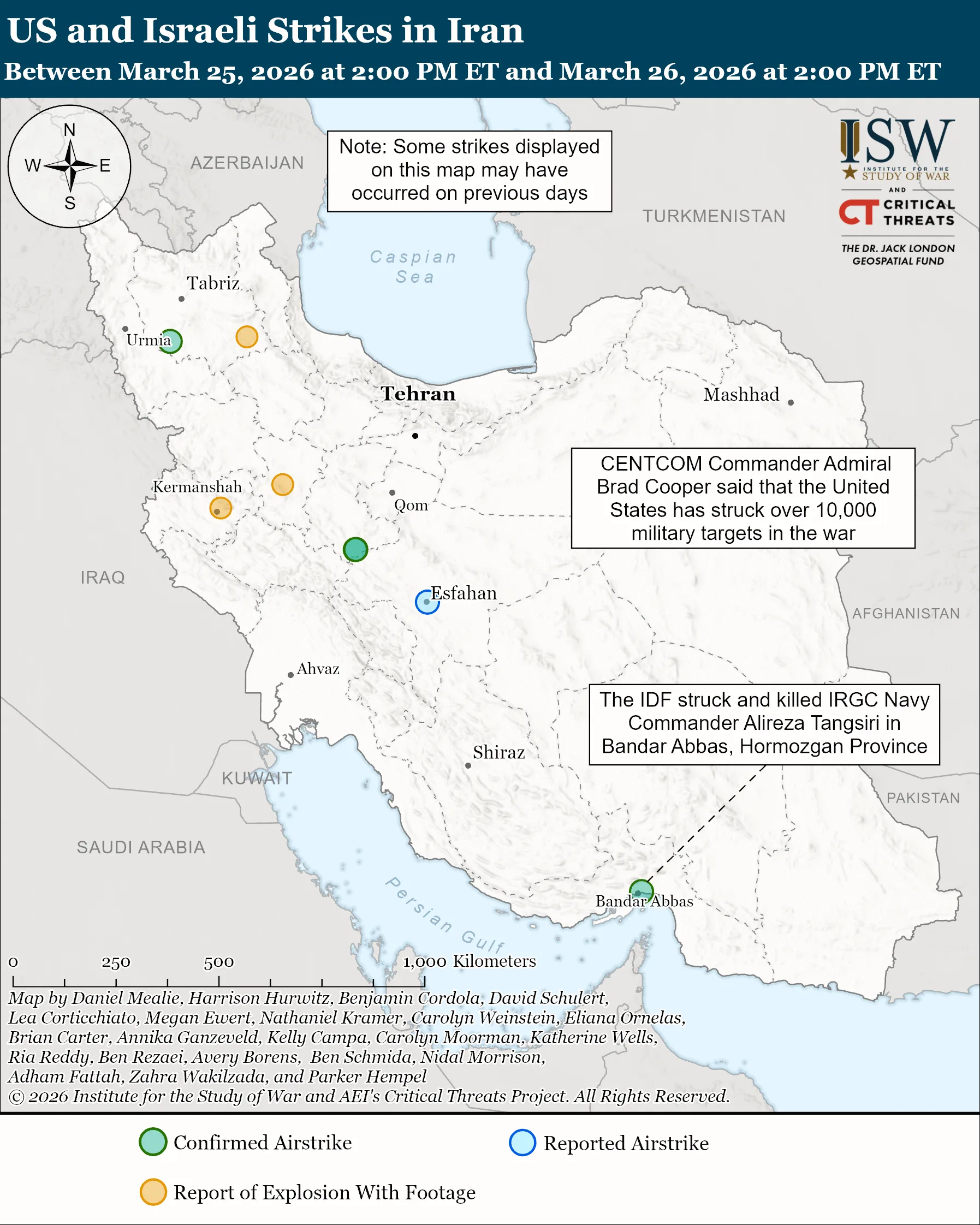
The combined force has intensified its strikes targeting the Iranian defense industrial base amid a report that Israeli Prime Minister Benjamin Netanyahu ordered the IDF to destroy as much of Iran’s arms industry as possible.[49] The New York Times reported on March 25 that Netanyahu ordered the IDF to maximize its destruction of Iran’s arms industry over the next 48 hours, citing two senior Israeli officials.[50] The IDF reported that it struck an IRGC Quds Force weapons production site and a ”major” defense industry site in Esfahan Province as well as other weapons production facilities used to supply Iran and its partners, including Hezbollah and the Houthis.[51] CENTCOM Commander Admiral Brad Cooper reported on March 25 that the combined force struck the Esfahan Province Mobarakeh munitions plant.[52] Cooper said that the combined force strikes on Iranian “large-scale manufacturing capacities” has removed Iran’s ability to build naval vessels, ballistic missiles, and one-way attack drones and share these weapon systems with regional and global ”bad actors.”[53]
The combined force has continued to degrade Iranian air and air defense capabilities in order to maintain air dominance in Iran. The combined force likely struck the 7th Artesh Air Force Tactical Airbase in Shiraz, Fars Province.[54] An Iranian OSINT account published footage and reported smoke rising from multiple explosions near Shiraz International Airport, Fars Province, on March 25.[55] The 7th Artesh Air Force Tactical Airbase is located at the Shiraz International Airport.[56] The combined force has struck the airbase at least five times since the start of the conflict.[57]
The combined force continued to strike Iranian repressive institutions as part of the broader combined effort to degrade the regime’s coercive capacity. The combined force reportedly hit the IRGC Ground Forces Ansar ol Hossein Provincial Unit in Hamedan City, Hamedan Province.[58] The IRGC Ground Forces plays a significant role in countering internal threats, including by violently suppressing protest activity.[59] The provincial units oversee IRGC ground elements that are largely dispersed across population centers.[60] The combined force previously struck Law Enforcement Command (LEC) sites in Hamedan City.[61] The LEC is Iran’s national police force and the regime’s first line of defense during civil unrest.[62] The IDF struck an IRGC headquarters around Bonab, East Azerbaijan Province.[63] The combined force previously struck an LEC building in Bonab.[64]
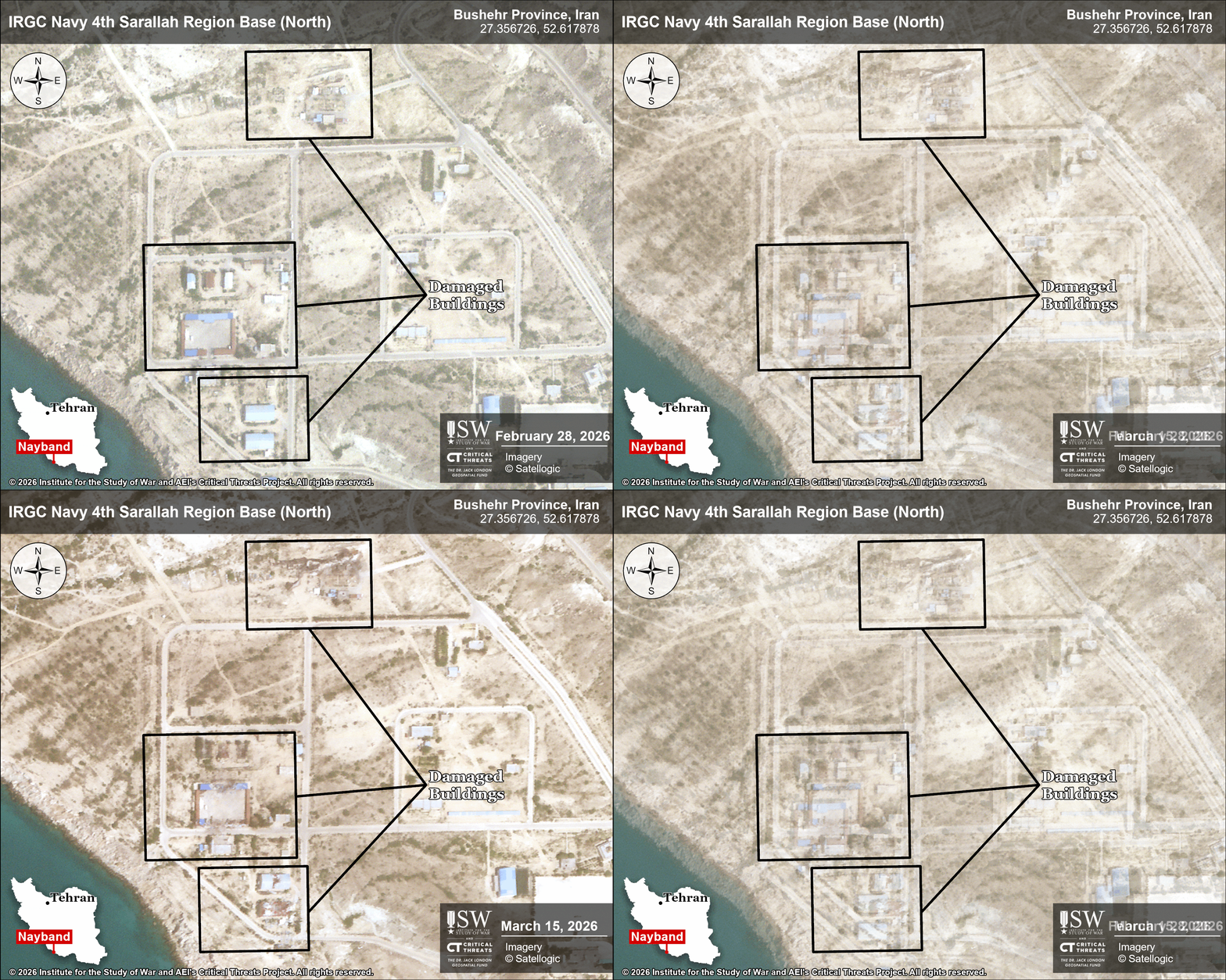
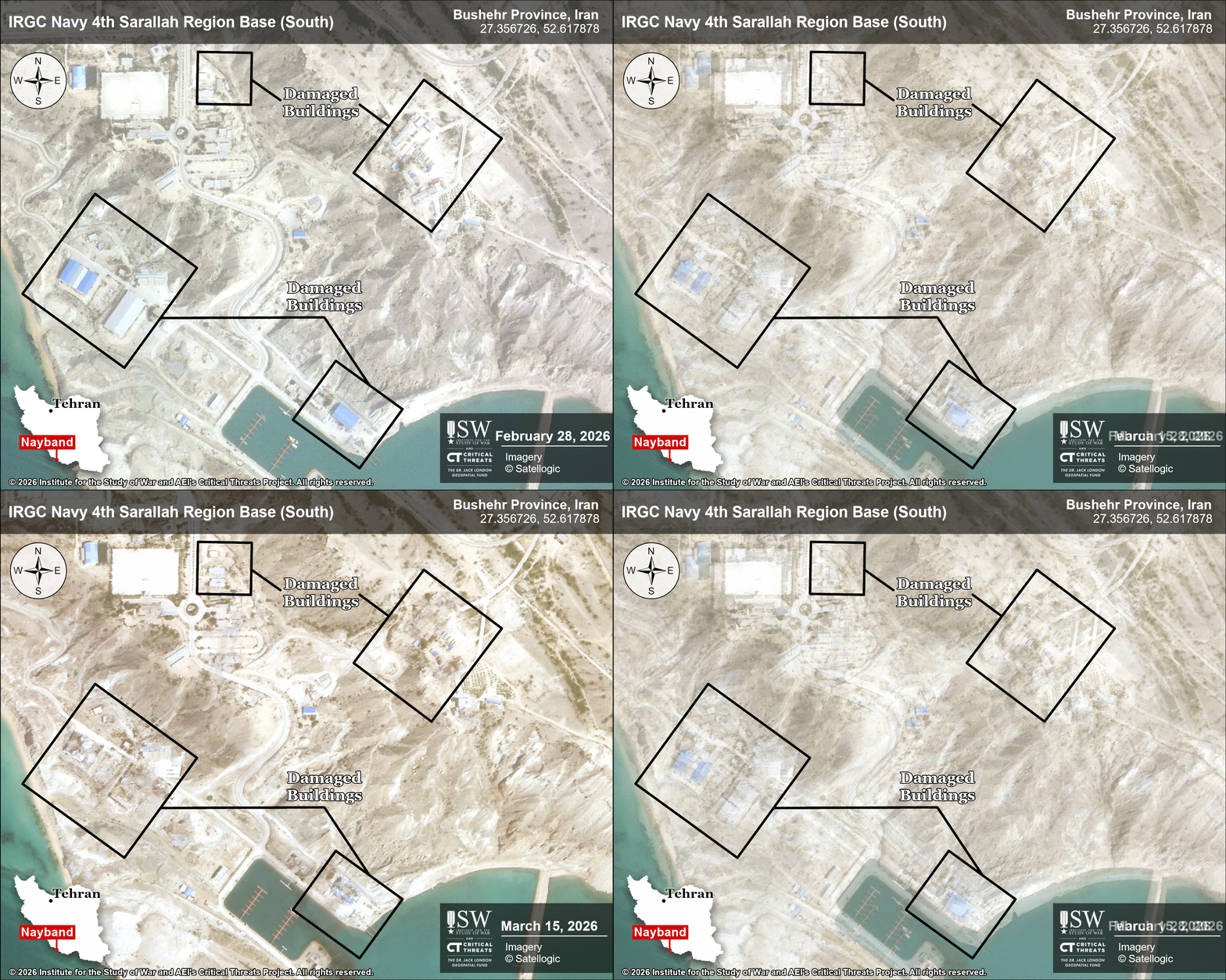
Satellite imagery from March 15 shows that the combined force has inflicted significant damage to Iranian naval and air infrastructure at the IRGC 4th Sarallah Naval District in Bushehr Province as part of efforts to degrade the Iranian ability to threaten international shipping.[65] The 4th Sarallah Naval District is responsible for controlling the central Persian Gulf, including the South Pars gas field, and is commanded by Commander Mansour Ravankar, who has held the position since 2016.[66] An American OSINT analyst published satellite imagery along with a battle damage assessment of what the combined force targeted on March 26.[67] The strikes likely occurred on or immediately before March 15, given that rising smoke is visible at the naval base.[68] Imagery shows that the combined force struck a hangar adjacent to the naval base’s airstrip on the northwest side of the base but did not strike nearby support buildings.[69] The analyst observed that the combined force struck support buildings and storage facilities, which likely degraded the base’s logistics network.[70] The imagery shows strikes destroyed six support buildings adjacent to the base’s pier.[71] Imagery also shows that the combined force targeted the base’s pier, multiple docked vessels, and six nearby support or storage buildings.[72] The analyst assessed that combined force strikes damaged or destroyed most of the base’s administrative and support buildings.[73] The cumulative damage to logistics, support, administrative, and operations assets has likely severely disrupted operations at the 4th Sarallah Naval District.
Iran is reportedly reinforcing defenses at Kharg Island.[74] Unspecified sources familiar with US intelligence reports told CNN on March 26 that Iran has reinforced Kharg Island with man-portable air-defense systems (MANPADS) in recent weeks.[75] Iran primarily operates domestically produced Misagh MANPAD, a variant of the Chinese QW-2 Vanguard missile system.[76] Iran recently signed an arms deal with Russia in December 2025 to acquire 500 Russian Verba MANPADS, but it is unclear if Russia delivered any before the start of the war.[77] The source added that Iran has also laid anti-personnel and anti-armor mines around the island, including on the shoreline.[78]
Iranian Response
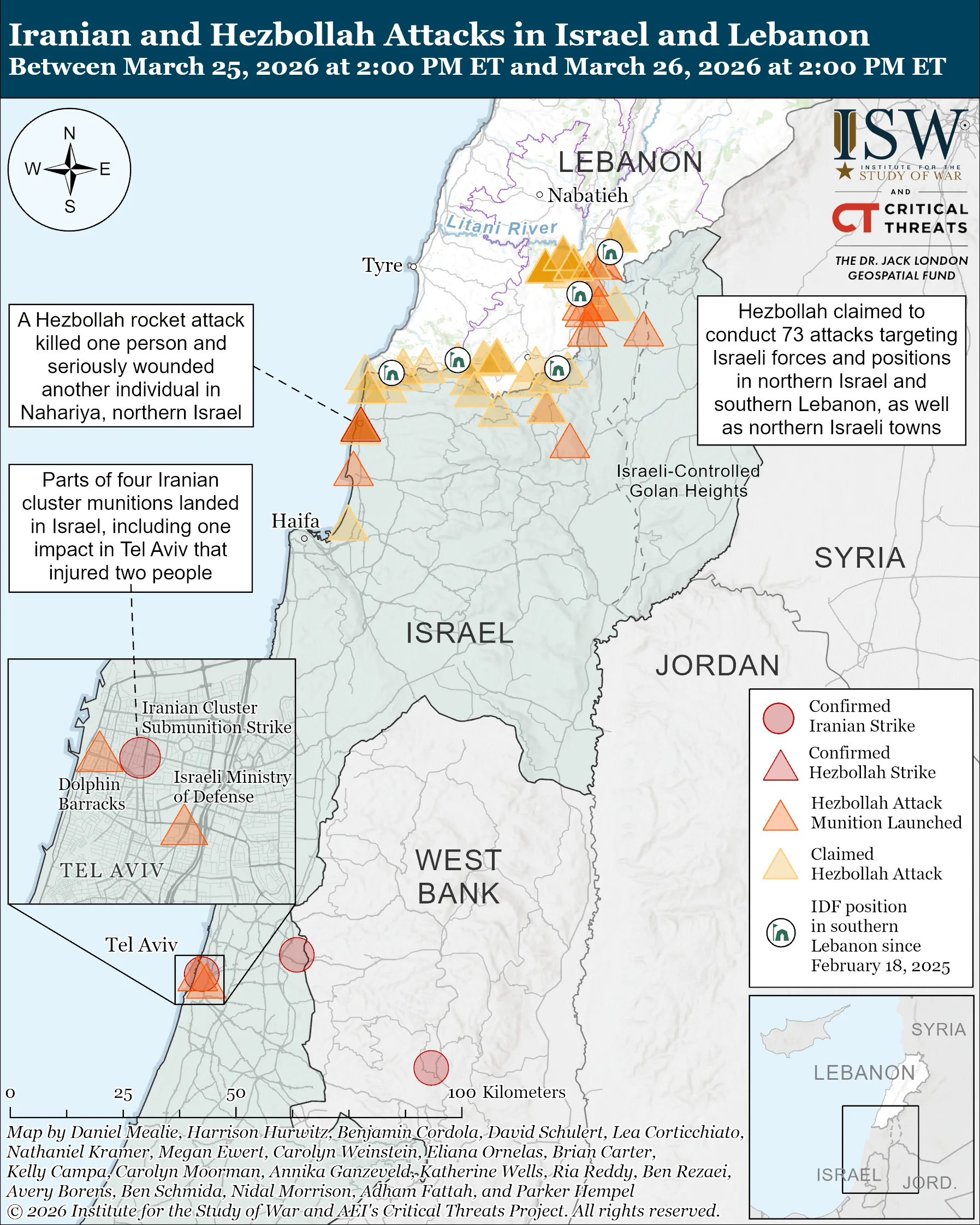
Iran has launched eight waves of missiles targeting Israel since ISW-CTP’s last data cutoff.[79] An Israeli military correspondent reported on March 26 than an Iranian cluster munition impacted in Tel Aviv, injuring two people.[80]
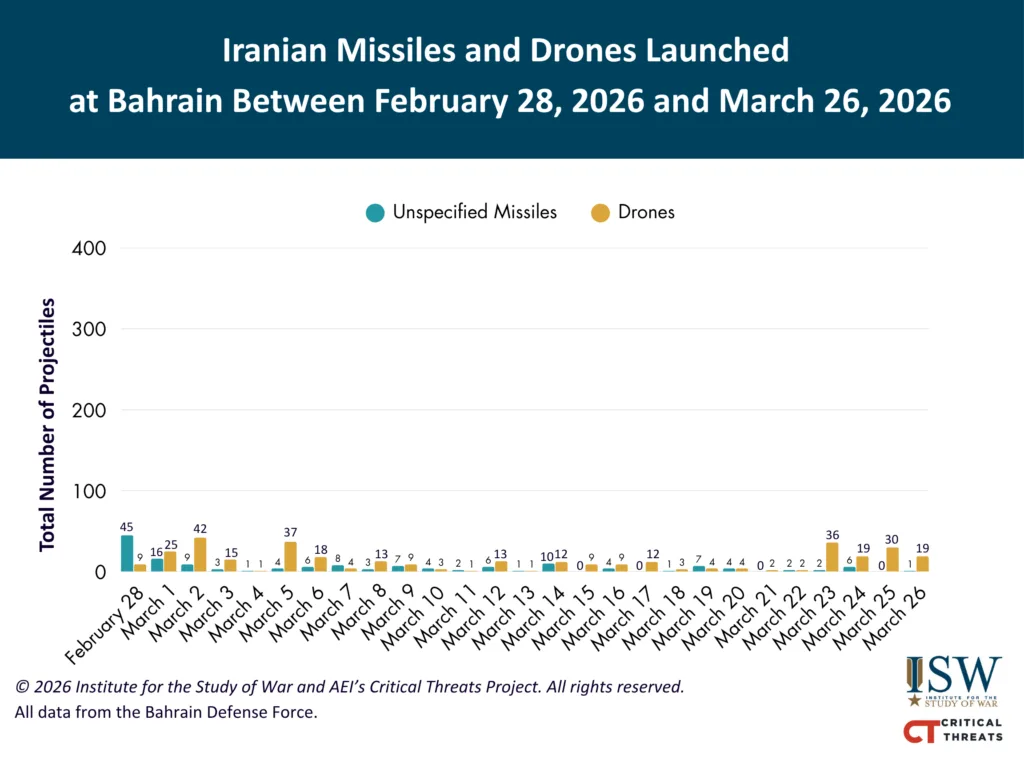
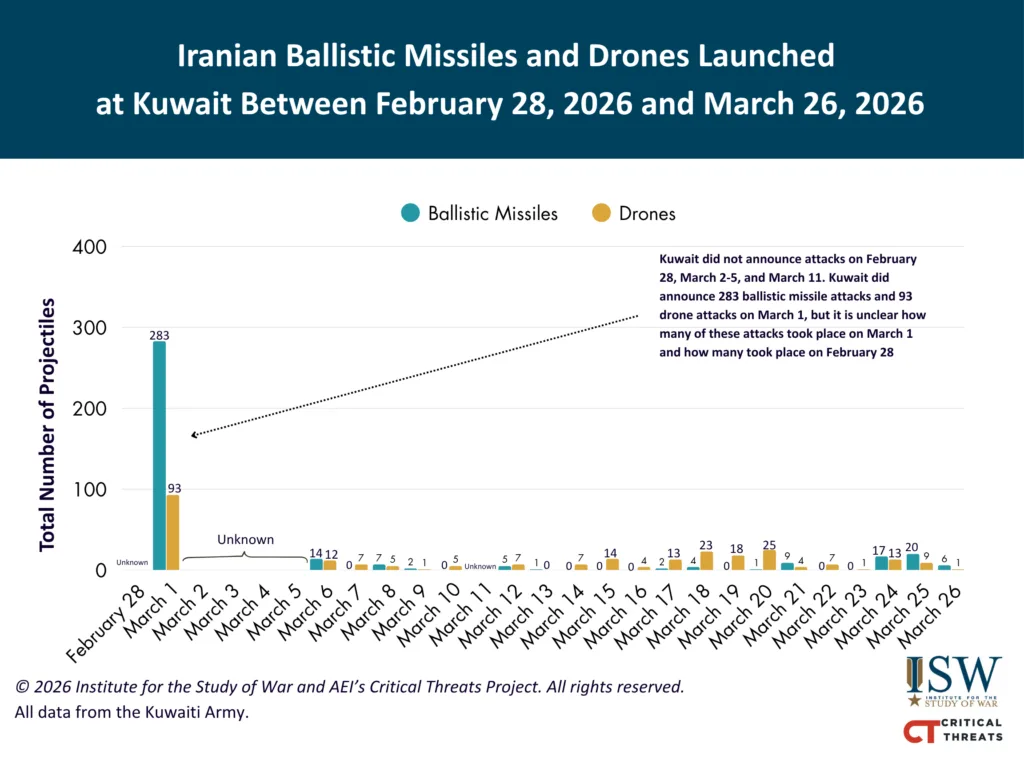
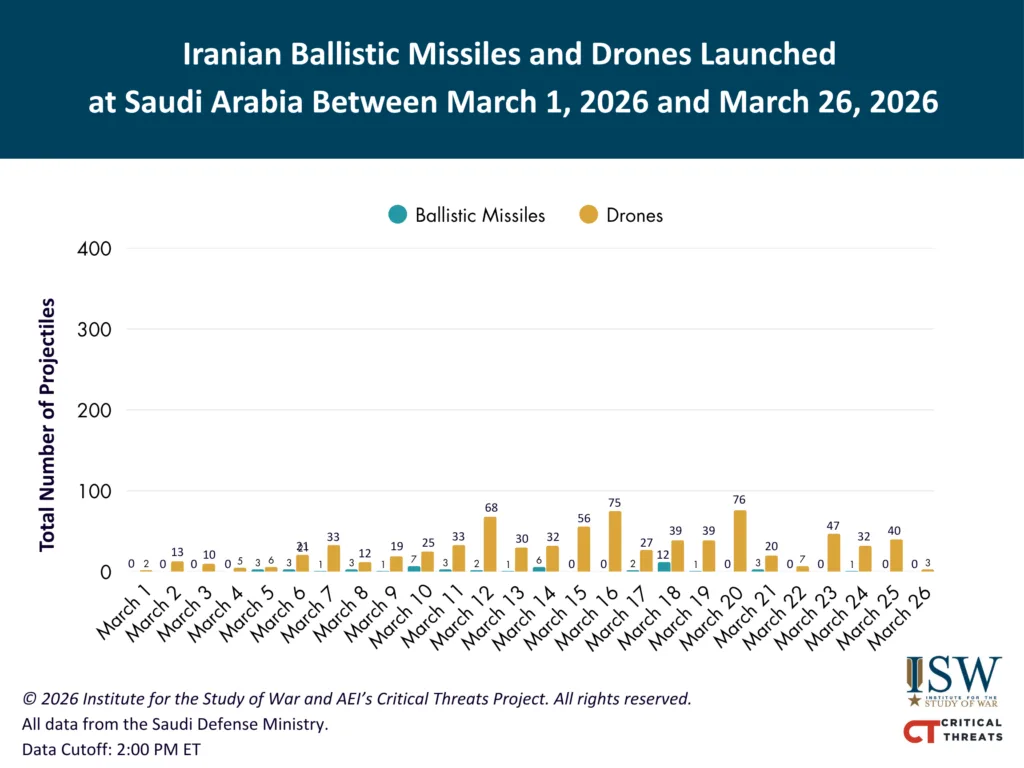
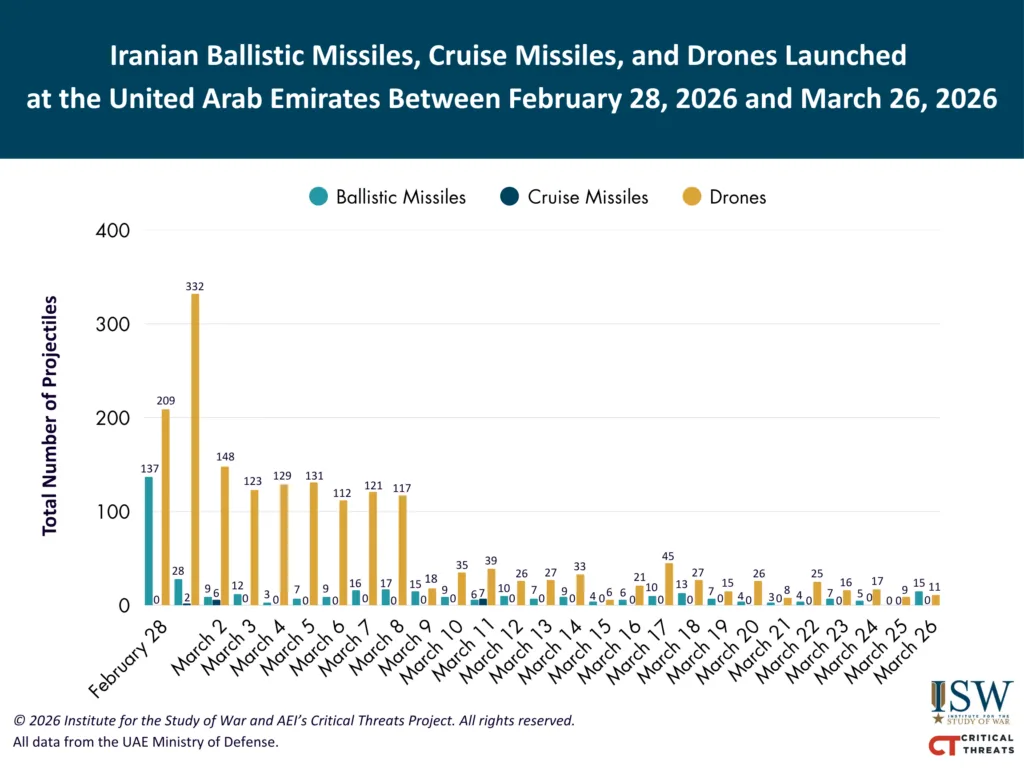
Iran continued to fire at Saudi Arabia, Bahrain, Kuwait, and the United Arab Emirates on March 26. Iran launched 37 drones at Saudi Arabia between 2:00 PM on March 25 and 2:00 PM on March 26.[81] Iran launched 19 drones and one missile at Bahrain.[82] Iran launched one drone and six ballistic missiles at Kuwait.[83] The Kuwaiti Army reported that the six missiles landed in open areas.[84] The Emirati Defense Ministry stated that it intercepted 11 Iranian drones and 15 missiles.[85]
Israeli Campaign Against Hezbollah and Hezbollah Response
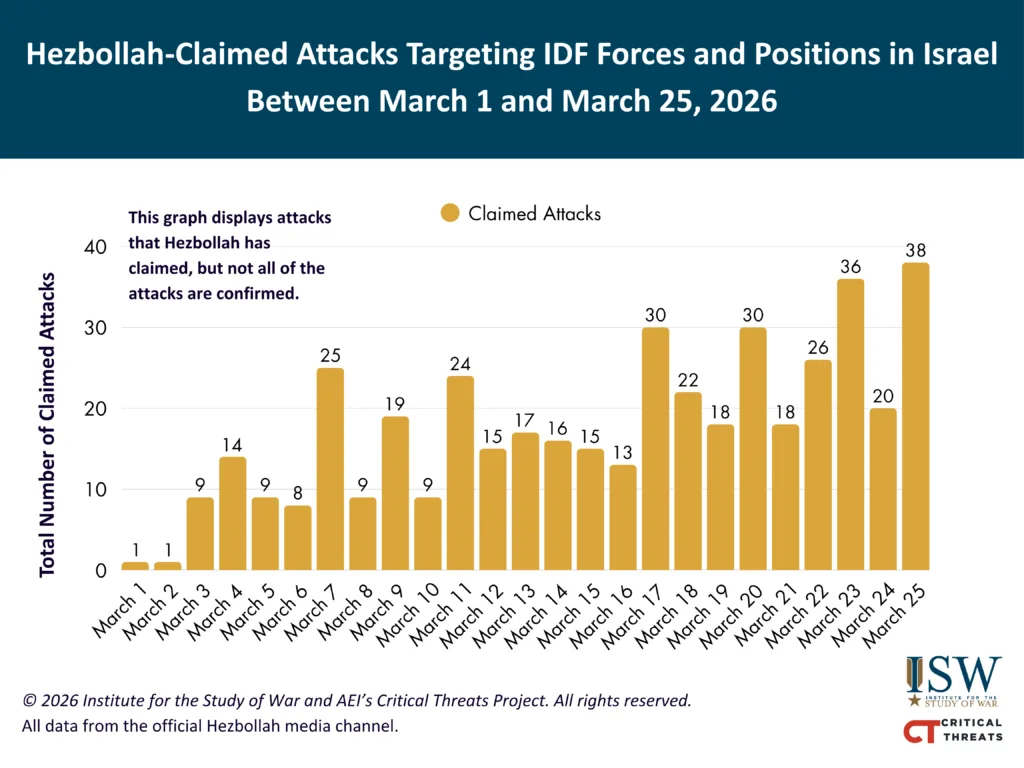
Hezbollah continues to claim a high rate of attacks against Israeli targets in northern Israel and southern Lebanon. Hezbollah claimed to conduct 73 attacks targeting Israeli forces in northern Israel and southern Lebanon, as well as northern Israeli towns, between 2:00 PM ET on March 25 and 2:00 PM ET on March 26.[86] Hezbollah has fired an average of about 150 rockets per day since joining the war on March 1, according to the IDF.[87] The IDF said that about two-thirds of the daily rocket fire has been directed at Israeli forces in southern Lebanon and along the border.[88] Hezbollah has directed one-third of its fire targeting northern and central Israel.[89] Hezbollah has claimed to conduct 35 attacks targeting Israeli military and civilian targets in northern and central Israel since CTP-ISW’s last data cut off.[90] Hezbollah rocket fire killed an Israeli man in Nahariya on March 26.[91]
The IDF killed a senior Hezbollah anti-tank unit commander in southern Lebanon on March 25, likely as part of the IDF effort to reduce the threat that Hezbollah anti-tank guided missiles pose to northern Israel.[92] The commander has reportedly directed anti-tank guided missile attacks targeting Israeli towns for the past two years.[93] Israeli Prime Minister Benjamin Netanyahu said on March 25 that the IDF is expanding operations in southern Lebanon in order to remove the ”anti-tank missile threat” to Israeli communities.[94]
Hezbollah has continued to defend against Israeli advances in southern Lebanon. Israeli forces reportedly attempted on March 25 and 26 to advance from Taybeh toward two Lebanese towns: southwest toward Qantara and northwest toward Deir Seryan.[95] Qantara is located about seven kilometers west from the Lebanon-Israel border. Hezbollah claimed that its fighters engaged Israeli forces and armor advancing from Taybeh towards Qantara with rockets, anti-tank guided missiles, rocket-propelled grenades, and small arms.[96] Hezbollah also said that fighters engaged Israeli forces in Deir Seryan with anti-tank missiles and rocket-propelled grenades.[97]
Hezbollah also claimed to engage Israeli forces in Marwahin and Debl, in southeastern Lebanon, and in Qouzeh, in southwestern Lebanon.[98] Hezbollah attacks inflicted at least three IDF casualties on March 25 and 26.[99]
The IDF is preparing to deploy the 98th Paratrooper Division (Res.) to southern Lebanon, according to an Israeli military correspondent.[100] The 98th Division will be the sixth division that the IDF has deployed in southern Lebanon as part of efforts to create a ”new security zone.”[101] Brigades of the 98th Division last operated in southern Lebanon in Fall 2024.[102]
Iran reportedly seeks to include Hezbollah in any ceasefire agreement with the United States and Israel. Six unspecified regional sources “familiar with Iran’s position” told Reuters on March 25 that Iran has told mediators that any ceasefire agreement with the United States and Israel must also end Israeli operations in Lebanon.[103] One regional source said that Iran had given Hezbollah ”guarantees” that it would include Hezbollah in any agreement to end the war.[104] Israeli officials have expressed that they expect Israeli operations in southern Lebanon to extend beyond the conclusion of the war in Iran .[105]
The IDF continued to strike Hezbollah targets across southern Lebanon and in Beirut on March 26.[106] Lebanese state media reported that IDF strikes killed at least five people.[107]



No comments:
Post a Comment