Should the US be worried? India’s Modi set for rare China trip after Trump’s tariff sting
CNN - Analysis by Rhea Mogul 27-08-2025
Chinese President Xi Jinping and Indian Prime Minister Narendra Modi at the BRICS Summit in Fujian, China on September 4, 2017.
Kenzaburo Fukuhara/AFP/Getty Images
A relationship frozen after a deadly clash high in the Himalayas five years ago appears to be thawing under the heat of US President Donald Trump’s economic pressure.
For the first time since 2018, Indian Prime Minister Narendra Modi will travel to China this week to attend a summit hosted by Chinese leader Xi Jinping, a visit that comes after Trump imposed punishing 50% tariffs on imports from India.
In a moment of geopolitical whiplash, the two leaders – whose soldiers fought a brutal hand-to-hand combat with fists, rocks and clubs at their disputed border in 2020 – could now shake hands, prioritizing economic stability over entrenched rivalry.
Alongside Modi, world leaders from Russia, Pakistan, Iran and Central Asia will join Xi this weekend for what Beijing has said will be the largest summit yet of the Shanghai Cooperation Organization (SCO), a Moscow and Beijing-founded regional security club aimed at reshaping the global balance of power.
India’s presence at the event is the most telling example yet of the warming ties between the two Asian powers – a budding realignment that threatens to undo years-long US efforts to cultivate New Delhi as a counterweight against a rising and increasingly assertive China.
While a thaw in India and China’s fractious relationship was already underway, analysts say Trump’s “America First” policies are making the two leaders, who have built their political brands on a strong foundation of nationalism, explore a partnership of necessity.
Trump’s imposition of tariffs over India’s purchases of Russian oil have been especially hard to swallow for Modi, who enjoyed a budding bromance with Trump during the US president’s first term.
The threat of the levies “infused a certain amount of urgency” in New Delhi’s pivot toward stabilizing its relationship with Beijing, said Manoj Kewalramani, who heads Indo-Pacific studies at the Takshashila Institution research center in the Indian city of Bengaluru. However he said it wasn’t the “primary driver” for a reset, with both India and China looking to stabilize their relationship for their own national interests.
Successive White House administrations have worked to boost strategic ties with India through technology transfers and joint military drills, working with the world’s largest democracy to counter an increasingly assertive China in the Indo-Pacific region.
Losing India would be “the worst outcome” for the US, analysts have said.
US President Donald Trump and Indian Prime Minister Narendra Modi shake hands at the White House in Washington, D.C., on February 13, 2025.
Kevin Lamarque/Reuters
Following a meeting between Chinese Foreign Minister Wang Yi and Prime Minister Modi in New Delhi last week, both sides recognized the recent improvements in their strained relationship.
“India-China relations have made steady progress guided by respect for each other’s interests and sensitivities,” the Indian leader said. “Stable, predictable, constructive ties between India and China will contribute significantly to regional as well as global peace and prosperity.”
The view from Beijing, according to Yun Sun, director of the China Program at the Stimson Center think tank in Washington, is that “this detente was definitely started by Trump.”
“India is no longer able to pretend that it still has strong support from (Washington),” Sun said. Therefore, Beijing’s view is that because the US has “dialed back”India has to “recalibrate its foreign policy and improve its relationship with China.”
But analysts say the summit is unlikely to usher in a fundamental realignment.
“To me, it’s not a reset in the sense that India is saying ‘we are done with America.’ That’s not going to happen,” said Kewalramani.
“The United States remains (India’s) most important partner in the world, but China is our largest neighbor,” Kewalramani said. “We have to live with it.”
From brotherhood to rivalry
The trajectory of India-China relations has evolved from one of post-colonial brotherhood to modern-day strategic rivalry.
India was one of the first countries to establish diplomatic relations with the People’s Republic of China in 1950, with that decade characterized by a shared vision of Asian solidarity. That nascent friendship was, however, shattered by the 1962 Sino-Indian War, a brief but brutal conflict that established a legacy of deep mistrust and an unresolved border dispute that remains the relationship’s festering wound.
In the decades that followed, the countries’ leaders took steps to build economic ties that saw bilateral trade grow, despite ongoing tensions at their shared border. But the deadly 2020 Galwan Valley clashes – which left at least 20 Indian and four Chinese soldiers dead – violently upended this balance.
Indian officers occupying a fort on the Ladakh border during the war between India and China in 1962.
Hulton Deutsch/Corbis Historical/Getty Images
“The 2020 clashes are not simply something India can put behind it,” said Farwa Aamer, director of South Asia Initiatives at the Asia Society Policy Institute. “Instead, the aim here is to ensure no such episodes repeat, and that is where rebuilding the relationship rests on reaching a joint understanding on border stability.”
There has been a gradual normalization of ties between India and China after Modi and Xi met on the sidelines of the BRICS summit in Russia last October. The two sides agreed to restart direct flights cancelled since the Covid-19 pandemic, Beijing recently agreed to reopen two pilgrimage sites in western Tibet to Indians for the first time in five years, and both started re-issuing tourist visas for each other’s citizens.
A balancing act
India’s recalibration of ties with China is a textbook application of its policy of strategic autonomy, which prioritizes national interests over rigid bloc allegiance.
At the SCO summit, as well as China’s Xi, Modi will be in the presence of the prime minister of traditional adversary Pakistan, with whom India recently engaged in a deadly conflict, as well as traditional partner Russia, whose continued oil sales to India since its invasion of Ukraine have irked the US and pushed Trump to slap 25% tariffs on Indian goods as punishment.
This engagement with a China-dominated bloc stands in stark contrast to India’s deepening ties with the Quad – a security grouping with the US, Japan, and Australia – that is widely seen as a democratic counterweight to China’s growing influence in the Indian Ocean.
Indian Prime Minister Narendra Modi meets with visiting Chinese Foreign Minister Wang Yi in New Delhi, India on August 19, 2025.
Javed Dar/Xinhua/Sipa
With their border dispute locked in a stalemate, India is choosing to insulate its diplomatic and economic imperatives from the security conflict with China, according to Kewalramani from the Takshashila Institution.
“While both sides know there are structural challenges and this relationship will remain difficult, both sides realize that a deterioration to the extent that it happened is in neither’s interest,” he said.
The path to stability
India’s strategic recalibration toward China is rooted less in a softening security posture and more in economic necessity.
Last year, China was India’s second-largest trading partner after the US, with bilateral trade reaching $118 billion, according to data from India’s department of commerce. India depends on China not just for finished goods like electronics, but for the essential intermediate products and raw materials that fuel its own industries.
Yet, this economic entanglement exists under the shadow of a tense military reality.
Any talks between Modi and Xi would be complicated by the tens of thousands of troops still deployed at their disputed Himalayan border and this unresolved conflict remains the primary barrier to rebuilding confidence. Last week, the two sides agreed to 10 points of consensus on their border issue, including maintaining “peace and tranquility,” according to a statement from China’s Ministry of Foreign Affairs.
Armoured vehicles of the Indian army at a military camp in Eastern Ladakh, on May 19, 2024.
Tauseef Mustafa/AFP/Getty Images
As Tanvi Madan, a senior fellow in the Center for Asia Policy Studies in the Foreign Policy program at the Brookings Institution, notes, it’s “not clear that either side will really trust each other.”
The major test, she said, is whether the rhetoric from the two leaders translates to de-escalation on the ground, something that has failed before.
The future of the India-China relationship will be defined by their ability to manage this delicate dance.
The future, said Asia Society’s Aamer, will bring “perhaps a more stable relationship, where competition isn’t necessarily over, but conflict is at bay.”
Israeli military uproots thousands of Palestinian olive trees in West Bank
Israeli destruction in al-Mughayyir near Ramallah is part of push to forcibly displace Palestinians, researcher says.
The destruction took place in al-Mughayyir, a Palestinian village of about 4,000 residents near Ramallah in the occupied West Bank [File: Ammar Awad/Reuters]
By Al Jazeera Staff
Published On 23 Aug 202523 Aug 2025
The Israeli military has destroyed about 3,000 olive trees in a village near Ramallah in the occupied West Bank, the head of the local council says, as Palestinians face a continued wave of violence across the territory in the shadow of Israel’s war on Gaza.
The Israeli military issued an order to uproot olive trees in a 0.27sq-km (0.1sq-mile) area in al-Mughayyir, a village of about 4,000 residents northeast of Ramallah
By Al Jazeera Staff
end of list
The army justified the measure by saying the trees posed a “security threat” to a main Israeli settlement road that runs through the village’s lands.
The destruction was carried out as al-Mughayyir has been under lockdown since Thursday after an Israeli settler said he was shot at in the area.
The deputy head of the village council, Marzouq Abu Naim, told Palestinian news agency Wafa that Israeli soldiers had stormed more than 30 homes since dawn on Saturday, destroying residents’ property and vehicles.
For decades, the Israeli military has uprooted olive trees – an important Palestinian cultural symbol – across the occupied Palestinian territory as part of the country’s efforts to seize Palestinian land and forcibly displace residents.
The West Bank also has seen a surge in Israeli military and settler violence since Israel launched its war on Gaza in October 2023, and tens of thousands of Palestinians have been forced out of their homes.
Palestinian men collect wheat after an attack by Israeli settlers in al-Mughayyir in May [File: Mohammed Torokman/Reuters]
More than 2,370 Israeli settler attacks against Palestinians have been reported across the area from January 2024 to the end of July this year, according to the latest figures from the United Nations Office for the Coordination of Humanitarian Affairs (OCHA).
The highest number of attacks – 585 – was recorded in the Ramallah area, followed by 479 in the Nablus region in the northern West Bank.
At least 671 Palestinians, including 129 children, also have been killed by Israeli forces and Israeli settlers across the West Bank in that same time period, OCHA said.
The Israeli military did not immediately respond to Al Jazeera’s request for comment on Saturday on the uprooting of the olive trees in al-Mughayyir.
Hamza Zubeidat, a Palestinian researcher, said the destruction is part of Israel’s “continuous” effort to force Palestinians off their lands.
“We have to be clear that since 1967, Israel is still implementing the same plan of evicting the Palestinian population from the countryside and the cities of the West Bank. What’s going on right now is just a continuous process of this eviction of Palestinians. It’s not a new Israeli process,” Zubeidat told Al Jazeera.
He noted that al-Mughayyir has a long agricultural history and, like other villages in the West Bank, relies almost entirely on agriculture and livestock as its main source of income.
“This area where more than 3,000 olive trees [were] uprooted is one of the most fertile areas in this part of the Ramallah area,” Zubeidat explained.
“Uprooting trees, confiscated water springs, blocking and preventing Palestinians from accessing their farms and water sources means more food and water insecurity.”
Mannar’s ‘plastic beaches’ a sinister sign of transboundary pollution
By Tharushi Weerasinghe
The Sunday Times 24-08-2025
With the southwest monsoon in full swing, the shores of Mannar are once again buried under waves of transboundary plastic pollution, this year, locals say, worse than ever.
“When we go out to sea, the southern coast leading to Adam’s Bridge is covered,” said Selvaratnam Dilaxan, a social and environmental activist from Mannar. “There’s plastic dust in the air, too, brought by the winds. We usually get a lot of it, but this time it is intense.” Locals speculated that the trash is coming in from India, though there is no official data or research at the moment to confirm this. “But everything is ending up here, and it is having extremely bad impacts on our ecosystems.” Mr. Dilaxan also noted that, in the absence of official studies, the impact of plastic pollution at this scale on groundwater and fish — the community’s primary sources of income and sustenance — remains unknown, though it is likely causing severe, yet undiscovered, health consequences.
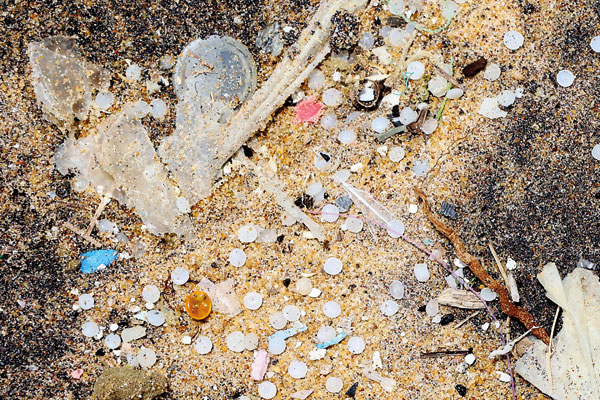
Plastic pellets washed ashore in Mannar
While the Marine Environment Protection Authority (MEPA) has been conducting regular cleanups to remove plastic pellets or “nurdles,” Dilaxan noted that the finer plastic dust, dispersed by the monsoon winds, is far more difficult to collect, leaving the community struggling with a problem that worsens each season.
This is not a new problem, said Prof. Terney Pradeep Kumara, Director General of the Department of Coastal Conservation and Coastal Resource Management. But he added that there is no reliable data on the plastic “dust”. “I can’t confirm it unless appropriate sampling is done and studied.” But he acknowledged that monsoon currents usually push debris toward Sri Lanka – “but during the rains, some of it also washes away,” he explained.
He noted that regional litter management frameworks such as SACEP and SAS, once developed to coordinate efforts, have largely fallen into disuse. “As long as countries don’t resolve their internal waste management issues, plastics will keep circulating through ocean currents,” Prof. Kumara said. “Data shows we receive plastics from across South and Southeast Asia, but our plastics also travel to the Maldives, so we are part of the problem too.” He stressed that the Global Plastics Treaty, the sixth round of negotiations for which collapsed last week, is vital, as it would place greater responsibility on wealthier plastic-producing nations.
Prof. Terney Pradeep Kumara
Despite local efforts such as reducing single-use plastics, conducting plastic audits with fishermen, and promoting larger reusable containers, many initiatives falter during implementation. “Plastic is no one’s baby,” he added. “Regulations exist, but without proper control mechanisms, they aren’t effective. Like the tax system, we need a well-established, accountable structure. New technology without the right policies and action is pointless.”
Minister of Environment Dr. Dammika Patabendi said the surge in plastic debris was first observed after two major ship incidents. “Plastic trash started to come after the two ships went under — both caught on fire, one drowned, and the other was dragged to international waters,” he said. “The western shores started seeing a lot of trash. We spoke to the Indian Coast Guard and the shipping company. They have agreed to pay damages and compensation, and the Attorney General’s Department is advising us accordingly. MEPA is coordinating cleanups with support from local authorities in Mannar and Jaffna.”
With the monsoon currents, Dr. Patabendi noted, the lingering effects of the MV X-Press Pearl disaster may be resurfacing, compounded by newer shipwrecks. “The MEPA Act has to be amended, and we are in the process of doing that,” he said.
On the international front, he acknowledged slow progress on the Global Plastics Treaty. “There were five negotiation rounds, with the last in April this year in Kenya, but we couldn’t reach an agreement. The follow-up session in Geneva also failed. The next step is still being decided,” he said. “There are two key divisions — whether the full life cycle of plastic, starting from production, should be covered, and whether the health implications, like the endocrine-disrupting chemicals in plastics, should be part of the framework. Petroleum-producing countries oppose these measures. Island states like us, compared to producers and users, face the brunt of plastic pollution, so we are pushing for the full cycle to be included. The High Ambition Coalition supports this, too.”
He added that the Environment Act has been amended and approved by Cabinet, introducing Extended Producer Responsibility (EPR) and bans on certain single-use plastics, alongside an action plan focused on the “three Rs” — reduce, reuse, and recycle. “Plastic pollution is a global crisis, and as a non-producing island nation, we cannot solve it alone,” Dr. Patabendi said. “This is bigger than international borders. MEPA and the other 12 authorities under the ministry have been under-resourced for years, with little capacity building. After the X-Press Pearl disaster, they should have been strengthened; that work is now underway, alongside the necessary legal amendments.”
Continental Power, Maritime Power, and the Fight for a New World Order
S. C. M. Paine
September/October 2025Published on August 19, 2025
Great-power competition once again defines international relations. But the exact contours of today’s contest remain the subject of debate. Some observers emphasize ideological precedents from the Cold War. Others focus on changing military balances. Still others highlight leaders and their choices. In truth, modern conflicts over the international system flow from a long-standing, if unrecognized, disagreement over the sources of power and prosperity. The dispute originates from geography, and it has produced two antithetical global outlooks: one continental and the other maritime.
In the continental world, the currency of power is land. Most countries, by geography, inhabit a continental world with multiple neighbors. Such neighbors have, historically, been each other’s primary adversaries. Those with enough power to conquer others—continental hegemons such as China and Russia—believe the international system should be divided among them into huge spheres of influence. They funnel resources into their militaries to protect boundaries, conquer and intimidate neighbors in wealth-destroying wars, and entrench authoritarian rule at home to prioritize military over civilian needs. The result is a vicious cycle. To justify their repression and retain the throne, despots require a big enemy and manufacture security threats that lead to more wars.
By contrast, states with an oceanic moat have relative security from invasion. They can thus focus on compounding wealth rather than on fighting neighbors. These maritime states see money, not territory, as the source of power. They advance domestic prosperity through international commerce and through industry, minimizing the tradeoff between military and civilian needs. While continental hegemons gravitate toward finite-game, winner-take-all strategies that are ruinous to the defeated, those vested in the maritime order prefer the infinite game of wealth-compounding, mutually beneficial transactions. They view neighbors as trade partners, not enemies.
The maritime worldview goes back to the ancient Athenians, whose rimland empire depended on accruing wealth from coastal trade. Such states wish to treat the oceans as commons, so all can share them and safely trade. It is not a coincidence that Hugo Grotius, the founding father of international law, came from the Dutch Republic, a trading empire. And since World War II, commercially minded countries have developed regional and global institutions to facilitate trade, minimize transaction costs, and compound wealth. They have coordinated their coast guards and navies to eliminate piracy so that trade gets through. This has produced an evolving maritime, rules-based order with dozens of members that together enforce the regulations that protect them all.
Today’s competition is just the latest iteration of the continental-maritime conflict. Since World War II, the United States’ strategy has reflected its position as a maritime power. Because of its economic structure, the country has an interest in maintaining trade and commerce. And thanks to its geography and strength, it can hinder countries from undermining the sovereignty of other states. China, Iran, North Korea, and Russia, meanwhile, want to undermine the rules-based order because their leaders consider more liberal societies an existential threat to their rule and national security visions.
The United States can prevail in the second cold war, just as in the first, by hewing to the successful strategies of maritime power. But if it reverts to a continental paradigm—by erecting barriers, threatening neighbors, and undermining global institutions—it is likely to fail. It may then be unable to recover.
THE TRICKS OF TRADE
The United Kingdom developed the modern maritime playbook for countering continental powers during the Napoleonic Wars. London became the world’s dominant power not by deploying its army to obliterate rivals but by growing rich from trade and industry while other European countries ruined each other militarily. All continental states had to maintain large armies either to conquer or to avoid being conquered. Often, they organized their economies around the needs of their army, not their merchants. But the United Kingdom, protected on every side by water and by its dominant navy, was less afraid of an invasion. It therefore did not need a large, expensive, potentially coup-generating ground force. It focused on compounding its wealth through commerce, relying on its navy to defend shipping lanes.
Alone of all the great powers, the United Kingdom belonged to every successive coalition fighting France. After the Royal Navy defeated Napoleon at Trafalgar, he turned to an economic strategy. He imposed a continent-wide blockade on British commerce, known as the Continental System—a strategy that Napoleon described as la France avant tout (France first). But this blockade hurt the economies of France and its allies far more than it did the United Kingdom, which had maritime access to alternative markets across the planet. The blockade led Napoleon to launch his ruinous invasion of Russia, which continued trading with the British.
In the continental world, the currency of power is land.
Rather than fighting Napoleon’s large military directly, the United Kingdom used its growing wealth to fund and arm Austria, Prussia, Russia, and numerous smaller states, which together pinned down the bulk of Napoleon’s forces on the main front in central or eastern Europe. The British then opened a peripheral theater on the Iberian Peninsula, what Napoleon called his “Spanish ulcer,” which had better sea than land access, so that attrition rates favored them. The cumulative casualties from this and the main front ultimately overextended Napoleon, dooming his military when his adversaries simultaneously ganged up. Virtually every European country suffered extensive war damage, but the British economy emerged unscathed. The same was true for the United States in both world wars.
After the Napoleonic Wars, the Industrial Revolution introduced compounded economic growth. This tilted the playing field even more in favor of maritime powers. Suddenly, it was far easier to accrue power from industry, commerce, and trade than from wealth-destroying wars. Doing so depended on the external lines of communication provided by the seas rather than the internal lines that continental powers, such as Napoleonic France, leveraged to defend and expand their empires. As a result, today, the world order is maritime in nature—even though few perceive it that way. Around half the world’s population lives by the sea, coastal areas create roughly two-thirds of global wealth, 90 percent of traded goods (measured by weight) arrive at their final destination via oceans, and submarine cables account for 99 percent of international communications traffic. International bodies and treaties regulate trade. The seas connect everyone with everything. No one state can keep them open, but a coalition of coastal states can make them safe for transit.
This system has broadly benefited the world’s people. Trading rules have minimized bottlenecks, reducing costs. Safe, open seas facilitate economic growth, raising living standards. People can travel, work, and invest abroad. Billionaires are the greatest beneficiaries of the maritime order because they have the most to lose to confiscation when the rules disappear, and because their economic interests are global. Countries vested in the maritime order are far richer than those that seek to undermine it. Even those intending to overturn this system have benefited from it. China, for instance, became rich only after it joined the maritime order when the Cold War ended. The Iranian and Russian economies are a fraction of what they could be if they followed international law and built institutions to protect their citizens instead of their dictators.
CONQUER AND COLLAPSE
In the continental world, power is a function of territory. Neighbors are dangerous. Since strong ones may invade, continental hegemons work to destabilize nearby countries. In modern times, they do so by deluging them with fake news to fuel internal resentments and regional disagreements. Weak neighbors also pose a threat, as terrorism and chaos can bleed over shared borders. To protect themselves and increase their power, continental states often invade and ingest their neighbors, eliminating potential threats by wiping them off the map.
In their drive to increase in size and power, successful continental hegemons follow two rules: avoid two-front wars and neutralize great-power neighbors. But the continental theory of security provides no counsel for when to stop expanding and yields no permanent alliances. Neighbors understand that the hegemon promises long-term trouble. As a result, continentalists often find themselves overextended, alone, and, eventually, at risk of collapse. Both wars for territory and the destabilization of neighbors swiftly destroy wealth.
Germany, for example, could have dominated the European continent economically during the twentieth century, given its more rapid economic growth rate relative to its neighbors. Instead, it fought two expansionist world wars. In both, it violated the rules for continental empire by fighting on multiple fronts against multiple great powers. The wars, far from cementing Germany’s dominance, delayed its rise by generations at a massive cost in both lives and wealth across Europe.
U.S. aircraft carriers training in the Sea of Japan, June 2017U.S. Navy / Reuters
Likewise, Japan prospered under a maritime trading order. Then, in the 1930s, it adopted a continental paradigm and seized a large empire on the Asian mainland. As with Germany, its quest initially yielded territory but produced multiple enemies and military and economic overextension that destroyed both Japan and those it invaded. Postwar Japan then returned to a maritime paradigm of working through international organizations and under international law. This produced the Japanese economic miracle, in which a ruined country quickly became one of the world’s richest. (Hong Kong, Singapore, South Korea, and Taiwan had Cold War economic miracles thanks to the maritime system, as well.)
Overextension was also central to the fall of the Soviet Union. That empire not only ingested Eastern Europe at the end of World War II; it imposed an economic model conducive to dictatorial rule but not to economic growth. It then expanded this program to as much of the developing world as possible. Ultimately, the lethargic Soviet economy could not sustain Moscow’s imperial adventures and impracticable projects.
In World War I, every European power, including the United Kingdom, pursued continental strategies that required using massive armies to establish diverse empires with overlapping territory. Each state had different primary adversaries and primary theaters, even within each alliance system. This produced a series of uncoordinated, parallel wars. The European powers, including the United Kingdom, also struggled because they allowed army officers to oversee the war effort with inadequate input from civilian leaders who had insights into the economic underpinnings of power. Army officers doubled down on stalemated offensives for months, wasting hundreds of thousands of young lives rather than owning up to the profligacy of their strategy.
Arguably, no European country fully recovered from its World War I losses. The war destroyed the continental empires that had insisted on fighting it—Austria-Hungary, Germany, and Russia. Despite their victory, France and the United Kingdom were worse off afterward. The United States emerged disgusted by European entanglements, paving the way for the original America Firsters, who enacted tariffs that deepened the Great Depression and set the stage for a world war rerun. By contrast, during the long peace between the Napoleonic Wars and World War I, Europe’s affluence compounded. Likewise, when the United States followed the maritime paradigm to win World War II, unprecedented prosperity ensued. Unlike after World War I, Washington did not recede into isolationism. Instead, it assumed the mantle of leadership by helping partners rebuild and acting as the guarantor of an international system it created in cooperation with its postwar allies to preserve peace. These institutions succeeded in Europe until Russian President Vladimir Putin invaded Ukraine.
THE DOGS OF WAR
Most countries are geographically continental. They lack an oceanic moat completely insulating them from threats. Only the maritime rules-based order offers such states full protection. Institutions and alliance systems integrate the diverse capabilities of the many to contain the threats from the few. They are the insurance program for the rules-based order. They cannot eliminate dangers altogether, but if members coordinate to maximize their economic growth and constrain the continentalists, they can minimize risks.
But the world still has many committed continentalists. Putin has made it clear he intends to expand Russia’s borders. His initial objective is control over Ukraine, the hors d’oeuvre before the main course. “There’s an old rule that wherever a Russian soldier sets foot, that’s ours,” Putin said, laying out his menu. It features, at a minimum, central and eastern Europe, which Soviet troops occupied after World War II. His statement may also portend visions of power over Paris, which Russian troops reached at the end of the Napoleonic Wars.
As during the first Cold War, Moscow wants to break apart the West both from without and from within. Ever since the Bolshevik Revolution, Russians have excelled at propaganda. They used it to successfully market communism around the world, costing many countries decades of growth. Now, Russia is using propaganda to spread the fiction that NATO threatens Russia rather than the reverse. (NATO countries do not covet Moscow’s territory; they want Russia to deal with its domestic dystopian mess and become a constructive member of the international system.)
Trading rules have minimized bottlenecks, reducing costs.
Social media has radically increased Russia’s ability to sow discord abroad, which it does by stoking hatred on both sides of divisive issues. Moscow has sought to transform the war in Ukraine into a wedge issue that divides the United States from Europe and different European states from each other, weakening both NATO and the EU. It helped promote Brexit, which has eroded the United Kingdom’s ties with the continent.It helped create massive migrant flows by supporting the dictator Bashar al-Assad’s forces during the Syrian civil war and now by destabilizing Africa, sending refugees pouring into Europe. These inflows have been profoundly destabilizing, facilitating the rise of the continent’s isolationist right.
Other continental powers also wish to overturn the present global order. North Korea wants control of the entire Korean Peninsula, eliminating South Korea. Iran’s primary theater is the Middle East, where Tehran seeks to extend its influence over Gaza, Iraq, Lebanon, and Syria.
Then there is China. The country’s decision to integrate into the current world order in pursuit of wealth suggested that, despite its authoritarian government, it might be adopting a maritime outlook. It even built a large navy. But Beijing cannot reliably deploy that navy in wartime because of the narrow, shallow, island-cluttered, enclosed seas that surround its coasts. This makes it much like Germany, which built large navies it could not reliably use in either world war. The United Kingdom blockaded the narrow North Sea and Baltic Sea, eliminating Germany’s merchant traffic and reducing its naval traffic mainly to submarines. In World War II, Berlin required the long French and Norwegian coastlines for more reliable egress for its submarines, but that was still insufficient for its navy, let alone its merchant marine. China is even more reliant on trade and imports than Germany was then, particularly energy and food. The economic bottlenecks from a shutdown of its oceanic trade would debilitate its economy.
Installing an antitank landmine, Chasiv Yar, Ukraine, October 2024Oleg Petrasiuk / Ukrainian Armed Forces / Reuters
As Ukraine has demonstrated with its sinking of Russian ships, drones can close narrow seas. China has 13 landward neighbors and seven seaward neighbors, and no shortage of disagreements with them. With submarines, shore artillery, drones, and planes, these neighbors can shut down China’s merchant traffic and make its naval passage perilous. Many of its close coastal neighbors, by contrast, do not need to traverse the South China Sea to reach the open ocean—Indonesia, Malaysia, the Philippines, and Thailand, as well as Taiwan, all have alternative coastlines on the open seas, making them difficult to blockade.
Like Russia, China retains a continental outlook. In addition to territorial claims on Japan and the Philippines, and its threat to use force to take all of Taiwan, Beijing seeks territory from Bhutan, India, and Nepal. When Chinese citizens list their historic lands, they either name the Mongol Yuan dynasty, which extended all the way to Hungary, or the Manchu Qing empire, which encompassed the lands the Belt and Road Initiative is now peeling away from the Russian sphere of influence. The Chinese still have two names for themselves, either “the central kingdom” or the even more grandiose “all under Heaven”—a complete world order unto itself and all the lands it conquers.
Beijing, unlike Moscow, has not yet launched outright wars of aggression. But China is waging financial war with its predatory Belt and Road Initiative loans, which leave recipients massively indebted. It is conducting cyberwarfare, hacking into other countries’ critical infrastructure and stealing their secrets. It engages in resource warfare by limiting rare-earth mineral exports, ecological warfare by damming Southeast Asia’s Mekong River and South Asia’s Yarlung Tsangpo River, and drug warfare by flooding the United States with fentanyl. It has even dabbled in irregular warfare, with incursions into Indian territory that killed Indian soldiers. This is a continental recipe for overextension.
AVERTING CATASTROPHE
To confront the continentalists, the United States and its allies do not need to reinvent the wheel. The strategy that won the previous Cold War remains equally serviceable today. It begins with a recognition that this struggle—like the last—will be protracted. Rather than attempting a rapid resolution, which could have triggered nuclear war, the victors in the first Cold War managed the conflict for several generations. The same advice applies today: the maritime powers must be patient and keep the current conflict cold. They should particularly avoid hot wars in theaters lacking adequate maritime access, in states surrounded by hostile countries likely to intervene, and in states where the local population is broadly unwilling to provide assistance. These characteristics applied to Afghanistan and Iraq, and help explain Washington’s unsuccessful conflicts there.
Instead of fighting hot wars, the United States and its partners should leverage the great strength of the maritime world against the great weakness of the continentalists: their different capacities to generate wealth. They should exclude continentalists from the benefits of the maritime order by sanctioning them until they cease violating international law, put aside warfare, and embrace diplomacy. Unlike tariffs, which are taxes on imports to protect domestic producers, sanctions make targeted transactions illegal to penalize malign actors. Even porous sanctions, which shave growth rates by a percentage point or two, can produce devastating, long-term compounding effects—as a comparison of sanctioned North Korea and unsanctioned South Korea illustrates. Sanctions are a form of economic chemotherapy. They may not eliminate the tumor, but they will, at a minimum, slow its progress. They can be particularly effective at setting back technological development, as the Soviets experienced.
Washington and its partners should accommodate states that are not revisionists. The victors in the last Cold War understood that alliances are additive. Partners bring new capabilities that can help overwhelm enemies. Institutions then mobilize expertise to provide services and prevent problems that can help member states combat the continentalists. The United States should thus strengthen and expand its network. It should focus on maintaining not just its own prosperity but also that of its partners, so they can gang up on the bullies. Alliance systems should also aid those beset by the continentalists, whose resistance weakens their enemies. Just as the West armed Moscow’s enemies until the Soviet Union withdrew from its war against Afghanistan, the West must now aid Ukraine for as long as it takes. The longer the Ukraine conflict continues, the weaker Moscow will become, opening itself up to possible Chinese predation.
Should Russia’s current regime fall, the resulting succession struggle will force it to reduce its foreign commitments—as occurred with the Soviet Union during the Korean War, when Joseph Stalin’s death led to that conflict’s rapid conclusion. Should any of the continentalists cease coveting other countries’ territory and instead peacefully contribute to improving international laws and institutions, then the United States and its partners should welcome them into the rules-based order. But if these countries do not change, containment is the answer. Washington prevailed in its earlier showdown with Moscow not with a dramatic military victory but by prospering while the Soviet Union endured an economic decline of its own making. In the 1980s, while Soviets waited in line for basic goods, Americans took family vacations. The present U.S. objective should be to keep other democracies and partners prospering while weakening the continentalists. The latter powers may not go away any time soon, but if they cannot match the economic growth rates of those upholding the maritime order, the relative threat will shrink.
OWN GOALS
The stakes of the clash between the continental order and the maritime, rules-based order have never been so high. There are many nuclear powers, and the United States is increasingly unwilling to act as the ultimate guarantor of the present global system by supporting allies and extending its nuclear umbrella. If the conflicts in Ukraine, across Africa, and between Israel and Iran expand and merge, a catastrophic third world war might ensue. Unlike in the previous ones, everyone would be vulnerable to nuclear strikes and their toxic fallout.
The United States has already taken major steps to defeat its continental adversaries. It has imposed strict sanctions and export controls. It has funded and armed the countries facing down shared antagonists. But critics of the rules-based order are gathering strength. They see the system’s many imperfections but not its even more important benefits—including the catastrophes the rules avert. The rules-based order benefits individuals, businesses, and governments not only by facilitating trade flows but also by deterring malign behavior. Unfortunately, people rarely appreciate a disaster averted.
Today, even top U.S. officials are critical of the present order. Over the last year, Washington has gravitated toward a continental approach. The United States will always have its natural moats—the Atlantic and the Pacific—to protect the mainland. But it also shares long borders with Canada and Mexico, and Washington is picking fights with both. It has berated numerous friendly democracies, levied tariffs on trading partners, and paralyzed international institutions that facilitate global economic growth by setting and enforcing the rules of the road. Musings from Washington about absorbing Canada, seizing Greenland from Denmark, and retaking the Panama Canal will, at a minimum, permanently alter Canadian and European shopping choices and vacation plans. At worst, they will rupture Western alliances.
Overextension was central to the fall of the Soviet Union.
Bad strategy could transform the United States from the essential power to the irrelevant power, as former partners form new alliances that exclude Washington. Such a shift would take time, but if it happens, the changes will be enduring. Europeans will grow stronger together, leaving the United States weaker and alone. In the worst-case scenario, Washington could become a shared primary adversary for China, Iran, North Korea, and Russia, with no allies left to help it. But even short of that, it may have to compete with Beijing on its own. If so, it may struggle to prevail. China has nearly three times as many people as does the United States and a much larger manufacturing base. It has nuclear weapons that can reach the American homeland, and might not have moral qualms about using them. The United States could also become less queasy about deploying its arsenal. If a state is about to lose a great-power conflict, after all, it may be incentivized to go nuclear, transforming a bilateral catastrophe into a global one.
For Washington, a scenario that leaves it alone and defeated would be a tragic conclusion to the last 80 years. At the end of World War II, it had earned friends across the globe. But that moral capital, gained at great cost, is being squandered. Like Napoleon’s France avant tout, the recent reversion to America First is antagonizing allies everywhere. Undoubtedly, Washington’s enemies would relish seeing the United States brought low.
Too many Americans have taken the benefits of the maritime order for granted and harped on its imperfections, frittering away their many geographic and historical advantages in the process. Like the oxygen around them, they will miss the global order should it disappear. As the Athenian leader Pericles lamented long ago on the eve of a succession of Athenian mistakes that permanently ended that city’s preeminence, “I am more afraid of our own blunders than of the enemy’s devices.”