SHARE

Tuesday, July 01, 2025

The risks of funding states via casinos

The risks of funding states via casinos

It is easy to imagine conditions in which money simply dries up, perhaps in response to large movements in bond yields

🟠________________________________________________  © நமது இணையத்தில் பதிப்புரிமைக் குறியிடப்பட்டுள்ள ஆக்கங்களை பகிர்வதற்கு, ஆக்கங்களின் அடியில் அல்லது வலது பக்கத்தில் உள்ள பகிர் குறி வழியாகக் காணப்படும் இணைப்புகளைப் பயன்படுத்தவும்.  ஆக்கங்கள் எவற்றையும்  பகுதியாகவோ அல்லது முழுமையாகவோ நகலெடுப்பது enbweb.co `விதிமுறை- நிபந்தனை`கள் மற்றும் பதிப்புரிமைக் கொள்கையை மீறுவதாகும்.Please use the sharing tools found via the share button at the bottom or right side of articles. Copying articles in part or full to share with others is a breach of enbweb.co T&Cs and Copyright Policy. ENB Admin-நிர்வாகம் ______________________________________

FT MARTIN WOLF 01-07-2025


© James Ferguson

Invest long, borrow short and leverage up as much as possible. That is the way to make money in finance. It is how banks have always made their living. But we also know very well that this story can end in panic-stricken runs for the exit and financial crises. That is what happened in the great financial crisis (GFC) of 2007-09. Since then, as the Bank for International Settlements explains in its latest Annual Economic Report, the financial system has changed a great deal. But this central characteristic has not.

Moreover, notes Hyun Song Shin, economic adviser to the BIS, “despite the fragmentation of the real economy, the monetary and financial system is now more tightly connected than ever”. If this sounds like an accident waiting to happen, you are quite right. Central banks must be prepared to ride to the rescue.

The story the BIS tells is an intriguing one. Thus, the aftermath of the GFC did not make the system fundamentally different. It just changed who was involved. In the run-up to the crisis, the dominant form of lending was to the private sector, particularly in the form of mortgages. Afterwards, lending to the private sector levelled off, while credit to governments exploded. The pandemic accelerated that tendency.

That was not surprising: if people want to save and lend, someone else has to borrow and spend. That is macroeconomics 101. In addition to the change in direction came a change in intermediaries: in place of the big banks have come global portfolio managers. (See charts.)

As a result, cross-border bond holdings have increased enormously. What matters here are changes in gross, not net, holdings. The latter are relevant to long-term sustainability of macroeconomic patterns of saving and spending. The former are more relevant to financial stability, because they drive (and are driven by) changes in financial leverage, notably cross-border leverage. Moreover, notes Shin, “the largest increases in portfolio holdings have been between advanced economies, especially between the US and Europe”. The emerging economies are relatively less involved in this lending.

How then does this new cross-border financial system work? It has two fundamental characteristics: the leading roles of foreign currency swaps and non-bank financial intermediaries.

The biggest part of this cross-border lending consists of the purchase of dollar bonds, particularly US Treasuries. The foreign institutions buying these bonds, such as pension funds, insurance companies and hedge funds, end up with a dollar asset and a domestic currency liability. Currency hedging is essential. The banking sector plays a key role, by enabling the market for foreign exchange swaps, which provide these hedges. Moreover, a forex swap is a “collateralised borrowing operation”. Yet these do not appear on balance sheets.


According to the BIS, outstanding forex swaps (including forwards and currency swaps) reached $111tn at the end of 2024, with forex swaps and forwards accounting for some two-thirds of that amount. This is vastly more than cross-border bank claims ($40tn) and international bonds ($29tn). Moreover, the market’s largest and fastest-growing part consists of contracts with non-dealer institutions. Finally, some 90 per cent of forex swaps have the dollar on one side of the transaction and over three-quarters have a maturity of less than one year.


As the BIS notes, this highly non-transparent set of cross-border funding arrangements also affects the transmission of monetary policy. One of the propositions it makes is that the greater role of non-bank financial intermediaries, notably hedge funds “may have contributed to more correlated financial conditions across countries”. Some of this is quite subtle. Given the large-scale foreign ownership of US bonds, for example, conditions in the owners’ home markets can be transmitted to the US. Again, exchange rate movements that affect the dollar value of holdings of emerging market debts can trigger adjustments in their domestic prices.

What are the risks in this new system of finance? As has been noted, banks are active in the market for forex swaps. They also provide much of the repo financing for hedge funds speculating actively in the bond market. Moreover, according to the BIS, over 70 per cent of the bilateral repo financing from banks is at zero haircut. As a result, lenders have very little control over the leverage of the hedge funds active in these markets. Not least, non-US banks are active in providing dollar funding for firms engaged in these markets.

What does all this imply? Well, we now have tightly integrated financial systems, especially among high-income countries, even as the countries are moving apart, politically and in terms of their trade relations. Moreover, much of the funding is in dollars on relatively short maturities. It is easy to imagine conditions in which funding dries up, perhaps in response to large movements in bond yields or some other shock. As happened in the GFC and the pandemic, the Federal Reserve would have to step in as lender of last resort, both directly and via swap lines to other central banks, notably those in Europe. We assume that the Fed would indeed come to the rescue. But can that be taken for granted, especially after Jay Powell is replaced next year?

The system the BIS elucidates has much of the fragility of traditional banking, but even less transparency. We have a vast number of unregulated businesses taking highly leveraged positions, funded on a short-term basis, to invest in long-term assets whose market values may vary substantially even if their capital values are ultimately safe. This system demands an active lender of last resort and a willingness to sustain deep international co-operation in a crisis. It should work. But will it?🔼

Wednesday, June 25, 2025

US strikes on Iran did not destroy nuclear sites-CNN

Exclusive: Early US intel assessment suggests strikes on Iran did not destroy nuclear sites, sources say

By Natasha Bertrand, Katie Bo Lillis and Zachary Cohen, CNN
Updated 12:50 PM EDT, Wed June 25, 2025


CNN-The US military strikes on three of Iran’s nuclear facilities last weekend did not destroy the core components of the country’s nuclear program and likely only set it back by months, according to an early US intelligence assessment that was described by seven people briefed on it.

The assessment, which has not been previously reported, was produced by the Defense Intelligence Agency, the Pentagon’s intelligence arm. It is based on a battle damage assessment conducted by US Central Command in the aftermath of the US strikes, one of the sources said.

The analysis of the damage to the sites and the impact of the strikes on Iran’s nuclear ambitions is ongoing, and could change as more intelligence becomes available. But the early findings are at odds with President Donald Trump’s repeated claims that the strikes “completely and totally obliterated” Iran’s nuclear enrichment facilities. Secretary of Defense Pete Hegseth also said on Sunday that Iran’s nuclear ambitions “have been obliterated.”

Two of the people familiar with the assessment said Iran’s stockpile of enriched uranium was not destroyed. One of the people said the centrifuges are largely “intact.” Another source said that the intelligence assessed enriched uranium was moved out of the sites prior to the US strikes.

“So the (DIA) assessment is that the US set them back maybe a few months, tops,” this person added.

The White House acknowledged the existence of the assessment but said they disagreed with it.

White House press secretary Karoline Leavitt told CNN in a statement: “This alleged assessment is flat-out wrong and was classified as ‘top secret’ but was still leaked to CNN by an anonymous, low-level loser in the intelligence community. The leaking of this alleged assessment is a clear attempt to demean President Trump, and discredit the brave fighter pilots who conducted a perfectly executed mission to obliterate Iran’s nuclear program. Everyone knows what happens when you drop fourteen 30,000 pound bombs perfectly on their targets: total obliteration.”

Trump, who’s in the Netherlands attending this week’s NATO summit, pushed back on CNN’s report in a Truth Social post. “One of the most successful military strikes in history,” Trump wrote in the all-caps post adding, “The nuclear sites in Iran are completely destroyed!”

Hegseth, who is also at the NATO summit, said Wednesday the assessment was “a top secret report; it was preliminary; it was low confidence;” adding that there were political motives behind leaking it and that an FBI investigation was underway to identify the leaker.

The US military has said the operation went as planned and that it was an “overwhelming success.”

It is still early for the US to have a comprehensive picture of the impact of the strikes, and none of the sources described how the DIA assessment compares to the view of other agencies in the intelligence community. The US is continuing to pick up intelligence, including from within Iran as they assess the damage.

Iran has a well-developed nuclear program

Iran has been developing its nuclear infrastructure since the 1960s, often in secret with some facilities buried underground. It is capable of most stages of uranium production from mining to enrichment; it insists its program is peaceful.


Israel had been carrying out strikes on Iranian nuclear facilities for days leading up to the US military operation but claimed to need the US’ 30,000-pound bunker buster bombs to finish the job. While US B-2 bombers dropped over a dozen of the bombs on two of the nuclear facilities, the Fordow Fuel Enrichment plant and the Natanz Enrichment Complex, the bombs did not fully eliminate the sites’ centrifuges and highly enriched uranium, according to the people familiar with the assessment.

Instead, the impact to all three sites — Fordow, Natanz and Isfahan — was largely restricted to aboveground structures, which were severely damaged, the sources said. That includes the sites’ power infrastructure and some of the aboveground facilities used to turn uranium into metal for bomb-making.

The Israeli assessment of the impact of the US strikes also found less damage on Fordow than expected. However, Israeli officials believe the combination of US and Israeli military action on multiple nuclear sites set back the Iranian nuclear program by two years, assuming they are able to rebuild it unimpeded which Israel would not allow. But Israel had also stated publicly before the US military operation that Iran’s program had been set back by two years.

Hegseth also told CNN, “Based on everything we have seen — and I’ve seen it all — our bombing campaign obliterated Iran’s ability to create nuclear weapons. Our massive bombs hit exactly the right spot at each target and worked perfectly. The impact of those bombs is buried under a mountain of rubble in Iran; so anyone who says the bombs were not devastating is just trying to undermine the President and the successful mission.“

On Tuesday morning, Trump repeated his belief the damage from the strikes was significant.

“I think it’s been completely demolished,” he said, adding, “Those pilots hit their targets. Those targets were obliterated, and the pilots should be given credit.”

On Wednesday, Trump lashed out at the media, including CNN, though he maintained the strikes put Iran’s nuclear ambitions back decades. Still, the US president acknowledged the intelligence was “inconclusive” and preliminary, and suggested Israel would provide a fuller picture shortly with its own findings.

“The intelligence was very inconclusive,” Trump said at the sidelines of the NATO summit in the Hague. “The intelligence says we don’t know. It could have been very severe.”

On Wednesday morning, a senior DIA official said in a statement that “We have still not been able to review the actual physical sites themselves, which will give us the best indication. We are working with the FBI and other authorities to investigate the unauthorized disclosure of classified information.” 
While Trump and Hegseth have been bullish about the success of the strikes, Chairman of the Joint Chiefs of Staff Dan Caine said Sunday that while the damage assessment was still ongoing it would be “way too early” to comment on whether Iran still retains some nuclear capabilities.

Republican Rep. Michael McCaul, the chairman emeritus of the House Foreign Affairs Committee, would not echo Trump’s claims that the Iranian program had been “obliterated” when pressed by CNN on Tuesday.

“I’ve been briefed on this plan in the past, and it was never meant to completely destroy the nuclear facilities, but rather cause significant damage,” McCaul told CNN, referring to the US military plans to strike Iranian nuclear facilities. “But it was always known to be a temporary setback.”

Jeffrey Lewis, a weapons expert and professor at the Middlebury Institute of International Studies who has closely reviewed commercial satellite imagery of the strike sites, agreed with the assessment that the attacks do not appear to have ended Iran’s nuclear program.

“The ceasefire came without either Israel or the United States being able to destroy several key underground nuclear facilities, including near Natanz, Isfahan and Parchin,” Lewis said, referring to the ceasefire between Israel and Iran that Trump announced on Monday. Parchin is a separate nuclear complex near Tehran.

“These facilities could serve as the basis for the rapid reconstitution of Iran’s nuclear program.”

Earlier on Tuesday, classified briefings for both the House and Senate on the operation were canceled.

The all-Senate briefing has been moved to Thursday, according to two sources familiar with the matter.

Two separate sources familiar told CNN the briefing for all House lawmakers has also been postponed. It was not immediately clear why it was delayed or when it would be rescheduled.

Democratic Rep. Pat Ryan of New York said on X on Tuesday that “Trump just cancelled a classified House briefing on the Iran strikes with zero explanation. The real reason? He claims he destroyed ‘all nuclear facilities and capability;’ his team knows they can’t back up his bluster and BS.”

Iran’s Fordow Fuel Enrichment Plant

A satellite image from space imaging company Maxar Technologies, taken on June 22, shows external visible damage to the Fordow plant after US strikes. At least six impact craters are visible along a ridge running over the underground site pointing to the use of bunker-busting bombs.


As CNN has reported, there have long been questions about whether the US’ bunker-buster bombs, known as Massive Ordnance Penetrators, would be able to fully destroy Iran’s highly fortified nuclear sites that are buried deep underground — particularly at Fordow and Isfahan, Iran’s largest nuclear research complex.

Notably, the US struck Isfahan with Tomahawk missiles launched from a submarine instead of a bunker-buster bomb. That is because there was an understanding that the bomb would likely not successfully penetrate Isfahan’s lower levels, which are buried even deeper than Fordow, one of the sources said.

US officials believe Iran also maintains secret nuclear facilities that were not targeted in the strike and remain operational, according to two sources familiar with the matter.🔺

This story has been updated with additional details.

CNN’s Kaitlan Collins, Jim Sciutto, Kevin Liptak, Lauren Fox, Annie Grayer and DJ Judd contributed reporting.


A Weakened Iran remains LETHAL-WSJ

 A Weakened Iran Remains Lethal


Monday, June 16, 2025

இஸ்ரேல் முழு முடக்கம்! நெத்தனி போர் முழக்கம்!!

Israel says Tehran residents to 'pay price' after Tel Aviv, Haifa attacks


  • LATEST DEVELOPMENTS:
    • Overnight Iranian missile strikes kill 8, wound more than 100 in Israel
    • 'The residents of Tehran will pay the price, and soon,' Israel's defence minister says
    • Conflict high on the agenda at G7 meeting of world leaders
    • Oil prices up, Asian stocks steady

  • The death toll in Iran was already at least 224, with 90% of the casualties reported to be civilians, an Iranian health ministry spokesperson said.
  • In Washington, two U.S. officials told Reuters that Trump had vetoed an Israeli plan in recent days to kill Iran's Supreme Leader Ayatollah Ali Khamenei.
  • Two U.S. officials said on Friday the U.S. military had helped shoot down Iranian missiles that were headed toward Israel

Emergency personnel work at an impact site after missiles were launched from Iran to Israel, in Tel Aviv, Israel, June 16, 2025. REUTERS/Ronen Zvulun

TEL AVIV/DUBAI/WASHINGTON, June 16 (Reuters) - Iranian missiles struck Israel's Tel Aviv and the port city of Haifa before dawn on Monday, killing at least eight people and destroying homes, prompting Israel's defence minister to warn that Tehran residents would "pay the price and soon".
The dangers of further escalation loomed over a meeting of the Group of Seven leaders in Canada, with U.S. President Donald Trump expressing hope on Sunday that a deal could be done but no sign of the fighting abating on a fourth day of war

Rescue and security personnel work inside an impacted residential building following missile attack from Iran on Israel, central Israel June 16, 2025. REUTERS/Itay Cohen

The latest fatalities in Israel, reported by Israel's national emergency services, raised its death toll to 23 since Friday. Israeli attacks in Iran have killed at least 224 people since Friday, Iran's health ministry has said.
At least 100 more were wounded in Israel in the overnight blitz, part of a wave of attacks by Tehran in retaliation for Israel's strikes targeting the nuclear and ballistic missile programmes of sworn enemy Iran.
Search and rescue operations were underway in Haifa where around 30 people were wounded, emergency authorities said, as dozens of first responders rushed to the strike zones. Fires were seen burning at a power plant near the port, media reported.
Rescuers evacuate an injured woman from an impacted residential building following a missile attack from Iran on Israel, central Israel, June 16, 2025. REUTERS/Itay Cohen

Video footage showed several missiles over Tel Aviv and explosions could be heard there and over Jerusalem. Several residential buildings in a densely populated neighbourhood of Tel Aviv were destroyed in a strike that blew out the windows of hotels and other nearby homes just a few hundred meters from the U.S. Embassy branch in the city. The U.S. ambassador said the building sustained minor damage, but there were no injuries to personnel.
Guydo Tetelbaun was in his apartment in Tel Aviv when the alerts came in shortly after 4 a.m. (0100 GMT).
"As usual, we went into the (shelter) that's right across the street there. And within minutes, the door of the (shelter) blew in," the 31-year-old chef said.
 Emergency personnel work at an impact site after missiles were launched from Iran to Israel, in Tel Aviv, Israel, June 16, 2025. REUTERS/Ronen Zvulun

"A couple of people came in bloody, all cut up. And then when we came to the apartment, after it quietened down, we saw there wasn't much of it... Walls are caved in, no more glass," he added.
"It's terrifying because it's so unknown. This could be the beginning of a long time like this, or it could get worse, or hopefully better, but it's the unknown that's the scariest.”
The predawn missiles also struck near Shuk HaCarmel, a popular market in Tel Aviv that typically draws large crowds of residents and tourists buying fresh fruit and vegetables, and to popular bars and restaurants. A residential street in nearby Petah Tikva and a school in ultra-Orthodox Jewish city Bnei Brak were also hit.
 Emergency personnel work at an impact site after missiles were launched from Iran to Israel, in Tel Aviv, Israel, June 16, 2025. REUTERS/Ronen Zvulun

'NEW METHOD'

Iran's Revolutionary Guards said the latest attack employed a new method that caused Israel's multi-layered defence systems to target each other and allowed Tehran to successfully hit many targets, without providing further details.
The Israeli Defence Force did not immediately respond to a request for comment on the strikes. There were no reports in Israel of interceptor missiles hitting each other. Israeli officials have repeatedly said its defence systems are not 100% and have warned of tough days ahead. 
 Emergency personnel work at an impact site after missiles were launched from Iran to Israel, in Tel Aviv, Israel, June 16, 2025. REUTERS/Ronen Zvulun

Israeli Defence Minister Israel Katz said in a statement: "The arrogant dictator of Tehran has become a cowardly murderer who targets the civilian home front in Israel to deter the IDF from continuing the attack that is collapsing his capabilities."
"The residents of Tehran will pay the price, and soon."
The death toll in Iran was already at least 224, with 90% of the casualties reported to be civilians, an Iranian health ministry spokesperson said.
All the fatalities in Israel have been civilians, according to Israeli authorities.
 Emergency personnel work at an impact site after missiles were launched from Iran to Israel, in Tel Aviv, Israel, June 16, 2025. REUTERS/Ronen Zvulun

Israel's military said on Monday morning it had struck again at command centres belonging to the Revolutionary Guard and Iran's military.

Emergency personnel operate after missiles were launched from Iran to Israel, in Tel Aviv, Israel, June 16, 2025. REUTERS/Ronen Zvulun

LEADERS MEET

Group of Seven leaders began gathering in the Canadian Rockies on Sunday with the Israel-Iran conflict expected to be a top priority.
German Chancellor Friedrich Merz said his goals  for the summit include for Iran to not develop or possess nuclear weapons, ensuring Israel's right to defend itself, avoiding escalation of the conflict and creating room for diplomacy.
The main known facilities of Iran's nuclear programme.

"This issue will be very high on the agenda of the G7 summit," Merz told reporters.

Before leaving for the summit on Sunday, Trump was asked what he was doing to de-escalate the situation. "I hope there's going to be a deal. I think it's time for a deal," he told reporters. "Sometimes they have to fight it out."

 Emergency personnel operate after missiles were launched from Iran to Israel, in Tel Aviv, Israel, June 16, 2025. REUTERS/Ronen Zvulun

Brent crude futures were up 0.5% in Asian trade on Monday, having surged late last week. While the spike in oil prices has investors on edge, stock and currency markets were little moved in Asia.
"It's more of an oil story than an equity story at this point," said Jim Carroll, senior wealth adviser and portfolio manager at Ballast Rock Private Wealth. "Stocks right now seem to be hanging on."

 Firefighters and rescue personel work at an impact site following missile attack from Iran on Israel, in Tel Aviv, Israel June 16, 2025. REUTERS/Itai Ron

TRUMP VETOES PLAN TO TARGET KHAMENEI, OFFICIALS SAY

In Washington, two U.S. officials told Reuters that Trump had vetoed an Israeli plan in recent days to kill Iran's Supreme Leader Ayatollah Ali Khamenei.
When asked about the Reuters report, Israeli leader Benjamin Netanyahu told Fox News on Sunday: "There's so many false reports of conversations that never happened, and I'm not going to get into that."
"We do what we need to do," he told Fox's "Special Report With Bret Baier."

 Firefighters and rescue personnel work at an impact site following missile attack from Iran on Israel, in Haifa, Israel, June 15, 2025. REUTERS/Rami Shlush ISRAEL OUT. NO COMMERCIAL OR EDITORIAL SALES IN ISRAEL

Israel began the assault with a surprise attack on Friday that wiped out the top echelon of Iran's military command and damaged its nuclear sites, and says the campaign will escalate in the coming days.

 Firefighters and rescue personnel work at an impact site following missile attack from Iran on Israel, in Haifa, Israel, June 15, 2025. REUTERS/Rami Shlush ISRAEL OUT. NO COMMERCIAL OR EDITORIAL SALES IN ISRAEL

Iran has vowed to "open the gates of hell" in retaliation.
Trump has lauded Israel's offensive while denying Iranian allegations that the U.S. has taken part and warning Tehran not to widen its retaliation to include U.S. targets.

A rescue personal walks inside a damaged synagogue at an impact site following missile attack from Iran on Israel, at Zavdiel, Israel, June 15, 2025. REUTERS

Two U.S. officials said on Friday the U.S. military had helped shoot down Iranian missiles that were headed toward Israel

 Emergency personnel operate after missiles were launched from Iran to Israel, in Haifa, Israel, June 15, 2025. REUTERS

Trump has repeatedly said Iran could end the war by agreeing to tough restrictions on its nuclear programme, which Iran says is for peaceful purposes but which Western countries and the IAEA nuclear watchdog say could be used to make an atomic bomb.

Emergency personnel operate after missiles were launched from Iran to Israel, in Haifa, Israel, June 15, 2025. REUTERS

Iran's President Masoud Pezeshkian told parliament on Monday Tehran has no intention of building nuclear weapons but it would continue to pursue its right to nuclear energy and research.

Reporting by Reuters; Writing by Howard Goller, Lincoln Feast and Tom Perry; Editing by Saad Sayeed and Gareth Jones🔺

Sunday, June 15, 2025

Sri Lanka Army chief visits Jaipur-India

 'This place forges bonds for a lifetime': Ex-cadet returns to IMA as Sri Lankan Army chief

Lt Gen Lasantha Rodrigo reminded the officer cadets that they now belong to an unbroken chain of patriots and warriors, urging them to wear the uniform not just with pride, but with purpose.
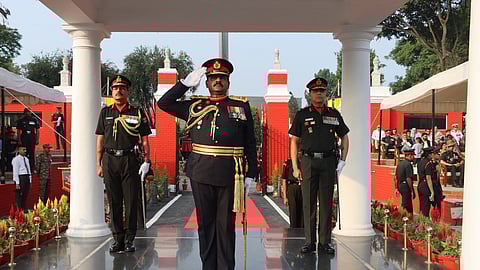
Lieutenant (Lt) General (Gen) BKGM Lasantha Rodrigo at the Indian Military Academy.
Lieutenant (Lt) General (Gen) BKGM Lasantha Rodrigo at the Indian Military Academy. Photo | Special Arrangement
Updated on: 
NEW DELHI: It was an emotional homecoming for Lieutenant General BKGM Lasantha Rodrigo when he arrived at the hallowed portals of the Indian Military Academy.

Now the Commander of the Sri Lankan Army, he returned as the Reviewing Officer for the Passing Out Parade, witnessing the commissioning of a new generation of officers, including foreign cadets from Sri Lanka.

It was in December 1990 that General Rodrigo was commissioned as part of the 87th IMA Course and rose to command one of the most battle hardened armies in the sub-continent.

While addressing the passing out course, General Rodrigo said, "I am deeply honoured and moved to the point of tears to stand before you as the first IMA alumnus to return as the Commander of the Sri Lanka Army and review this parade."

"Looking at your faces, I see my younger self. This place doesn't just train officers; it forges bonds that last a lifetime," he added. He thanked General Upendra Dwivedi and the Indian Army for the invitation.

The Sri Lankan Army chief reflected on how his journey, like that of the officer cadets present, had begun with a simple haircut in the barber chair of the Indian Military Academy.

Reflecting on his own journey, he reminded the cadets that commissioning into the armed forces is not just about earning a rank, but embracing a lifelong way of service, responsibility, and leadership.

Quoting the IMA Credo, the General Officer highlighted the three unshakable responsibilities that every officer must uphold. First, to the nation, second, to their soldiers, and third, to the families of our bravehearts, the Army added.

The General Officer reminded the officer cadets that they now belong to an unbroken chain of patriots and warriors, urging them to wear the uniform not just with pride, but with purpose.

The chief of the Sri Lanka Army said the IMA has not only shaped soldiers but also future guardians of the nation. As their real journey begins, he urges them to lead with wisdom, fight for what's right, and carry the hopes of a billion with pride.

Gen Rodrigo was on a four-day official visit to India, from 11th to 14th June 2025, reinforcing the longstanding and robust military ties between the two Armies.

A total of 451 Officer Cadets of 156 Regular Course, 45 Technical Entry Scheme and 139 Technical Graduate Course, Special Commissioned Officers (SCO-54) including 32 Officer Cadets from nine friendly foreign countries successfully passed out from the portals of the Indian Military Academy.

The institutionalised India-Sri Lanka military ties have not only been able to build professional competence "but also deepened interpersonal and institutional bonds between the two Armies," the Indian Army in a statement said.

India and Sri Lanka conduct bilateral exercise "Mitra Shakti", the flagship Army-level counter-insurgency and counter-terrorism training initiative between the two nations. The 10th edition of the exercise was held in Sri Lanka in August 2024, and it continues to serve as a cornerstone for operational synergy and trust-building between the Armies.

At any given time, approximately 700 Sri Lankan Army personnel are undergoing training at various Indian Army establishments, making Sri Lanka Army the largest foreign participant in Indian military training programmes.

These include prestigious institutions such as the Defence Services Staff College, Infantry School, Counter-Insurgency and Jungle Warfare School, Army Air Defence College, School of Artillery, Armoured Corps Centre and School, Mechanised Infantry Centre and School; and the Indian Military Academy itself.

The commissioning on Saturday took the total number of Sri Lankan Army officers commissioned from IMA to 296, highlighting India's continued role in shaping the leadership of friendly foreign forces.

The Army said, "During his address to the cadets, the General Officer expressed deep honour in reviewing the Passing Out Parade at IMA, calling it a profoundly emotional homecoming."

During his visit, Lieutenant General Rodrigo held detailed discussions with senior leadership of the Indian Army including Vice Chief of Army Staff Lt Gen NS Raja Subramani and GOC-in-C, South Western Command, Lt Gen Manjinder Singh focusing on enhancing professional military cooperation, joint training, and regional security frameworks.

General Rodrigo's visit continues a tradition of regular Army-to-Army engagements between the two nations.

The Commander's visit symbolised more than a routine military engagement. The Army said, "It was a celebration of shared values, mutual trust, and enduring friendship. From reviewing the parade at IMA to holding strategic discussions in Delhi and Jaipur, the visit reflected the Indian Army's pivotal role in building strong defence ties across the Indian Ocean region."🔺

காலநிலை அறிவிப்பு-பேராசிரியர் நா.பிரதீபராஜா

https://www.facebook.com/Piratheeparajah 03.12.2025 புதன்கிழமை பிற்பகல் 3.30 மணி விழிப்பூட்டும் முன்னறிவிப்பு இன்று வடக்கு மற்றும் கிழக்கு ம...