Overnight Iranian missile strikes kill 8, wound more than 100 in Israel
'The residents of Tehran will pay the price, and soon,' Israel's defence minister says
Conflict high on the agenda at G7 meeting of world leaders
Oil prices up, Asian stocks steady
The death toll in Iran was already at least 224, with 90% of the casualties reported to be civilians, an Iranian health ministry spokesperson said.
In Washington, two U.S. officials told Reuters that Trump hadvetoedan Israeli plan in recent days to kill Iran's Supreme Leader Ayatollah Ali Khamenei.
Two U.S. officials said on Friday the U.S. military had helped shoot down Iranian missiles that were headed toward Israel
Emergency personnel work at an impact site after missiles were launched from Iran to Israel, in Tel Aviv, Israel, June 16, 2025. REUTERS/Ronen Zvulun
TEL AVIV/DUBAI/WASHINGTON, June 16 (Reuters) - Iranian missiles struck Israel's Tel Aviv and the port city of Haifa before dawn on Monday, killing at least eight people and destroying homes, prompting Israel's defence minister to warn that Tehran residents would "pay the price and soon".
The dangers of further escalation loomed over a meeting of the Group of Seven leaders in Canada, with U.S. President Donald Trump expressing hope on Sunday that a deal could be done but no sign of the fighting abating on a fourth day of war
Rescue and security personnel work inside an impacted residential building following missile attack from Iran on Israel, central Israel June 16, 2025. REUTERS/Itay Cohen
The latest fatalities in Israel, reported by Israel's national emergency services, raised its death toll to 23 since Friday. Israeli attacks in Iran have killed at least 224 people since Friday, Iran's health ministry has said.
At least 100 more were wounded in Israel in the overnight blitz, part of a wave of attacks by Tehran in retaliation for Israel's strikes targeting the nuclear and ballistic missile programmes of sworn enemy Iran.
Search and rescue operations were underway in Haifa where around 30 people were wounded, emergency authorities said, as dozens of first responders rushed to the strike zones. Fires were seen burning at a power plant near the port, media reported.
Rescuers evacuate an injured woman from an impacted residential building following a missile attack from Iran on Israel, central Israel, June 16, 2025. REUTERS/Itay Cohen
Video footage showed several missiles over Tel Aviv and explosions could be heard there and over Jerusalem. Several residential buildings in a densely populated neighbourhood of Tel Aviv were destroyed in a strike that blew out the windows of hotels and other nearby homes just a few hundred meters from the U.S. Embassy branch in the city. The U.S. ambassador said the building sustained minor damage, but there were no injuries to personnel.
Guydo Tetelbaun was in his apartment in Tel Aviv when the alerts came in shortly after 4 a.m. (0100 GMT).
"As usual, we went into the (shelter) that's right across the street there. And within minutes, the door of the (shelter) blew in," the 31-year-old chef said.
Emergency personnel work at an impact site after missiles were launched from Iran to Israel, in Tel Aviv, Israel, June 16, 2025. REUTERS/Ronen Zvulun
"A couple of people came in bloody, all cut up. And then when we came to the apartment, after it quietened down, we saw there wasn't much of it... Walls are caved in, no more glass," he added.
"It's terrifying because it's so unknown. This could be the beginning of a long time like this, or it could get worse, or hopefully better, but it's the unknown that's the scariest.”
The predawn missiles also struck near Shuk HaCarmel, a popular market in Tel Aviv that typically draws large crowds of residents and tourists buying fresh fruit and vegetables, and to popular bars and restaurants. A residential street in nearby Petah Tikva and a school in ultra-Orthodox Jewish city Bnei Brak were also hit.
Emergency personnel work at an impact site after missiles were launched from Iran to Israel, in Tel Aviv, Israel, June 16, 2025. REUTERS/Ronen Zvulun
'NEW METHOD'
Iran's Revolutionary Guards said the latest attack employed a new method that caused Israel's multi-layered defence systems to target each other and allowed Tehran to successfully hit many targets, without providing further details.
The Israeli Defence Force did not immediately respond to a request for comment on the strikes. There were no reports in Israel of interceptor missiles hitting each other. Israeli officials have repeatedly said its defence systems are not 100% and have warned of tough days ahead.
Emergency personnel work at an impact site after missiles were launched from Iran to Israel, in Tel Aviv, Israel, June 16, 2025. REUTERS/Ronen Zvulun
Israeli Defence Minister Israel Katz said in a statement: "The arrogant dictator of Tehran has become a cowardly murderer who targets the civilian home front in Israel to deter the IDF from continuing the attack that is collapsing his capabilities."
"The residents of Tehran will pay the price, and soon."
The death toll in Iran was already at least 224, with 90% of the casualties reported to be civilians, an Iranian health ministry spokesperson said.
All the fatalities in Israel have been civilians, according to Israeli authorities.
Emergency personnel work at an impact site after missiles were launched from Iran to Israel, in Tel Aviv, Israel, June 16, 2025. REUTERS/Ronen Zvulun
Israel's military said on Monday morning it had struck again at command centres belonging to the Revolutionary Guard and Iran's military.
Emergency personnel operate after missiles were launched from Iran to Israel, in Tel Aviv, Israel, June 16, 2025. REUTERS/Ronen Zvulun
LEADERS MEET
Group of Seven leaders began gathering in the Canadian Rockies on Sunday with the Israel-Iran conflict expected to be a top priority.
German Chancellor Friedrich Merz said his goals for the summit include for Iran to not develop or possess nuclear weapons, ensuring Israel's right to defend itself, avoiding escalation of the conflict and creating room for diplomacy.
The main known facilities of Iran's nuclear programme.
"This issue will be very high on the agenda of the G7 summit," Merz told reporters.
Before leaving for the summit on Sunday, Trump was asked what he was doing to de-escalate the situation. "I hope there's going to be a deal. I think it's time for a deal," he told reporters. "Sometimes they have to fight it out."
Emergency personnel operate after missiles were launched from Iran to Israel, in Tel Aviv, Israel, June 16, 2025. REUTERS/Ronen Zvulun
Brentcrude futureswere up 0.5% in Asian trade on Monday, having surged late last week. While the spike in oil prices hasinvestors on edge,stock and currency markets were little moved in Asia.
"It's more of an oil story than an equity story at this point," said Jim Carroll, senior wealth adviser and portfolio manager at Ballast Rock Private Wealth. "Stocks right now seem to be hanging on."
Firefighters and rescue personel work at an impact site following missile attack from Iran on Israel, in Tel Aviv, Israel June 16, 2025. REUTERS/Itai Ron
TRUMP VETOES PLAN TO TARGET KHAMENEI, OFFICIALS SAY
In Washington, two U.S. officials told Reuters that Trump had vetoed an Israeli plan in recent days to kill Iran's Supreme Leader Ayatollah Ali Khamenei.
When asked about the Reuters report, Israeli leader Benjamin Netanyahu told Fox News on Sunday: "There's so many false reports of conversations that never happened, and I'm not going to get into that."
"We do what we need to do," he told Fox's "Special Report With Bret Baier."
Firefighters and rescue personnel work at an impact site following missile attack from Iran on Israel, in Haifa, Israel, June 15, 2025. REUTERS/Rami Shlush ISRAEL OUT. NO COMMERCIAL OR EDITORIAL SALES IN ISRAEL
Israel began the assault with a surprise attack on Friday that wiped out the top echelon of Iran's military command and damaged its nuclear sites, and says the campaign will escalate in the coming days.
Firefighters and rescue personnel work at an impact site following missile attack from Iran on Israel, in Haifa, Israel, June 15, 2025. REUTERS/Rami Shlush ISRAEL OUT. NO COMMERCIAL OR EDITORIAL SALES IN ISRAEL
Iran has vowed to "open the gates of hell" in retaliation.
Trump has lauded Israel's offensive while denying Iranian allegations that the U.S. has taken part and warning Tehran not to widen its retaliation to include U.S. targets.
A rescue personal walks inside a damaged synagogue at an impact site following missile attack from Iran on Israel, at Zavdiel, Israel, June 15, 2025. REUTERS
Two U.S. officials said on Friday the U.S. military had helped shoot down Iranian missiles that were headed toward Israel
Emergency personnel operate after missiles were launched from Iran to Israel, in Haifa, Israel, June 15, 2025. REUTERS
Trump has repeatedly said Iran could end the war by agreeing to tough restrictions on its nuclear programme, which Iran says is for peaceful purposes but which Western countries and the IAEA nuclear watchdog say could be used to make an atomic bomb.
Emergency personnel operate after missiles were launched from Iran to Israel, in Haifa, Israel, June 15, 2025. REUTERS
Iran's President Masoud Pezeshkian told parliament on Monday Tehran has no intention of building nuclear weapons but it would continue to pursue its right to nuclear energy and research.
Reporting by Reuters; Writing by Howard Goller, Lincoln Feast and Tom Perry; Editing by Saad Sayeed and Gareth Jones🔺
'This place forges bonds for a lifetime': Ex-cadet returns to IMA as Sri Lankan Army chief
Lt Gen Lasantha Rodrigo reminded the officer cadets that they now belong to an unbroken chain of patriots and warriors, urging them to wear the uniform not just with pride, but with purpose.
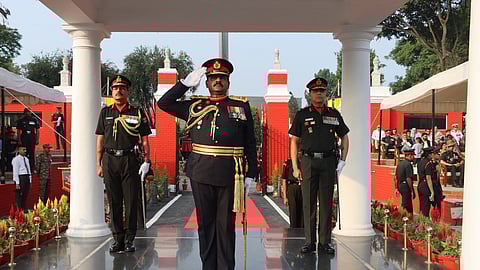
Lieutenant (Lt) General (Gen) BKGM Lasantha Rodrigo at the Indian Military Academy. Photo | Special Arrangement
Updated on: NEW DELHI: It was an emotional homecoming for Lieutenant General BKGM Lasantha Rodrigo when he arrived at the hallowed portals of the Indian Military Academy.
Now the Commander of the Sri Lankan Army, he returned as the Reviewing Officer for the Passing Out Parade, witnessing the commissioning of a new generation of officers, including foreign cadets from Sri Lanka.
It was in December 1990 that General Rodrigo was commissioned as part of the 87th IMA Course and rose to command one of the most battle hardened armies in the sub-continent.
While addressing the passing out course, General Rodrigo said, "I am deeply honoured and moved to the point of tears to stand before you as the first IMA alumnus to return as the Commander of the Sri Lanka Army and review this parade."
"Looking at your faces, I see my younger self. This place doesn't just train officers; it forges bonds that last a lifetime," he added. He thanked General Upendra Dwivedi and the Indian Army for the invitation.
The Sri Lankan Army chief reflected on how his journey, like that of the officer cadets present, had begun with a simple haircut in the barber chair of the Indian Military Academy.
Reflecting on his own journey, he reminded the cadets that commissioning into the armed forces is not just about earning a rank, but embracing a lifelong way of service, responsibility, and leadership.
Quoting the IMA Credo, the General Officer highlighted the three unshakable responsibilities that every officer must uphold. First, to the nation, second, to their soldiers, and third, to the families of our bravehearts, the Army added.
The General Officer reminded the officer cadets that they now belong to an unbroken chain of patriots and warriors, urging them to wear the uniform not just with pride, but with purpose.
The chief of the Sri Lanka Army said the IMA has not only shaped soldiers but also future guardians of the nation. As their real journey begins, he urges them to lead with wisdom, fight for what's right, and carry the hopes of a billion with pride.
Gen Rodrigo was on a four-day official visit to India, from 11th to 14th June 2025, reinforcing the longstanding and robust military ties between the two Armies.
A total of 451 Officer Cadets of 156 Regular Course, 45 Technical Entry Scheme and 139 Technical Graduate Course, Special Commissioned Officers (SCO-54) including 32 Officer Cadets from nine friendly foreign countries successfully passed out from the portals of the Indian Military Academy.
The institutionalised India-Sri Lanka military ties have not only been able to build professional competence "but also deepened interpersonal and institutional bonds between the two Armies," the Indian Army in a statement said.
India and Sri Lanka conduct bilateral exercise "Mitra Shakti", the flagship Army-level counter-insurgency and counter-terrorism training initiative between the two nations. The 10th edition of the exercise was held in Sri Lanka in August 2024, and it continues to serve as a cornerstone for operational synergy and trust-building between the Armies.
At any given time, approximately 700 Sri Lankan Army personnel are undergoing training at various Indian Army establishments, making Sri Lanka Army the largest foreign participant in Indian military training programmes.
These include prestigious institutions such as the Defence Services Staff College, Infantry School, Counter-Insurgency and Jungle Warfare School, Army Air Defence College, School of Artillery, Armoured Corps Centre and School, Mechanised Infantry Centre and School; and the Indian Military Academy itself.
The commissioning on Saturday took the total number of Sri Lankan Army officers commissioned from IMA to 296, highlighting India's continued role in shaping the leadership of friendly foreign forces.
The Army said, "During his address to the cadets, the General Officer expressed deep honour in reviewing the Passing Out Parade at IMA, calling it a profoundly emotional homecoming."
During his visit, Lieutenant General Rodrigo held detailed discussions with senior leadership of the Indian Army including Vice Chief of Army Staff Lt Gen NS Raja Subramani and GOC-in-C, South Western Command, Lt Gen Manjinder Singh focusing on enhancing professional military cooperation, joint training, and regional security frameworks.
General Rodrigo's visit continues a tradition of regular Army-to-Army engagements between the two nations.
The Commander's visit symbolised more than a routine military engagement. The Army said, "It was a celebration of shared values, mutual trust, and enduring friendship. From reviewing the parade at IMA to holding strategic discussions in Delhi and Jaipur, the visit reflected the Indian Army's pivotal role in building strong defence ties across the Indian Ocean region."🔺
Trump’s tariff war brings with it unpredictability and a consequent loss of confidence
MARTIN WOLF FT 10-06-2025
We are living in the early stages of a revolution — the attempted conversion of the American republic into an arbitrary dictatorship. Whether Donald Trump will succeed in this attempt is, as yet, unclear. But what he wants to do seems self-evident. His way of governing — lawless, unpredictable, anti-intellectual, nationalist — will have the greatest impact on the US itself. But it is, inevitably, having a huge impact on the rest of the world, too, given the hegemonic role of the US since the second world war. No other country or group of countries can — or wants — to take its place. This revolution threatens chaos.
It is far too early to know what the full consequences will be. But it is not too early to make informed guesses on some aspects, notably the unpredictability and consequent loss of confidence being created by Trump’s tariff war. This loss of confidence was the theme of a podcast I did recently with Paul Krugman. Without predictable policies, a market economy cannot function well. If the uncertainty comes from the hegemon, the world economy as a whole will not function well either.
In its latest Global Economic Prospects, the World Bank has analysed just this. Its conclusions are inevitably provisional, but the direction of travel must be correct. It starts from the assumption that the tariffs in place in late May will remain over its forecast horizon. This might be too optimistic or too pessimistic. Nobody, perhaps not even Trump, knows. “In this context”, it judges, “global growth is projected to slow markedly to 2.3 per cent in 2025 [0.4 percentage points below the January 2025 forecast]— the slowest pace since 2008, aside from two years of outright global recession in 2009 and 2020. Over 2026-27, a pick-up in domestic demand is expected to lift global growth to a still subdued 2.5 per cent — far below the pre-pandemic decadal average of 3.1 per cent.”
All this is bad enough. But risks seem overwhelmingly to the downside. Thus, the uncertainty created by Trump’s trade war could lead to far greater declines in trade and investment than projected. Certainly, it will be hard to trust in any supposed “deals” now announced. Again, lower growth will increase social, political and fiscal fragility, so raising perceptions of risk in markets. This might create a doom-loop, with higher costs of finance increasing risk and lowering growth. Weak borrowers, private and public, might be driven into default. Shocks from natural disasters or conflict would then be even more economically damaging.
Upsides can be imagined. New trade deals might be reached, in which many might, courageously, trust. AI-fairy-dust might cause a surge in global productivity and investment. Also, everything might just calm down. A difficulty for this is that today’s Trump shock comes after almost two decades of shocks: global and Eurozone financial crises; pandemic; post-pandemic inflation; and Ukraine-Russia war. Animal spirits must have been impaired. Alas, as Indermit Gill, World Bank chief economist, stresses in his foreword, “the poorest countries will suffer the most”. “By 2027, the per capita GDP of high-income economies will be roughly where it had been expected to be before the Covid-19 pandemic. But developing economies would be worse off, with per capita GDP levels 6 per cent lower.” With the exception of China, it might take two decades for these countries to recoup their losses of the 2020s.
This is not just a result of recent shocks. Thus, “Growth in developing economies has been ratcheting downward for three decades in a row — from an average of 5.9 per cent in the 2000s, to 5.1 per cent in the 2010s to 3.7 per cent in the 2020s.” This tracks the declining growth of world trade, from an average of 5.1 per cent in the 2000s to 4.6 per cent in the 2010s to 2.6 per cent in the 2020s. Meanwhile, debt is piling up. In the long run, it will not help that Trump insists climate change is a myth, too.
So, what is to be done? First, liberalise trade. While developing countries have liberalised substantially in recent years, most of them still have far higher tariffs than high-income economies. Targeted infant-industry promotion can work. But if a country has little international leverage, the best policy remains one of free trade, coupled with the best possible policies for attracting investment, improving human capital and preserving economic stability. In a bad environment, as now, this is even more important than in a benign one.
The choices for bigger powers — China, the EU, Japan, India, the UK and others — are more complex. First, they, too, need to improve their own policies to the greatest possible extent. They also need to co-operate in trying to sustain global rules among themselves, not least on trade. Some powers need to recognise that global imbalances are indeed a significant issue, though they are not about trade policy but rather global macroeconomic imbalances.
This is far from all. As the US retreats from its historic role, others are having greatness thrust upon them. Continued progress on addressing the challenges of climate change and economic development depend on these powers. A better way to resolve excessive debts is necessary, for example. That requires going against today’s trend towards ever greater suspicion of one another. It is possible — even likely — that we are witnessing the withering away of a great effort to promote a more prosperous and co-operative world. Some people will say that such an ending would just signal healthy “realism”. But it would be a folly: we share one planet; and so our destinies are intertwined. Modern technology has made this inescapable. We are at a turning point: we must choose wisely.🔴