SHARE

Monday, February 10, 2025

In major win for Trump, PA’s Abbas signs decree ending ‘pay-to-slay’ system

 In major win for Trump, PA’s Abbas signs decree ending ‘pay-to-slay’ system

Reform will bring families of security prisoners and slain terrorists into same welfare system as other Palestinians, be based on economic need; move was largely finalized in Biden era
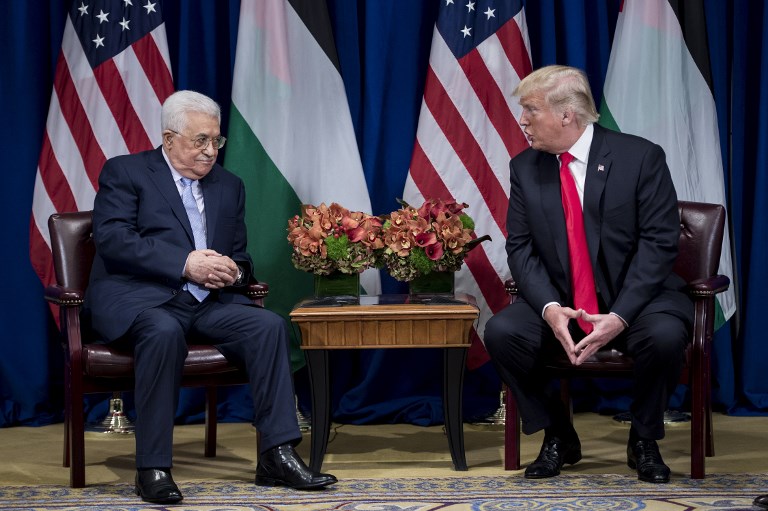
Palestinian Authority President Mahmoud Abbas listens while then-US President Donald Trump makes a statement for the press before a meeting at the Palace Hotel during the 72nd United Nations General Assembly on September 20, 2017, in New York. (AFP/Brendan Smialowski/ File)

WASHINGTON — Palestinian Authority President Mahmoud Abbas signed a decree on Monday canceling legislation that conditioned welfare payments to Palestinian security prisoners on the length of their sentences in Israeli jails, in addition to providing stipends to the families of terrorists killed while carrying out attacks.

The decree states that families of prisoners and slain attackers who require welfare assistance will be eligible for stipends based solely on their financial needs, as is the case with other Palestinians.

Israel and other countries have long denounced the stipends that Jerusalem said actively encouraged terror, with critics dubbing it the “pay-to-slay” system.

The initiative to cancel the stipends had been in the works for years, and its pilot program was even quietly launched toward the end of the Biden administration, a source familiar with the matter told The Times of Israel.

Ramallah presented the reform to the US near the beginning of the previous administration, seeking to bring the PA into compliance with the Taylor Force Act — 2018 congressional legislation that suspended US aid to the PA as long as it continued granting the stipends.

The US then facilitated a dialogue with the Israeli government to explain the contents of the reform, the source said, acknowledging that it was met with skepticism in Jerusalem.

US Deputy Assistant Secretary of State for Israeli and Palestinian Affairs Hady Amr (L) meets with Palestinian Authority President Mahmoud Abbas in Ramallah on May 17, 2021. (Wafa)

There were several points toward the end of the Biden administration’s term in which the PA decision was on the verge of being announced, a second source said, arguing that Israel seemed to be trying to stall the matter. In the months leading up to Hamas’s October 7 onslaught, the Biden administration sought to receive a nod of approval from Israel for the reform, worried that a rejection could lead pro-Israel lawmakers in Congress to follow suit, thereby hampering the reform’s legitimacy in Washington. The second source indicated that Prime Minister Benjamin Netanyahu’s office had dragged its feet on the matter, even as the premier regularly cited the controversial policy to argue that the PA cannot be trusted.

It is unlikely that the reform will satisfy the Netanyahu government, which has pledged to box the PA out of any role in the post-war governance of Gaza.

The Foreign Ministry issued a statement Monday night dismissing the decree “as a new fraudulent exercise by the PA, which intends to continue making payments to terrorists and their families through other channels.”

Israeli law requires the government to conduct a review of the PA’s prisoner payment system at the beginning of every calendar year, so Jerusalem could theoretically wait until early 2026 before deciding whether Ramallah is in compliance with Knesset legislation targeting the PA over its controversial stipends.

The Trump administration may also have different criteria for adjudicating the PA reform, even though it was authorized by career legal bureaucrats under the previous administration.

Biden officials also briefed congressional lawmakers about the reform last year and received support from both sides of the aisle, including Republican Lindsey Graham, the second source said.

The Taylor Force Act requires the US government to review the PA’s compliance every six months.
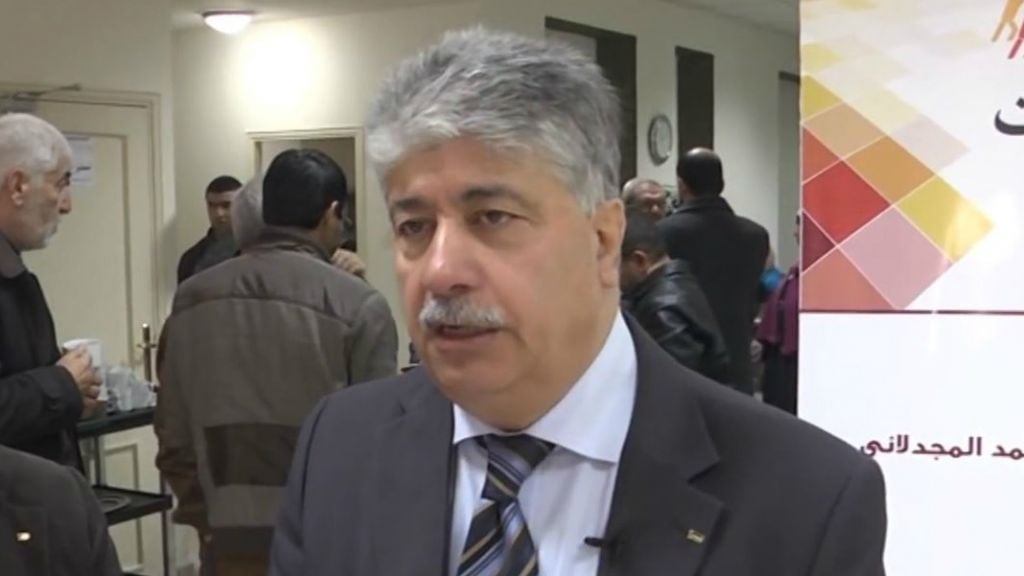
Palestinian Authority Social Welfare Minister Ahmed Majdalani. (Screen capture/YouTube)

According to the text of the decree posted on the official PA news agency WAFA, the program to allocate welfare funds will be transferred from the Social Development Ministry to a new fund called the Palestinian National Foundation for Economic Empowerment.

The fund will be headed by current PA Social Welfare Minister Ahmad Majdalani, according to the second source.

A strict criteria system has been put in place to determine eligibility that will be reviewed twice a year, said the second source.

Many families of prisoners and slain attackers who were receiving government stipends will continue to receive financial aid, given the high poverty rate in the West Bank. This has only gone up further since October 7, with Israel ending its permit system to over 100,000 Palestinians working in Israel and the settlements — a key component of the West Bank’s economy.

The practice of paying allowances to those convicted of carrying out terror attacks, and to the families of those killed while carrying out attacks, has been pilloried by critics as incentivizing terror, and held up by Israel as a symbol of PA corruption and its inability to serve as a partner for peace.

Palestinian leaders have long defended the payments, describing them as a form of social welfare and necessary compensation for victims of what they said is Israel’s callous military justice system in the West Bank.
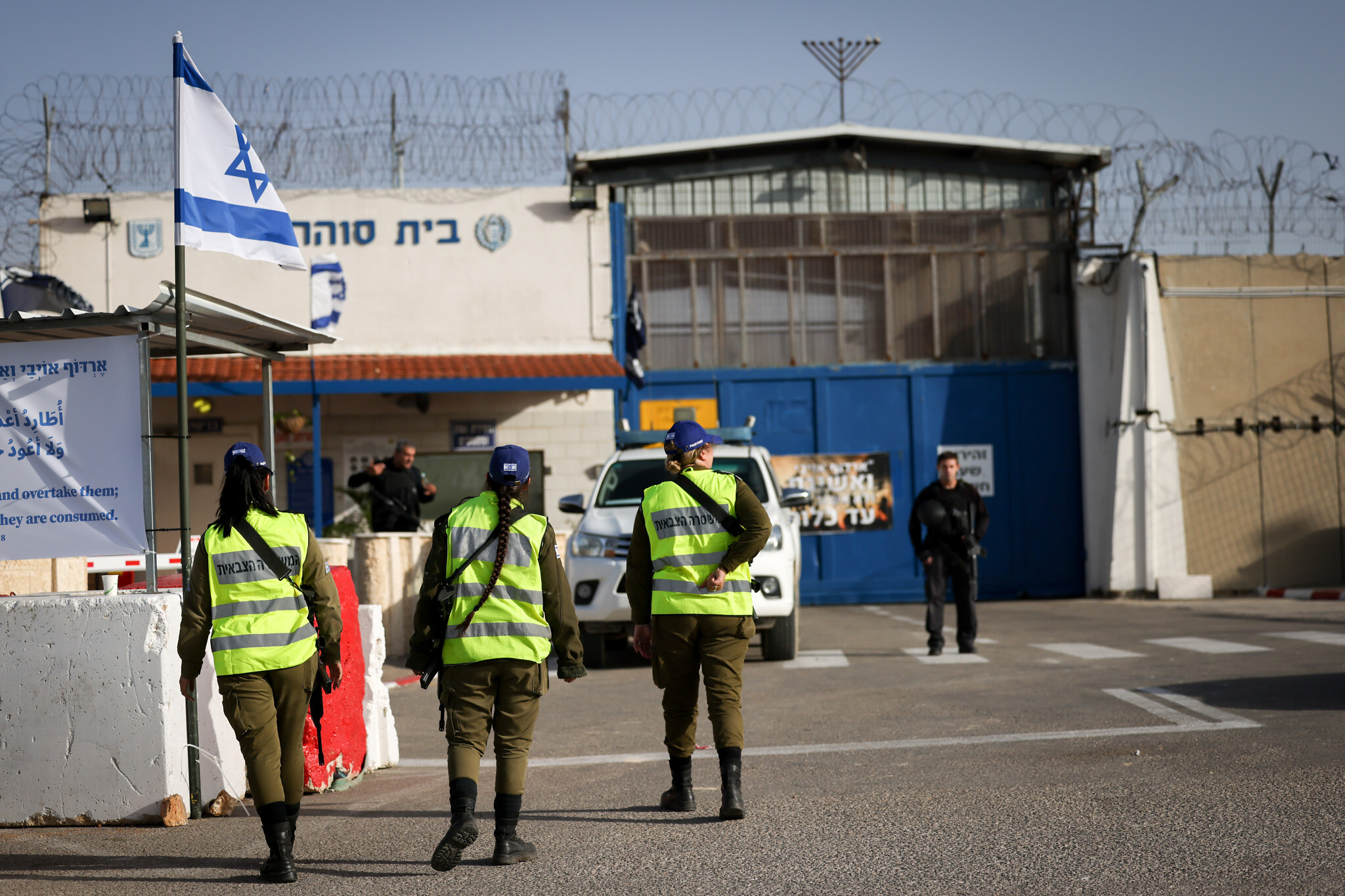
Israel Police stand outside the entrance to Ofer prison, outside Jerusalem, from where Palestinian terror convicts are slated to be released, November 26, 2023. (Yonatan Sindel/Flash90)

Abbas signed the decree as the US Supreme Court prepares to adjudicate a case in the coming months on whether American victims can sue the PA and its international arm, the Palestine Liberation Organization, for damages due to Ramallah’s payments program.

According to the PA, the decree was made in part to “strengthen the status of the state of Palestine” in the UN and other international bodies and gain further international recognition, as well as “with the aim of restoring international aid programs that were suspended in the past year.”

The move was also designed to stop “the illegal deductions” that Israel made from taxes it gathered on behalf of the Palestinian Authority, the decree added. Neither the English nor Arabic version of the announcement made any reference to the Trump administration or to the United States.

Under interim peace accords reached in the 1990s, Israel’s Finance Ministry collects tax revenues on behalf of the PA and makes monthly transfers to Ramallah, but it has withheld funds over the years due to disputes, including, most recently, in the wake of Hamas’s October 7, 2023, onslaught.

In 2018, Israel passed a law requiring that a sum equal to the monthly stipends the PA pays to security prisoners and the families of slain attackers be withheld from the tax revenues it transfers to the Palestinians.

Israel withheld hundreds of millions of shekels from the PA under the legislation, citing the payments. At the same time, Israel has in the past offered loans to the PA in order to keep it afloat and prevent its total breakdown.
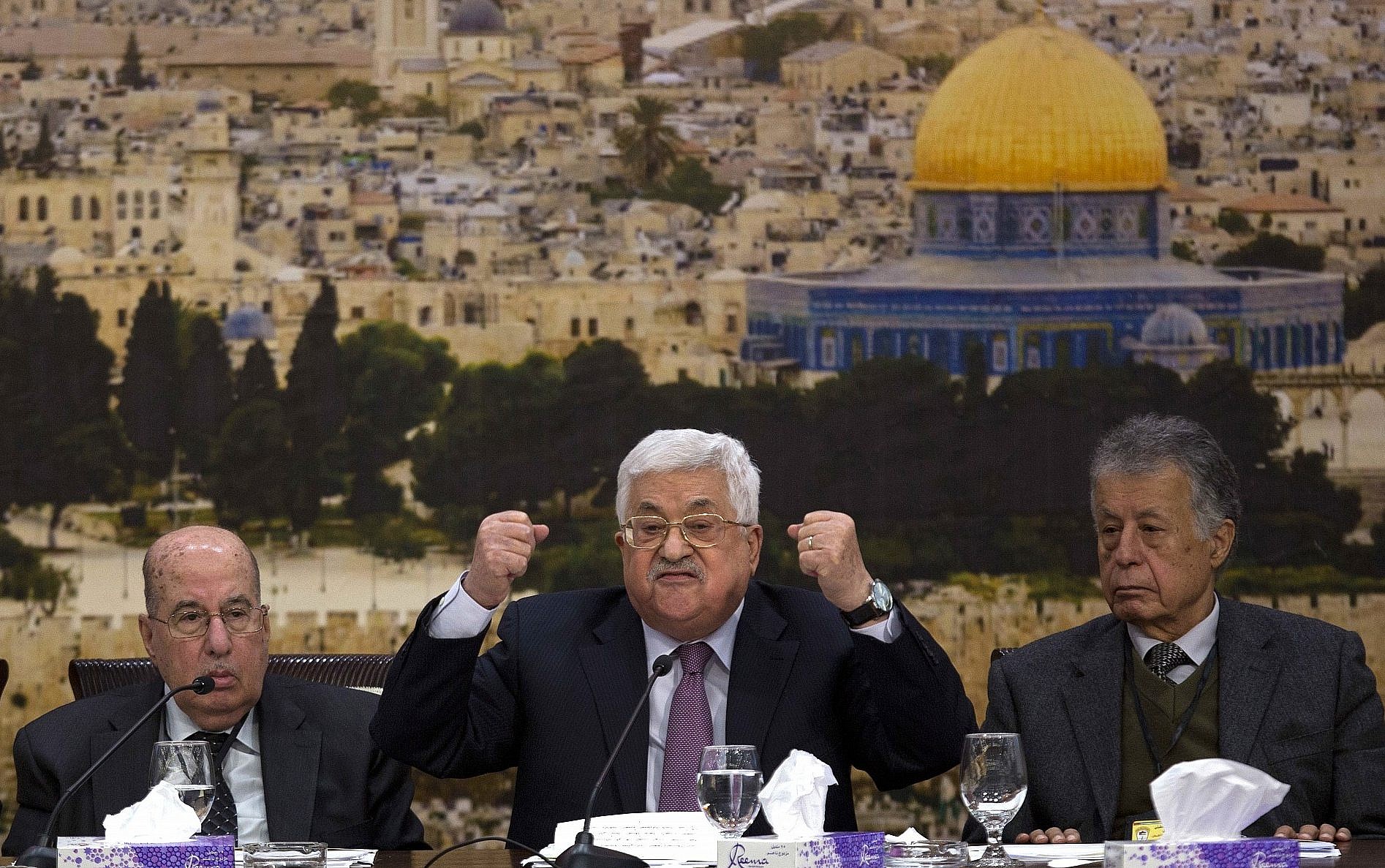
Palestinian Authority President Mahmoud Abbas speaks during a meeting with the Palestinian Central Council, a top decision-making body, at his headquarters in the West Bank city of Ramallah, January 14, 2018. (AP/Majdi Mohammed/File)

While the previous administration believed that the reform would bring the PA into compliance with the Taylor Force Act, the US would still be barred from directly funding the PA, due to separate US legislation preventing such aid once Ramallah began advancing investigations against Israel at the International Criminal Court.

However, the reform would still theoretically be sufficient enough to enable the US to fund projects that directly benefit the PA.

The decree from the PA on Monday noted that the move should also assist with “the new burdens of helping our people in the Gaza Strip.”

While the effort to reform the PA prisoner payment system has been in the works for years, and was largely finalized under the Biden administration, Ramallah decided to hold off on announcing the move, preferring to save it as a goodwill gesture for the incoming Trump administration.

A flag of the United States flies outside the then-US consulate building in Jerusalem, on March 4, 2019. (Ariel Schalit/AP/File)

During the transition between the Biden and Trump White Houses, top PA officials briefed their counterparts in the incoming Trump administration regarding their plan, a third and a fourth source familiar told The Times of Israel on Monday.

However, those two sources believed that the announcement would be put on the back burner following Trump’s declaration last week that he planned to take over Gaza and permanently displace the population. The Gaza proposal sent shockwaves throughout the Arab world, which is now in the middle of a full-throttled campaign against the Trump idea.

A Palestinian official told The Times of Israel during the presidential transition process that Ramallah had learned lessons from the way it dealt with Trump during his first term. Abbas severed ties with the US after Trump recognized Jerusalem as Israel’s capital in 2017, less than a year after taking office. The US proceeded to broker the Abraham Accords, while the Palestinians were left out of the process.

As efforts to include Saudi Arabia in those accords have intensified, Ramallah has worked to boost its ties with Riyadh, hoping that the latter will condition a deal with Israel on a credible and irreversible pathway to a future Palestinian state. Meanwhile, PA officials indicated to Trump aides that they would be prepared to use his 2020 peace plan as a basis for negotiations.

The decree on Monday is Ramallah’s latest effort to improve ties with Washington and amounts to a major victory for Trump, who managed to secure a concession from the PA that repeated US administrations had worked to actualize.🔺

Times of Israel staff contributed to this report.

Sunday, February 09, 2025

Monkeying around with ‘the grid’

Cartoon-Daily Mirror


Monkeying around with ‘the grid’

10 Feb 2025 The Morning

Sri Lankans were once again bitterly reminded that progress is slow in Sri Lanka, even when there is a new political force, with a resounding mandate for ‘system change’ in governance. Last morning’s islandwide power outage, ‘jolted’ Sri Lankans and visitors alike, bringing back memories of a time, when the island’s energy security vulnerabilities were clear and in-your-face. The fact that energy security or lack thereof is one of Sri Lanka’s greatest national security vulnerabilities. However, we do not seem to view it as such, as governments often move at a snail’s pace, when it comes to enacting reforms and structural changes to the national energy landscape, indicating a lack of prioritisation and focus on the matter. The association between national security and energy is a vital one. Today, access to affordable and uninterrupted energy supply has become essential to the functioning of modern economies, and Sri Lanka is no different.

One only needs to look at the energy crisis Europe has been facing, due to over-reliance on Russian sources since the 1990s, only to be caught between a rock and a hard place today, over the conflict in Ukraine and its implications on energy security. Europe has identified the need for diverse energy sources and reinforced their capacity and transmission networks as a matter of national priority, and even work together to network and share resources. However, Sri Lanka which began to reform and restructure the energy landscape of the country over the last few years, moved to roll back many of those plans when the new Government came into power.

🔺Regime change has done little to address an ‘energy mafia’ that plagues the nation. 

As of last evening, there is no clear explanation about why the islandwide outage occurred, except for a vague, and almost laughable statement which states that there was an ‘emergency situation’ that broke out at the Panadura Grid Sub Station, which the Ministry of Energy claims caused an islandwide outage which lasted nearly 7 hours. The Minister of Energy Kumara Jayakody, issuing a press release last evening passed the buck on to the many previous governments (a well-established political tactic in Sri Lanka) claiming that: “Preliminary investigations have indicated that the actions of the previous governments, who had acted without foresight and understanding of maintaining the stability of the national electricity system, and their lack of understanding the technology, led to this situation.”

Last month, The Sunday Morning reported on the vulnerabilities in the national grid due to poor planning and stumbling in the absorption of renewable energy sources. The Ceylon Electricity Board (CEB) was facing a serious risk of system failure during holidays due to the sudden influx of solar-based Renewable Energy (RE) into the grid, particularly when electricity demand is low. “CEB Chairperson Dr. Tilak Siyambalapitiya, addressing this concern, revealed plans to mitigate such risks through an incentive-based electricity tariff system. This mechanism will encourage industries to operate on holidays, thereby stabilising demand and reducing strain on the system,” The Sunday Morning reported. According to the report, the system faced risks when renewable energy flooded the local grid, explaining that the lack of RE storage facilities was a significant factor. A CEB official had highlighted that rooftop solar generation at the household level surged into the system during long holidays when energy consumption was low. “As of now, we manage the system by controlling firm energy capacities, but since RE generation is unpredictable, sudden surges can still pose a risk to the entire system,” the official explained, adding that shortages could be managed by generating more electricity, but excess rooftop solar generation flowed directly into the system without any control, creating a risk of failure. If this was the case, why were there no planning and risk-reduction measures initiated? Why did the CEB not address this issue as a priority if they saw the threat on the horizon?

    It is no secret that the CEB and their ‘engineer’ clan have shown little or no enthusiasm to add renewable energy sources to the national energy mix. The energy ‘establishment’ has long resisted the push to bring onboard more renewable energy into the energy mix that fuels and powers the island nation. Some, including two former ministers of power and energy, have gone as far as to allege attempts and acts of ‘sabotage’ by the energy bureaucracy of Sri Lanka to kill renewable energy plans in the crib. Today, some observers and energy experts continue to question the ‘establishments’ negative approach to renewables, pointing out the regime change has done little to address an ‘energy mafia’ that plagues the nation.🔺  

Poverty in post-crisis Sri Lanka still a concern


Poverty in post-crisis Sri Lanka still a concern

09 Feb 2025 | By Maneesha Dullewe

While there has been a reduction in poverty figures along with Sri Lanka’s gradual restoration of macroeconomic stability following the economic crisis, much work remains to be done to empower vulnerable populations to break free of the cycle of poverty. 

Poverty rates, as per the official poverty line measured by the Department of Census and Statistics (DCS), have declined from a high of 28.8% in 1995/’96 to 4.1% in 2016. 

According to the DCS, Sri Lanka’s official poverty line, defined as the minimum expenditure per person per month to fulfil basic needs, has fallen from Rs. 16,524 in December 2023 to Rs. 16,191 as of December 2024, which is nevertheless an increase from Rs. 16,017 in November 2024 and Rs. 15,994 in October 2024.

Accordingly, the minimum required monthly income for a family of four to meet basic needs is Rs. 64,764.

The DCS notes that the official poverty line increased due to the lower National Consumer Price Index (NCPI) value reported in December 2024 compared to preceding month.

University of Peradeniya (UOP) Department of Economics and Statistics Professor of Economics Dileni Gunewardena highlighted that Sri Lanka had been following a standard methodology to calculate the poverty line and to estimate poverty since 2002. 

“In addition, in 2019, the official poverty line was updated and is based on 2012 spending patterns, which are not vastly outdated. The poverty line is updated monthly based on the cost of living index, and to the extent that this is accurately measured, there is no concern about the accuracy of poverty figures. 

“The World Bank (WB) also provides estimates of poverty based on higher poverty lines, which gives us a sense of the incidence of poverty if we use a more generous definition of poverty.”

While the Centre for Poverty Analysis (CEPA) notes that Sri Lanka has achieved substantial reduction in monetary and multidimensional poverty in the last 25 years, aspects of poverty also undergo changes, for instance following the recent the Covid-19 pandemic. 

Prof. Gunewardena told The Sunday Morning that based on WB poverty estimates, there had been a slight reduction in poverty figures, which “makes intuitive sense given that the economy has been picking up between 2022 and 2024”.

“The main source of poverty estimates since 2019 are the WB analyses, which are based on 2019 data with some assumptions about how prices have changed and how the distribution of income has changed,” she noted. 

Accordingly, the estimates of the headcount index (percentage of the population that is poor) are as follows:


2019 – 11.3%, 2020 – 12.7%, 2021 – 13.1%, 2022 – 25%, 2024 – 23.4%

When contacted, the World Bank referred The Sunday Morning to its Sri Lanka Development Update of October 2024, which notes that while positive growth, low inflation, a steady exchange rate, and improved fiscal and external balances throughout 2024 have contributed to greater stability and a nascent recovery, poverty remains high and Labour Force Participation (LFP) continues to decline. As such, the WB notes that poverty is projected to have tripled in urban areas.

Contributory factors 

Leading to the present conditions of poverty, according to Prof. Gunawardena, are the rising cost of living; job losses that followed the economic crisis, especially in the informal sector; and the somewhat sluggish recovery in 2023. 

“What we know from studies done during Covid-19 and during the economic and political crises of 2022 is that food insecurity was high. Families were cutting back on food, health, and education. 

“We can also expect that children born during 2021-2023 are also likely to have higher malnutrition than in typical years, because of the poorer nutrition of their mothers during pregnancy. These are the effects of the rise in poverty that are pernicious and have long-term consequences,” she said. 

The World Bank similarly notes: “Human development outcomes have deteriorated in the face of high poverty and falling LFP. Households’ budgets have shrunk since 2019, leading to increases in malnutrition and child mortality. The effects of the crisis have been felt across the country and affected households not considered vulnerable before 2019.” 

Moreover, in addition to worsening job losses, wages have contracted by 16.9% and 22% in the informal private and public sector, respectively, between July 2021 and 2024, leading to generalised worsening of living conditions, including deteriorating health outcomes.

The WB also points out that while reforms were undertaken to restore macroeconomic stability, they nevertheless imposed additional burdens on the poor, meaning that

“crisis-induced poverty increased by 9.6 percentage points between 2019 and 2023”. 

Poverty alleviation

Meanwhile, speaking to The Sunday Morning, Minister of Rural Development, Social Security, and Community Empowerment Upali Pannilage stressed that the Government’s priority in terms of addressing poverty was to tackle rural poverty and empower these communities while moving away from dependency on subsidies. 

Explaining the Government’s policy stance, he said: “As a policy, we have identified rural poverty as a priority. In order to eliminate rural poverty, the rural economy must be strengthened. To this end, we will soon be launching a national programme; the basic plan has been formulated and it has been presented to Cabinet.”

However, Pannilage pointed out that there would continue to be vulnerable segments among these communities which would be difficult to empower, such as the elderly, who would continue to receive subsidies. 

“We are providing relief to targeted segments – the poorest of the poor. Programmes are also operational to eradicate poverty in general, since it cannot be done through subsidies alone. However, since people have been suffering due to the economic crisis for some time, many have been stricken by poverty,” he stated. 

Accordingly, he pointed out that the Government had increased the ‘Aswesuma’ monthly benefit allowance currently granted to poor and extremely poor categories from Rs. 8,500 to Rs. 10,000 and from Rs. 15,000 to Rs. 17,500, respectively. 

Moreover, since the transitional poor are yet to emerge from their poverty levels, the benefit period has been extended by three months until 31 March. 

Addressing further relief measures, Pannilage noted that the Government had also taken steps to provide fuel subsidies to fisheries communities, increase allowances for pensioners, and provide relief to schoolchildren. 

“In this manner, relief measures are ongoing, targeting the poorest in society. Alongside this, our main target is empowering the families that have been identified as extremely poor through the Samurdhi Development Department, moving away from the mentality of depending on subsidies alone,” he noted. 

According to the Minister, this programme has commenced and the Government’s aim is to empower 400,000 families through it this year, helping these individuals to rise from poverty through various programmes that will facilitate foreign employment, self-employment, etc.  

Addressing what is needed to ensure sustained poverty reduction, Prof. Gunawardena outlined the need for policymakers to consider both programmes to alleviate poverty as well as broader policies to strengthen the economy and to broad-base economic growth. 

According to her, reforms aimed in this direction need to focus on improved revenue mobilisation, improved targeting of welfare benefits, and structural reforms aimed at job creation and increasing LFP. 

“In terms of ‘Aswesuma’ or any similar welfare benefit scheme, the Government needs to find ways of reducing the mistargeting that has very clearly taken place in the past. The best way to do this is to minimise the need for human intervention and let poor people communicate their poverty through their expenditure patterns. 

“In addition, strengthening the economy by encouraging foreign direct investment as well as service sectors like hospitality and tourism will generate the kinds of jobs that engage people from low-income households,” she said. 

Prof. Gunawardena further highlighted the importance of improving both physical and social infrastructure to “make good use of the best resource we have, which is our people”. 

“To release our well-educated female labour force from unpaid household work, we need to improve care infrastructure – childcare and elder care as well as for care for persons with disabilities,” she asserted.🔺

Economic future hinges on skilled workforce, entrepreneurial growth: Deputy Minister


Deputy Minister Chathuranga Abeysinghe

Economic future hinges on skilled workforce, entrepreneurial growth: Deputy Minister

Daily FT Monday, 10 February 2025


  • Distinguishes between ‘lifestyle businesses’ and ‘serial entrepreneurship’; says 90% entrepreneurs earn below Rs. 10 m annually
  • Calls for rural businesses to connect with high-value industries than just encouraging participation
  • Identifies boatbuilding as promising sector requiring skilled workforce across multiple trades
  • Urges SMEs to focus on value-added exports than internal competition
  • States Govt. to introduce sector-specific strategic blueprints within six months and Rs. 50 b SME funding pool via Development Bank initiative with major State banks
  • Offers unsecured Rs. 1 m startup loans, contingent on financial discipline and feasibility planning 
  • Introduces Credit Guarantee scheme covering 70% of loan risks to encourage SME lending at lower interest rates

By Charumini de Silva

Industry and Entrepreneurship Development Deputy Minister Chathuranga Abeysinghe stated that the Government is shifting its focus towards encouraging entrepreneurship and enhancing workforce skills to drive economic growth.

Speaking at the recently concluded Sri Lanka Economic Summit 2025, he outlined a strategic vision aimed at bridging skill gaps, enabling rural entrepreneurs and integrating local businesses into the global supply chain.

Abeysinghe highlighted a crucial distinction between ‘lifestyle businesses’ — small-scale ventures primarily for self-sustenance and ‘serial entrepreneurship’, which contributes significantly to economic expansion.

Citing available data, he said 90% of country’s entrepreneurs generate below Rs. 10 million annually (US$3400), raising the question of whether they are ‘true business owners’ or simply ‘earning a living’.

“What we need is a model that does more than just encourage economic participation. The goal should be to create businesses in rural areas that are directly linked to high-value industries,” he said. 

One such promising sector he outlined is boatbuilding, where Sri Lanka has demonstrated strong potential over the past few years. The Deputy Minister emphasised the need for a supply chain of skilled workers from rope makers to electrical engineers and painters to support the industry’s growth.

🔻90% of country’s entrepreneurs generate below Rs.10 million 

(US$3400) annually, raising the question of whether they are ‘true business owners’ or simply ‘earning a living’.

Given the country’s strategic location and expanding demand for maritime services, Abeysinghe believes that Sri Lanka can emerge as a key player in regional boat manufacturing and marine tourism.

The Deputy Minister underscored the need for businesses to integrate into global supply chains rather than merely competing within the domestic market. “Although the SMEs contribute significantly to the gross domestic production (GDP) growing at around 5% annually, most local businesses are engaged in internal competition rather than value-added exports,” he disclosed.

Looking ahead, the Deputy Minister said the Government is also focusing on long-term industrial planning, with a commitment to developing sector-specific strategic blueprints. 

Abeysinghe asserted that within six months, each major industry should have a clear roadmap defining its growth trajectory, energy efficiency targets, workforce requirements and competitive positioning. 

“We need clarity on where each industry is heading, what they aim to become — their short and long term goals and how the Government will support them,” he said.

He said this collaborative approach will ensure that both private sector and policymakers are aligned on economic priorities.

Abeysinghe pointed to industries such as coconut, rubber and agriculture, which offer vast untapped potential for value-added exports if businesses can scale effectively. “The Government is therefore prioritising knowledge-sharing, capacity building and better connectivity between rural SMEs and global markets,” he added.

He stressed access to finance and operational space is a major challenge for startups and SMEs. “Many entrepreneurs invest heavily in land and buildings before their businesses are fully established, leading to financial strain,” he said.Noting that the country lacks a comprehensive loan scheme for startups that do not own any assets, Deputy Minister revealed that the Government is working on a Development Bank initiative, bringing together major banks — People’s Bank, National Savings Bank (NSB) and Regional Development Bank (RDB) and others, to create a Rs. 50 billion SME funding pool. “This initiative will offer startups unsecured loans of Rs. 1 million, provided they meet certain financial discipline requirements such as proper accounting, feasibility studies and training completion,” he explained.

In addition, he disclosed a Credit Guarantee Scheme is in the works, where 70% of loan risks will be covered to encourage banks to lend to SMEs at lower interest rates.

According to him, another pressing issue is informality in the SME landscape, with 70-80% of businesses operating outside the formal economy—limiting their ability to access financing and global markets.

He said the Government is introducing incentives for formalisation, including a performance-based rating system that links business growth to better credit access and market opportunities.

“By offering clear advantages for businesses to register and follow structured development programs, the Government aims to incentivise SMEs to move from informal survival businesses to scalable enterprises,” he added.🔺

President calls on exporters to seize new opportunities to lead economy

President calls on exporters to seize new opportunities to lead economy

FT Monday, 10 February 2025 


In address at 26th Presidential Export Awards, reaffirms Govt.’s support for export sector 

Awards recognise 14 major winners and 51 companies 

Stresses importance of trust between SL and international economic stakeholders 

Advocates strategic trade agreements that align with national interests than aggressive trade policies 

Acknowledges country’s weak market position, need for external support 

Highlights Govt. initiatives to provide technical assistance, improve product quality 

Emphasises renewable energy investments, lower electricity tariffs to boost competitiveness 

President Anura Kumara Dissanayake on Friday urged exporters to seize new opportunities and drive economic recovery, stating the need for strategic engagement in global markets. 

Addressing the 26th Presidential Export Awards at the Bandaranaike Memorial International Conference Hall (BMICH) last Friday, he reaffirmed the Government’s commitment to supporting exporters as they rebuild the economic future.

The Presidential Export Awards, initiated in 1981 by the Sri Lanka Export Development Board (EDB), recognise exporters who make significant contributions to the economy. The latest edition honoured 14 major award winners and 51 companies across the production and service sectors, with recipients gaining the right to use the Presidential Export Award logo for three years as a global marketing tool.

Dissanayake reiterated his commitment to fostering an export-driven economic recovery, asserting the importance of trust between Sri Lanka and international economic stakeholders.  He assured exporters that their concerns would be addressed and invited them to work alongside the Government to strengthen the economy.

“The Government’s role is to facilitate the conditions for success, but it is the exporters who must take the lead in rebuilding the country’s economic future,” he said.

Dissanayake also underscored the interconnected nature of the global economy, insisting that Sri Lanka must compete strategically for market share rather than adopting aggressive or reckless trade policies. 

He called for well-structured trade agreements that align with Sri Lanka’s national interests, cautioning against hasty decisions that could have long-term economic consequences.

The President acknowledged the country’s weak market position, noting that external support was necessary to regain lost ground. 

He stressed that economic stabilisation efforts had created a foundation for recovery and the Government was prepared to assist exporters in leveraging these for long-term growth. 

Recognising the pressures faced by exporters, the President highlighted initiatives to provide technical assistance and support for high-quality product development. 

He also outlined the Government’s focus on renewable energy, stating that lower electricity costs would contribute to the long-term competitiveness of Sri Lankan industries.

The awards ceremony was attended by several distinguished individuals, including Industry and Entrepreneurship Development Minister Sunil Handunneththi, Labour Minister and Economic Development Deputy Minister Prof. Anil Jayantha Fernando, Energy Minister Kumara Jayakody, Industry and Entrepreneurship Development Deputy Minister Chathuranga Abeysinghe, Industry and Entrepreneurship Development Ministry Secretary Thilaka Jayasundara, EDB Chairman Mangala Wijesinghe, Senior Adviser to the President Duminda Hulangamuwa, along with exporters, other Ministers, Deputy Ministers, Parliamentarians, foreign diplomats, Ministry Secretaries, and officials of the EDB.

Overall Awards 2023/24

1.Best SME Exporter - eMarketingEye Ltd. 2. Emerging Exporter - Link Natural Products Ltd. 3. Woman Exporter - Ashok Garments Ltd. 4. Best Performing Exporter in Emerging Markets - MAS Holdings  5. Contributor from the Regions to the Export Supply Chain - MAS Holdings 6. Innovative Export Service - OREL IT Ltd. 7. Innovative Export Product - Dipped Products PLC 8. Contributor to Sustainable Development in Exports - MAS Holdings 9. Best Value-Added Exporter - Sysco LABS Technologies Ltd.10. Best Exporter in Product Diversification - MAS Holdings11. Market Diversified Exporter - Dilmah Ceylon Tea Company PLC 12. Globally Outreached Sri Lankan Brand - Akbar Brothers Ltd.13. Net Foreign Exchange Earner - MAS Holdings14. Exporter of the Year - MAS Holdings🔺

காலநிலை அறிவிப்பு-பேராசிரியர் நா.பிரதீபராஜா

https://www.facebook.com/Piratheeparajah 03.12.2025 புதன்கிழமை பிற்பகல் 3.30 மணி விழிப்பூட்டும் முன்னறிவிப்பு இன்று வடக்கு மற்றும் கிழக்கு ம...