Sri Lanka spy chief sacked, agency returns to police control
Saturday October 5, 2024 7:19 pm
ECONOMYNEXT – The head of Sri Lanka’s State Intelligence Service (SIS) was sacked on Saturday, and the premier spy agency was brought back under the control of the police after nearly five years.
Retired Major General Suresh Sallay was dismissed after he refused to resign following the takeover by the new government of President Anura Kumara Dissanayake, an official source involved in the shake-up told Economynext.
Police Deputy Inspector General Dhammika Priyantha, who had earlier served at the CID/FCID, was appointed as the director of the SIS, bringing the agency back under the police’s jurisdiction.
The SIS had shifted to military control under Gotabaya Rajapaksa’s presidency, but his successor, Ranil Wickremesinghe, not only retained the controversial Major General Sallay but also re-employed him after his retirement.
Gotabaya Rajapaksa had blamed Sallay’s SIS for intelligence failures that led to his downfall in July 2022, following months of street protests against acute shortages of food, fuel, and medicines amid the country’s worst economic crisis.
Sallay was present, along with other service chiefs, when Rajapaksa was forced to flee the President’s House in Colombo as mobs of protesters stormed it on July 9, 2022.
Sallay had failed to alert Rajapaksa about a group of women storming Rajapaksa’s private home on March 31, 2022, an event that marked a turning point leading to his eventual downfall. Rajapaksa disclosed the intelligence failures of Sallay in his book,
The Catholic Church had repeatedly urged successive governments to take action against Sallay, who was accused of involvement in the Easter Sunday bombings of April 2019.
A British newspaper reported in September 2023 that Sallay had orchestrated the Easter Sunday bomb plot while working for the Directorate of Military Intelligence, with the aim of creating instability to pave the way for the Rajapaksas to return to power.
The Times newspaper said that the deadly bombings, which killed at least 280 people, including 45 foreign nationals, were orchestrated by Sri Lanka’s military intelligence.
Sallay was promoted to head of the State Intelligence Service shortly after Gotabaya Rajapaksa came to power in November 2019. He was recently given a one-year service extension by President Ranil Wickremesinghe, and when it ended, he was re-employed as a retired officer.
Islamic extremists set off suicide bombings at two Catholic churches, a Christian church, and three hotels. The attacks were later claimed by the Islamic State group.
Sallay has denied the allegations and has counter-sued Catholic priests who accused him. He has also filed a civil defamation case against Yasmin Sooka, a former South African chief justice, who accused Sallay of masterminding the bombings.
The Criminal Investigation Division (CID), then headed by Ravi Seneviratne, concluded that the Directorate of Military Intelligence (DMI) where Sallay employed had attempted to mislead those investigating the April 2019 bombings.
Seneviratne’s team of detectives, led by Shani Abeysekera, also found a direct link between DMI operatives and several suicide bombers involved in the most audacious terror attack in the country’s history.
With Seneviratne now heading the Public Security Ministry as its secretary and in charge of the police department, investigations into the Easter Sunday attacks have resumed⍐.
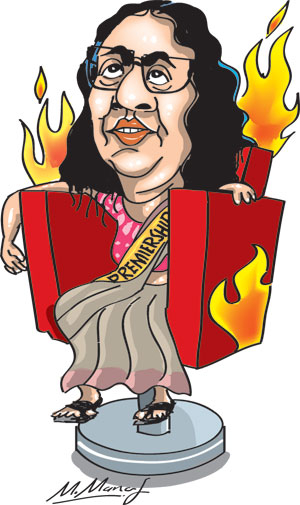
I can see that you are a very busy lady these days, burdened as you are with the duties of your many ministries and, of course, being Prime Minister. I thought I must still write to you to congratulate you. After all, it is only about once in every 30 years or so that we choose a female Prime Minister!
We did start the trend with the first female Prime Minister in the world with Sirima but I would still say you deserve a special mention. Not to take anything away from what your two female predecessors have done, but they were both thrust into those positions only after their husbands were assassinated.
In contrast, you were appointed to this position because of who you are and not whose who you are. It was also a refreshing change because, for many decades, we have been used to presidents appointing prime ministers based not on merit but depending on who was least likely to be a threat to them.
Some will say it was good fortune that got you to the hot seat. After all, Anura sahodaraya didn’t have much of a choice. It was only between you and Vijitha. We must admire Vijitha too because he has been fully supportive of your appointment. That is not what we would have seen in any other party.
There are always critics too. One chap says you don’t represent the typical ‘Sri Lankan female’. We can’t expect anything intellectual from one who produces snakes from the Kelani River at one election and thinks eating ‘roti’ will win him the next. Thankfully, the typical Sri Lankan male is not like him!
Then there is Champika, belittling the mandate your party received. His curious logic is that, since Anura sahodaraya polled only 42 per cent of the vote, 58 per cent of voters were against him. He should then try telling Sajith that since only a third of voters voted for him, two-thirds were against!
Despite all this whingeing, Harini, I think it was a smart move by Anura sahodaraya to appoint you as PM. He is from the ‘original’ rathu sahodarayas, you are from the ‘maalimaaawa’. By having you in power and in place, he is now able to attract a different type of person to vote for the ‘maalimaawa’.
Your appointment was hailed in many quarters, and not because you have a PhD. You were a dignified voice of reason in a parliament where we heard the rowdy rants of Diana, Geetha and Pavithra. You are also not a senile politician awaiting retirement who is usually made PM. You can still contribute.
Only two weeks ago, we had one of the largest Cabinets in the world with ministers, deputies and state ministers. There was also a time when we had non-Cabinet ministers, senior ministers, project ministers and ministers without a portfolio. Now, we possibly have the smallest Cabinet in the world.
That is most welcome but people who voted for you expect more. They want a clean government, to restore law and order and for you to keep that promise of ‘catching thieves’ – and that is not done by parading dozens of government vehicles at Galle Face, even if it is Rosy’s termite infested Porsche!
Yes, they will expect you to solve their economic problems too. Yet, since no one else was able to do so before you, they will give you time for that if you show that you are doing your best and running a government that is not corrupt. If you achieve that, you would have changed the ‘system’ by then.
Most governments are allowed a ‘honeymoon’ period, where whatever it does is applauded. Yours hasn’t been afforded that luxury. Every decision you take is scrutinised and criticised. That maybe because you promised a ‘pure’ regime during your campaign. So beware, the snipers are already out.
The next election is in a few weeks. Your party needs a comfortable majority in Parliament. Your greatest advantage is the state your rivals are in. The Greens are bickering with the former Greens, the Blues are fighting the Blues and the ‘pohottuwa’ is split into three camps. What more can you ask for?
We hope you don’t follow the ‘yahapaalanaya’. They too promised a ‘good’ government but, by the time the general election was held, they were in disarray. The ‘maalimaawa’ (Compass திசையறி கருவி) must now live up to the hype they created. Remember, you may have won the presidential battle but the war is far from over.
That crucial election which will decide whether Anura sahodaraya can govern in comfort is on the 14th of November. If the ‘maalimaawa’ does secure a majority, it will be a historic win. It will also be 35 years and one day since the demise of the man who started it all, Rohana sahodaraya.
Already, some wonder whether you will still be PM after that election. I am sure you are not bothered about that because you see the office you hold not as an ornament but as a great responsibility and a job you have to do. We sincerely wish you well, Harini, do keep up the good work.
Yours truly,
Punchi Putha
PS: You may not know, Harini, but you are following JR’s footsteps. You are the second Bishopian to become PM. He was the first. He began school there, not at Royal. We hope you will live up to your schools’ motto: “Not for self, but for all”. In hindsight, what JR did was “Not for all, but for self”!
AKD Govt. faces ground realities in governance and economic recovery while chaos reigns in Opposition
06 Oct 2024| Black Box By Capt. Vasabha The Morning
AKD tells IMF third review can be after Parliamentary Polls; Jaishankar told project discussions also after polls
Next tranche under IMF’s EFF likely to be delayed till 2025; Govt. seeks some changes within existing parameters
IMF and Paris Club OCC consultations on debt restructuring conclude; approval granted to ISB holders’ deal
AKD’s meetings with foreign envoys witness issues in translations; Govt. yet to formulate foreign policy direction
President Anura Kumara Dissanayake (AKD) and his Government were no doubt awakened to the ground realities in governance as well as the country’s precarious economic situation following the many meetings held by the new President last week with India’s External Affairs Minister Dr. S. Jaishankar, members of the International Monetary Fund (IMF), and envoys representing several key foreign nations.
The one thing that all these meetings highlighted was that Sri Lanka was at an economic crossroads and that the new President would have to tread carefully to ensure recovery and not let Sri Lanka slide back to 2022.
The AKD Government will definitely have to give prominence to foreign policy, given the increasing engagements required in Sri Lanka’s recovery path. Geopolitical sensitivities will also have to be given special focus, given the preconceived notion that being a Leftist Government, there could be more alignment with the Chinese, while neighbouring India keeps a close watch after playing a significant role in assisting Sri Lanka’s economic recovery programme by way of financial aid as well as intervening to secure the IMF programme for Sri Lanka and the debt restructuring programme.
Unfortunately, it is reliably learnt that there have been concerns over translations during the President’s meetings with the foreign envoys last week. Several foreign envoys had realised that what they were articulating to AKD had not been fully translated to the President. A continuation of such a scenario could lead to complications in foreign relations. It is also learnt that the AKD Government is yet to grasp the need for a foreign policy direction, relying mostly on the Ministry of Foreign Affairs (MFA) for current engagements.
However, there was also good news that came out on Friday (4) night: the announcement of the successful completion of the IMF and Official Creditor Committee (OCC) of the Paris Club consultation process on Sri Lanka’s debt restructuring programme.
Accordingly, the Government on Friday night announced: “The Democratic Socialist Republic of Sri Lanka (‘Sri Lanka’) is pleased to announce that, following the Agreement in Principle (AIP) reached with representatives of its international and local holders of International Sovereign Bonds (ISBs) on 19 September 2024, the Sri Lankan authorities have now completed their consultations with Sri Lanka’s OCC and the IMF regarding the compliance of the AIP terms with the Comparability of Treatment (CoT) principle and the parameters of Sri Lanka’s IMF-supported programme.”
The Sri Lankan Government had also received confirmation from the IMF staff that the AIP terms met programme parameters under the Extended Fund Facility (EFF) arrangement second review macro framework, when considered in conjunction with the restructuring of official claims in line with the terms agreed with the OCC and China’s Export-Import (Exim) Bank in June.
The Government’s announcement also notes: “Following the Presidential Election held in Sri Lanka on Saturday, 21 September, and the appointment of the new Government on 25 September, the Sri Lankan authorities confirm their endorsement of the programme debt targets and the AIP terms as announced on 19 September and confirm their intention to expedite the implementation of the ISBs’ restructuring transaction in line with these terms.”
It is however learnt that the AKD Government is looking at the possibility of revisiting Sri Lanka’s deal on debt treatment with ISB holders. Although a final decision has not been reached on the matter, President AKD’s Janatha Vimukthi Peramuna (JVP)-led National People’s Power (NPP) was critical of the deal reached between the ISB holders and the then Ranil Wickremesinghe Government just days before the September Presidential Election.
Also of concern would be the delay in conducting the third review of Sri Lanka by the IMF team until after the 14 November Parliamentary Election. This will effectively mean a delay in the disbursement of the next tranche under the EFF programme to Sri Lanka until next year.
In the event the IMF review is carried out towards mid- to end-November, the report might not be included in the IMF Executive Board schedule for December, before the holiday season. The review report will then be taken up by the Executive Board in January 2025.
Meanwhile, the AKD Government’s economic team that met with the IMF team last week is also expected to travel to Washington, DC towards the end of this month to discuss the changes being proposed by the new Government within the parameters of the ongoing programme.
An IMF delegation led by Asia Pacific Department Director Krishna Srinivasan met with President AKD on Thursday (3) and Friday to discuss the ongoing EFF programme. An IMF team led by Peter Breuer met with AKD’s economic team that will spearhead the negotiations with the fund from now on. This team will however include two members from the previous team – Central Bank Governor Dr. Nandalal Weerasinghe and Finance Ministry Secretary Mahinda Siriwardana.
In all these meetings, the new Government emphasised the need for the inclusion of welfare schemes and reducing the tax burden on the masses within the existing parameters of the programme. The IMF, it is learnt, had agreed that the proposals could be looked at while giving priority to State revenue targets.
The IMF meanwhile has warned there are important vulnerabilities and uncertainties in Sri Lanka. IMF Communications Department Director Julie Kozack said that sustaining the reform momentum in Sri Lanka was critical.
On October 1st, Iran launched another ballistic missile attack on Israel, and unlike last time, this time a large number of Iranian ballistic missile systems appear to have impacted various target areas in Israel. Here is what we know so far: Iran launched around 180 ballistic missiles, and this time they used some of their most advanced designs. Unlike the strikes in April, which appear to have been conducted mainly using older, liquid-fueled Scud derivatives like the Emad missile, Iran launched a large number of their more modern solid-fueled systems as well. My former colleague Sam Lair over at CNS has been going around looking at Iranian missile bases for evidence of launches, and so far we know that Iran launched solid-fueled missiles from several bases including Tabriz and liquid-fueled missiles from their missile base in Shiraz. The targets, according to Iran, included various Israeli air defense radar installations, two airbases (Nevatim Airbase and Tel Nof Airbase) and Mossad headquarters in Glilot. Of these it seems the strike on Mossad headquarters in Glilot was the least successful. We only saw two impacts, and the one impact that landed even remotely near the headquarters building did so about 520 meters away from the building itself.
The strikes at Tel Nof and Nevatim seem to have been much more successful. We don’t have imagery of Tel Nof yet, but there is social media footage of warheads raining down on the base, and some seemed to have caused secondary explosions, which is good evidence that they likely hit something worth hitting. As soon as we have imagery of Tel Nof myself and the crew at CNS will start counting.
We got some high resolution imagery of one of the targets, Nevatim Air Base, that our friends at Planet Labs snapped on October 2nd. Its worth talking about the imagery at length. Yesterday Jeffrey, his crew over at CNS, and myself conducted a battle damage assessment on Nevatim Air Base, and we count at least 33 likely impact craters, with likely more impacts currently obscured by clouds. It may shake down that Iran hit the base with something like 40 warheads. Big shout out to Sam Lair, Michael Duitsman, and the rest of the crew for doing some good geospatial work on this problem.
Here’s the image Jeffrey posted. Before going further it’s worth pausing on this for a moment. Last time Iran tried to hit Nevatim back in April, they only got 5 warheads through, and those warheads were pretty spread out and didn’t hit much of interest. I had an argument with Jeffrey at the time about what sort of target points they would be aiming at. Jeffrey, under the reasonable assumption that the liquid-fueled missiles like Emad that Iran uses aren’t that accurate (an assessment I think I agree with) made the argument that likely Iran aimed a single target point. I disagreed with him at the time about the number of target points, and the slightly clustering effect here seems to support the tentative conclusion that Iran probably aimed at multiple points. There is a slight clustering effect at several important targets, like the airborne refueling aircraft hangars and the F-35 shelters. But more data is needed to come to a specific conclusion. It’s possible that Iran aimed at a single aim point back in April, but this time had multiple aim points because they were using different missiles. Iran used more modern systems for this strike – they appear to have used their latest Fattah and Kheibar Shekan missiles, which are solid-fuel and have maneuvering warheads. The Fattah is especially sophisticated as it has a powered warhead. There are some people attempting to use this analysis to claim that Iranian missiles have an accuracy of 500 meters, and I would hold off on that given how much we don’t know about what they targeted.
Another important thing to note is that airbases are really hard targets. The vast majority of an airbase is empty land and most of the things you probably wanna hit are pretty spread out. The Russians didn’t have all that much luck hitting Ukrainian airbases for much the same reason. In order to be very effective at destroying aircraft, you have to be very, very precise, and most missiles simply don’t have that accuracy.
So what did they hit? Well, not much. Most of the impact zones either missed entirely or simply hit the taxiways around the base, most of which has now been repaired. They did score some hits on one refueling aircraft hangar and a couple buildings.
There’s a slight cluster effect in this area where Israeli stores a large number of aircraft unprotected, which again may be an indication that Iran aimed at this area specifically, or Iran simply got very lucky that they had such good cluster in such a high value area.
One support building at the south end of the base took a hit from a missile, but the hit wasn’t centered on the building, and only part of the building was destroyed.
Lastly, the 3 meter imagery shows likely serious damage to a building on the eastern side of the base, likely used for something like maintenance. The damage to those three structures are the most obvious pieces of serious damage Iran’s strike inflicted. From there we move on to the F-35 shelters, which appear to have mainly weathered the storm.
Two near misses here, with impact craters apparent on either side of one of the rows of F-35 shelters. A third hit a little further away off the image. Should demonstrate that the lack of serious damage to the facilities here at Nevatim was as much luck as it was due to the relative inaccuracy of Iranian missiles.
Jeffrey pointed out that one of the F-35 shelters does appear to have sustained some damage, perhaps even a direct hit. There’s what might be a small hole in the roof of the shelter, and a large amount of concrete dust on the roof. But the shelter itself seems to still be intact. It could either be that the warhead that landed here was a dud and didn’t explode or Israeli aircraft shelter construction techniques contain explosions really well. It is notable that this shelter still has its doors closed, unlike most of the other shelters, possibly because its damaged and not in use.
The rest of the impacts did not hit much of anything, and many landed further down the runway. A friend is working on a theory as to why this is that I will talk about next time when its a little fleshed out.
So what does all this tell us? There’s still a lot we don’t know about the overall strike, but I think some data can be pulled from this. We cannot state much about the overall effectiveness of Israeli air defense. We know Israel launched a large number of interceptors, and we can see footage of those interceptors intercepting SOMETHING beyond the atmosphere, but we don’t know how effective they were as a whole system. But the fact remains that over 30 missiles impacted Nevatim, and I don’t think that’s because Israel did not intercept missiles they thought were going to miss. As the imagery of the F-35 shelters show, many of the misses here at Nevatim were only meters away from something worth hitting, and it seems unlikely that Israel can determine the impact points of maneuvering missiles while they are still traveling through the mid-course down to 5 meters.
We also don’t know much about the specific capabilities Iranian missiles have at maneuvering to defeat Israeli missile defense. Perhaps some of the Iranian missiles did manage to bamboozle Israel’s missile defense grid, but without hard data on that, there’s not much we can say.
We also don’t know why Nevatim was hit much harder than Glilot. It’s possible that Israel prioritized intercepting missiles heading for Glilot as Glilot is within an urban area. This if true lends credence to the idea that Israel was either genuinely overwhelmed by missiles, or they simply chose to conserve their interceptors for another day. Both may be true.
Regardless of which may be true or truer than the other, the core fact remains that Iran has proven it can hit Israel hard if it so chose. Airbases are hard targets, and the sort of target that likely won’t produce many casualties. Iran could choose a different target – say, a densely packed IDF ground forces base, or a target within a civilian area – and a missile strike there would produce a large number of causalities.
There’s also the long term conflict problem Israel has now. Interceptors are more expensive than ballistic missiles, and Iran is dramatically expanding their production facilities for ballistic missiles at all three sites they produce missiles at. The disparity between the rate at which Israel can produce interceptors and the rate at which Iran can produce ballistic missiles will likely swing in Iran’s favor, which suggests that Iran could, in a longer missile campaign or a protracted war, simply continually spit missiles at Israel until Israel does not have any interceptors left.
This has always been the enduring problem with missile defense – once you build up a defensive shield and identify the number of missiles you want to intercept, your adversary is going to simply build more missiles. I’ve been convinced that theater missile defense generates off-ramps in conflicts, but this argument only works in conflicts where the actors CAN back away, which is why I still think the argument doesn’t really work at the nuclear strategic level. It also depends on the personality in question at the head of a state wanting to take an off-ramp, and unfortunately, we’re talking about Israel here.
So despite the mockery of Iran’s missile accuracy, my personal takeaway is the opposite of what people seem to be concluding about this whole episode: Iran has proven that its missiles are effective and that they can indeed hurt Israel. No one should be fooled that Iranian missile accuracy (or lack thereof) means the Iranian missile force is some sort of paper tiger. A different target would produce different results. Whether or not Israel will feel deterred by this revelation is another story that depends on the Israeli domestic political climate and the personalities within the Israeli government. Given that Israel seems to have already publicly committed to striking Iran, this is likely not the last time we will see exchanges of missiles. My concern is that this will be, in the long term, an exchange that Israel won’t be able to afford to make if this becomes a protracted conflict⍐.