

Friday, November 24, 2017

Tax Haven Cash Rising, Equal To At Least 10% Of World GDP
Cross-border wealth management first developed in Switzerland in the 1920s, but until the 1980s there was no other country where one could easily hide assets.

Tax Haven Cash Rising, Now Equal To At Least 10% Of World GDP
 |
Kenneth Rapoza , CONTRIBUTOR
I cover business and investing in emerging markets.
Opinions expressed by Forbes Contributors are
their own.
|
That's because the equivalent of at least 10% of the world's GDP is in offshore banks, and that number is probably higher due to the opaqueness of the world's global tax havens, according to a research report release this month by the National Bureau of Economic Research. In other words, there is much more money out there than economists thought, and it is increasingly concentrated in the hands of the world's richest people.
The percentage of household wealth held in offshore accounts ranges widely from country to country from the equivalent of a couple points of GDP in China, to about 15% in Europe, and as high as 60% in some Persian Gulf and Latin American countries, report authors found. The study uses these estimates to construct a revised series of top wealth percentage holders in 10 countries, which has their net worth equal to about half of the world's GDP, the NBER study states.
"Because offshore wealth is very concentrated at the top, accounting for it increases the top 0.01% wealth share substantially in Europe, even in countries that do not use tax havens extensively," the report abstract says. Offshoring is huge in Russia, where the vast majority of wealth is held in foreign bank accounts. The paper suggests national economists look beyond tax and census survey data to truly understand wealth accumulation among the world's one-percenters.

The data is not entirely complete.
Offshore banks and countries known as tax havens rarely publish informative statistics about their account holders. It is not entirely clear if most of the wealth held offshore is owned by rich Westerners, or if it belongs to rich people from developing countries with a history of economic instability and high inflation. If so, as last year's Panama Papers data dump revealed, the question is how much of it belongs to corrupt politicians and is derived from criminal sources? How much belongs to a broader segment of the population just looking for tax relief? Is most of it off shore just to hide it from tax authorities, or are people setting up these accounts for non-tax reasons, such as preparing to set up a presence in another country, or for buying real estate.
For the report's authors, tax haven wealth is a key issue that helps understand the rise of income inequality. It is likely to become even more important in the future, as trends in global wealth and stateless entities are rising. As these trends increase, so will the use of off shore banking.
After the Sept. 11 terrorist attacks in the U.S., President George W. Bush and congress signed the USA Patriot Act to crack down on offshore tax havens. It had some impact on traditional shelters that did not report account holders assets to tax authorities: Switzerland is not as big as it once was, as other offshore centers provide it with ample competition. The Patriot Act has not put a dent in off-shoring capital.
 |
| National Bureau of Economic Research. |
Switzerland And Beyond
The Swiss central bank has been publishing a country-by-country breakdown of the wealth owned by foreigners in Swiss banks annually since the 1970s. The data cover all the banks located in Switzerland, including the subsidiaries of foreign banks, but excluding the subsidiaries of Swiss banks abroad. But they only provide information on a specific type of account, known as fiduciary deposits. These are large accounts and believed to be representative of the offshore wealth managed by Swiss banks.
The problem with cracking this number is that a large fraction of the money held in Switzerland belongs on paper to shell companies, trusts, foundations, and personal holding companies incorporated in other tax havens. A significant percentage of the offshore wealth managed by Swiss banks belongs to people whose primary accounts, or entities, are based in the British Virgin Islands, Panama, or Jersey.
The use of shell companies increased after 2005 following the EUs Savings Tax Directive, a tax on interest income earned by EU residents in Switzerland and other tax havens. Because the tax did not apply to accounts nominally owned by shell companies, savvy investors were advised to shift their assets into shell companies.
The biggest Swiss bank account holders are nationals of: Russia, Saudi Arabia, United Arab Emirates, Spain, France, Belgium, Argentina, Venezuela, Egypt and Jordan.
Most tax havens compile statistics on who owns the money. For instance, Switzerland worked with Brazil law enforcement to provide evidence that accounts held in family names belonged to a top congressman named Eduardo Cunha. He had lied about having $5 million in that account, money that was earned through a bribe scandal. He is now in prison.
In 2016, many off-shore centers authorized the Bank for International Settlements to disseminate bilateral banking statistics -- like the amount of deposits owned by Brazilians in Switzerland. This series of data is retrospective, and goes back in most cases to the early 2000, giving researchers enough evidence now as to how much the rich own in terms of world wealth.
As of August 2017, Guernsey, Hong Kong, the Isle of Man, Jersey, Luxembourg, Macao, and Switzerland reported bilateral current and historical banking statistics through the BIS. A number of offshore centers still did not, most notably the Bahamas, Singapore, and the Cayman Islands.
 |
| National Bureau of Economic Research. |
Cayman is a favorite of U.S. high net worth individuals, and is used as a holding company base for U.S. companies, the NBER report states.
Taking offshore wealth into account increases the rise in inequality seen in tax data. All the available evidence suggests that once offshore wealth is factored in, the top one percent of wealth share is now significantly higher than previously thought.
The NBER report was conducted by three professors from the University of California at Berkeley, the University of Copenhagen and the Norwegian University of Life Sciences.
Tax havens barely existed before World War I, when the direct taxation of income and wealth was in its infancy and top marginal tax rates did not exceed a few percentage points. Cross-border wealth management first developed in Switzerland in the 1920s, but until the 1980s there was no other country where one could easily hide assets. Now there are many, and all of them are flourishing despite the political rhetoric, and even political will, to at least crack down on money laundering and
serial tax evaders.
Find me on Twitter at @BRICBreaker
Thursday, November 23, 2017

Monday, November 20, 2017
கபடதாரி சீமானின் ஈழத் தமிழ் ஆதரவு அரசியல் வேடம், அம்பலம்!

Seemans political cheekiness குட்டான்களின் குரல்
----------------------------- தொடர்ந்து ஒலிக்கும் ---------------------------

Friday, November 17, 2017
Israel and Saudis: Best of Friends?
 Israel and Saudis: Best of Friends?
By Stephen Lendman
Global Research, November 17, 2017
They’re strange bedfellows, allies of convenience against a common adversary – Iran for its sovereign independence and opposition to their hegemonic ambitions.
In an unprecedented interview with London-based, Saudi-owned Elaph.com, IDF chief of staff Gadi Eizenkot said Israel is willing to share intelligence with Riyadh.
He claimed with Trump as US president,
“there is an opportunity for a new international alliance in the region and a major strategic plan to stop the Iranian threat.”
“We are ready to exchange experiences with moderate Arab countries and exchange intelligence to confront Iran.”
Riyadh and Tel Aviv share “many common interests,” he added, calling Tehran the region’s “biggest threat.”
Eisenkot lied claiming Tehran aims “to control the Middle East by means of two Shiite crescents. The first from Iran through Iraq to Syria and Lebanon, and the second from Bahrain through to Yemen until the Red Sea.”
“This is what must be prevented in the region. In this matter, there is complete agreement between us and the kingdom of Saudi Arabia, which has never been our enemy. It has not fought us nor have we fought it.”

Israel admits to a working relationship with Saudi Arabia

Israel admits to a working relationship with Saudi Arabia
It turns out that something can bring two adversaries together: Iran
JEREMY BINCKES 11.17.2017•2:55 PM
The political situation in the Middle East is now, officially, a lot more complex than initially thought.
Israel is openly admitting that the country has been working with Saudi Arabia in military matters. The two countries, which don't have diplomatic ties, have found that there's a common adversary to deal with: Iran.
Israel's military chief told a Saudi newspaper that Israelis and Saudis were in agreement that Iran was the "largest threat to the region," per the Israeli newspaper Haaretz.
The news isn't surprising to anyone who has closely followed Middle East politics. Israel and Saudi Arabia both have a common enemy in Iran. Israel has claimed that Iran causes an existential threat to its existence — Iran has funded the anti-Israel group Hezbollah, which the U.S. considers a terrorist organization — while Saudi Arabia has been fighting a proxy war with Iran in Yemen, which until recently, has had American consent.
For two countries that have had a long history of tensions between them, notice of an alliance, no matter how small, represents a big step. As NBC noted, there's significant risk of blowback, especially for Saudi Arabia, which has claimed to be the standard-bearer for a strain of Islam that has spread through the world:
An Israeli-Saudi alliance would also be vastly unpopular on the Arab street given the ongoing occupation of the West Bank and Gaza.
"An alliance with Israel will definitely hurt the Saudis and their allies," said Hassan Hassan, an author and Middle East expert with the Tahrir Institute for Middle East Policy in Washington. "It makes sense for them on the geopolitical level but not internally or on the social level."
"The paradox is that Saudi Arabia and others want to counter Iran through an alliance with Israel, but failing to stand up to Iran and then align with Israel is ticking all the boxes of a bad policy" . . .
The stakes are much higher for Saudi Arabia than Israel. The Saudis remain reluctant to publicly acknowledge or accept that relations are, indeed, improving. It's unlikely that any relationship will be formalized in the absence of Palestinian statehood — a condition the Saudis have demanded for years. But under the table, both sides agree that the enemy of your enemy is your friend.
Indian farmers bury themselves to protest land acquisition deal

Indian farmers bury themselves to protest land acquisition deal
Nita Bhalla
READNEW DELHI (Thomson Reuters Foundation) - Scores of farmers in western India have buried themselves neck-deep in the ground or are sitting in trenches to protest against what they say is meager financial compensation from authorities keen to build housing on their land.
More than 50 farmers - men and women - from the desert state of Rajasthan began their protest two days ago, claiming local authorities had forcibly acquired their land at rates dating back to 2010 and called for increased compensation.

Television pictures from Nindar village, about 15 km (10 miles) from the fort city of Jaipur, showed about a dozen men standing in narrow pits dug up to their necks, and scores of women sitting in trenches as crowds gathered round.
“We are here to demand (a) better rate for our land. What the government is offering us is not enough. The cost of land is much higher than it was before,” an elderly farmer, wearing a colorful turban and standing in a narrow pit, told the NDTV news channel on Wednesday.
Officials from the Jaipur Development Authority, which has acquired the land to build a housing project as part of the expansion of the popular tourist city, were not immediately available to comment on the protest.
The villagers have been holding demonstrations for better compensation since mid-September, but there has been no response from the government, they said.

This is not the first time farmers have staged dramatic protests to draw attention to their plight.
In March, drought-hit and debt-ridden farmers from the southern state of Tamil Nadu traveled to New Delhi in a protest where they displayed the skulls of fellow farmers believed to have committed suicide, and placed live rats in their mouths.
Reporting by Nita Bhalla @nitabhalla, Editing by Lyndsay Griffiths. Please credit the Thomson Reuters Foundation, the charitable arm of Thomson Reuters, that covers humanitarian news, women's rights, trafficking, property rights, climate change and resilience. Visit news.trust.org Our Standards:The Thomson Reuters Trust Principles.
Waiting for India’s response: Pakistan on J&K dialogue

Waiting for India’s response: Pakistan on J&K dialogue
Pakistan last week announced that the wife of Jadhav, who has been sentenced to death by a military court, can meet him “purely on humanitarian grounds.”
Islamabad, Publish Date: Nov 16 2017 11:47PM | Updated Date: Nov 16 2017 11:47PM
Pakistan on Thursday said it has offered to resume a dialogue with India on Jammu and Kashmir, Siachen, Sir Creek and other pending issues and was awaiting a response from New Delhi.
Foreign Office spokesperson Muhammad Faisal said that it was also awaiting India’s reply on Pakistan’s offer to allow alleged Indian spy Kulbhushan Jadhav to meet his wife.
Pakistan last week announced that the wife of Jadhav, who has been sentenced to death by a military court, can meet him “purely on humanitarian grounds.”
The spokesman expressed concern over recent cruise missile tests conducted by India, complaining that Pakistan should have been informed prior to the tests.
He termed the tests a potential threat to peace in the region.
The spokesman said there was no response from India on Pakistan’s Lt Col. (retd) Habib Zahir, who went missing in Nepal earlier this year.
Habib went missing from Lumbini, a Nepalese town near the Indian border, on April 6 soon after arriving in Nepal. (IANS)
Zimbabwe crisis
 |
| The rivalry between First Lady Grace Mugabe talks to Vice-President Emmerson Mnangagwa led to a military intervention in Zimbabwe [Reuters] |
Veterans of the war of independence are highly influential in the army and the ruling party.
Mugabe has regularly removed veterans from posts in Zanu-PF in recent years, replacing them with officials who did not fight in the war.
Who are the key players in the Zimbabwe crisis?
15 Nov 2017
Robert Mugabe
Robert Mugabe was born on February 21, 1924, in what was then known as Rhodesia but is now called Zimbabwe.
The former school teacher, with seven university degrees, first came to prominence after waging a bloody guerrilla war against white colonial rulers, who jailed him for 10 years over a "subversive speech" he made in 1964.
Soon after his release from jail in 1974, he caused a seismic shift in Rhodesian politics, riding a wave of popular outrage against the colonial establishment.
He fought in Rhodesia's war for independence and became prime minister in 1980 of the newly independent country born from that conflict.
The new state was renamed Zimbabwe and Mugabe later assumed the presidency in 1987.
He married his current wife and Zimbabwe's First Lady, Grace Mugabe, in 1996.
Since then, he has won a series of controversial elections marred by accusations of vote rigging, most significantly the 2008 vote, which he allegedly lost to now-Prime Minister Morgan Tsvangirai, sparking political violence that human rights groups say claimed over 200 lives.
While his supporters say he speaks for the poor; his critics say he has become increasingly authoritarian.
Mugabe's rule has so far culminated in a massive economic crisis in Zimbabwe, once one of Africa's richest countries.
Grace Mugabe
Born in 1965 in South Africa, Grace Mugabe has been the first lady of Zimbabwe since she married President Robert Mugabe in 1996.
She is 41 years younger than her husband and was known for her expensive shopping habits and charity work before taking an active role in the country’s ruling party, Zanu-PF, in which she leads the women’s division.
Her extravagant lifestyle has been a source of discomfort in Zimbabwe where many face severe economic hardship.
Grace Mugabe is said to be working to succeed Mugabe and her main rival to the presidency, Vice President Emmerson Mnangagwa was sacked by her husband in November 2017, leading to the military intervention.
She recently sued Zimbabwean newspaper, The Standard, after it published Wikileaks cables, which claimed she took huge kickbacks from diamond mines in Zimbabwe.
The University of Zimbabwe awarded her a doctoral degree in Sociology in 2014, two months after she started the course, sparking outrage among academics in the country.
He fought in the country’s war of independence and was arrested in 1965, subsequently spending the next ten years in prison.
After he was freed, he was deported to Zambia, where he studied and practiced law, in addition to serving as Zanu-PF's secretary in Lusaka.
He became the special assistant to Mugabe in 1977, heading both the military and civil divisions of the party.
After independence, Mnangagwa became the first minister for national security and held various positions during his political career, ending up as vice president in 2013.
As a veteran of the war of independence and a powerful figure in Zanu-PF, he was seen as a possible successor to Mugabe.
Mnangagwa was removed from government by Mugabe in November 2017 for allegedly plotting against the incumbent leader and later fled to South Africa.
The vice president commanded the support of the army and veterans of the war of independence.
On November 15, the army took over the headquarters of the state broadcaster ZBC and blocked access to government offices, but denied a coup was underway.
ZNA was formed after independence in 1980, through the integration of the former Rhodesian army, Zimbabwe African National Liberation Army, Zimbabwe African People's Union and the Zimbabwe People's Revolutionary Army. The latter three fought the war of independence against the government in the seventies.
The army's mission statement is "to defend the sovereignty, territorial integrity and national interests of Zimbabwe and to contribute to international peace and security".
The Zimbabwean government claimed in 2007 that it foiled an alleged coup involving hundreds of soldiers and high-ranking officers.
Independence war veterans
Veterans of the war of independence are highly influential in the army and the ruling party.
Mugabe has regularly removed veterans from posts in Zanu-PF in recent years, replacing them with officials who did not fight in the war.
As a result, relations with the president the veterans soured and many vowed to form a front in opposition to Mugabe, backing Mnangagwa In the power struggle between the vice-president and Grace Mugabe within Zanu-PF.
Before November's takeover, some army generals publicly said that they will not allow someone who did not fight in the independence war to rule the country after Mugabe, seemingly a reference to Grace Mugabe.
Right after the military intervention, Chris Mutsvangwa, the head of the war veterans' group Zimbabwe National Liberation War Veterans Association (ZNLWVA), issued a statement, praising the army for "a bloodless correction of gross abuse of power".
The statement said the army will return Zimbabwe to "genuine democracy".
Subscribe to:
Posts (Atom)
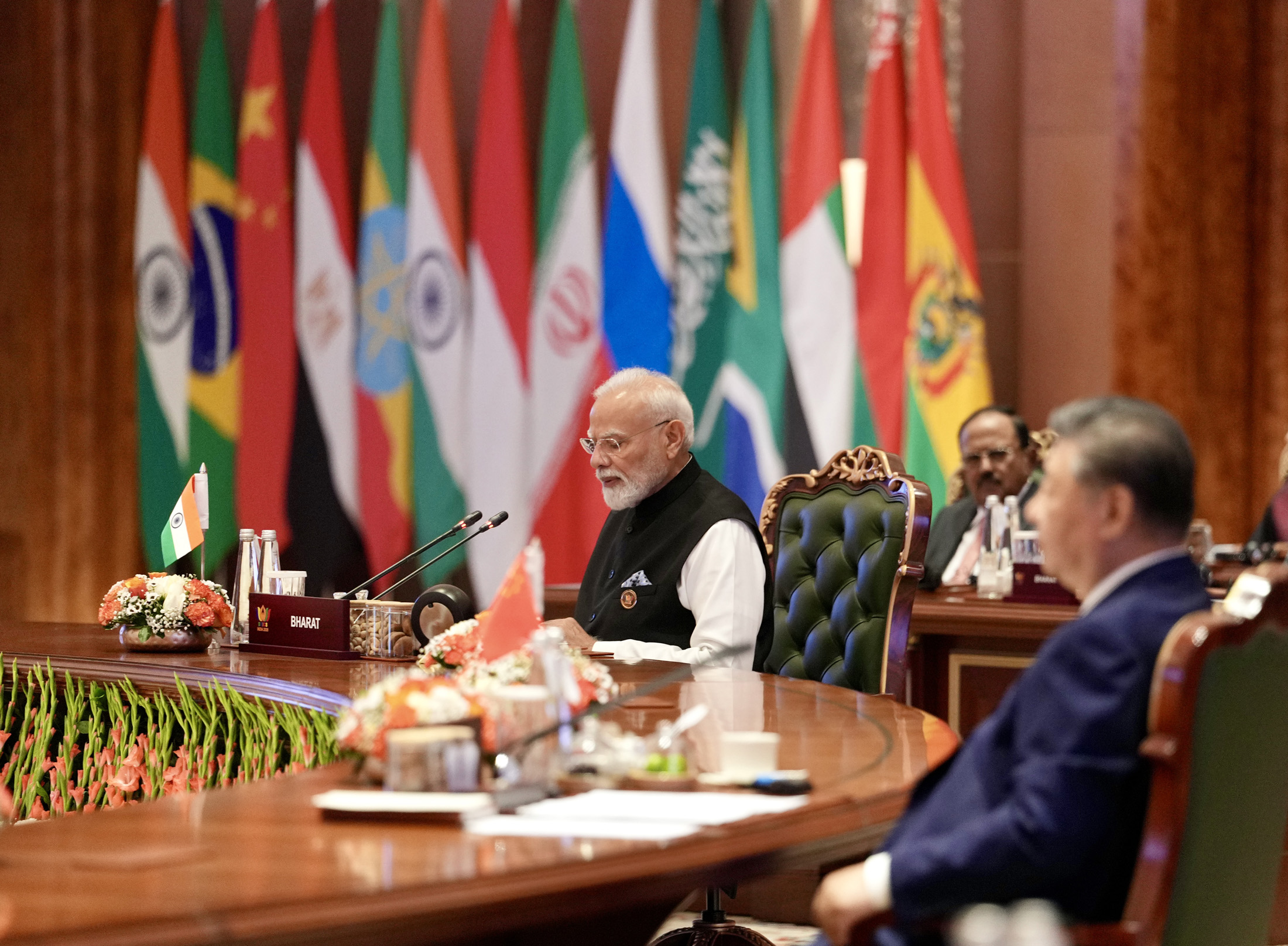
2026 BRICS New Delhi Declaration
BRICS New Delhi Declaration: Building for Resilience, Innovation, Cooperation and Sustainability (September 12, 2026) 12 Sep, 2026 1. We, th...
-
 தமிழகம் வாழ் ஈழத்தமிழர்களை கழகக் கண்டனப் பொதுக்கூட்டத்தில் கலந்து கொள்ளக் கோருகின்றோம்!
 -
சமரன்: தோழர்கள் மீது எடப்பாடி கொலை வெறித்தாக்குதல், கழகம்...


