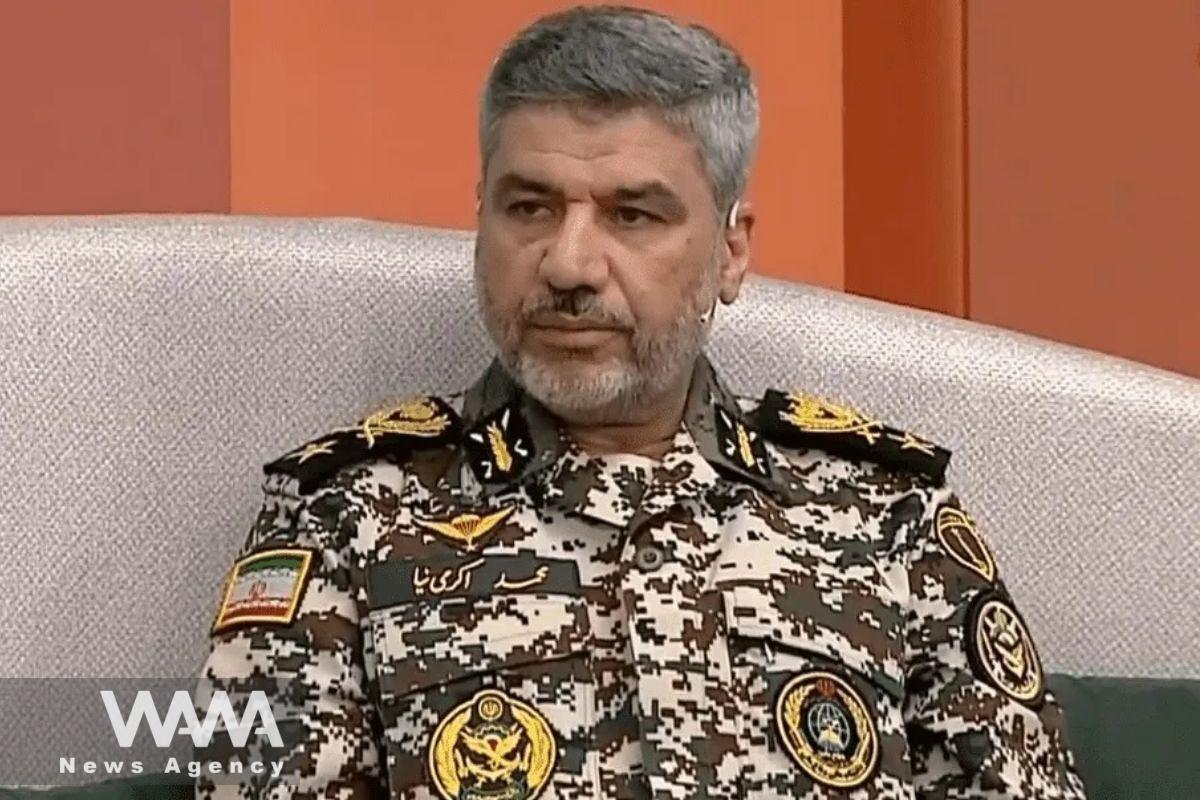
WANA (Oct 16) – Iran has new operational plans underway that will force US naval forces to withdraw farther from the country’s coastline in the coming days, Iranian Army spokesperson Brigadier General Mohammad Akraminia said on Friday, claiming that American military vessels have already moved more than 500 kilometres from Iran’s shores.
Speaking in a televised interview, Akraminia said the reported withdrawal reflected Iran’s military capabilities and intelligence-gathering operations. He claimed that US warships were no longer operating in the Gulf of Oman and warned that further operational measures would push American forces farther away from the region.
“We have new operational plans underway, and their implementation in the coming days will force US naval forces to withdraw farther away from the region,” he said.
The spokesperson made the remarks during a wide-ranging discussion covering Iran’s air defence capabilities, naval operations in and around the Strait of Hormuz, attacks on US military installations in the region, and the role of religious and political training in maintaining the morale of Iranian military personnel.

Akraminia cited an operation conducted by Iranian Air Force pilots against the Buehring base, also known as Al-Adiri, in Kuwait as an example of what he described as the determination and sacrifice of Iranian military personnel.
He said Iranian Air Force F-5 fighter jets had carried out the operation despite the considerable risks involved.
According to the spokesperson, the mission required pilots to carefully plan their approach to the target, execute the attack and withdraw from the area while facing the threat of enemy air defences.
Akraminia described the operation as a significant demonstration of the pilots’ courage, religious convictions and willingness to sacrifice themselves for Iran.
He said initial reports from the pilots involved in the mission, followed by satellite intelligence, indicated that the attack had inflicted considerable damage on helicopters stationed at the base.
The spokesperson claimed that approximately 250 US helicopters had been stationed at Buehring, which he described as a major helicopter facility. He also alleged that the attack caused confusion among US forces and that Kuwaiti forces mistakenly struck three of their own aircraft.
These claims, including the reported damage to helicopters and the alleged friendly-fire incident, have not been independently confirmed.
Akraminia said the operation could serve as a case study for military academies because of its complexity and the planning required to penetrate enemy defences.
He also referred to Iranian Air Force operations against US facilities in Qatar and positions associated with opposition groups in Iraq’s Kurdistan Region.
According to Akraminia, Iranian military operations in the region have included fighter sorties, attacks involving drones and missile and drone strikes conducted by the Islamic Revolutionary Guard Corps (IRGC).
He said Iranian forces had targeted military installations in Jordan, Kuwait and Bahrain, which he described as important components of the US military presence in the region.
Akraminia rejected US President Donald Trump’s claims that Iran’s air defence systems, air force and navy had been destroyed.
He said the reported downing of several US drones over Iranian territory in recent weeks demonstrated that Iran’s air defence systems remained operational.
According to the spokesperson, Iran has introduced new operational plans, repaired damaged air defence equipment and incorporated additional systems into its military structure.
He said the country had also developed and tested new tactics designed to improve its ability to respond to aerial threats.
Akraminia added that joint exercises had been conducted between the Iranian Army and the IRGC Aerospace Force under the coordination of the Khatam al-Anbiya Joint Air Defence Headquarters.
He claimed that Iran’s air defence coverage had improved significantly compared with both the period before the war and the fighting itself.
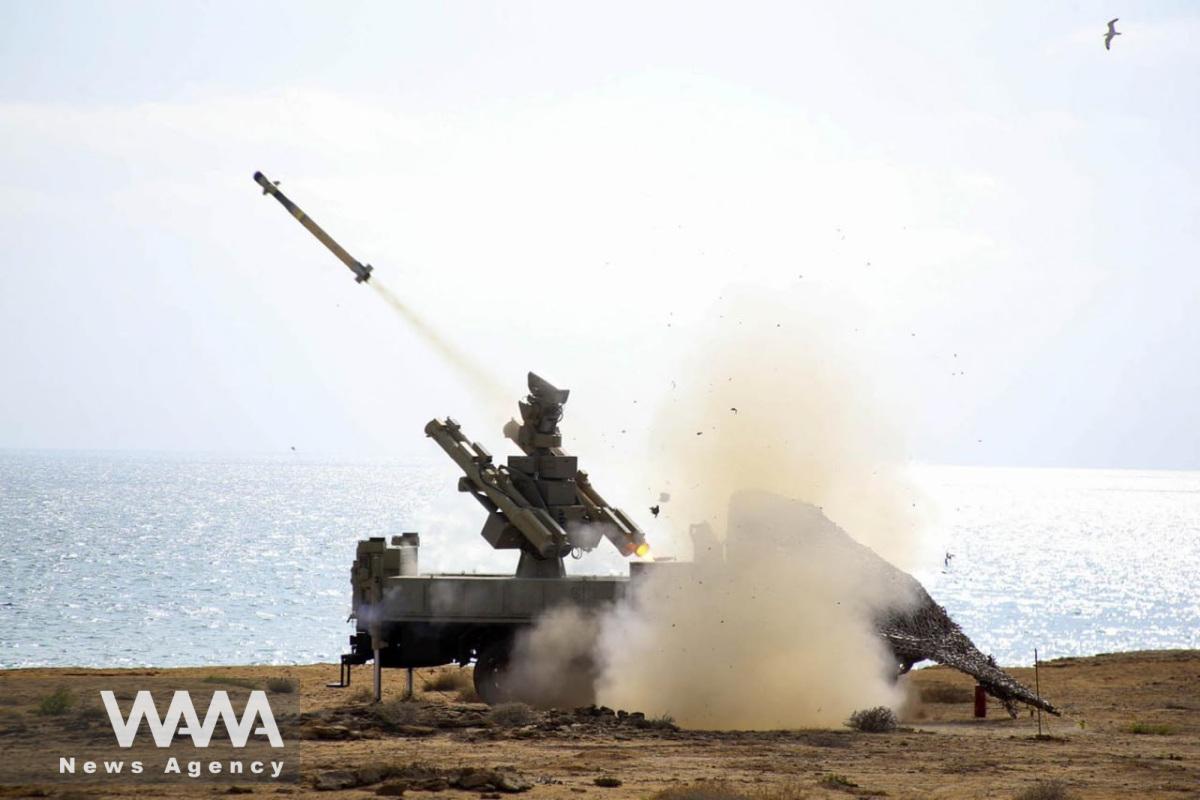
The spokesperson said damaged equipment had been repaired and returned to service, while new systems had been added to strengthen the country’s defensive capabilities.
He also argued that Iran’s armed forces had adapted their operational methods and improved coordination between military units.
The extent of these claimed improvements and the operational status of Iran’s military systems could not be independently established from his remarks.
Akraminia said the Iranian Army Navy and the IRGC Navy have separate but coordinated areas of responsibility in the region.
According to his account, the IRGC Navy is responsible for the Persian Gulf and the waters west of the Strait of Hormuz.
The regular Iranian Navy, meanwhile, is responsible for the waters east of the strait, including the Gulf of Oman, the Arabian Sea and the northern Indian Ocean.
Akraminia said the Iranian Navy had strengthened its intelligence-gathering capabilities and operational presence throughout its area of responsibility.
He disputed US claims of control over the Strait of Hormuz, asserting that American forces were reluctant to approach the strategic waterway because of Iran’s military capabilities and surveillance activities.
He also claimed that US military vessels had been forced to remain more than 500 kilometres from Iran’s coastline. The spokesperson said Iran’s new operational plans were intended to push American forces farther away in the coming days.
Akraminia accused the United States of being the principal cause of insecurity in the Strait of Hormuz and the wider region.
He argued that the region had enjoyed relative stability before the current war and that US military intervention had contributed to insecurity, economic disruption and regional instability.
According to the Iranian Army spokesperson, US actions had affected not only regional security but also global trade and the economies of countries across the region.
He called on regional governments to establish a joint security framework and cooperate to end the US military presence. Akraminia said Iran believed lasting peace and stability could be achieved only if American military involvement in the region ended.

Collapsed telecommunications infrastructure in the aftermath of an attack in Kuhestak, Sirik, Iran, September 4, 2026. Majid Asgaripour/WANA (West Asia News Agency)
He expressed hope that neighbouring countries would develop regional mechanisms for collective security and take greater responsibility for protecting their shared interests.
Akraminia warned commercial shipping operators that vessels seeking safe passage through the Strait of Hormuz should coordinate their movements with Iran’s armed forces.
He said ships intending to enter the area or transit the strait should make the necessary arrangements with Iranian military authorities before entering.
According to the spokesperson, such coordination would help prevent potential incidents and reduce risks to commercial vessels and their cargoes.
He also alleged that US forces had directed numerous commercial vessels over the preceding one to two months to use an alternative route south of the strait. Akraminia described that route as unsafe and unlawful, claiming that some vessels using it had sustained damage.
He urged shipowners to return to the route designated by Iranian military authorities and coordinate their passage with Iran’s armed forces.
The spokesperson further claimed that vessels that had complied with Iran’s requirements and coordinated their movements had transited the strait without problems.
Akraminia said the conflict involving Iran was not limited to conventional military operations, describing it as a broader confrontation involving military, media, cultural and cognitive dimensions.
He argued that efforts to influence public opinion and undermine the beliefs and morale of military personnel formed part of what Iran considers a wider campaign against the country.
According to the spokesperson, the Iranian Army’s Ideological and Political Organization plays an important role in countering these efforts by strengthening religious convictions, cultural identity and morale among military personnel.
He said the organisation’s activities were particularly important during wartime, when military personnel face difficult conditions and the loss or injury of fellow service members.
Akraminia cited the determination demonstrated by Iranian Army personnel during the current conflict, including pilots involved in dangerous missions and personnel who continued operating military equipment despite the risks.

Rubble lies around damaged houses following a reported attack near a wedding gathering in Kuhestak, Sirik, Iran, September 4, 2026. Majid Asgaripour/WANA (West Asia News Agency)
He said religious faith and a strong sense of duty were important factors in maintaining cohesion and resilience within the armed forces.
Akraminia argued that the United States had failed to achieve its objectives in the conflict and lacked a coherent strategy for either continuing the war or bringing it to an end.
He pointed to what he described as contradictory statements by Trump as evidence of uncertainty in Washington’s approach. The spokesperson also said the conflict had imposed economic and security costs on Iran, the United States and other countries in the region.
He cited disruptions to energy markets, financial markets and regional economic activity as examples of the broader consequences of the fighting.
Akraminia further argued that the conflict had weakened existing regional security arrangements, including bilateral defence relationships between Washington and regional governments.
He said the war could accelerate a shift towards a more multipolar international order, with a greater role for countries such as China and Russia.
These comments reflect the Iranian Army spokesperson’s assessment of the conflict’s strategic consequences rather than an independently established assessment of the balance of power.
Akraminia said military operations conducted by the Iranian Army and the IRGC were coordinated through the central Khatam al-Anbiya Headquarters.
He explained that the two organisations have distinct responsibilities but operate within a coordinated command structure.
According to the spokesperson, intelligence is gathered and analysed before targets are selected according to their operational importance and their role in supporting enemy activities.
He said targets are then prioritised and assigned to the relevant military units for action.
Akraminia added that Iranian forces had used information gathered from multiple sources, including intelligence assessments and satellite imagery, to evaluate the impact of military operations against US facilities.
He claimed that several US installations in the region had suffered significant damage, particularly facilities in Iraq’s Kurdistan Region.

Akraminia concluded that Iran’s armed forces remained prepared to continue military operations if the conflict persisted.
He said the country had introduced new operational plans and equipment, strengthened coordination between military branches and conducted joint exercises to improve readiness.
The spokesperson reiterated that US naval forces would be compelled to withdraw farther from Iran’s coastline as the new plans were implemented.
He also maintained that safe commercial passage through the Strait of Hormuz required coordination with Iranian military authorities.