SHARE

Wednesday, September 06, 2023

US to provide controversial depleted uranium weapons to Ukraine

Continued supply of Western arms and military equipment for the Ukrainian military would only prolong the war.-Russia

Press TV Thursday, 07 September 2023 

The United States says it is sending depleted uranium ammunition to Kiev, despite global concerns about serious health problems caused by such ammunition.

Washington said on Wednesday the controversial ammunitions are part of a new security assistance package worth up to $175 million.

The package also includes anti-tank missiles, artillery and mortar rounds, tactical air navigation systems, and additional ammunition for High Mobility Artillery Rocket Systems.

The new military assistance is part of more than one billion dollars in overall aid announced for Ukraine during US Secretary of State Antony Blinken’s Wednesday visit to Kiev.

The US aid also includes over $665 million in new military and civilian security assistance and millions of dollars in support for Ukraine's air defenses and other areas.

The US promise of depleted uranium rounds comes about two months after Washington said it would provide cluster munitions to Ukraine.


Kiev has already received more than $43 billion from the US in the form of weapons systems like howitzers and millions of rounds of ammunition, including widely-banned cluster munitions, since February 2022 when Russia started a "special military operation" in Ukraine.

A number of Republican presidential hopefuls have questioned the US aid to Ukraine, fuelling concerns over whether Washington will still support Kiev at the same level once the US 2024 election campaign intensifies.

The US has decided, in contravention of the Convention on Cluster Munitions, to provide Ukraine with cluster munitions as part of the latest military aid package.

In reaction to Blinken’s visit to Ukraine, Kremlin spokesman Dmitry Peskov told reporters, “We have heard repeated statements that they (the Americans) intend to continue to help Kiev for as long as it takes.”

“In other words, they are going to continue to support Ukraine in a state of war and to wage this war to the last Ukrainian, sparing no money for this. That's how we perceive it, we know it. It's not going to affect the course of the special military operation,” Peskov added.

Russia has repeatedly warned that a continued supply of Western arms and military equipment for the Ukrainian military would only prolong the war.


Li calls for opposing new Cold War, promoting cooperation


Premier makes a four-point proposal for closer China-ASEAN ties

GT By Yang Sheng, Li Xuanmin and Zhang Yuying Sep 06, 2023 

    Chinese Premier Li Qiang said at the 26th China-ASEAN Summit in Jakarta, Indonesia Wednesday that as long as China and ASEAN countries keep to the right path, whatever storms may come, their cooperation will be as firm as ever and they can press ahead against all odds, and analysts said that China-ASEAN ties remain close and will continue to develop to withstand the impacts of any external interference that attempts to instigate tensions and conflicts.

Li said that China-ASEAN cooperation has come a long way thanks to their keen understanding about hardships. "China and ASEAN countries have been committed to the unwavering pursuit of peace with a strong aspiration for development, and both take real actions to safeguard regional stability," he said at the summit, the Xinhua News Agency reported on Wednesday.

The Chinese premier also said that China and ASEAN countries have properly handled disagreements by seeking common ground while shelving differences through dialogue and consultation. 

"The two sides have been deepening practical cooperation in the traditional and non-traditional security fields, and have upheld the five principles of peaceful co-existence and the purpose of the TAC (Treaty of Amity and Cooperation in Southeast Asia)," Li remarked.

Xu Liping, director of the Center for Southeast Asian Studies at the Chinese Academy of Social Sciences, told the Global Times on Wednesday that "facing rising turbulence among the international community and the challenge of reverse globalization, China continues its attendance at the multilateral event held by ASEAN and chaired by Indonesia, where it presents China's solutions to global challenges with sincerity despite interruptions brought by external forces. These have shaped an image of China as a responsible major power."

The US is making great efforts to use disputes among regional countries on the South China Sea issue to instigate new tensions, interrupting the stability and development of the region to ruin the process of negotiation, experts said. These acts are not welcomed by the majority of ASEAN members, and with more pragmatic cooperation and dialogues with China, ASEAN is able to maintain peace and stability for the region to withstand external interruptions, they noted.   

For ASEAN, the key is to see whether China or the US is sincere in its support of ASEAN's centrality in the region, Xu said. "While it openly expresses support, the US' actions show its duplicity. The Biden administration is trying to promote its Indo-Pacific strategy over and over again. It wants to force ASEAN members to join its small clique and to have unnecessary but dangerous tensions with China while offering no meaningful support to boost regional integration or economic development. It is only interested in costly security cooperation. This in fact weakens ASEAN's centrality and shows that the US' purpose is different from what ASEAN wants," Xu noted.

China has proven its respect and support for ASEAN by actions and notable cooperation projects like high-speed rail construction. China has always insisted on seeking solutions to disputes via diplomacy with relevant countries in the region, and China has never established any new multilateral platforms in the region to weaken the ASEAN's position. ASEAN members are crystal clear about these differences between China and the US, experts said. 

Premier Li took a test ride Wednesday on Southeast Asia's first high-speed railway, the Jakarta-Bandung High-Speed Railway, which connects two Indonesian cities as part of China-proposed Belt and Road Initiative, media reported.

ASEAN's wisdom

According to Indonesian media TEMPO, Indonesian President Joko Widodo hailed the importance of China-ASEAN mutual trust as he opened the summit on Wednesday. He stressed the need for ASEAN and China to realize concrete cooperation that is mutually profitable. "This can only be done if we have trust in each other, which of course needs to be developed and maintained by all parties," Jokowi said at the Jakarta Convention Center on Wednesday.

On Tuesday, at the 43rd ASEAN Summit, Widodo stated that ASEAN would continue to uphold equality. As the world faces all kinds of issues, greater challenges will come, and there will be things leading to a tussle for influence by the superpowers. "ASEAN has agreed not to become a proxy for any power," Jokowi said, TEMPO reported.

Chinese analysts said as a major power in ASEAN, Indonesia realizes that with the rising tensions caused by the US-launched containment against China, as well as the tensions between the West and Russia over the Ukraine crisis, ASEAN is facing a danger of becoming an arena for confrontation between great powers. 

Marzuki Alie, former speaker of the House of Representatives of the Republic of Indonesia, told the Global Times in an exclusive interview that "The relationship between China and the United States has a very complex and growing effect on Southeast Asian conditions. To attain stability and prosperity in Southeast Asia, it is essential that countries in the region maintain a balance and establish mutually beneficial relations with the two countries, as well as promote constructive dialogue and cooperation to achieve stability and prosperity in Southeast Asia."

"In some respects, China's contribution to ASEAN is greater than that of other nations, including the United States," Marzuki said.

Wirun Phichaiwongphakdee, director of the Thailand-China Research Center of the Belt and Road Initiative and researcher at the Thailand-China Strategic Research Center at the National Research Institute of Thailand, told the Global Times that "It seems like some Western countries have gone to great lengths to maintain their hegemonic position on the global stage, even at the cost of instigating divisions and even conflicts." 

"But what ASEAN economies and other parts of the world need are cooperation and development, which are incorporated in the concepts and initiatives China has put forward. We welcome competition, but not in the form of veering into confrontation," said the Thai expert.

"China is not only the creator of mutually beneficial concepts, but also a true propeller of regional development, which are in stark contrast to some countries' empty promises. I would suggest that some countries not interfere and create chatter while interfering in China-ASEAN cooperation, because we know what is best for us," Wirun said.

Singaporean Prime Minister Lee Hsien Loong said at the ASEAN-China summit on Wednesday that the US and China need to "show leadership" to address a range of global issues, making it crucial for both to continue dialogue, build strategic trust at all levels and strive for greater cooperation, according to the CNA.

When the US only interested in containing China's development by all means to preserve its hegemony, it is impossible for the two biggest economies to "show leadership" together, even though China has always urged the US not to be driven by a cold war mentality, to cease its hostile containment strategy against China, and has called for cooperation to find a solution for global challenges, experts noted. On this matter, China shares a consensus with the majority of the international community, and the key is for the rest of the world to convince the US to change its mind, experts said. 

Economic growth center

In his speech, Li outlined the Chinese economic situation with the ASEAN members and other Asian countries. According to Xinhua, Li said in his opening remarks at the 26th ASEAN Plus Three Summit that the "Chinese economy is on track to realize the annual growth target of around 5 percent." China is advancing high-quality development in Chinese modernization on all fronts. The Chinese economy enjoys bright prospects, and will continue to generate fresh and greater opportunities for the region and the rest of the world, he remarked.

Li stressed that the ASEAN Plus Three countries, and indeed all countries in Asia, share so many things in common. They share a common home, common interests and common opportunities, Li said at the 26th ASEAN Plus Three Summit.

Li made a four-point proposal for fostering a closer China-ASEAN community with a shared future, the first of which is that China and ASEAN should work together to build an economic growth center, enhance interconnectivity, and deepen cooperation in industrial and supply chains.

Both sides should also jointly promote cooperation in emerging industries, and strengthen collaboration in such fields as new energy vehicles, photovoltaics and artificial intelligence, Li said.

Li Haidong, a professor at the Institute of International Relations at the China Foreign Affairs University, told the Global Times on Wednesday that "the premier's remarks sent a strong signal to counter the recent narratives among Western media and politicians that have badmouthed China's economy. He delivers confidence to the region about not only China's economic growth, but also the joint growth that will benefit all countries in Asia."

"According to some data released by the US, it might be able to realize 2 to 3 percent annual growth, and if we take the US national debt into account, the US can only realize an annual growth of 0.2 to 0.3 percent at the most. Based on these facts, China, with a 5 percent annual growth, is still growing faster than the US, and with more potential," Li Haidong noted.

By badmouthing China's economy, the US is trying to spread fear and concern about a potential crisis in Asia, to drive talents and money away from the region and move to the US, so when US leaders and media talk about the economy, they do not care about benefiting everyone, but try to ruin the growth of others and use the crisis for their own benefit, Li Haidong said. "This is what the US is really good at, and it has tried many times in the past."

This is why China is encouraging ASEAN, as well as the whole of Asia, to remain confident and work together to build an economic growth center with strong certainty amid a world in turbulence, experts said. 

During the summit, a joint statement was issued on mutually beneficial cooperation between the Belt and Road Initiative and the ASEAN Outlook on the Indo-Pacific, and a series of outcome documents were adopted, including a joint statement on deepening agricultural cooperation between China and ASEAN, an action plan on China-ASEAN green agricultural development (2023-2027), an initiative on enhancing bilateral e-commerce cooperation, and an initiative on jointly implementing China-ASEAN science and technology innovation enhancement program.

The summit also welcomed the signing of an agreement on China-ASEAN technical cooperation and announced the year of 2024 as the China-ASEAN year of people-to-people exchanges.


C4: Who was behind 2019 Sri Lanka Easter bombings? (Video)


 Review

Sri Lanka’s Easter Bombings review – startling and deeply disturbing viewing

This chilling Dispatches documentary reports on the aftermath of 2019’s apparently random terrorist attack, and alleges unpalatable truths

The Guardian (UK) Wed 6 Sep 2023  

On Easter Sunday 2019, six suicide bombings hit Catholic churches and luxury hotels in Sri Lanka, killing 269 people. Quickly, the perpetrators were identified as domestic religious extremists the NTJ (National Thowheeth Jama’ath), claimed by Islamic State as their own. The wider world, pausing to note that the perceived threat of Islamic fundamentalism helped the controversial Rajapaksa family regain the Sri Lankan presidency a few months after the bombings, chalked it up as yet another terrorist atrocity about which nothing much could be said or done and moved on.

Sri Lanka’s Easter Bombings, a new Dispatches investigation, makes serious new allegations about the attacks, based on whistleblower testimony. While the accusations are startling, they are straightforward: the charge is that allies of the Rajapaksas had associations with the NTJ, and that they made it hard for law enforcement to arrest its leaders prior to the bombings or to fully investigate the massacre afterwards.

Such information does not fill an hour of television; the programme is three-quarters done before the bombings take place. But, while the programme may feel like a 15-minute news report with a 45-minute preamble, that context is fascinating. The earlier section is a pithy summary of modern Sri Lankan politics, telling a tale of how authoritarians wield power, the lengths they will go to when that power is challenged, and how they lay dormant in the aftermath of apparent defeat, waiting to return.

We start in 1983, when an armed uprising by Tamil separatists sparked civil war, before spooling forward to the end of that conflict in 2009. Actions taken then by the Sri Lankan army, under the presidency of Mahinda Rajapaksa, have since been widely described as war crimes, not least by the 2011 Channel 4 documentary Sri Lanka’s Killing Fields – a film furiously criticised by Sri Lankan authorities.

Rajapaksa and his younger brother Gotabaya, appointed by the president as defence secretary, had already built a reputation as leaders to be feared. Numerous political opponents were threatened or attacked. The film recalls the chilling murder in 2009 of journalist Lasantha Wickrematunge, the government’s most prominent critic, who predicted his own demise and left behind an editorial to be published after his death: “Murder,” he wrote, “has become the primary tool whereby the state seeks to control the organs of liberty.” Such violent retribution was, the Dispatches contributors say, believed to be carried out by a clandestine death squad called the Tripoli Platoon.

In 2015, the Rajapaksas, who had flooded government posts with extended family and were beset by allegations of corruption, were voted out. Senior police officer Nishantha Silva then investigated the Wickrematunge murder, finding phone record evidence putting Tripoli Platoon members at the scene. Making his first public statements in this programme, Silva claims that, despite no longer running the country, the Rajapaksas still had enough friends in powerful positions to ensure the case stalled in the Sri Lankan courts.

Dispatches’ star whistleblower is an exile named Hanzeer Azad Maulana, who spent nearly 20 years working within the Rajapaksas’ inner circle as a translator and aide. And so we come finally to those headline allegations: Maulana says he was in the room when Gotabaya Rajapaksa ordered the founding of the Tripoli Platoon. Even more seriously, he says that in 2018, the year before the bombings, he brokered a meeting between NTJ members and Suresh Sallay, who was the Rajapaksas’ head of military intelligence. (Sallay, who was demoted to an outpost in Malaysia after the end of Mahinda Rajapaksa’s presidency in 2015, denies this, telling Dispatches he was in Malaysia at the time of the supposed 2018 meeting. Gotabaya Rajapaksa did not respond to requests to comment.)

We are told that information from Indian intelligence sources, warning of an attack by the NTJ on Catholic churches, was not acted upon. Efforts by the police to arrest NTJ followers were, according to documents obtained by Dispatches and testimony from a further, anonymous whistleblower, derailed by briefings from military intelligence filled with baseless accusations against other groups.

In this thicket of secrets and lies, the film takes time to hear from the victims, interviewing two survivors of the Easter 2019 attack on St Sebastian’s church in Negombo. Their memories of seeing loved ones die – 115 perished at St Sebastian’s, including 27 children – form a lurching contrast to the smiling face of Gotabaya Rajapaksa, elected as president in November 2019 on a wave of fierce, fearful nationalism. The new ruler appointed Suresh Sallay as his new intelligence boss – Dispatches’ anonymous whistleblower claims to have evidence of Sallay then obstructing the investigation into the bombings. Sallay, who denies everything and is now pursuing defamation claims in the Sri Lankan courts, is still the director-general of the State Intelligence Service today.

Citizens of many countries are accustomed, in the aftermath of apparently random and unstoppable terrorist horror, to learning that in fact the culprits had been “known to the intelligence services” and ought to have been intercepted. If the allegations here prove correct, the truth in Sri Lanka is even more disturbing.

📺 Dispatches: Sri Lanka’s Easter Bombings is on Channel 4

Monday, September 04, 2023

Channel 4 to telecast documentary on Easter Sunday attacks


Channel 4 to telecast documentary on Easter Sunday attacks

UK’s Channel 4 News has announced that it will telecast a special documentary tomorrow pertaining to the Easter Sunday terror attacks in Sri Lanka in 2019.

Channel 4 in its weekly programme parade announced that a highly anticipated documentary that would make shocking revelations about the Easter Sunday carnage would be aired from 11.05 pm to 12 midnight London time on Sept 5. The programme, titled “Sri Lanka’s Easter Bombings – Dispatches”, will shed light on new information brought forward by highly-placed whistle blowers, implicating government officials in complicity, the organization announced.

Whistle blower was leader of the  TMVP  Sivanesathurai Chandrakanthan alias Pillayan.

A British television station is to reveal shocking details over the Easter Sunday attacks in Sri Lanka, which it says alleges complicity by officials inside the Government.

Channel 4 television announced it will broadcast the program, ‘Sri Lanka’s Easter Bombings – Dispatches’ on Tuesday 5th September based on information from highly-placed whistle blowers.

Just last year Colombo Gazette and Daily Mirror had reported that a whistle blower had shared sensitive information related to the Easter Sunday attacks to diplomatic missions in Colombo.

That whistle blower was later revealed to be a close aide of the leader of the Tamil Makkal Viduthalai Pullikal (TMVP) and current State Minister for Rural Road Development Sivanesathurai Chandrakanthan alias Pillayan.

The informant of the TMVP, the breakaway faction of the LTTE, had made explosive revelations to the United Nations (UN) in Geneva.

Diplomatic sources had told Daily Mirror last year that the informant had revealed sensitive information related to the Easter Sunday attacks and a number of murders and enforced disappearances.

The informant had written to some key diplomatic missions in Colombo and overseas giving brief details of the information in his possession.

He had then fled the country and sought refuge overseas fearing for his life.

Pillayan later told Daily Mirror that the allegations were baseless.

The MP told Daily Mirror that anyone can leave Sri Lanka and seek asylum by making false allegations. 

Complicity by officials inside the government

UK Channel-4 News has announced that it will unveil shocking revelations about the 2019 Easter bombings in its latest programme titled “Sri Lanka’s Easter Bombings – Dispatches” to be broadcast tomorrow (5), what it says, ‘allege complicity by officials inside the government’.

“Shocking new revelations about Sri Lanka's deadly Easter bombings of 2019, as high-placed whistle-blowers allege complicity by officials inside the government,” it stated.

Informed sources said that the primary source of the programme is the former spokesperson of Pillayan, who is currently living in Geneva, Switzerland seeking asylum. 

He was the media spokesperson and finance secretary of Sivaneshthurai Chandrakanthan alias Pillayan group.

Sources also said that Channel 4 had planned to broadcast this video on August 15, but had stopped broadcasting the video on that day following a clarification given to Channel 4 by the Chief of State Intelligence Service (SIS), Major General Suresh Salley through his lawyers about the allegations levelled against him in the video.

It is also reported that Major General Suresh Salley has informed Channel 4 with documents confirming that he was not on duty in Sri Lanka during the period related to the incidents that Azad Maulana made using his name.

However, it is reported that after Major General Suresh Salley’s response, Channel-4 had reportedly changed the title of the video and scheduled to broadcast it tomorrow.

Channel 4 previously aired a documentary video titled Sri Lanka's Killing Fields, a hard-hitting investigation into the final weeks of the Sri Lankan civil war.

Source: Media + ENB

Sunday, September 03, 2023

Indian Minister’s visit ‘deferred’; no reason given


https://www.sundaytimes.lk/230903/

Indian Defence Minister Rajnath Singh, who was due in Sri Lanka yesterday, suddenly called off his visit on Friday night, with no official reason made public by either Colombo or New Delhi for the cancellation.


The Sri Lankan Government was informed on Friday evening that the minister was indisposed, and the Indian High Commission issued a brief statement the same night saying the visit had been “deferred” and fresh dates were to be decided later, without giving reasons for the cancellation. The Indian Defence Ministry, however, said on Friday that “due to unavoidable circumstances” the visit was being called off but the Minister “remains committed to strong bilateral cooperation” between the two countries and looks forward to visiting Sri Lanka “at the earliest possible time frame”.

The ‘deferred’ visit of the Minister comes against the backdrop of a simmering issue over the visit of a Chinese ‘research’ ship that has been granted permission ‘in principle’ to dock in Sri Lanka amidst opposition by India, which claims the ship is a ‘spy ship’ and inimical to the security of India.

There was little confirmation if the cancellation of the visit was connected to the Chinese vessel being granted permission.

The Sunday Times learns that though the Chinese ship has been granted permission to dock in Sri Lanka, the details are yet to be worked out. These details also include which ports it will call at, the duration of the visit, and the exact work it will be engaged in while in Sri Lankan waters. The National Aquatic Research Agency has strongly supported the ship’s visit, saying its scientists hope to be engaged with the vessel’s work.

Saturday, September 02, 2023

Poultry sector predicts long-term damage from Indian imports


https://www.sundaytimes.lk/230903/ By Ryan Casiechetty  

The government’s decision to approve a proposal to import 92.1 million eggs from India for three months has drawn strong reactions from the local poultry businesses, which fear that it would affect the industry in the long run, but the government says imports will continue until prices are stabilised.

Approval was given, citing the importance of stabilising prices.

Following the elimination of the maximum retail price, both producers and consumers were hopeful about the probable decline in the price of an egg below Rs. 50. They believed that this would enable the market to establish equilibrium based on supply and demand dynamics.

Stakeholders, however, were perplexed.

The All-Island Poultry Farmers’ Association had previously promised self-sufficiency by December and that the price of an egg would fall below Rs. 35. However, the association urged the government to gradually cut back on imports from India, as local producers will increase supply in the upcoming months following the 50% reduction in the import duty on corn.

Ajith Gunasekera, the president of the All-Island Ceylon Poultry Association, told the Sunday Times there was a severe threat to the local poultry farmers due to excess imports.

Also, the poultry industry will fall into the same state as it was after the economic crisis. The government’s main aim is to import eggs until the local market price reduces to Rs. 35 per egg, he said.

He called on the government to treat the poultry industry equally with other industries.

Mr. Gunasekera emphasised the importance of eggs and chicken as the cheapest protein foods. “Very soon, poultry farmers will be on the streets protesting,” he warned.

The future of the poultry industry is uncertain due to the next generation investing in other ventures, he said.

Anton Appuhami, the chairman of the All Island Egg Traders Association, said the government had so far imported around 250 million Indian eggs. Noting the fresh imports of 92 million eggs would be unnecessary, he, however, added that selling eggs for Rs. 35 would be a big loss, as requested by the government.

Asiri Walisundara, chairman of the Sri Lanka State Trading Corporation, told the Sunday Times they would be importing eggs until the local market price dropped to Rs. 35.


He claimed that the production cost per egg is around Rs. 25, and the local producers are earning a reasonable profit. “Our main concern is the welfare of consumers, and we will be working towards it,’’ he added.

Quotations have been called from three Indian companies recommended by the Department of Animal Products and Health.

Market watchers, however, said a right balance needs to be struck, taking into consideration the welfare of consumers and the welfare of the local poultry industry.

China approves first batch of AI language models


SOURCE / ECONOMY

Authorities strengthen regulation to prevent risks, ensure digital safety

By GT staff reporters Published: Aug 31, 2023 

A total of 11 Chinese artificial intelligence (AI) large models, including Baidu's ERNIE Bot, reportedly have obtained approval for release to the general public starting from Thursday as Chinese technology companies ramp up innovations to compete with ChatGPT. 

Analysts and industry insiders said that China's AI sector has developed at an unprecedented speed so far this year despite the intensifying US blockade, and they expressing confidence in China's ability to break the US-led Western stranglehold in the high-tech sector.

On Thursday, Baidu took the lead by announcing that its AI-generated language model ERNIE Bot is now fully open to the general public.

Moreover, Baidu will launch a suite of new AI-native apps that allows its users to fully experience the four core abilities of generative AI - understanding, generation, reasoning and memory, the company said in a statement sent to the Global Times.

Boosted by the news, Baidu's shares in Hong Kong closed up by 2.12 percent at HK$139.4 ($17.77), while semiconductor-related shares such as East China's Jiangsu-based China Wafer Level CSP Co rose by the daily limit of 10 percent to 21.34 yuan ($2.93).

For its part, China's leading AI company iFlytek plans to upgrade its general large model, comprehensively benchmarking ChatGPT, on October 24. The new model is expected to surpass ChatGPT in Chinese capability and be equivalent to it in English capability. It is expected to be benchmarked against GPT-4 in the first half of 2024, according to a press release sent to the Global Times.

"Overall, the development of China's AI sector has witnessed progress at an unprecedented speed so far this year," Liu Dingding, an independent tech analyst, told the Global Times on Thursday.

Thanks to policy support, China entered a rapid development period for large AI models starting in 2020, and the total number of published large AI models in China and the US now accounts for more than 80 percent of the global total, Liu said.

He said that Chinese AI language models are running neck-and-neck with those developed in the US, with China even leading the US in applications driven by the country's 5G, mobile internet and other digital infrastructure.

China ranked second in the Global AI Innovation Index for a third straight year in 2022, as it has been accelerating efforts to create a talent pool, build data infrastructure and make technological breakthroughs.

Liu Qingfeng, chairman of iFlytek, said at the China Entrepreneurs Forum 2023 on August 25 that Huawei's graphics processing units can match Nvidia's A100 performance.

"We are collaborating with Huawei to build a cluster advantage in the training of ultra-large language models, and we have confidence in breaking the stranglehold in computing power and striving to benchmark with OpenAI in terms of the application of general AI," Liu said.

"The achievements in China's AI sector, especially AI chips, show that it is wishful thinking for the US to contain China's technological rise by restricting high-tech chip exports," Xiang Ligang, director-general of the Beijing-based Information Consumption Alliance, told the Global Times on Thursday.

Chinese tech giant Huawei surprised the market by unveiling its Mate60 Pro smartphone on Tuesday, which the company said is the most powerful of the series, with new breakthroughs in aspects including satellite communications, AI and Kunlun Glass, a screen that is high performing on the inside and toughen on the outside.

Huawei's rollout of a cutting-edge product despite severe US restrictions shows that the US crackdown is doomed and instead it will prompt Chinese firms to develop faster, Xiang said, noting that China has become stronger despite escalating US efforts at containment.

The era in which the US could contain Chinese companies' development with political measures has gone, and the US needs to ponder the China-US relationship. Does the US want to pursue globalization and cooperation, and what are the world's two largest economies competing over, Xiang asked, urging the US to refrain from hegemonic actions but instead strengthen sci-tech innovations to maintain global competitiveness.

While the boom of generative AI technology has created new opportunities for economic and social development, there are potential risks such as the spread of fake information, the infringement of personal information and data safety, Liu said, noting that the authorities are stepping up regulation of AI language models for the healthy development of the market.

An interim regulation on the management of generative AI services, released by the Cyberspace Administration of China and several other authorities, took effect on August 15. 

The move is aimed at promoting the sound development of generative AI and its standard applications, safeguarding national security and the public interest, and protecting the legitimate rights and interests of citizens, legal entities and organizations, according to the CAC.

Friday, September 01, 2023

SLPP dissidents ask AG if Adani Group represents govt. of India


https://island.lk/ By Shamindra Ferdinando  2023/09/01

The rebel SLPP group has demanded to know whether Adani Green Energy Ltd., represents the government of India.It has raised this question in the wake of Sri Lanka declaring its intention to consider the proposed construction of two wind and solar power parks in Mannar (286 Megawatt) and Pooneryn (234 megawatt) in terms of Government to Government basis as required by Section 43(4)(c) (1) of the Electricity Act No 20 of 2009.


Prof. Charitha Herath

Prof. Charitha Herath discussed the issues at his weekly media briefing held at the Nawala Office of Nidahasa Janatha Sabhawa on Tuesday (29). The group consists of 12 MPs, including former External Affairs Minister Prof. G.L. Peiris and ex-Power and Energy Minister Dullas Alahapperuma.

The one-time Media Ministry Secretary alleged that Power and Energy Minister Kanchana Wijesekera had sought cabinet approval to categorise the Indian conglomerate as a government entity to circumvent the Electricity Act.

Prof. Herath said that Attorney General Sanjay Rajaratnam’s opinion on this contentious issue should be obtained without further delay. The AG should clarify the status of the government-to-government agreements and say whether Adani projects could be categorised under them, he said.

Having briefly dealt with Indo-Lanka relations over the past couple of decades, including the direct intervention here that led to the 1987 accord, he explained how the Wickremesinghe-Rajapaksa government advanced ousted

President Gotabaya Rajapaksa’s project with Adani group finalised in March 2022.

Prof. Herath recalled the then CEB Chairman M. M. C. Ferdinando’s disclosure regarding Indian PM Modi pressing President Rajapaksa on the proposed Adani projects and the circumstances the official retracted those remarks made at a meeting of the Committee on Public Enterprises (COPE). Lawmaker Herath urged the media to reexamine that episode against the backdrop of President Wickremesinghe building on Rajapaksa-Adani agreement.


The academic said that the issues should be apprised taking into consideration the agreements India and Sri Lanka entered into during President Wickremesinghe’s two-day visit to New Delhi last month. Minister Wijesekera was a member of the government delegation.

MP Herath said that another matter of grave concern is the move to deviate from the Electricity Act in respect of the proposed establishment of a Kilinochchi-Habarana 400 kv backbone transmission line. Although the private sector had been allowed to engage in electricity generation, the CEB remained the only transmission licensee, Prof. Herath pointed out, adding that the government justified the Adani investment amounting to USD 135 mn on the basis of its inability to make available required funding for the project.

According to the relevant Cabinet paper dated Aug. 14, 2023 seen by The Island, the total cost of the on-grid renewable energy development project is USD 442 mn and restricted to wind power for want of free land for solar power projects. Contrary to the Electricity Act, the cabinet paper directed that the CEB to seek proposal in this regard specifically from the Adani group.

Prof. Herath questioned whether the government carried out New Delhi’s dictates regardless of consequences. How one conglomerate could be granted special status at the expense of the law of the land? the first time entrant to parliament asked.


At the onset of the briefing, Prof. Herath appreciated the stand taken by the Catholic Church on the controversial proposal to establish a bridge between Sri Lanka and India. Referring to Archbishop of Colombo Malcolm Cardinal Ranjith’s declaration that such a move should be subject to a referendum, the MP said that the consequences could be quite catastrophic and irreversible.

Prof. Herath compared the Colombo Port City with the proposed bridge-building project while stressing that the incumbent President chosen by parliament to complete the remainder of Gotabaya Rajapaksa’s five year term couldn’t take such far reaching decisions. The MP said that the then government revised the Administrative District Act No 22 of 1955 to bring the reclaimed land under the Colombo district. Prof. Herath asked constitutional experts to examine whether Sri Lanka’s boundaries could be changed as the President desired.

Acknowledging that the SJB and JJB (Jathika Jana Balawegaya) had declared Sajith Premadasa and Anura Kumara Dissanayake as their respective candidates, Prof. Herath stressed the responsibility on their part to adopt a common strategy. Responding to queries, MP Herath pointed out how the entire Opposition regardless of differences backed Maithripala Sirisena at the 2015 presidential poll to bring Mahinda Rajapaksa’s reign to an end.

Declaring that Wickremesinghe social market economic policies had failed and certainly didn’t have the slightest chance to succeed in current environment, Prof. Herath said that foreign policy pursued by President Wickremesinghe could cause an unprecedented crisis against the backdrop of China and India seeking favoured status here.

Wednesday, August 30, 2023

Tackling the water crisis


Tackling the water crisis

https://www.sundaytimes.lk/230827

Somewhere in the Anuradhapura district, women carrying clay pots are trudging in search of water. This is the worst-affected district in terms of the current water shortage.

The other areas affected by the dry spell are reportedly Ratnapura, Trincomalee, Puttalam, Kurunegala, Jaffna, Mannar, Mullaitivu, Vavuniya, Badulla and Moneragala. Often women bear the brunt of any drought, walking for several kilometres in search of water for the family’s daily needs.

President Ranil Wickremesinghe, meanwhile, in a recent speech at a school at Nugegoda said that a (serious) water shortage is expected in 20 years and people need to prepare for it.

The water shortage in fact is happening every year and despite this regular occurrence the authorities have not been able to prepare a proper plan to address the crisis. If the answer is yes, there is a plan in place, how do you explain the water shortage and the disorganised water distribution for power and irrigation this time? Thousands of acres of paddy land have been destroyed due to non-release of water for irrigation purposes and even though the water was released last week after rising farmer protests, it was too late to save these fields.

This was the topic of conversation by the trio under the margosa tree. “Niyagaya nisa ape gamey kumburu vinasha wela (Our paddy fields in the village have been destroyed by the drought),” said Kussi Amma Sera.

“Ape gam paththeth me prashnayama thiyenawa. Govin kiyanawa egollange wagawan siyayata panahak vinasha wela kiyala (The same issue is faced in our area where farmers say 50 per cent of their crop has been affected),” noted Serapina.

“Me prashna hinda haal hingayak ethi wewida (Would this mean that there will be a rice shortage this time)” asked Mabel Rasthiyadu.

Agriculture Minister Mahinda Amaraweera has said there won’t be a shortage of rice. Even if there is, imports from India, Sri Lanka’s main rice import source, are not possible this time since India has banned rice exports due to a shortage there.

In a water-related development this week, India successfully landed its spacecraft Chandrayaan-3 on the moon’s surface and has begun exploration for “frozen water (ice)” that could be a resource for future missions.

As I reflected on these issues, the phone rang. Who was calling on this Thursday morning? It was Pedris Appo – short for Appuhamy, a retired agriculture expert who does farming.

“I say, the drought is affecting many sectors in Sri Lanka, in particular rice production and water for consumption,” he said.

“The problem with the authorities is that there is no set plan on an issue that crops up every year – distribution of water resources for human consumption and irrigation,” I said, adding that there is no need for a crisis if a proper plan is in place every year.

“That’s right. For instance, droughts and dry spells have been occurring every year for the past decade and one needs to prepare for them. For example, after this year’s crisis would we have another water crisis next year and, if so, do we have a plan to tackle it (next year)?” he asked.

“Even though water was released from reservoirs for irrigation purposes, farmers whose fields were at the bottom end of the water channels complained that they were not receiving water since only fields at the upper end of the channels were receiving water,” I said.

Admittedly, the authorities were caught napping this time because the drought and dry spells are one of the worst on record.  The level of evaporation in the water catchment areas is also higher this time due to the intense heat being experienced in the country, so much so that a heat index has emerged.

According to media reports, the Department of Meteorology has cautioned the public that the temperature felt on the human body is expected to increase in some areas of the Northern, North-Central and Eastern Provinces and the Monaragala District. It was pointed out that prolonged activity or exposure to the sun could lead to fatigue and heat cramps.

Sri Lanka has two monsoon seasons – the Maha (October to January) and the Yala (May to August) during which paddy is grown. Apart from paddy, several other crops including tea have been affected by the drought and arid weather conditions.

One of the arguments put forward by administrators and experts is that farmers didn’t start cultivations on time as proposed by the authorities and the delay led to issues in water distribution.

Experts told the Business Times that farmers should not delay their cultivation at the next Maha season “to ensure the harvest yields could be acquired as per requirements in a bid to overcome the drought weather pattern of (global phenomenon) El Nino”.

The Yala season’s harvest yield is likely to drop as a result of which only 20-40 per cent of the 26,000 hectares affected by the drought will fully recover while the rest will be hard to recover, Peradeniya University Crop Science Senior Prof. Buddhi Marambe told this newspaper.

He said that all stakeholders involved in the cultivation of the next season need to ensure that they get all farmers onboard and ensure cultivation starts together on time with the onset of the rains.

Nearly 40,000 acres of paddy land have been destroyed by the current drought conditions and affected over 30,000 paddy farmers with Kurunegala being the worst-hit area.

Drought and dry spells are a perennial problem and this year’s drought is no exception or surprise. Planners are known to prepare for these emergencies and ensure fair distribution of water for consumption and irrigation purposes. So what went wrong this time? Is it, as explained earlier, that farmers didn’t follow the prepared calendar for cultivation times or was it simply disorganisation on the part of the administrators? There were also reports that despite warnings of the crisis by one ministry, it was not heeded by others.

Apart from these annual disturbances in the proper distribution of scarce water resources, comes the warning of an acute water shortage in the next 20 years.

As I wound up my column, Kussi Amma Sera brought in my second mug of tea saying: “Sir, ada hari rasnei (Sir, it’s very hot today).”

I nodded in agreement and spent some time wishing that this year’s crisis would serve as a reminder to have a proper water distribution plan in 2024, dredge catchment areas that are filled with mud and other sediments so that more rain water can be stored and prepare a forward-looking plan to tackle future shortages.

Read: Climate Change Risk Assessment for Kurunegala, Sri Lanka: Water and Heat Waves


Climate Change Risk Assessment for Kurunegala, Sri Lanka: Water and Heat Waves


Climate Change Risk Assessment for Kurunegala, Sri Lanka: Water and Heat Waves

Korea Adaptation Center for Climate Change, Korea Environment Institute, 232 Gareum-ro, Sejong 30121, Korea
Climate 20208(12), 140; https://doi.org/10.3390/cli8120140
Received: 2 November 2020 / Revised: 23 November 2020 / Accepted: 24 November 2020 / Published: 27 November 2020

Abstract

Sri Lanka is experiencing various social and environmental challenges, including drought, storms, floods, and landslides, due to climate change. One of Sri Lanka’s biggest cities, Kurunegala, is a densely populated city that is gradually turning into an economic revitalization area. This fast-growing city needs to establish an integrated urban plan that takes into account the risks of climate change. Thus, a climate change risk assessment was conducted for both the water and heat wave risks via discussions with key stakeholders. The risk assessment was conducted as a survey based on expert assessment of local conditions, with awareness surveys taken by residents, especially women. The assessment determined that the lack of drinking water was the biggest issue, a problem that has become more serious due to recent droughts caused by climate change and insufficient water management. In addition, the outbreak of diseases caused by heat waves was identified as a serious concern. Risk assessment is integral to developing an action plan for minimizing the damage from climate change. It is necessary to support education and awareness in developing countries so that they can perform risk assessment well and develop both problem-solving and policy-making abilities to adapt to a changing climate.

1. Introduction

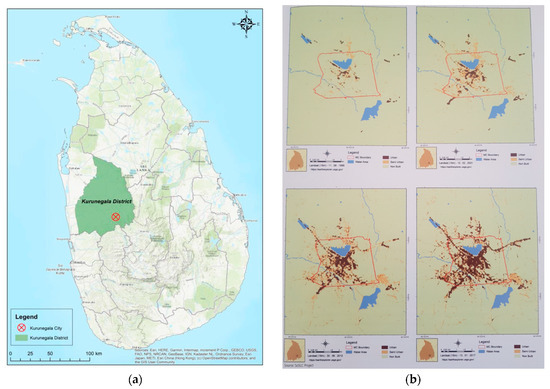
Sri Lanka is an island located in the Indian Ocean (Figure 1), which is affected by various natural hazards, including weather-related events, such as cyclones, monsoonal rain and subsequent flooding, and landslides [1]. Sri Lanka has experienced significant and systematic atmosphere warming in all regions [2]. Sri Lanka was one of the countries most affected by climate change in 2018 [3]. The year 2018 began with severe monsoon rains from 20 to 26 May, affecting 20 districts, resulting in at least 24 deaths, more than 170,000 people affected, and nearly 6000 people displaced [4].
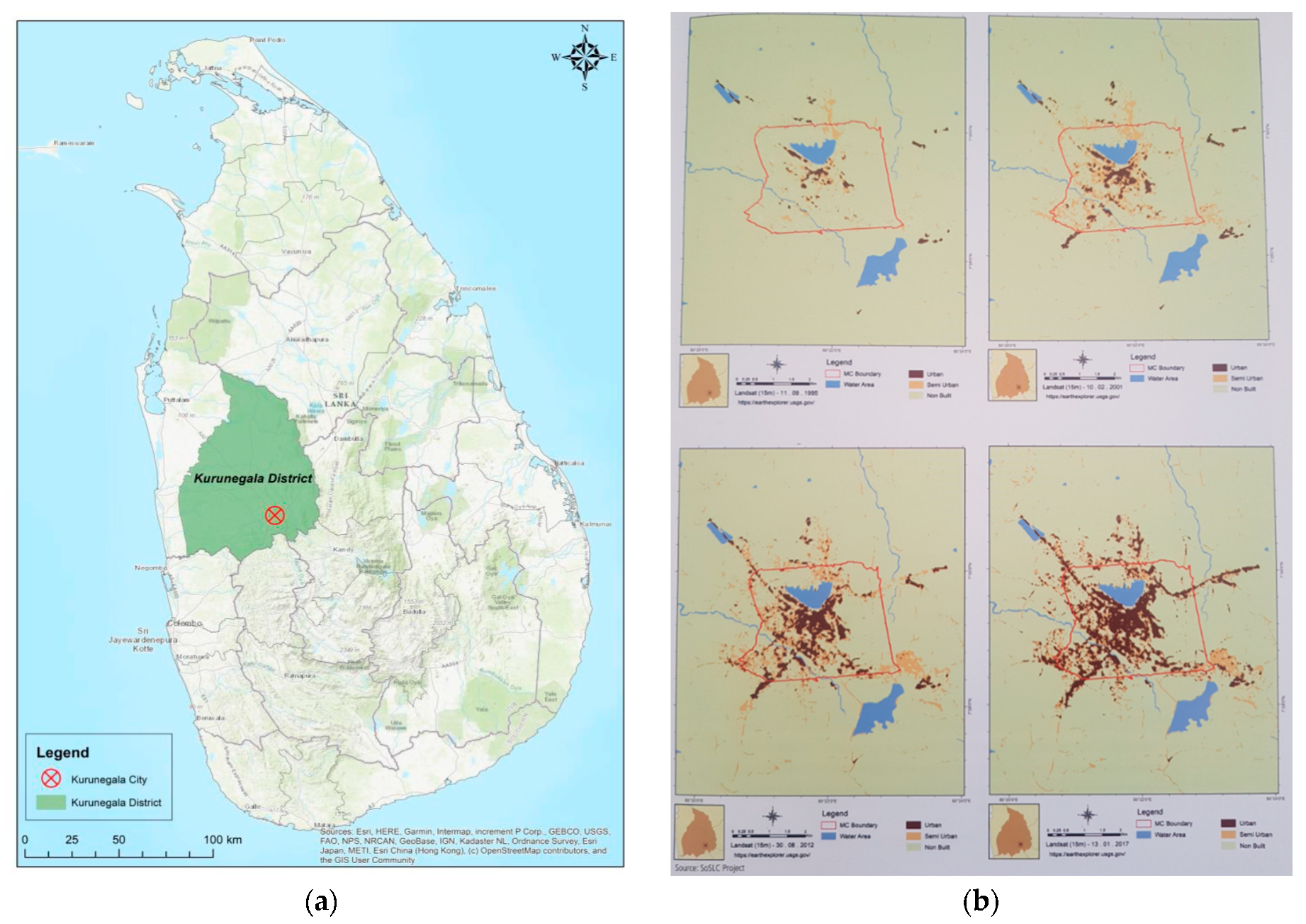
Figure 1. Location of Kurunegala (a) and the expansion in Kurunegala city (b) (1995–2017) (The state of Sri Lankan Cities, 2018).
Sri Lanka has a total area of 65,610 km2 and a population of 21.8 million, including 3.704 million urban residents living in 64 municipal areas [5]. It is a lower-middle-income country, with a GDP per capita of USD 3853 (2019). Following 30 years of civil war that ended in 2009, the economy grew at an average of 5.3% from 2010–2019 [6]. The country’s propitious location favored rapid development projects, such as mega cities, airports, harbors, urban beautification projects, and major highways, during the last ten years [7].
Kurunegala, located in the north-western province, was once the capital of one of the ancient Kingdoms of Sri Lanka. The city is now the capital of the Kurunegala District and is experiencing rapid growth and development [5], with its main economic sectors based on service and industry [8]. This city is one of the most intensively developed economic and administrative capitals in the north-western Province of Sri Lanka, and it is one of the central cities directly connected to a number of other major capital cities and towns.
Most urban systems in Kurunegala are vulnerable to the impacts of climate change and the city has faced challenges while attempting to adapt to climate change. There is an increased need to build with increased risk resilience and develop more and diverse adaptation measures to protect the economic and social wellbeing of city dwellers. To develop a climate change adaptation plan, several processes are needed, i.e., analysis of climate change impacts, vulnerability assessments, and risk assessments are all key processes needed to develop this plan [9,10,11,12,13,14,15,16]. Assessment and analysis of current and future climate change risks and vulnerabilities are required for the development of robust climate change adaptation policies. They inform policy decision-makers of the potential effects of climate change, such that their results can be used to choose among available strategies and their associated technical and social plans for climate change adaptation.
Therefore, this study aims to conduct a climate change risk assessment, the results of which will be used for the development of a climate change adaptation plan for Kurunegala City. This process can also improve the climate resilience of other local cities that are vulnerable to climate change.

2. Materials and Methods

Kurunegala city is a densely built residential, business, and commercial area, with a constantly increasing traffic volume and a significantly decreasing amount of green space. Kurunegala city is one of the sprawling cities [5]. Urban sprawl is typically defined as unplanned and uncoordinated low density expansion and involves rapid land consumption as rural spaces transition to urban land use [17]. Urban sprawl can be observed in the Kurunegala city, as demonstrated by satellite images from 1995, 2001, 2012, 2017 (Figure 1). In 1995, the image shows a very small urban space, concentrated in a few areas at the center of the municipal council area. By 2007, we can see significant sprawling expansion in urban and semi-urban areas.
The city’s climate remains hot throughout the year and is exacerbated by the rock outcrops surrounding the city, which retain heat during the day. Through the data of the past 10 years, the highest mean monthly temperature was observed during the month of May (26.82 °C), whereas relatively-cooler temperature was experienced in January (23.45 °C). Similar to the nation-wide trend, air temperature in Kurunegala exhibited a general increase. In the year 2016, the mean annual temperature in Kurunegala was 25.92 °C, which is 0.08 to 1.25 °C higher as compared with the previous year [18]. Monsoons occur from May to August and again from October to January. The average annual rainfall in Kurunegala is approximately 2000 mm [2,5]. Sri Lanka experienced a nation-wide drought from the beginning of the year 2016 up to the year 2017. Increase in temperature and lack of rainfall resulted in massive damage in the agricultural produce of the country, especially in the north-western region. Only 458 mm of cumulative rainfall was experienced in Kurunegala in the year 2016. This value was almost 45% lower as compared with the decadal average rainfall experienced in Kurunegala [18]. The city is facing socio-spatial climate vulnerabilities, with the most crucial being extreme heat conditions, periods of flooding, disaster-related public health crises, a decrease in drinking water reserves, and groundwater pollution [9,10,11,12].
Climate change risk assessments are conducted to understand how current and projected risk factors impact a community and are a key element of climate change adaptation policy development. They inform policy decision-makers of the potential risks of climate change and provide them with means to evaluate its impacts, as well as to compare different strategies and policies.
For the assessment of climate change risk and vulnerability at the community level, various methods have been studied and performed [10,11,12,13,14,15,16,19,20,21,22]. In South Korea, both quantitative and qualitative data, as well as information to characterize socio-ecological systems, are required, as both current and predicted risks and vulnerabilities caused by climate change should be included in the assessment [10,11,12,15,23]. Collecting enough data to understand the impact of climate change in Kurunegala city is difficult; therefore, the assessment focuses on the qualitative method. Quantitative assessment using scientific physical parameters is also needed to increase the accuracy of risk identification in the future.
The qualitative method is a survey-based assessment approach and includes several steps to solve the problem. The purpose of the survey-based assessment approach is to prioritize the risk factors that present the latest problems in Kurunegala city.
The risk assessment was carried out via the following steps.

2.1. Step 1: Establish the Context

This stage determines the subject area and purpose. The target area for risk assessment is Kurunegala city, where the risk assessment is limited to water and heat wave problems and is based on key stakeholder information and field observations.

2.2. Step 2: Identify the Risks

This step confirms what the types of risks are. To identify the most serious risk in terms of water management and heat stress in Kurunegala city, a detailed set of indicators should be established. Based on Korean examples [23,24,25,26,27,28,29], the Kurunegala Municipal Council (KMC) developed their own indicators considering the current situation within their city. KMC developed the following indicators. The difference in Korea’s case is that there are no DWR and SDF indicators there. The discovery of indicators for drinking water and sanitation is solely a reflection of the situation in Kurunegala city, Sri Lanka.
  • Drinking water resources risk/vulnerability to drought (DWR); Risk or vulnerability on sources of useful or potentially useful portable water
  • Water management risk/vulnerability (WM); Risk or vulnerability on water management that is the control and movement of water resources to minimize damage to life and property and to maximize efficient, beneficial use
  • Water quality and aquatic ecosystems (WQAE); Risk or vulnerability on water quality and the condition or health of waterways, like rivers, wetlands
  • Water resources risk/vulnerability (WR); Risk or vulnerability on resource of water that is useful or potentially useful, for agricultural, industrial, household, recreational and environmental activities
  • Sanitation risk/vulnerability to droughts and floods (SDF); Risk or vulnerability on sanitation, which is the process of keeping places clean and healthy, especially by providing a sewage system and a clean water supply, due to drought and flood
  • Health risk/vulnerability to floods (HF); Risk or vulnerability of health that is impacted by flood
  • Health and infrastructure risk/vulnerability to heat stress (HIH); Risk or vulnerability on health and infrastructure that is impacted by heat stress and drought

2.3. Step 3: Analyze the Risks

Detailed risk factors for each indicator should be analyzed to prioritize the risks of climate change in Kurunegala city. The 84 risk factors determined to be indicators were collected from the Korean national and municipal climate change assessment. KMC reviewed the list of risk factors and revised it to suit their city. Experts and environment ministry officials in the Kurunegala modified and excavated indicators reflecting the characteristics of the city. A total of 57 risk factors were finalized for Kurunegala city (Appendix A).

2.4. Step 4: Evaluate the Risks

For the planning, an adaptation action plan for Kurunegala city, we needed to prioritize the risks and find the largest and most serious climate change impacts. Basically, it should be evaluated using objective and quantitative data and information. If quantitative assessment is difficult, it can be diagnosed and predict regional risks through qualitative methods of collecting opinions and discussing them at T/F meetings, expert advice, workshops, etc., using data collected through statistical data, interviews with officials, and surveys. Therefore, a survey was conducted to evaluate the priority of these risk factors because of the lack of quantitative data.
Although it is difficult to quantitatively express the risks of climate change, this study attempted to evaluate climate change with as much objectivity as possible to prepare for its effects. According to the Intergovernmental Panel on Climate Change 5th Assessment Report (IPCC AR5), risk is correlated with “Vulnerability”, “Exposure”, and “Hazard”. Risk is often represented as the probability of an occurrence of hazardous events multiplied by the impacts of these events [30].
Seven indicators and fifty-seven risk factors related to water and heat waves were agreed upon through a meeting between key KMC stakeholders and the Sri Lankan Ministry of Environment. The probability of occurrence and impact of 57 risk factors were each measured on a five-point scale by 35 experts in Kurunegala city. The expert survey was conducted at the Consultant Workshop on 17–19 July 2019. Experts are water and heat wave experts who have been well aware of the current state of Kurunegala city for more than five years recommended by the KMC. The criteria for five-point scale are presented in Table 1 and Table 2. Based on the average value of the experts for each indicator, the score was calculated by multiplying these values, and then each indicator and risk factor were ranked (Table A1Table A2Table A3Table A4Table A5Table A6 and Table A7).
Table 1. Guidance on possibility of occurrence (Scale).
Table 2. Guidance on impacts (Scale).
Generally, adaptation plans should be established in various fields, including water, ecosystem, land use, agriculture, fisheries, and industry, etc. As cooperation from multiple ministries is needed, opinions from experts in other areas should also be collected. Therefore, a climate change awareness survey from stakeholders was conducted. They are 23 experts in the fields of environment, land use, health and forestry, etc., recommended by the KMC.
A climate change awareness survey from women was also conducted, aiming to identify the impact of climate change on residents living there. In developing countries, the gender problem needs to be considered, and the damage caused by climate change can be more vulnerable to women and children [31,32]. The survey collected opinions from 40 women on the most serious climate-related problems in the city and the adaptation measures that the residents think are most needed. They are people of various occupations, including transportation, sales, self-employed, housewives, and students, and were conducted on-site surveys led by the KMC. We obtained their perspectives on the impact of climate change, as well as ideas on how to reduce this impact.

3. Results

3.1. Survey-Based Approach Assessment with Experts

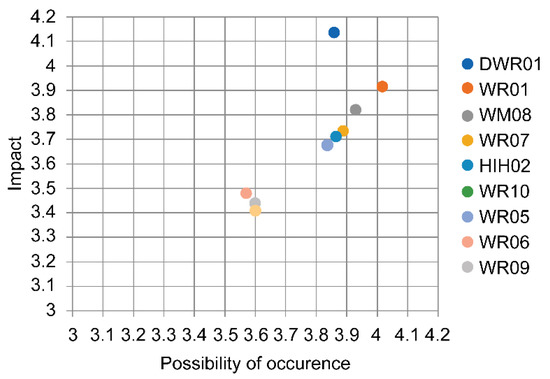
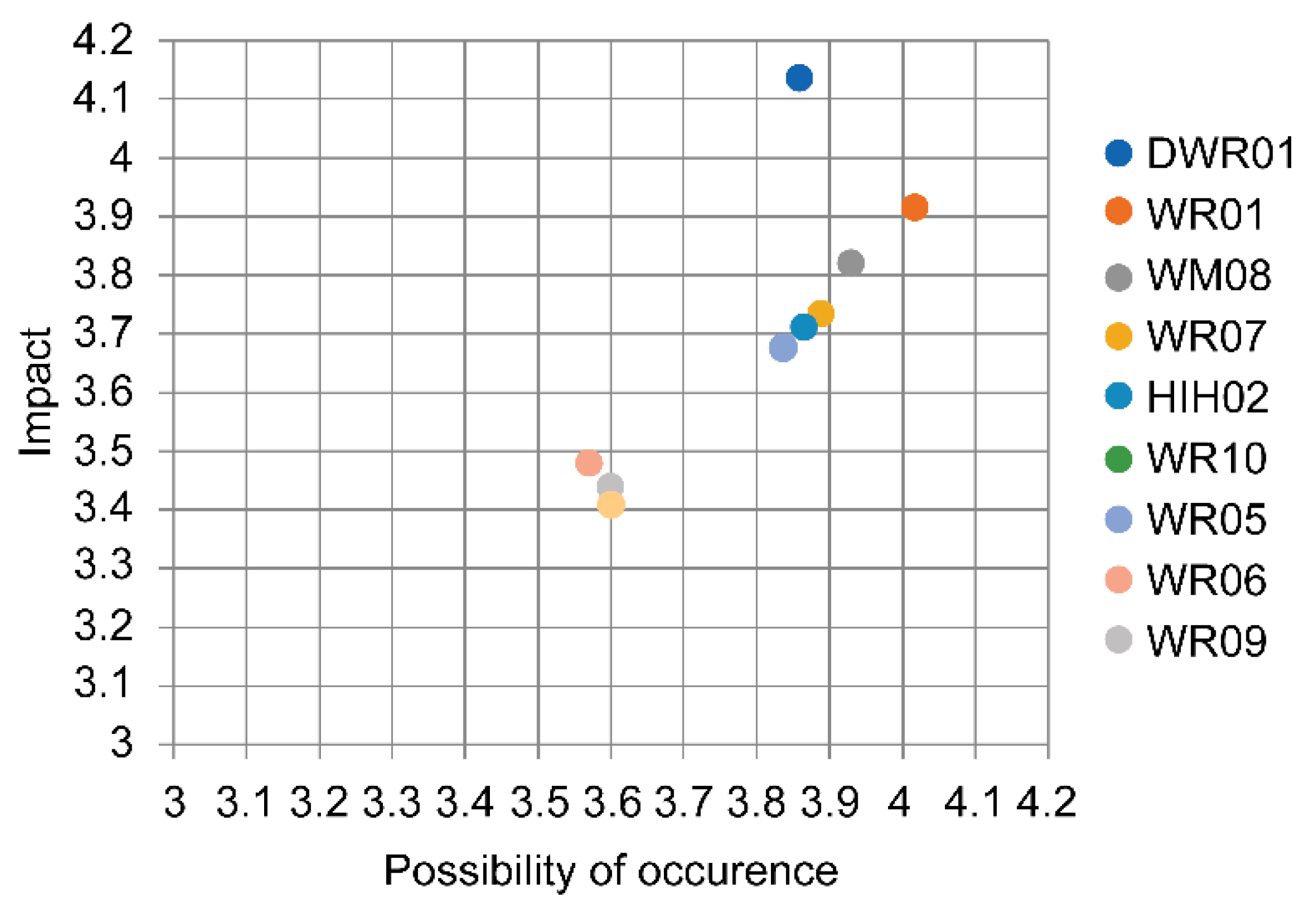
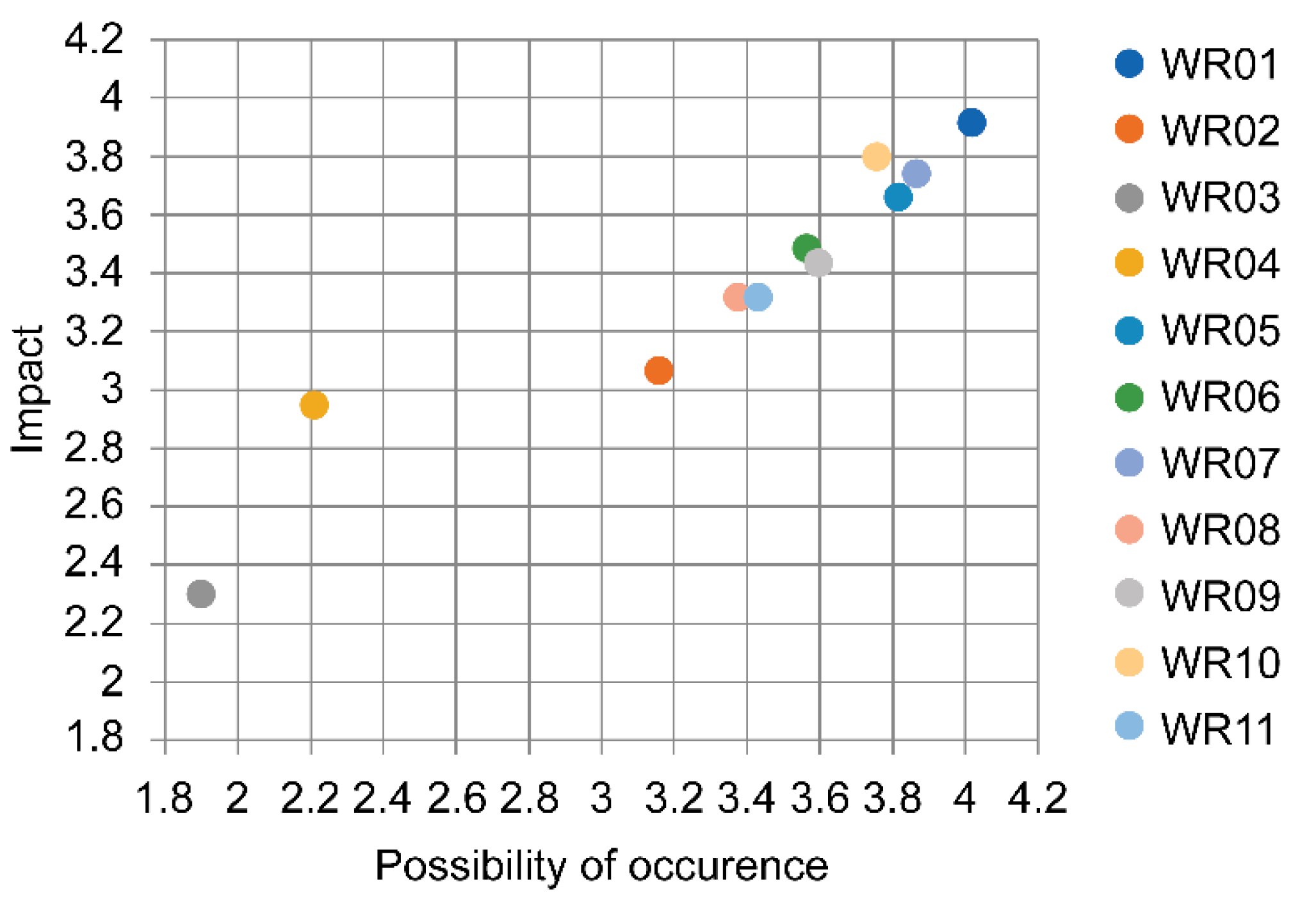
The top 10 among the 57 risk factors of the seven indicators were analyzed. When all risk factors are compared, ‘Lack of drinking water resources due to drought’ is considered to be an exceptional risk factor (Table 3). When comparing DWR01 and WR01, the probability of DWR01 occurrence was lower than that of WR01, but its impact on the city was significant. This indicates that the lack of water is a serious problem; securing drinking water is the top priority of the climate change adaptation plan in Kurunegala city (Figure 1). The risk factors in TOP 10 are in DWR, WR, and HIH; therefore, we can observe that severe drought, water scarcity, and heat stress are the largest concerns for water and heat experts and policymakers of Kurunegala City (Table 3Figure 2).
Figure 2. Top 10 risk factors.
Table 3. Rank of risk factors.
Moreover, its impact is of high concern to local experts in Kurunegala. Sri Lanka has been experiencing an ongoing drought since the beginning of 2016. In recent months, approximately one million people across the country have been affected by the drought [18]. Kurunegala city was specifically noted as the most damaged of the nine provincial Sri Lankan capital cities by drought between 1974 and 2017 [33]. Through interviews with residents, it was understood that as many as three to four months of severe drought each year have occurred in recent years.
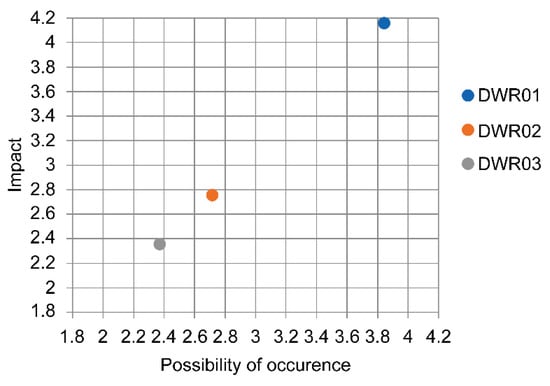
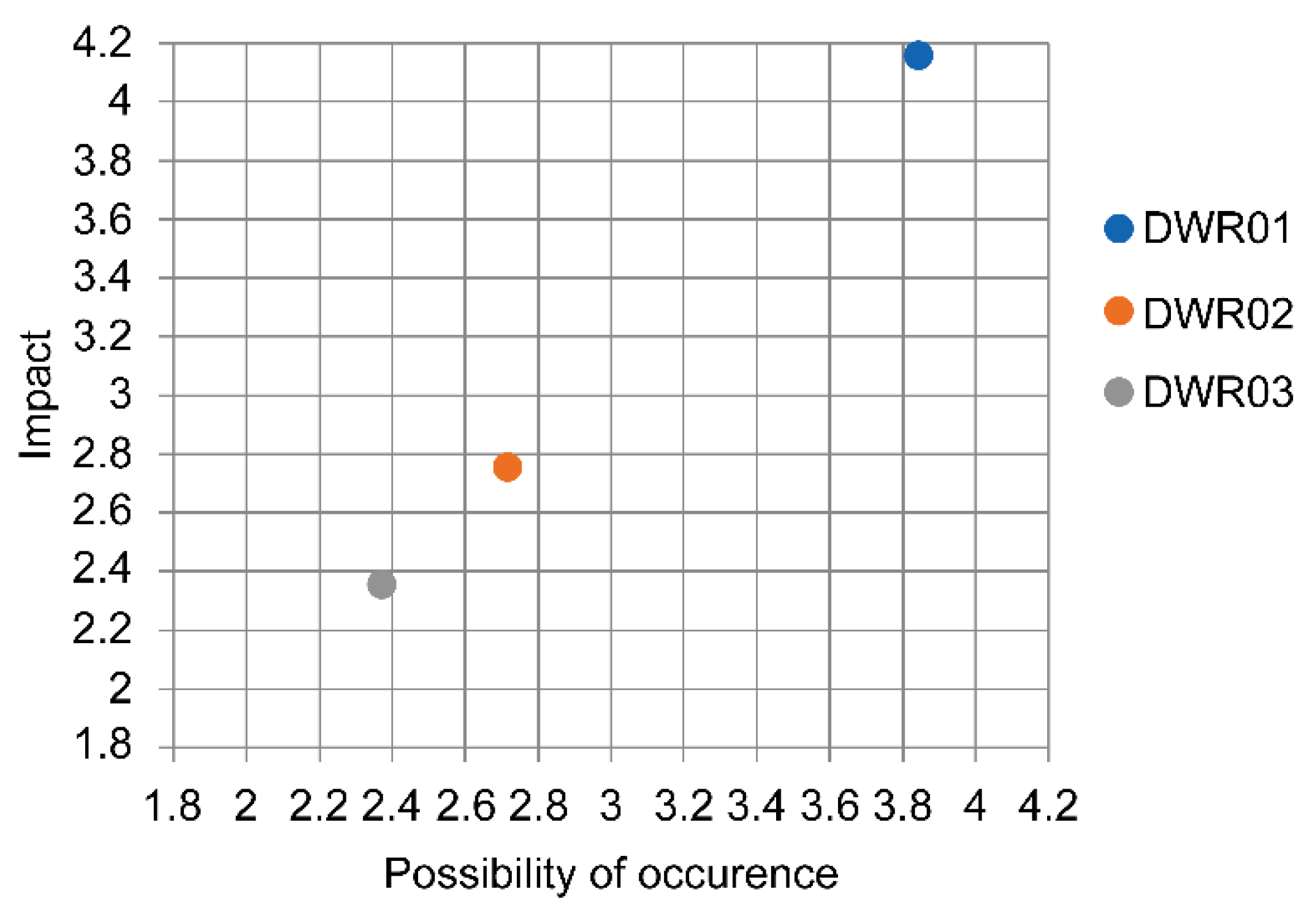
As mentioned before, there is no indicator of drinking water resources in Korea. These differences relate to the basic management of drinking water and the securing of water resources. In addition to drought, there are also problems with water supply facilities and water treatment in developing countries (Table 4Figure 3).
Figure 3. Risk to DWR (drinking water resources).
Table 4. Rank of DWR (drinking water resources) risk factors.
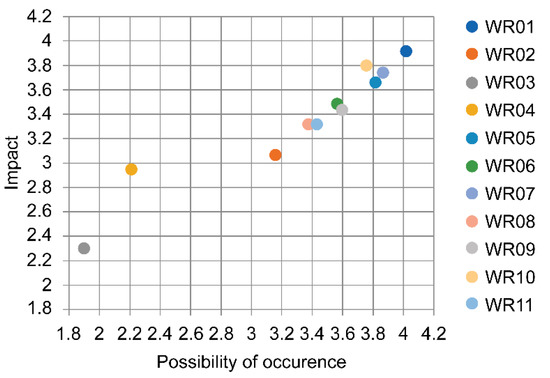
In the “Water resources” category, “Lack of water for building maintenance and management” and “Decrease in national water supply capacity due to rainfall pattern change” are high-effect factors, which indicates that Kurunegala city infrastructure requires the maintenance and local leaders to consider climate change as a high risk. In contrast, “Loss of fisheries because of the increase in harmful organisms (i.e., red tides and jellyfish) due to the increase in average water temperature” and “Fluctuations in spawning habitat and season of fish, mollusks, and crustaceans due to the increase in water temperature” are low-effect indicators because Kurunegala is an inland region (Table 5Figure 4).
Figure 4. Risk of WR (water resources risk/vulnerability).
Table 5. Rank of WR (water resources risk/vulnerability) risk factors.

3.2. Climate Change Awareness Survey

The purpose of the climate change awareness survey was to understand the actual damage and impact of climate change that stakeholders and residents actually feel. To analyze the general population’s climate change awareness, two surveys were conducted. (1) The “Stakeholder survey”, was conducted to determine the views of general residents in Kurunegala. (2) The “Climate change awareness survey for women”, was aimed at investigating differences in perceptions of climate change by women.

3.2.1. Climate Change Awareness Survey: Stakeholders

The Climate Change Awareness Survey was taken by 23 stakeholders who are all public workers in Kurunegala.
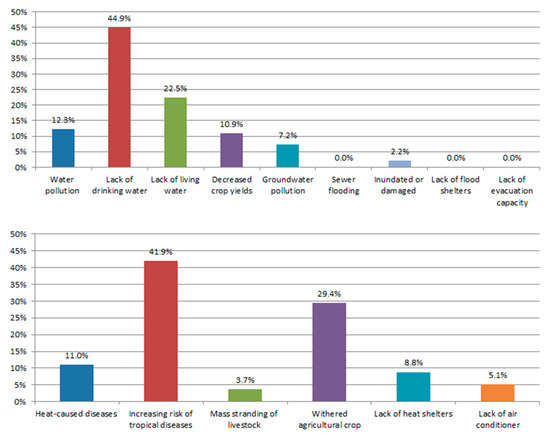
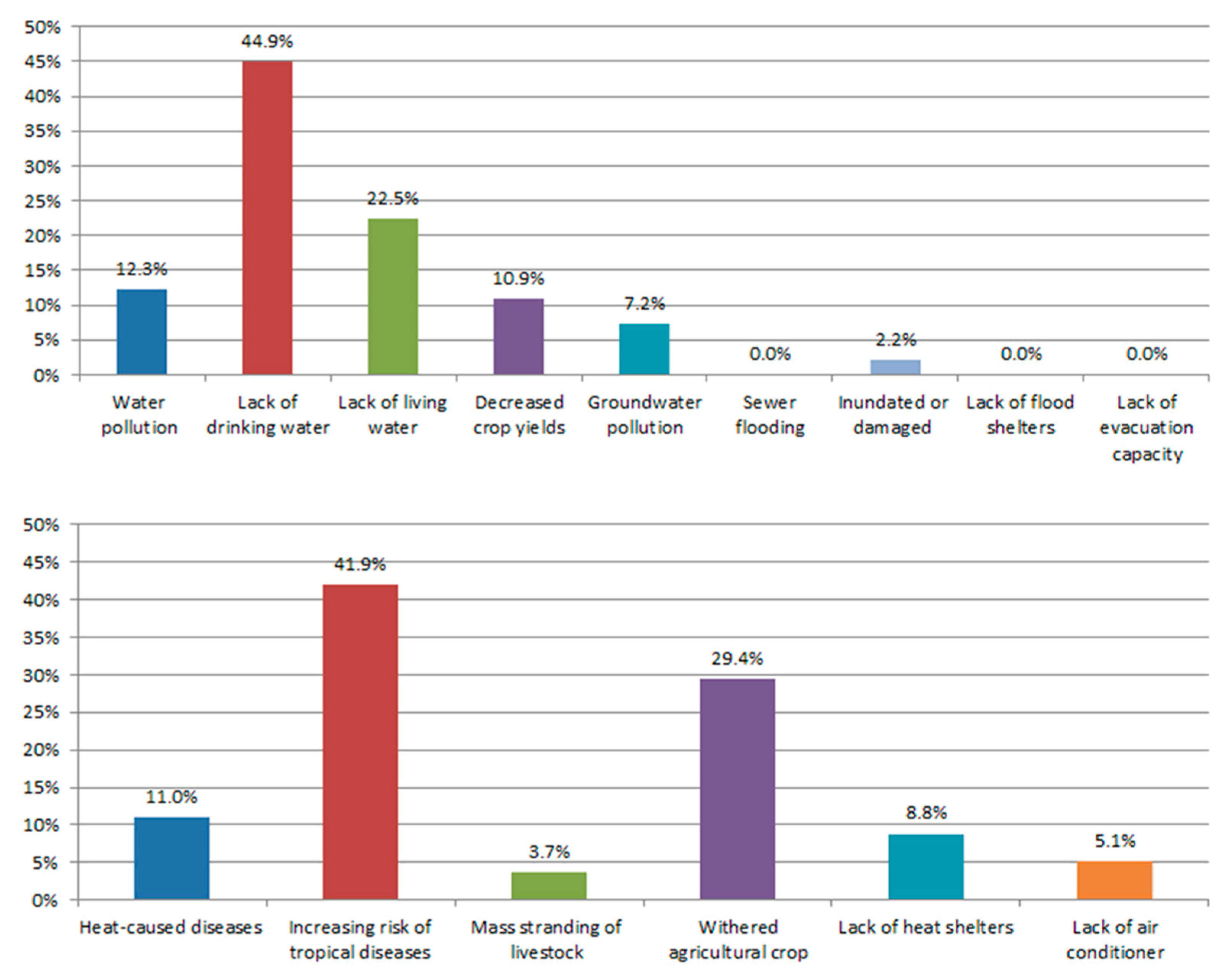
In terms of water, most respondents (44.9%) chose “Lack of drinking water” as the most serious climate change risk while “lack of living water” was the second (22.5%). This result shows that many respondents have a significant concern for the scarcity of drinking water. In contrast, the level of awareness among those who responded to the flooding and evacuation survey was relatively low (0%) (Figure 5, top).
Figure 5. Most affected climate change risks in terms of water (top) and heat (bottom) as assessed by stakeholders.
Most respondents (41.9%) selected “Increasing risk of tropical diseases” as the most serious climate change risk associated with heat, followed by “Withered agricultural crop” (29.4%). However, as many of the respondents belong to the health department of KMC, they may have a particular interest in tropical diseases (Figure 5, bottom).
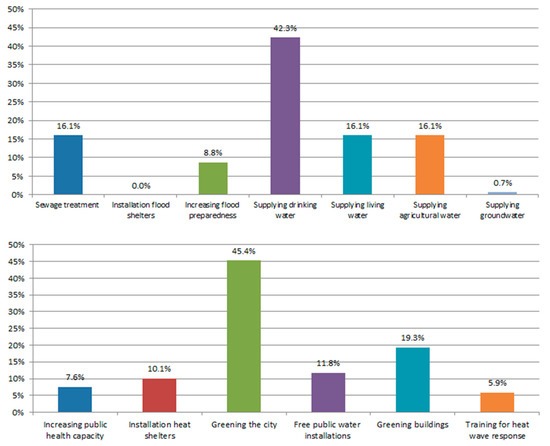
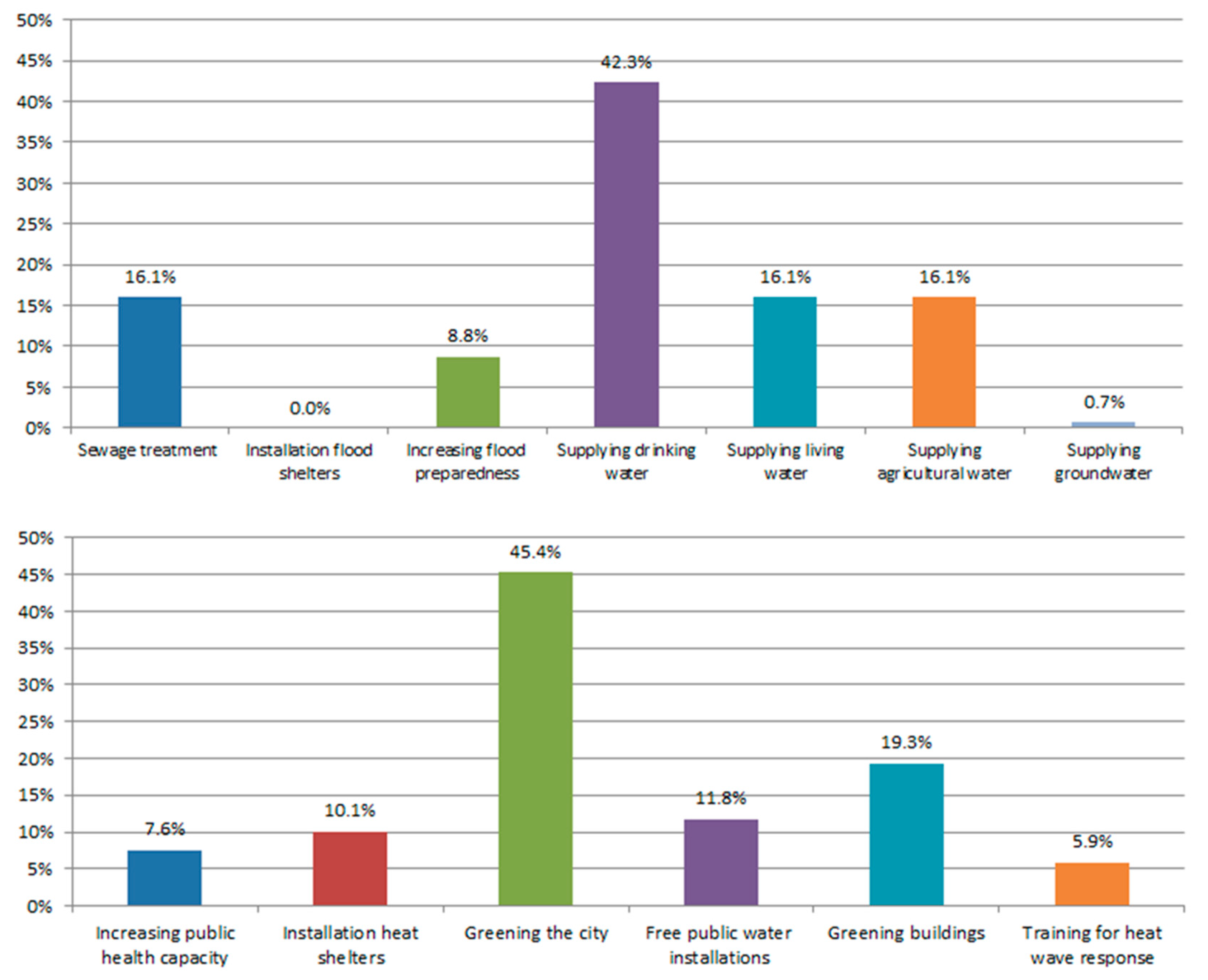
In terms of climate change measures for water, most respondents are concerned with the water supply, with “Supplying drinking water” (42.3%), “Supplying living water” (16.1%), and “Supplying agricultural water” (16.1%) as their three most critical concerns. People in Kurunegala city also ask for increased attention to “Sewage treatment” (16.1%) while there are few demands for the “Installation of flood shelters” (0%) and “Supplying groundwater” (0.7%) (Figure 6, top).
Figure 6. Most desirable climate change measures for the water (top) and heat (bottom) sectors as assessed by stakeholders.
More than half of the respondents chose “Greening the city” (45.4%) as the most desirable measure for addressing the heat issue, followed by “Greening buildings” (19.3%). This result shows that Kurunegala citizens want to have more green areas in their city (Figure 6, bottom).

3.2.2. Climate Change Awareness Survey: Women

We also analyzed climate change awareness from the female perspective. The “climate change awareness survey for women” was taken by 40 females in Kurunegala, aged 16–75.
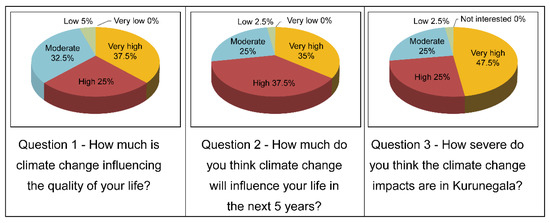
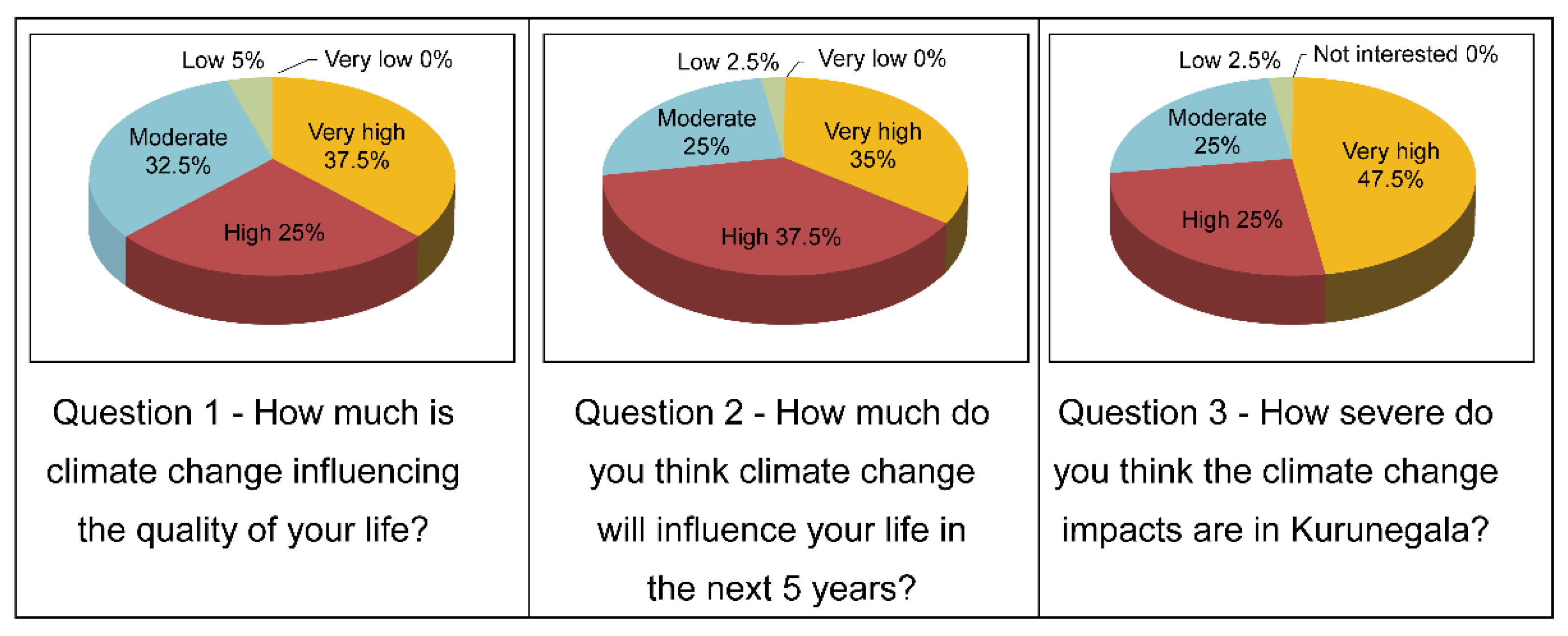
Three main questions were utilized to analyze climate change awareness among women in Kurunegala city. The first question asked about the “level of climate change influence”, where 62.5% of the respondents considered the climate change category as a high risk for their lives (“Very high”: 37.5%, “High”: 25%). Meanwhile, climate change is currently considered a huge risk; 72.5% of the respondents are concerned about climate change in the near future (Question 2, “Very high”: 35%, “High”: 37.5%). Moreover, most of the respondents identify the impacts of climate change as a severe risk to their society in Kurunegala. Almost half of the respondents, 47.5%, believe that the impacts of climate change are a “Very high” risk and 25% agreed that it is a “High” risk (Figure 7).
Figure 7. Women’s awareness of local climate change impacts.
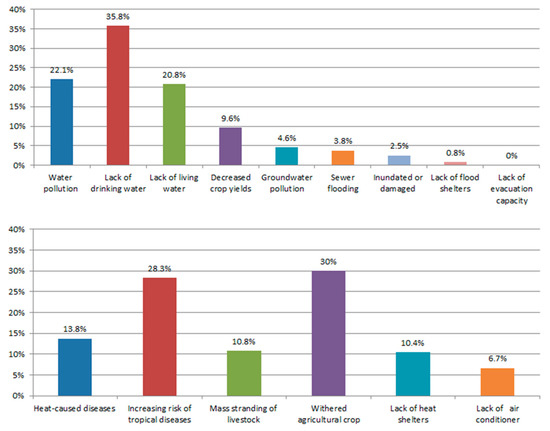
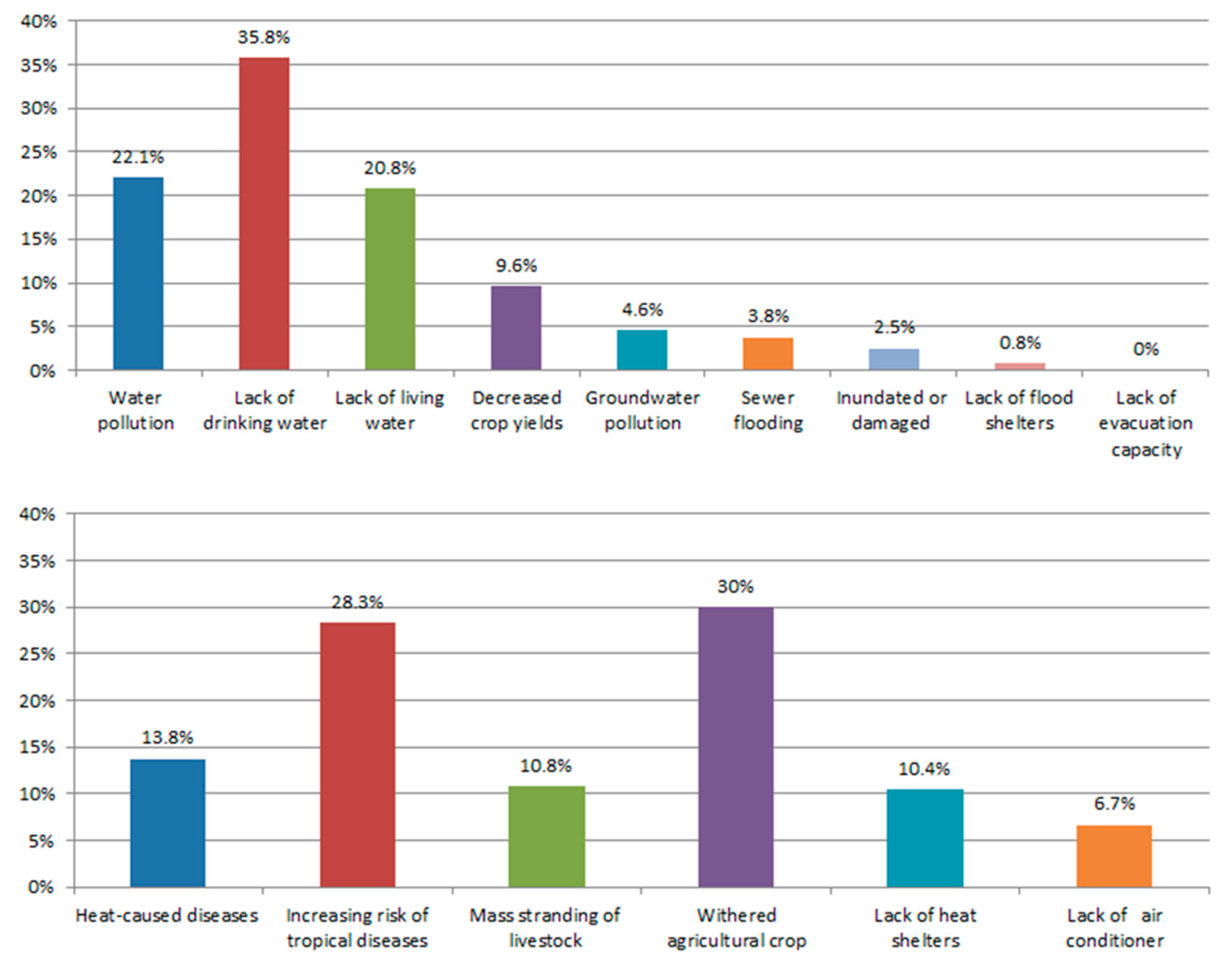
Similar to our stakeholder survey, most of the women selected “Lack of drinking water” (35.8%) as the most serious climate change risk, followed by “Lack of living water” (20.8%). In terms of heat, most women selected “Withered agricultural crop” (30%) as the most serious climate change risk while “Increasing risk of tropical diseases” (28.3%) (Figure 8) was their second most important concern.
Figure 8. Most important climate change risks with respect to water (top) and heat (bottom) sectors as assessed by the women respondents.
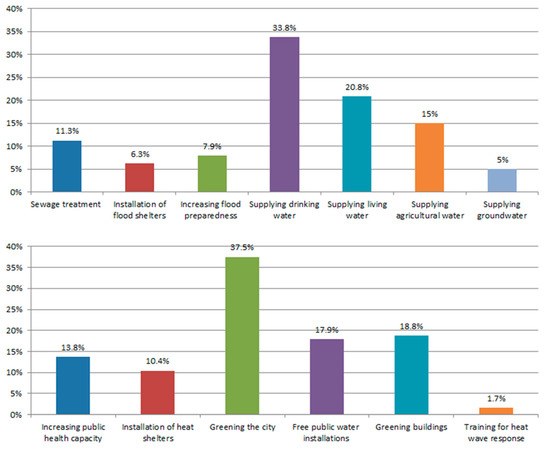
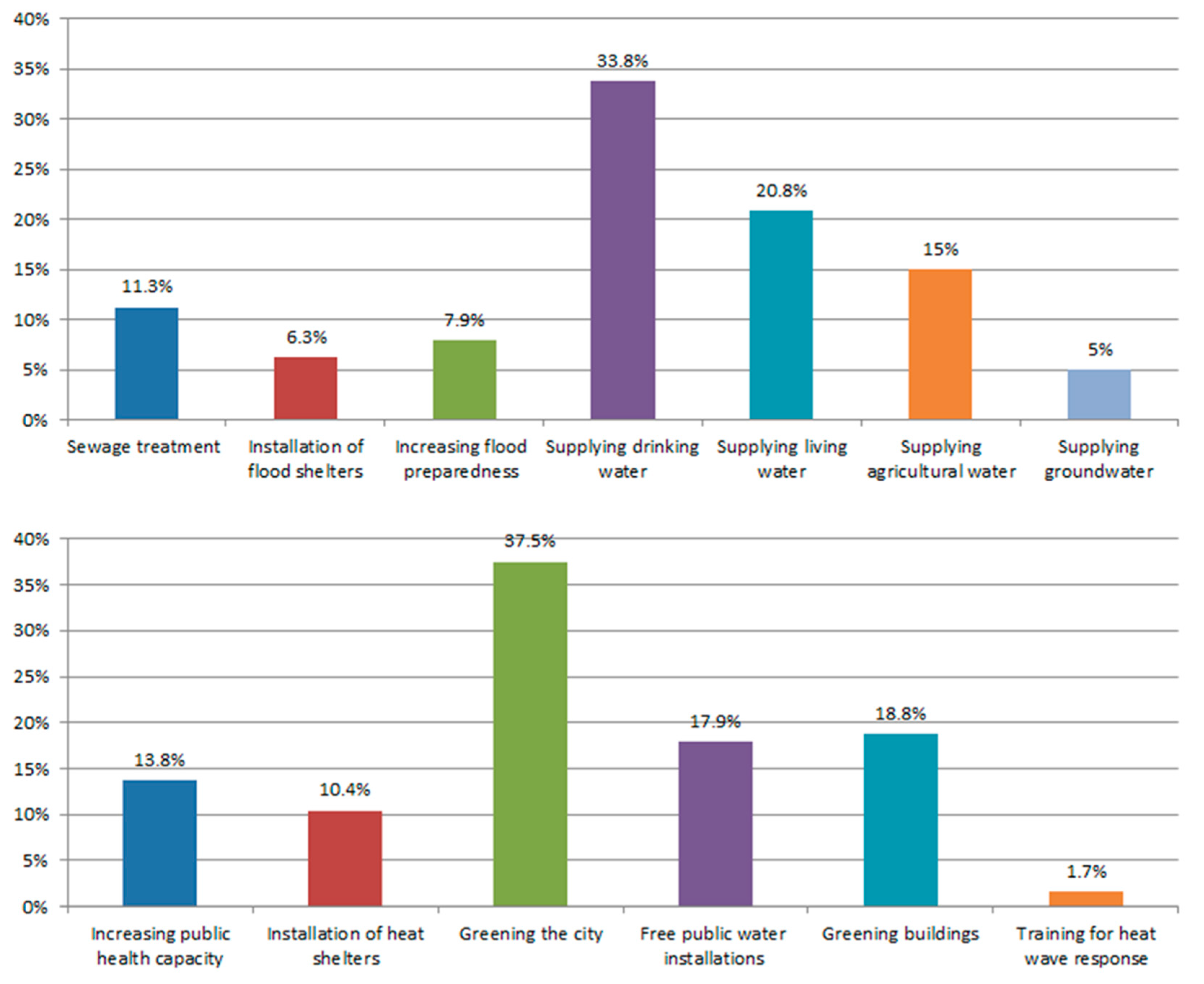
The women surveyed viewed the water management policy priorities to be “Supplying drinking water” (33.8%), “Supplying living water” (20.8%), and “Supplying agricultural water” (15%). Women in Kurunegala also saw “Sewage treatment” (11.3%), “Installation of flood shelters” (6.3%), and “Supplying ground water” (5%) as important. Their responses to flood and underground water measures show that women have more realistic responses than the stakeholders (Figure 9, top).
Figure 9. The most desirable climate change measures with respect to the water (top) and heat (bottom) sectors as assessed by the women respondents.
Regarding heat, a large number of women (37.5%) chose “Greening the city” as the most desirable measure, followed by “Greening buildings” (18.8%) and “Free public water installations” (17.9%). In addition, “Increasing public health capacity” and “installation of heat shelters” have approval ratings of over 10% from the women respondents. This result shows that the women in Kurunegala city want to have more green areas in their city and public facilities to provide both water and heat protection (Figure 9, bottom).

4. Discussion

The biggest limitation to implementing this risk assessment related to water and heat waves in Kurunegala city was the lack of quantitative data on their current status. This type of data is critically important for identifying the effects of climate change and establishing measures against it. These data are necessary for developing the ability to collect, organize, and interpret varied information that can identify and predict climate change.
There were several other limitations to conducting the risk assessment for Kurunegala city. The local government is aware of the problem; however, they are not aware of the processes required to analyze the situation and determine specific solutions. It is important to grasp the current problem and to accurately identify and analyze the current situation through both political and scientific methods.
Adapting to climate change is not something that one department can solve; it requires the recognition and cooperation of related departments and stakeholders as it requires joint work in various sectors of the ministry. Therefore, various stakeholders need to be aware of climate change and promote capacity building.
The process of listening to and gathering the opinions of residents is necessary for planning and establishing policies to protect what is considered vulnerable. When collecting opinions from stakeholders or women, it is necessary to gather opinions from as many diverse groups as possible. In this study, field surveys and stakeholder meetings were conducted to verify risks and establish adaptive measures based on the climate change risk assessment results. We engaged different stakeholders so that we could incorporate different opinions from water and heat experts, technical experts, and policymakers, as well as relevant authorities. As a result of our risk assessment of climate change, and the ongoing discussions through various stakeholder meetings, the most urgent issue appears to be securing drinking water during drought periods. In 2019, the drought period lasted from June to August, but there was a rise in the ambient temperature beginning in April. In 2018, the dry period lasted only two months. The duration of hot, dry weather appears to extend each year.
The principal issue in water availability is that there is no reliable water source. The Deduru Oya reservoir had been utilized all of these years to provide paddy irrigation but the irrigation department built a weir in Deduru Oya to provide additional water for agricultural purposes. During the dry periods, the KMC and other related organizations have monthly discussions with the District Secretariat to assess the drought situation and the availability and distribution capacity of water sources. They desperately need to establish measures to manage water shortages during these increasing dry periods.
The other serious water availability issue is the high percentage of non-revenue water (NRW) consumption [34]. On a three-year average (2014–2016), the NRW is approximately 50% in Kurunegala [35]. The primary reason for the loss of NRW is frequent leaks within the aged pipe distribution network and defective domestic meters. As there is no digitized system for data collection and data storage at the KMC, it is necessary to formally design databases for continuous data collection and dissemination of information. The amount of bulk water bought from the Water Supply and Drainage Board, which categorizes (e.g., household, commercial) how the water units are being utilized, needs to be digitized. The distribution of wells, groundwater wells, and common bathing wells need to be mapped and monitored for whether they are in use or not during droughts and during normal capacity and use. Based on the data collected through an updated and modernized digitized system, it will be possible to determine which area has a leak and perform pipe network maintenance for that area.
Rainwater can be used to secure drinking water in the short term. Using the right efficiency membrane, drinking water can be secured in the current extreme situation. Water can be secured through large storage facilities in government facilities, such as city hall and school buildings, among others, or small storage containers in each household [36]. In the long term, better sustainable urban planning is needed in Kurunegala, such as the types now practiced at a global scale. The growing threat of climate change and environmental degradation has led to actions worldwide that have created resilient communities based on the principle of Natural Based Solution [37,38,39]. By applying new technologies, grey infrastructures are slowly being transformed to perform ecosystem services, aside from their conventional functions. Recent trends in urban design and planning involve the concept of water circulation cities, which involve the efficient utilization of all water resources by promoting natural water circulation and water reuse within the city area. For this to work, it is necessary to prepare proper water circulation measures in the city in advance.
Despite the fact that there are constant and increasing complaints of heat stress and related discomfort, this has not been fully or formally documented in Kurunegala. There are no factual reports connecting heat stress to health problems. We found that there is a slight increase in the incidence of dengue fever; however, no mortality statistics have been reported. There are several organizations involved with heat stress, but individual responsibilities are unclear. It is necessary to do physical and quantitative research on heat waves [40,41]. Based on the quantitative research, it needs to define the impact and damage status of heat stress and design databases for continuous data collection and dissemination of information to manage this factor. Due to the lack of a current database, it is necessary to manage the problem first, and then establish action plans for reducing the impact. In the short term, the installation of green and shade curtains in areas where damage is severe can reduce the damage from heat waves. Appropriate green-oriented landscape management mitigates the effects of heat waves [42,43]. Measures that can be formulated need to be implemented immediately.
Especially in the case of water shortage, the actual impact on residents can be substantial. As international climate-related funds have risen recently, it is also necessary to take advantage of them immediately to implement urgent policies and plans. Developing countries will need mid- to long-term support, rather than fragmentary and short-term support.

5. Conclusions

This study covered the process of risk assessment in Kurunegala city and its results. Risk assessment is an important component of the urban planning process to improve resilience against climate change. Among the various methods of climate change risk assessment, a survey-based assessment approach was conducted in line with the current status of Kurunegala city.
The climate change risk assessment was carried out through various stages. The major problems were determined to be water and heat waves after discussions with key stakeholders. Various impact indicators that could have a significant impact on water and heat waves were drawn up with KMC experts and stakeholders. Based on the water and heat wave indicators, two surveys were conducted with experts, stakeholders, residents, and local women to prioritize the risks that should be addressed. The climate change awareness survey is important in establishing plans for adaptation to climate change. This can help identify the experiences of local residents and what they actually need. The residents of Kurunegala city are highly concerned about climate change; however, most lack an awareness of water resources and health issues, including heat waves and tropical diseases.
As a result of the climate change risk assessment of experts and awareness survey of stakeholders and women, the major overall problem was determined to be the lack of drinking water. Water scarcity due to prolonged drought, which may be exacerbated by anthropological interventions, is also not properly documented. The problem of a lack of drinking water was found to be more serious due to the effects of severe drought caused by climate change, as well as a lack of water resource and water leak management. The impact of the heat wave is also understood to be significant. Residents have experienced heat stress in their communities, but there is no published information related to heat stress health hazards. No records are available from the Medical Officer of Health indicating the relationship between heat stress and health, such that it was not possible to fully understand the current situation. The climate change risk assessment results show that action plans are urgently needed to solve problems caused by the lack of drinking water and heat waves. Several adaptation measures are suggested: recirculating city water, rainwater utilization, effective use of existing water resources, including a reduced NRW rate, response to heat stress, data establishment for identifying and managing the impact of heat stress, and the installation of green and shade curtains.
These climate change risk outcomes play an important role in the development of climate change adaptation action plans. It is also important that the information being delivered to general residents about climate change and its associated risks is correct and clear. Policymakers in Kurunegala city should select and implement these policies in full consideration of the current situation, so the city will gradually grow into a climate-resilient city.

Funding

This study was conducted by the Korea Adaptation Center for Climate Change (KACCC) at the Korea Environment Institute (KEI) as part of the “Sri Lanka, Technical support for climate smart cities (2018-115)” project. This project is a pro-bono Technical Assistance project of the Climate Technology Centre Network (CTCN), entitled “Developments of an urban adaptation plan for Kurunegala.” This project was funded by the Korea Ministry of Science and ICT, “Sri Lanka: Technical support for climate smart cities” (grant number NRF-2018M1A2A2080813).

Conflicts of Interest

The author declares no conflict of interest.

Appendix A. Risk Factors for Each Indicator for Survey-Based Approach Assessment and Experts Survey Result

Table A1. DWR risk factors and assessment result of Kurunegala.
Table A2. WM risk factors and assessment result of Kurunegala.
Table A3. WQA risk factors and assessment result of Kurunegala.
Table A4. WR risk factors and assessment result of Kurunegala.
Table A5. SDF risk factors and assessment result of Kurunegala.
Table A6. HF risk factors and assessment result of Kurunegala.
Table A7. HIH risk factors and assessment result of Kurunegala.

References

  1. UNDDR. Disaster Risk Reduction in Sri Lanka Status Report 2019. Available online: https://www.unisdr.org/files/68230_10srilankadrmstatusreport.pdf (accessed on 9 September 2020).
  2. De Costa, W.A.J.M. Climate Change in Sri Lanka: Myth or Reality? Evidence from Long-Term Meteorological Data. J. Natl. Sci. Found. Sri Lanka 200836, 63–88. [Google Scholar] [CrossRef][Green Version]
  3. Germanwatch. Global Climate Risk Index 2020. Available online: https://germanwatch.org/en/17307 (accessed on 9 September 2020).
  4. Ministry of Irrigation and Water Resourced and Disaster Management. Summary Situation Report Sri Lanka. Available online: https://reliefweb.int/sites/reliefweb.int/files/resources/20180528_Sri_Lanka_Situation_Impact_1200hours_Final__1527495971.pdf (accessed on 9 September 2020).
  5. UN Habitat. State of Sri Lankan Cities. Available online: https://unhabitat.org/the-state-of-sri-lankan-cities-2018-report (accessed on 9 September 2020).
  6. WB Homepage. Available online: https://www.worldbank.org/en/country/srilanka/overview (accessed on 9 September 2020).
  7. Urban Development Authority. Development Plan for Urban Development Area of Kurunegala; Urban Development Authority: Battaramulla, Sri Lanka, 2006.
  8. Government of the Democratic Socialist Republic of Sri Lanka; UNDP. Maps Approach Supporting SDG Implementation in Sri Lanka. Available online: https://www.lk.undp.org/content/srilanka/en/home/library/undp-sri-lanka-publications-and-factsheets/MAPS2018.html (accessed on 27 November 2020).
  9. Bollin, C.; Cárdenas, C.; Hahn, H.; Vatsa, K. Disaster Risk Management by Communities and Local Governments. Available online: http://publications.iadb.org/handle/11319/4642 (accessed on 9 September 2020).
  10. City of Vancouver. Climate Change Adaptation Strategy. Available online: https://vancouver.ca/files/cov/Vancouver-Climate-Change-Adaptation-Strategy-2012-11-07.pdf (accessed on 9 September 2020).
  11. City of Melbourne. Climate Change Adaptation Strategy. Available online: https://www.melbourne.vic.gov.au/SiteCollectionDocuments/climate-change-adaptation-strategy.pdf (accessed on 9 September 2020).
  12. City of Copenhagen. Copenhagen Climate Adaptation Plan. Available online: https://en.klimatilpasning.dk/media/568851/copenhagen_adaption_plan.pdf (accessed on 9 September 2020).
  13. LTS International and Acclimatize. Government of Kenya Adaptation Technical Analysis Report. Available online: https://environmentalmigration.iom.int/government-kenya-adaptation-technical-analysis-report (accessed on 9 September 2020).
  14. Morsch, A. A Climate Change Vulnerability and Risk Assessment for the City of Atlanta. Master’s Thesis, Duke University, Durham, NC, USA, 2010. Available online: https://dukespace.lib.duke.edu/dspace/bitstream/handle/10161/2157/Masters%20Project%20by%20Amy%20Morsch.pdf?sequence=1 (accessed on 27 November 2020).
  15. UNISDR. National Disaster Risk Assessment—Governance System, Methodologies, and Use of Results. 2017. Available online: https://www.unisdr.org/files/52828_nationaldisasterriskassessmentwiagu.pdf. (accessed on 29 September 2020).
  16. The City of Windsor. Draft Climate Change Adaptation Plan. Available online: https://www.citywindsor.ca/residents/environment/documents/climate%20change%20adaptation%20plan.pdf (accessed on 2 November 2020).
  17. Basudeb, B. Causes and Consequences of Urban Growth and Sprawl. Analysis of Urban Growth and Sprawl from Remote Sensing Data. Advances in Geographic Information Science; Springer: Berlin/Heidelberg, Germany, 2012; Available online: https://doi.org/10.1007/978-3-642-05299-6_2 (accessed on 2 November 2020).
  18. WFP. Sri Lanka: Initial Assessment of Drought 2016/17. Available online: https://www.wfp.org/publications/Sri_Lanka_Drought_Assessment (accessed on 9 September 2020).
  19. Fussel, H.M.; Klein, R.J. Climate change vulnerability assessments: An evolution of conceptual thinking. Clim. Chang. 200675, 301–329. [Google Scholar] [CrossRef]
  20. Kelly, P.M.; Adger, W.N. Theory and practice in assessing vulnerability to climate change and facilitating adaptation. Clim. Chang. 200047, 325–352. [Google Scholar] [CrossRef]
  21. David, H.C.; Grant, S.S.; John, O.C.; Joe, C.S.; Nathan, R.T.; Xike, Z.; Jacqui, W.; Greg, M.M. The Climtae Change Risk Management Matrix for the Grazing Industry of Northern Australia. Rangel. J. 200931, 31–49. [Google Scholar] [CrossRef][Green Version]
  22. Suraje, D.; Mike, H. Does Climate Policy Need Probabilities? Tyndall Centre Working Paper No. 34. Available online: https://www.researchgate.net/publication/245968397_Does_climate_adaptation_policy_need_probabilities (accessed on 2 November 2020).
  23. Ministry of Environment of Korea. Guidelines for Establishing LAP to Climate Change (Korean); Ministry of Environment of Korea: Sejong, Korea, 2013.
  24. City of Busan. Second Climate Change Adaptation Plan of Busan (Korean); City of Busan: Busan, Korea, 2016. [Google Scholar]
  25. City of Daegu. Second Climate Change Adaptation Plan of Daegu (Korean); City of Daegu: Daegu, Korea, 2016. [Google Scholar]
  26. City of Daejeon. Second Climate Change Adaptation Plan of Daejeon (Korean); City of Daejeon: Daejeon, Korea, 2016. [Google Scholar]
  27. City of Incheon. Second Climate Change Adaptation Plan of Incheon (Korean); City of Incheon: Incheon, Korea, 2016. [Google Scholar]
  28. City of Gwangju. Second Climate Change Adaptation Plan of Gwangju (Korean); City of Gwangju: Gwangju, Korea, 2016. [Google Scholar]
  29. City of Ulsan. Second Climate Change Adaptation Plan of Ulsan (Korean); City of Ulsan: Ulsan, Korea, 2016. [Google Scholar]
  30. IPCC. Climate Change 2014: Summary for Policymaker. Available online: https://www.ipcc.ch/site/assets/uploads/2018/02/ar5_wgII_spm_en.pdf (accessed on 27 November 2020).
  31. Aguilar, L. Gender Perspectives on Climate Change. In Proceedings of the 52nd Session of the Commission on the Status of Women, New York, NY, USA, 25 February–7 March 2008; Available online: http://www.gdnonline.org/resources/Aguilar_CSWgender-climatechange.pdf (accessed on 9 September 2020).
  32. NEST (Nigerian Environmental Study/Action Team). Gender and Climate Change Adaptation: Tools for Community-Level Action in Nigeria. Available online: https://genderinsite.net/sites/default/files/BNRCC-Gender-Toolkit.pdf (accessed on 9 September 2020).
  33. CTCN. Literature Review Report, Climate Technology Centre and Network (CTCN) Technical Assistance for the Development of an Urban Adaptation Plan for Kurunegala. Available online: https://www.ctc-n.org/system/files/dossier/3b/D3%20Literature%20review%20report.pdf (accessed on 9 September 2020).
  34. Asian Development Bank. Sri Lanka Water Supply and Sanitation Sector. Achievements and a Way Forward. Available online: https://www.adb.org/publications/sri-lanka-water-supply-and-sanitation-sector-achievements-way-forward (accessed on 9 September 2020).
  35. Greater Kurunegala Water Supply & Sewerage Project. Identification Report of Kurunegala Water Supply System; Project Monitoring Unit, Greater Kurunegala Water Supply & Sewerage Project: Kurunegala, Sri Lanka, in press.
  36. Wouter, P.; Ding, A.; Eberhard, M.; Derlon, N.; Desmond, P.; Burkhardt, M.; Wu, B.; Fane, A.G. Gravity-Driven Membrane Filtration for Water and Wastewater Treatment: A Review. Water Res. 2019149, 553–565. [Google Scholar] [CrossRef]
  37. European Commission. Nature-Based Solutions. Available online: https://ec.europa.eu/research/environment/index.cfm?pg=nbs (accessed on 9 September 2020).
  38. UN Environment Programme. Nature-Based Solutions for Climate. Available online: https://www.unenvironment.org/nature-based-solutions-climate (accessed on 9 September 2020).
  39. United Nations Global Compact. Nature-Based Solutions to Address Climate Change. Available online: https://www.unglobalcompact.org/take-action/events/climate-action-summit-2019/nature-based-solutions (accessed on 9 September 2020).
  40. Di Cristo, R.; Mazzarella, A.; Viola, R. An analysis of heat index over Naples (Southern Italy) in the context of European heat wave of 2003. Nat. Hazards 200740, 373–379. [Google Scholar] [CrossRef]
  41. Manjula, R.; Sujith, S.R.; Dmslb, D.; Lalit, K.; Hasula, W.; Jagathdeva, V.; Hanna, C.; Susantha, U.; Keshav, K.J.; Matamyo, S.; et al. Spatiotemporal Variation of Urban Heat Islands forImplementing Nature-Based Solutions: A Case Study of Kurunegala, Sri Lanka. ISPRS Int. J. Geo Inf. 20209, 461. [Google Scholar] [CrossRef]
  42. Dissanayake, D.; Morimoto, T.; Ranagalage, M.; Murayama, Y. Land-Use/Land-Cover Changes and Their Impact on Surface Urban Heat Islands: Case Study of Kandy City, Sri Lanka. Climate 20197, 99. [Google Scholar] [CrossRef][Green Version]
  43. Estoque, R.C.; Murayama, Y. Monitoring Surface Urban Heat Island Formation in a Tropical Mountain City Using Landsat Data (1987–2015). ISPRS J. Photogramm. Remote Sens. 2017133, 18–29. [Google Scholar] [CrossRef]
Publisher’s Note: MDPI stays neutral with regard to jurisdictional claims in published maps and institutional affiliations.

காலநிலை அறிவிப்பு-பேராசிரியர் நா.பிரதீபராஜா

https://www.facebook.com/Piratheeparajah 03.12.2025 புதன்கிழமை பிற்பகல் 3.30 மணி விழிப்பூட்டும் முன்னறிவிப்பு இன்று வடக்கு மற்றும் கிழக்கு ம...