SHARE

Friday, October 03, 2025

What remains of Gaza?

What remains of Gaza?

Israel has reduced large swaths of the territory to rubble. It will take decades and tens of billions of dollars to repair the damage

Heba Saleh in Cairo  FT 03-10-2025

Palestinian poet Fedaa Zeyad resisted fleeing her temporary home in Shati refugee camp in the west of Gaza City for as long as she could. 

For days in early September she endured loud explosions and the ground shaking beneath her feet as Israeli forces pounded and demolished neighbouring districts in the famine-stricken city — the largest urban centre in the enclave, which was then housing up to 1mn people. 

Zeyad hoped for “a miracle” so she would not be displaced yet again during the two-year war. But when the bombing reached her street she joined an exodus of hundreds of thousands of battered Gazans heading south to escape an impending advance of Israeli tanks into their city. “This time there will be no return to Gaza City,” says Zeyad, who has moved to the so far relatively undamaged town of Deir al-Balah in the centre of the strip. “If I ever go back, it will not be the same city I have known. Already much of it has been erased and obliterated.” Zeyad’s prediction is an indication of the task ahead, should the war triggered by the October 2023 Hamas attack on southern Israel come to an end. Over two years of relentless bombardment and repeated ground incursions, Israel’s offensive has pulverised the Gaza Strip, reducing huge swaths of it to rubble and wrecking its agricultural land and food systems. 

Last week, the US put forward a ceasefire and postwar plan that is backed by Israel and Arab states. It is conditioned on the disarming of Hamas militants and envisions that control of the territory would pass to a supervisory body, dubbed the “board of peace” that will oversee a Palestinian committee administering day-to-day affairs. Hamas, which has ruled Gaza since 2007, is yet to formally respond to the proposal. 

But even if the plan is adopted and a ceasefire holds, it could cost billions of dollars and take many years to clear some 54mn tonnes of concrete debris and rebuild Gaza’s vital infrastructure and battered cities, according to UN estimates. 

Three small girls carry big buckets of water in a refugee camp

Much of Gaza’s 2.1mn population have been crowded in tents in camps where there are no public services such as running water or proper sanitation © Hamza Z H Qraiqea/Anadolu/Getty Images 

A senior aid official who closely monitors the destruction says that last year there had been hope of using “an incremental model” to fix and upgrade existing neighbourhoods and facilities. But the extent of the damage in the months since now demands a ground-up approach. 

 The US-backed Gaza plan, which includes a phased Israeli withdrawal with no firm timeline, would also leave Israel in control of a buffer zone inside the perimeter of the enclave. “There are serious problems in the proposal,” says Amjad Shawa, director of the Palestinian Non-Governmental Organisations Network. “But we Palestinians cling to any chink of hope. The priority is to stop the killing.” 

Though the US plan states explicitly that there will be no forced displacement, many Gazans are fearful that the devastation is a prelude to expelling them from the enclave or forcing them into what Israeli officials call “voluntary emigration” because their homeland has been rendered uninhabitable. 

“I feel we are being uprooted, not just [temporarily] displaced,” says Shawa. “This total ravaging of the land is aimed at breaking our connection with it, so they can plant the idea that there is nothing to come back to.” 

The toll from the war on Gazan society can be understood not only in terms of the numbers of those killed, injured or displaced but is also reflected in the decimation of vital infrastructure and resources that underpinned life on the strip. 

The latest UN assessment, based on satellite imagery published on August 6, shows that 78 per cent of buildings in the Gaza Strip have been damaged and more than half of them completely destroyed. 

Almost all cropland has undergone some level of destruction and will need rehabilitation to become productive again. Large tracts of farming land have also become inaccessible because they are located in no-go military zones controlled by Israel. 

Smoke rises from destroyed buildings following an Israeli air strike inside Gaza, as seen from the Israeli side, near the border with Gaza Strip, in southern Israel, 12 August 2025.

The aftermath of an air strike in Gaza in August. Hardly a corner of the strip has been spared the ferocious bombardment of Israel’s armed forces © Abir Sultan/EPA 

A majority of schools have been either destroyed or severely damaged and not a single university has been left standing. Students have lost a second year of education and no one knows how or when learning could resume. 

In addition to the destruction, more than 80 per cent of the territory of the Gaza Strip has been subsumed into Israeli military exclusion zones, or is covered by forced displacement orders. Of that area, half is estimated to have been completely destroyed, aid officials say. 

Much of the 2.1mn population have been crowded in tents in parts of central Gaza or in the southern Mawasi coastal strip where there are no public services such as running water or proper sanitation. 

In February, the World Bank estimated it would cost around $53bn in recovery and reconstruction for damage inflicted during the first year of war up to October 2024. It has yet to update its estimate, but since then hardly a corner of the strip has been spared the ferocious bombardment of Israel’s armed forces. 

“Everything has been lost and very little remains,” says PNGO’s Shawa. “The damage this time is unlike in any previous wars in Gaza. The place needs to be rebuilt from scratch.” 

The trauma and loss of life, frequent forced displacement of exhausted people along with restrictions on the entry of aid have fuelled a humanitarian catastrophe. Famine has taken hold in Gaza City and its surrounding area, a UN-backed hunger monitor declared in August, and is likely to spread to other parts of the enclave. 

A UN-appointed panel and human rights groups have accused Israel of committing genocide in Gaza, allegations rejected by Israeli leaders who insist they are conducting a necessary war against terrorism. Israel says it is rooting out infrastructure used by Hamas to conceal tunnels, launch attacks on Israeli troops and hide weapons. It has repeatedly denied that it is demolishing entire Palestinian towns and neighbourhoods in order to prevent civilians from being able to return after hostilities cease. 

Benjamin Netanyahu, the prime minister, said at the UN last week that Israel had been “wiping out the Hamas terror regime” across Gaza and dealing with “hundreds of miles of terror tunnels underground, and countless terror towers above ground”. 

Israel’s onslaught has killed more than 66,000 Palestinians, according to local health authorities. The October 2023 Hamas-led attacks on southern Israel killed 1,200 people, according to the government. Hamas also took 250 people hostage and still holds 48 captives, only 20 of whom are believed to be alive. 

In Gaza City, as elsewhere in the strip, entire residential blocks have been levelled, bombed, bulldozed or blown up by remote-controlled explosive-laden armoured vehicles. The systematic demolitions started on the eastern and southern flanks of the city months before Israel ordered a full evacuation of residents on September 9 and, a week later, launched its ground offensive. 

If a ceasefire does not come through and the full evacuation goes ahead, Gaza City is likely to be “completely destroyed”, the aid official says, pointing to what has happened in the past. 

According to the UN assessments of satellite imagery 78% of buildings in the Gaza Strip have been damaged. More than half have been completely destroyed. 98.5% of cropland has undergone some level of destruction and will need rehabilitation to become productive. 90% of schools have either been destroyed or severely damaged and not a single university has been left standing. 

On Wednesday, Israel Katz, the defence minister, said Israel was tightening its encirclement of Gaza City and has ordered all remaining residents to leave. Those who refuse will be treated as “terrorists and supporters of terror”, he warned.

 Demolitions have been used in various parts of the strip to raze buildings and clear land of all construction. An Israeli reservist who served in Gaza and gave testimony to Breaking the Silence, an Israeli NGO dedicated to ending the occupation of Palestinian territories, tells the FT how a method, dubbed the “Kung Fu Panda”, was used to blow up buildings. 

“It is a kind of APC [armoured personnel carrier] — no longer in military use — that has been packed with lots of explosives and an emulsion. You introduce it in a house, you detonate it and there is no house,” says the reservist. “The landscape was completely flattened — you only see ruins.” 

Gomaa Salama, a teacher from Rafah governorate on the southern border with Egypt, returned to his house in January when a ceasefire was declared. He recalls a tense atmosphere, with drones surveilling the Palestinians residents and troops carrying out targeted house demolitions. 

To his relief, his house was still standing. It had suffered only “superficial damage” in the preceding seven months after Israeli ground forces invaded Rafah and forced out around 1mn people. 

But it was a brief respite. Israel broke the ceasefire on March 18 and ordered another forced evacuation. The army proceeded to demolish remaining structures in Rafah, and declared most of it an exclusion zone bordered in the north by the new Morag military corridor, an Israeli-controlled axis that cuts east to west across the Gaza Strip and separates Rafah from Khan Younis to its north. 

Salama monitored his house via satellite images shared by a friend. “By the third month after we left it was half destroyed and a month later the entire area was obliterated,” he says. “I am bitter because this is my life’s work gone. I built it over 12 years because I could not pay for it all at once.” 

Around the perimeter of Gaza, the Israeli army has demolished civilian structures in an expanded buffer zone, averaging one kilometre deep into the enclave. All construction has also been razed in at least four broad military corridors cutting up the enclave, including Morag, satellite images show. 

Beit Lahia, an agricultural hub in the north bordering Israel and the Mediterranean, has also been encompassed by an exclusion zone and can no longer be accessed by Palestinians. Once known for its strawberries, citrus fruit and old Sycamore trees, it is now out of bounds for the farmers who used to work its land. 

Ashraf Shafai and his four brothers farmed their family’s fields and orchards in Beit Lahia until bombardment and evacuation orders drove them out in the first month of the war. For a year, they transferred money to relatives, who had decided to stay on despite the danger, so they could buy fuel to keep the farm going. But when the brothers returned during the ceasefire, all five family homes on the land had been demolished, says Shafai. Their orchards, fields and farm equipment had all been smashed. 

“The army invaded our land in October 2024 and toppled the trees,” he says. “They bulldozed our local Lahwani apple trees and the citrus planted by our grandfathers. Anything left standing withered for lack of water. We tried to repair the irrigation system but the wells were destroyed.” 

Also wiped out is his brother Hani’s $8mn investment in an agricultural business on a nearby 24-acre farm from where he had planned to export strawberries to Israel. Speaking from the US where he has lived for 44 years, Hani Shafai says his dream had been to create jobs for locals. 

“I finished my last phase of greenhouses about a year before the war started and I had fitted all the pumps with solar panels, but now all of it is gone,” he adds. “Not a single tree is left.” 

H

Hani Shafai finished the last greenhouses in an $8mn agricultural investment in Gaza a year before the war started. He says nothing has been left standing 

Palestinian farmers inspect greenhouses and olive trees destroyed in an Israeli air strike in Rafah in the southern Gaza Strip last January 

Palestinian farmers inspect greenhouses and olive trees destroyed in an Israeli air strike in Rafah in the southern Gaza Strip last January © AFP/Getty Images 

The UN Food and Agriculture Organization published a satellite imagery assessment in August, which it says reveals the “staggering reality” that as famine looms in Gaza 98.5 per cent of cropland is either damaged, inaccessible or both. 

Of 15,000 hectares of cropland in Gaza before the war, only 232 hectares are still available for cultivation, says the FAO. In addition, some 83 per cent of irrigation wells have been damaged and livestock numbers have been decimated. 

The destruction of agricultural land, says Neil Marsland, FAO senior technical officer, is not just the result of crops being burnt and trees uprooted, but also an outcome of bombing and contamination from damaged sanitation infrastructure.

 Tanks and heavy weapon movements have degraded the soil in some places rendering agricultural production impossible, he adds. 

The UN has estimated that for every square metre in Gaza there is on average 383kg of debris. 

“That the conflict has contaminated the soil and the water table is beyond doubt,” says Marsland. “However, before any soil and water rehabilitation can take place, debris has to be removed.” 

The Shafai family's property has been destroyed over the course of the war

Although many Gazans relied on food aid even before the war, almost 15 per cent of the calories consumed came from domestic production, mainly protein from livestock, poultry and dairy, says Marsland. Now only 1.4 per cent of poultry has survived, 3.8 per cent of cattle and 26 per cent of sheep. 

“Agriculture was not just important for food, it was also important for livelihoods,” he explains. “People were earning incomes.” FAO estimates that before the war a quarter of Gazans derived full or partial livelihoods from agriculture and fishing. In February, the agency estimated the recovery cost for the sector at $7.4bn, which is likely to be higher now. 

“After the conflict there could be some gradual re-establishment of agriculture over the next decade, but large scale, safe cultivation and a full recovery could take several decades,” says Marsland. 

Hajj Abu Hani, a farmer from Qarara, a small town north of Khan Younis, has also lost his land to an exclusion zone. Displaced five times during the war, he now lives in a tent in Deir al-Balah. His land, which used to support an extended family of 48 people, has been impossible to reach since the ceasefire ended in March. 

“I had olive trees, 17 sheep and two cows, but now there is nothing,” says Abu Hani. “Some of the animals were killed in the bombing and others died from hunger and thirst after we left. The house has been demolished and the land bulldozed.”

Palestinians in Gaza are not just living in perpetual trauma, hunger and the destruction of their society, but their future existence in their shattered homeland remains uncertain. 

Israel’s extreme far-right government embraced a controversial plan first announced by Trump in February calling for the mass ejection of the population to Egypt and Jordan and a redevelopment of the strip as the Riviera of the Middle East.

Trump has since walked back his outlandish proposal, however. His most recent ceasefire proposal explicitly rules out Israeli occupation or annexation. The plan also has provisions for economic development and reconstruction. But all timelines are vague, including if and when Israeli forces will withdraw from the enclave. Israel would still retain its perimeter buffer zone around the Gaza Strip. 

A man waters a tiny vegetable garden amid the rubble of ruined buildings

A Palestinian tries to grow vegetables amid the ruins of Jabalia in Gaza. Israel’s offensive has destroyed huge swaths of agricultural land and domestic food production © Mahmoud Issa/Anadolu/Getty Images 

Before the announcement of the Trump plan, Netanyahu spoke frequently of the “voluntary emigration” of the Palestinians and has lambasted Egypt in recent weeks for depriving Gazans of the “human right” to flee a war zone. 

Two weeks ago, Bezalel Smotrich, the far-right finance minister who has lashed out at Nentanyahu for agreeing to the ceasefire deal, touted Gaza as a potential “real estate bonanza” that could be shared with the US. 

Netanyahu has also vowed that Israel will “finish the job” in Gaza if Hamas does not agree to the US-led deal. 

With so much destruction and uncertainty, thinking of the future is confusing and dispiriting for young Palestinians. 

“We just need to forget the future for now because all avenues appear blocked,” says Shahd Ghassan, a fifth-year dentistry student. 

She has been struggling for two years with poor internet connections to attend online lectures offered by her university, but these only cover theoretical subjects, not the practical courses she would need to become a dentist. 

“In a normal situation I would be graduating this year,” she says. “What I very much want now is a chance to leave Gaza with my family and escape this genocide.” 

Cartography by Aditi Bhandari. Additional reporting by Quique Kierszenbaum

Friday, September 26, 2025

World headlines highlight empty chairs


World headlines highlight empty chairs and Netanyahu’s hardline UN address

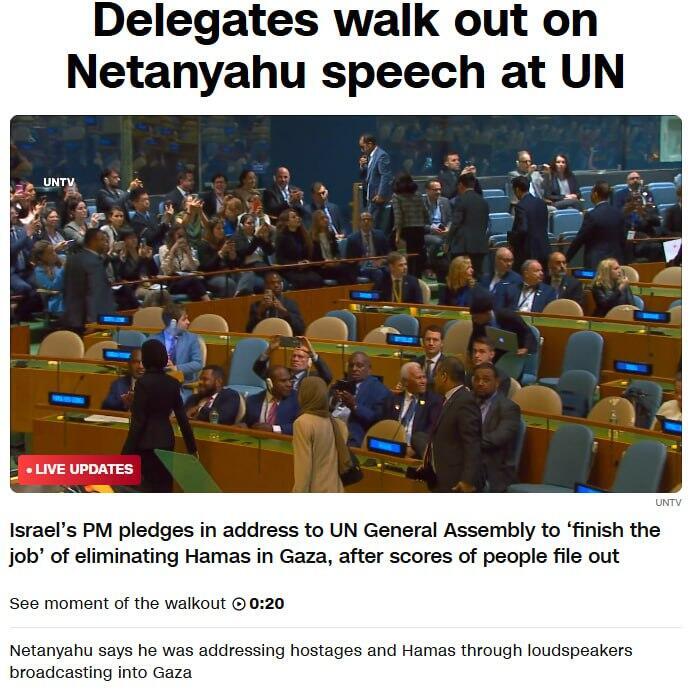
Prime Minister Benjamin Netanyahu’s 41-minute address to the UN General Assembly drew global attention less for his remarks than for the delegates who walked out, with world media emphasizing both the mass exit and his defiant tone

Prime Minister Benjamin Netanyahu delivered a 41-minute speech at the UN General Assembly on Friday, but the headlines across the world were not about what he said. Instead, they focused on the mass walkout by envoys from several countries just before he began speaking.

The images of diplomats leaving the hall quickly spread across international and Arab media, overshadowing Netanyahu’s remarks on Gaza, Hamas and Palestinian statehood.
CNN led its coverage with: “Representatives walk out during Netanyahu speech.” The network posted video of the departures and noted that Netanyahu nevertheless pledged in his remarks to “finish the job” of eliminating Hamas in Gaza. Another CNN headline highlighted Netanyahu’s claim that he had addressed both hostages and Hamas through loudspeakers set up in Gaza.
In Britain, The Guardian ran the headline: “Netanyahu vows to ‘finish job’ in Gaza during UN speech as delegates walk out.” The outlet published its report alongside a looping GIF showing the envoys leaving the chamber and noted that Netanyahu promised Israel would continue its war until Hamas is defeated. In a separate headline, The Guardian also stressed the unusual broadcast of his remarks: “Israeli loudspeakers broadcast Netanyahu’s speech to U.N. into Gaza.”


The Daily Mail did not place Netanyahu’s speech in its main headline, but tied its coverage of the walkout to his statement that Western recognition of a Palestinian state “shows that murdering Jews pays off.”
Ad 
The New York Times described the address as a “defiant speech after dozens walked out.” Its report referenced the protests outside U.N. headquarters in New York and noted the QR code that Netanyahu wore on his suit lapel, which linked to October 7 footage. The Times of India highlighted the same detail under the headline: “QR code on Netanyahu’s lapel links to October 7 footage … ‘You will see why we fight.’”
הכותרות בעולם
The Associated Press wrote: “Facing global isolation at UN, a defiant Netanyahu says Israel ‘must finish the job’ against Hamas.” A second AP story observed, “Always a showman, Netanyahu again turns to props and visual aids as he fends off critics at the U.N.” Both dispatches emphasized his isolation amid broad criticism and his use of theatrical tactics.
Arab media also placed the walkout at the center of their coverage. Hezbollah-linked Al-Manar in Lebanon paused programming marking the anniversary of the killing of former Hezbollah leader Hassan Nasrallah to describe Netanyahu’s remarks as “a speech before empty chairs.” A Lebanese outlet used the same phrase in its headline.
הכותרות בעולם
Qatar’s Al-Arabi Al-Jadid reported: “The UN hall was nearly empty after delegations walked out during Netanyahu’s speech, in protest of Israel’s policy in Gaza and ongoing violence against Palestinians.” The site added that “thousands protested outside the U.N. headquarters in New York against his address. Netanyahu invited allies and leaders whose role was to applaud him.”
Saudi-owned Al-Arabiya was more restrained, reporting: “Netanyahu’s ascending to the podium faced wide opposition from several delegations. Dozens of representatives from various countries left the U.N. hall while Netanyahu, with a stern face, took the lectern. His supporters, who were invited, applauded.”
Netanyahu was joined at the assembly by his wife Sarah and son Yair, who sat alongside ministers Ofir Akunis and Idit Silman. Media in Qatar pointed to their presence, describing them as part of an entourage of loyalists invited “to clap.”
In his address, Netanyahu repeated his rejection of international recognition of Palestinian statehood, calling it “madness” and “national suicide.” He pledged that Israel would continue its military campaign in Gaza until Hamas was eliminated.
שרה יאיר נתניהו נואם בכינוס עצרת האו"ם הכללית
(Photo: Alexi J. Rosenfeld / GETTY IMAGES NORTH AMERICA / AFP)
Despite the walkouts, Netanyahu’s allies at home praised the speech as a strong defense of Israel’s security. But across much of the global press, the most enduring image from his address was that of rows of empty chairs in the General Assembly hall.

Saturday, September 20, 2025

Keir Starmer’s long road to recognising Palestine

Keir Starmer’s long road to recognising Palestine

The Labour government’s approach to Israel’s war in Gaza has soured the party’s relationship with many of its voters

David Sheppard

FT SEP 19 2025

When David Lammy stepped down from the UN podium in late July having announced that the UK would recognise a Palestinian state, he received a standing ovation as he was embraced by the Palestinian delegation.

The then foreign secretary said the UK had a historic responsibility, stretching back to the Balfour declaration of 1917, which pledged the establishment of a Jewish state would not infringe on Arab rights.

But back home, most Labour politicians were more relieved than elated.

Labour’s long road to Palestinian recognition and its approach to Israel’s 23-month war against Hamas in Gaza have soured the party’s relationship with many of its traditional voters.

Following the declaration of famine in Gaza by a UN-backed panel, with Benjamin Netanyahu’s far-right government restricting food supplies, many Labour voters feel the war has become a stain on the party’s conscience and that Prime Minister Sir Keir Starmer’s approach has been far too timid.

“For lots of Labour voters, particularly Muslim voters, our response to the situation in Gaza has triggered a real break with the party,” said one cabinet minister. “And we shouldn’t expect them to come back.” 

A UN-backed panel declared in August there was famine in Gaza © Abood Abusalama/Middle East Images/AFP via Getty Images

The FT has spoken to the key players involved in Labour’s response to the crisis, mapping its journey towards Palestinian recognition. They paint a picture of a party often at war with itself, torn between its liberal internationalist roots and the demands of diplomacy in the age of Trump.

There remains a fragile hope within the party that the UK’s long-awaited recognition, often dismissed as a symbolic gesture as war still rages, might help bring about a peace deal and an eventual two-state solution.

“Now that the decision has been made we need to try and extract what we can from the situation,” said one Labour official.

Labour’s position on Palestine was shaped long before they were elected in July last year, with a manifesto commitment on recognition.

After becoming Labour leader in 2020, Starmer moved aggressively to rid the party of the toxic legacy of former leader Jeremy Corbyn, who had been accused of antisemitism during his frequent attacks on Israel.

“You went from a place where under Corbyn some Jews in the UK had their bags packed and ready to go,” said Michael Rubin, director of Labour Friends of Israel. “To this huge push under Starmer to reassure Jewish voters that Labour was on their side, and he understood their fears.”

One cabinet minister said Starmer had crafted a “brilliant and unequivocal stance,” on antisemitism. “But in our response to Israel it did sometimes feel like we were hamstrung by overhanging guilt for what happened during the Corbyn years.”

Former Labour leader Jeremy Corbyn was accused of antisemitism © Tolga Akmen/AFP/Getty Images

The October 7 2023 attack, when Hamas killed 1,200 people in Israel and seized 250 hostages, affected Starmer deeply according to those close to him. His wife Victoria is Jewish and they have extended family in the country.

In their first meeting after the atrocities, Labour shadow cabinet ministers were unanimous that they had to stand behind Israel.

But there were caveats.

“Any country that had experienced that kind of horrendous attack would expect their allies to support them,” Emily Thornberry, then shadow attorney-general told the FT. “But we also agreed that Israel’s response, to maintain our support, had to stay within the confines of international law.”

Others, including former party leader Ed Miliband and then shadow health minister Wes Streeting voiced concern about Israel’s response.

“You could see in the language being deployed by Netanyahu’s government that they were laying the ground for the collective punishment of the Palestinian people,” one cabinet minister said.

As the offensive in Gaza began, Starmer backed Israel’s right to defend itself. But in one interview four days after the October 7 attack, Starmer made a catastrophic error.

Asked whether Israel’s siege of Gaza, cutting off power and water — a clear breach of international law threatened by Netanyahu — was “appropriate”, Starmer kept repeating his talking points.

“I think that Israel does have that right,” Starmer said. “I don’t want to step away from the core principles that Israel has a right to defend herself.”

Starmer later tried to clarify his comments. But the damage had been done.

“That interview was absolutely disastrous for how our approach to the war in Gaza was viewed — it spread like wildfire,” said one cabinet minister. 

“Dissatisfaction among some Labour voters with our position quickly turned to horror — it made it look like Labour didn’t care about Palestinians.”

As the death toll rose in Gaza, pro-Palestinian protests gained momentum in the UK © Tolga Akmen/EPA/Shutterstock

Israel’s offensive has killed more than 65,000 according to Palestinian health officials. As the death toll rose and Gaza was turned into a rubble-strewn wasteland, pro-Palestinian protests gained momentum in the UK. 

Labour won a landslide victory at the general election last July as voters turned on the Conservative party. But four Labour MPs, including former shadow cabinet member Jon Ashworth, lost their seats to pro-Palestinian independents. Meanwhile Corbyn, running as an independent after being expelled from Labour, held on to his seat in Islington North.

“We came out of the general election with all of that hanging over us,” one cabinet minister said. “Some of us wanted to see an immediate move towards [Palestinian] recognition — but Keir wasn’t ready for a significant shift.”

Labour did not hit the ground running once in power. Starmer, a human rights lawyer, seemed trapped between the increasingly febrile politics of left and right.

He was dubbed a “pro-genocide” prevaricator by some on the left for his support of Israel and “two-tier Keir” by some on the right, who contrasted his robust response to anti-migrant protests with alleged soft-touch policing of pro-Palestine marches. Israel fiercely denies committing genocide in Gaza.

Labour lost its lead in the polls, with Nigel Farage’s anti-immigration populists Reform UK surging ahead.

Starmer’s government took some steps, such as restoring aid funding to the UN agency for Palestinians, UNRWA, and halting arms exports licences, although Israel can still access UK-made components for F-35 fighter jets from a global pool of parts.

But the election of staunchly pro-Israel Donald Trump as US President forced caution. Starmer calculated that building a close relationship with Trump was critical for the UK, putting his pledge to recognise Palestine on ice.

“Trump’s election didn’t just complicate things, it completely changed the focus,” said one senior Labour MP.

In June, the UK risked blowback from Trump by sanctioning ultranationalist Israeli ministers Bezalel Smotrich and Itamar Ben-Gvir. And as pressure mounted from Labour MPs, Lammy slammed the Netanyahu government’s calls to forcibly displace Palestinians as “monstrous” while Starmer described the situation in Gaza as “intolerable”.

After UN agencies warned of widespread starvation, calls for tougher action grew.

President Emmanuel Macron, during a state visit in early July, urged the UK to work with France to recognise a Palestinian state. Any discussions were derailed when Israel launched a 12-day war against Iran.

A protest outside the Foreign Office in London in late July © Vuk Valcic/Alamy

By late July, YouGov polling showed a majority of British people no longer viewed Israel’s actions in Gaza as justified.

The Daily Express newspaper splashed its entire front page with a photo of a malnourished Gazan infant with the headline “For pity’s sake stop this now”.

“The most horrific images from the conflict have circulated for a long time in WhatsApp groups among those who care deeply about the conflict,” one minister said.

“Once they were on the front pages of national newspapers, suddenly we were inundated with messages from Joe Public.”

Macron then announced France would recognise a Palestinian state at the UN General Assembly in September, a move UK officials say “blindsided” them. Ministers in Starmer’s cabinet pounced.

“Anger in the cabinet, which had been simmering, boiled over,” said one cabinet minister.

Streeting, Miliband and the then justice secretary Shabana Mahmood all lobbied in favour of recognising Palestine.

UK officials say Starmer felt vulnerable having just faced a rebellion over welfare reform. They feared a vote on Palestinian recognition could be forced in parliament, putting Starmer’s credibility as leader at stake.

“Until that point, the line had held. But then panic set in,” said one official.

Sir Keir Starmer and French President Emmanuel Macron during a UK-France Summit in London in July © Yui Mok/PA

Within five days of Macron’s announcement, Starmer held an emergency cabinet meeting. It was decided to recognise a Palestinian state in September, unless Israel met a series of conditions.

“I’ve always said we will recognise a Palestinian state as a contribution to a proper peace process,” Starmer announced. “This is the moment to act.”

Some Jewish Labour voters were furious, believing that recognition should only come at the end of a two-state process, not before, especially when Hamas still holds hostages.

“There’s a sense of being let down — betrayal wouldn’t be too strong a word,” said one Jewish community leader.

But some Labour officials argue the decision had a galvanising effect, with Canada and Australia set to join the UK in recognition, and Arab states calling for the first time for Hamas to disarm.

Starmer, who had consulted with Trump, has faced only minor pushback from the US president who acknowledged this week they “disagreed” on the issue while on a state visit to the UK.

Dr Simon Opher, a Labour MP who was stopped by Israel from entering the country this week, said that while he welcomed the government’s decision to recognise Palestine there was still a lot of frustration on the backbenches.

“I think that as a party we have come a hell of a long way since we got elected, but we’ve just always been slightly behind the curve,” Opher told the FT on Friday.

He added that there was likely to be pressure on the government to impose economic sanctions if Israel did not change course.

“When a country is committing genocide, we do not want to help them.”

இலங்கையின் சிக்கன நடவடிக்கை வரலாற்றில் மிகக் கடுமையான ஒன்றாகும்.


இலங்கையின் 'சிக்கன நடவடிக்கை' வரலாற்றில் மிகக் கடுமையான ஒன்றாகும்.

Counter Punch செப்டம்பர் 19, 2025

சிரான் இளன்பெரும

உலக வங்கி அறிக்கையின்படி, பொது முதலீட்டில் பாரிய ஆட்குறைப்பு மற்றும் உண்மையான ஊதியங்கள் சுருக்கப்பட்டதன் மூலம், இலங்கை வரலாற்றில் மிகக் கூர்மையான மற்றும் வேகமான சிக்கன நடவடிக்கைகளில் ஒன்றை அனுபவித்துள்ளது.

செப்டம்பர் 9, 2025 அன்று, உலக வங்கி, " இலங்கை பொது நிதி மதிப்பாய்வு: சமநிலையான நிதி சரிசெய்தலை நோக்கி" என்ற ஒரு அறிக்கையை வெளியிட்டது . 109 பக்கங்களைக் கொண்ட இந்த அறிக்கை, 2022 ஆம் ஆண்டில் இலங்கை அதன் வெளிநாட்டுக் கடன்களைத் திருப்பிச் செலுத்தத் தவறியதைத் தொடர்ந்து, சிக்கன நடவடிக்கைகள் ஒரு வேதனையான ஆனால் அவசியமான சரிசெய்தல் என்ற தத்துவார்த்த உறுதிப்பாட்டில் நங்கூரமிடப்பட்டுள்ளது. ஆயினும்கூட, இந்த முன்னுதாரணத்திற்குள் கூட, சிக்கன நடவடிக்கைகள் எவ்வாறு முதலீட்டை நசுக்கியது, வளர்ச்சியைக் குறைத்தது மற்றும் சமூக துயரத்தை ஆழப்படுத்தியது என்பதற்கான ஒரு மோசமான குற்றச்சாட்டாக செயல்படும் தரவுகளின் புதையலை அறிக்கை வழங்குகிறது.

உலக வங்கியின் கூற்றுப்படி, 1980 மற்றும் 2024 க்கு இடையில் 123 நாடுகளில் 330 சிக்கன நடவடிக்கைகள் மேற்கொள்ளப்பட்ட நிலையில், 2021 முதல் 2024 வரையிலான இலங்கையின் 'நிதி சரிசெய்தல்' 'கூர்மையானதாகவும் வேகமாகவும்' உள்ளது. இலங்கையைப் பொறுத்தவரை, இந்த சாதனை நிதி ஒருங்கிணைப்பு 1980 முதல் 1983 வரையிலான காலத்திற்கு அடுத்தபடியாக இரண்டாவது இடத்தில் உள்ளது - இது அரசு ஆதரவுடன் தொழிற்சங்கங்களை உடைத்தல் மற்றும் இனப் படுகொலைகளால் பதிவு செய்யப்பட்ட புதிய தாராளமயமாக்கலின் கொந்தளிப்பான காலமாகும்.

வளர்ச்சி மற்றும் முதலீடு

2021 ஆம் ஆண்டு இலங்கை அதன் 17வது IMF திட்டத்தில் நுழைந்ததிலிருந்து, அதன் முதன்மை இருப்பு (கடன் திருப்பிச் செலுத்துதலைக் கணக்கிடாமல், அரசாங்க வருவாய்க்கும் செலவினத்திற்கும் இடையிலான வேறுபாடு) எட்டு சதவீதம் அதிகரித்துள்ளது. இருப்பினும் இந்த சாதனை ஒரு அசாதாரண செலவில் வந்தது.

பொது முதலீட்டிற்கு மிகக் கடுமையான அடி ஏற்பட்டுள்ளது: இந்தப் பகுதியில் ஏற்பட்ட ஆட்குறைப்பு 2019 மற்றும் 2023 க்கு இடையில் செலவின சரிசெய்தலில் எழுபத்திரண்டு சதவீதத்தை அதிகரித்தது. 2021 மற்றும் 2023 க்கு இடையில் வளர்ச்சிக்கு பொது முதலீட்டின் பங்களிப்பு எதிர்மறையாக மாறியது, ஒட்டுமொத்த மொத்த உள்நாட்டு உற்பத்தியை கீழ்நோக்கி இழுத்தது. எதிர் சுழற்சி முறையில் செயல்படுவதற்குப் பதிலாக, தொழிலாளர்களை உறிஞ்சுவதற்கும், தேவையைத் தூண்டுவதற்கும், தொழில்துறை மீட்சிக்கான அடித்தளங்களை அமைப்பதற்கும் மிகவும் அவசியமானபோது பொது முதலீடு துல்லியமாகக் கட்டுப்படுத்தப்பட்டது.

இலங்கையில் ஏற்கனவே மோசமான உள்கட்டமைப்பு இருப்பதால், பொது முதலீட்டில் வெட்டுக்கள் குறிப்பாக மிக மோசமானவை. உலக வங்கியே இலங்கையின் பொது மூலதன பங்கு 2019 ஆம் ஆண்டில் 166 நாடுகளில் 143 ஆக இருந்தது - ஒட்டுமொத்த உள்கட்டமைப்பில் வெளிப்படையான குறைபாடுகளுடன் மிகக் கீழே உள்ளது என்பதை ஒப்புக்கொள்கிறது. இலங்கையின் கிராமப்புற சாலை வலையமைப்பின் கணிசமான பகுதி இன்னும் செப்பனிடப்படாமலும் மோசமான நிலையிலும் உள்ளது. பொதுப் போக்குவரத்தில்: பொதுப் பேருந்துக் குழுவில் மூன்றில் ஒரு பங்கு இயங்கவில்லை, மேலும் ரயில் எஞ்சின்களில் மூன்றில் இரண்டு பங்கு நாற்பது ஆண்டுகளுக்கும் மேலானவை.

இலங்கையின் உதாரணம் உலகளாவிய தெற்கில் -Global South-உள்ள பல நாடுகளில் ஒன்றாகும். 3.4 பில்லியன் மக்களைக் கொண்ட சுமார் ஐம்பத்து நான்கு பின்தங்கிய நாடுகள், தங்கள் வரி வருவாயில் பெரும்பகுதியை தங்கள் மக்களின் நல்வாழ்வில் முதலீடு செய்வதற்குப் பதிலாக கடனாளிகளுக்கு பணம் செலுத்துவதற்காக செலவிடுகின்றன. இந்த நாடுகளில், கடன் வழங்குபவரின் கூற்றுக்கள் மனிதர்களின்-மக்களின் கண்ணியத்தை விட அதிகமாக உள்ளன.

இந்த முதலீட்டு ஒடுக்குமுறை, நாட்டை முடக்கியுள்ள பொருளாதார தேக்கத்துடன் நேரடியாக இணைக்கப்பட்டுள்ளது. "உண்மையான மொத்த உள்நாட்டு உற்பத்தி 2026 வரை அதன் 2018 நிலைக்குத் திரும்பும் என்று எதிர்பார்க்கப்படவில்லை" என்று உலக வங்கி ஒப்புக்கொள்கிறது. வேறு வார்த்தைகளில் கூறுவதானால், நாடு கிட்டத்தட்ட ஒரு தசாப்த கால வளர்ச்சியை இழந்துவிட்டது. வேலைவாய்ப்பு மற்றும் மேம்பாட்டிற்கான முக்கிய இயந்திரமான தொழில்துறை துறை, 2022 மற்றும் 2023 ஆம் ஆண்டுகளில் இருபத்தைந்து சதவீத ஒட்டுமொத்த சுருக்கத்தால் கடுமையாக பாதிக்கப்பட்டுள்ளது.

ஊதியம் மற்றும் வறுமை

இந்த சிக்கனக் கொள்கையின் மனித உயிரிழப்பு ஜீரணிக்க கடினமாக உள்ளது. மக்கள்தொகையில் கால் பங்கிற்கும் அதிகமானோர் வறுமைக் கோட்டிற்குக் கீழே விழுந்துள்ளதாகவும், மூன்றில் ஒரு பங்கு மக்கள் பாதிக்கப்படக்கூடியவர்களாகவும் வறுமையின் விளிம்பில் வாழ்பவர்களாகவும் வகைப்படுத்தப்பட்டுள்ளதாக அறிக்கை கூறுகிறது. 2022 ஆம் ஆண்டின் நடுப்பகுதிக்கும் 2023 ஆம் ஆண்டின் நடுப்பகுதிக்கும் இடையிலான நிதி சரிசெய்தல் காரணமாக வறுமையில் நான்கு சதவீத அதிகரிப்பு நேரடியாகக் காரணம் என்று அறிக்கை ஒப்புக்கொள்கிறது. ஏழைகள் விகிதாசாரமாகப் பாதிக்கப்பட்டுள்ளனர்; மின்சார மானியங்களை நீக்குவது மட்டும் ஏழைக் குடும்பங்களின் செலவழிப்பு வருமானத்தில் ஐந்து சதவீதம் குறைவதற்கு வழிவகுத்தது.

இதற்கிடையில், சராசரி தொழிலாளிக்கு நிலைத்தன்மை மற்றும் மீட்சி என்ற வாக்குறுதி நிறைவேறத் தவறிவிட்டது. தனியார் மற்றும் பொதுத் துறைகளுக்கு நெருக்கடிக்கு முந்தைய நிலைகளை விட உண்மையான ஊதியங்கள் முறையே பதினான்கு மற்றும் இருபத்து நான்கு சதவீதம் குறைவாகவே உள்ளன. பணியமர்த்தல் முடக்கத்தின் கீழ் பொதுத்துறை இதன் சுமையைச் சுமந்துள்ளது. ஏற்கனவே குறைவாக இருந்த சராசரி பொதுத்துறை ஊதியம், 2020 இல் தனிநபர் மொத்த உள்நாட்டு உற்பத்தியில் எண்பத்தெட்டு சதவீதத்திலிருந்து 2023 இல் வெறும் அறுபத்தி இரண்டு சதவீதமாகக் குறைந்தது, இதனால் அரசாங்க ஊதியங்கள் மிகவும் திறமையான தொழிலாளர்களுக்கு மிகக் குறைந்த போட்டித்தன்மை கொண்டதாக மாறியது.

இந்த புள்ளிவிவரங்கள், நாடு போராடி வரும் திறமையான தொழிலாளர்கள் அல்லது "மூளை வடிகால்" (Brain Drain- மூளை உழைப்புச் சக்தியின் அழிவு)  வெளியேற்றத்தை சூழ்நிலைப் படுத்துகின்றன. சமீபத்திய ஆய்வில் , நிபுணர்கள் உட்பட 1,489 மருத்துவர்கள் 2022 மற்றும் 2024 க்கு இடையில் இடம்பெயர்ந்தனர், இதனால் இலங்கை அரசாங்கத்திற்கும் வரி செலுத்துவோருக்கும் கிட்டத்தட்ட $41.5 மில்லியன் நிதிச் சுமை ஏற்பட்டது. இந்த வெளியேற்றம் சுகாதார அமைப்பில் குறிப்பிடத்தக்க அழுத்தத்தை ஏற்படுத்தியுள்ளது, இதன் விளைவாக முக்கிய நிபுணர்களின் பற்றாக்குறை, மருத்துவப் பயிற்சியில் இடையூறு மற்றும் சுகாதாரப் பராமரிப்பு அணுகலில் ஏற்றத்தாழ்வுகள் அதிகரித்து வருகின்றன.

வெளிப்படையான இல்லாமைகள்

சிக்கன நடவடிக்கைகளை மேலும் ஏற்றுக்கொள்ளத்தக்கதாக மாற்றுவதற்காக இந்த அறிக்கை ஏராளமான தொழில்நுட்ப பரிந்துரைகளைக் கொண்டுள்ளது. வரி நிர்வாகத்தை மேம்படுத்துதல், மறைமுக வரிவிதிப்புக்கு பதிலாக நேரடி வரிவிதிப்புக்கு மாறுதல் மற்றும் பொதுச் செலவினங்களை சிறப்பாக இலக்காகக் கொள்வது போன்ற இந்தப் பரிந்துரைகளில் பலவும் தாங்களாகவே பாதிப்பில்லாதவை. அவை ஒரு பொருட்டல்ல என்று ஒருவர் கூறலாம். அறிக்கையில் பதில் இல்லாத இடத்தில் இரண்டு முக்கியமான கட்டமைப்பு சிக்கல்கள் உள்ளன:

1) கடன் குண்டு

உண்மை என்னவென்றால், இலங்கையில் ஒட்டுமொத்த பொதுச் செலவு குறைவாக உள்ளது. பொதுச் செலவினங்களின் மிகப்பெரிய கூறு வட்டி செலுத்துதல்கள் ஆகும், இது 2023 ஆம் ஆண்டில் மொத்த உள்நாட்டு உற்பத்தியில் ஒன்பது சதவீதமாக இருந்தது. அறிக்கையை மேற்கோள் காட்டவேண்டுமானால், 'இலங்கையின் வட்டி செலுத்தும் செலவுகள் ஒப்பீட்டளவில் பெரியவை, அதே நேரத்தில் பொதுத்துறை ஊதிய மசோதா, மூலதனச் செலவுகள் மற்றும் சுகாதாரம், சமூகப் பாதுகாப்பு மற்றும் கல்விக்கான செலவுகள் ஒப்பீட்டளவில் குறைவாக உள்ளன'. 

சமூக முதலீட்டை நிரம்பி வழியும் கடன் குண்டைத் தணிக்காமல், எந்த அளவிலான உள் நிதி சரிசெய்தலும் நீண்டகால ஸ்திரத்தன்மையை வழங்க முடியாது. முழுமையான மறுசீரமைப்பு அல்லது ரத்து தேவை.

2) கட்டமைப்பு ரீதியாக மாறாத தன்மை: 

"உற்பத்தி" அல்லது "தொழில்மயமாக்கல்" என்ற வார்த்தைகள் அறிக்கையில் அரிதாகவே காணப்படுகின்றன. இயற்கையாகவே, விவசாய ஏற்றுமதிகள் மற்றும் சேவைகளை அடிப்படையாகக் கொண்ட ஒரு மேம்பாட்டு மாதிரியை பரிந்துரைப்பதில் நீண்ட வரலாற்றைக் கொண்ட உலக வங்கி, கட்டமைப்பு மாற்றத்திற்கு அதிக அக்கறை காட்டவில்லை. உள்கட்டமைப்பு மற்றும் பொது சேவைகளை நிலைநிறுத்தும்போது வேலைவாய்ப்புகளையும் வளர்ச்சியையும் உருவாக்கக்கூடிய ஒரு நவீன பொருளாதாரத்தை கட்டியெழுப்பும் பணியிலிருந்து அரசாங்க செலவினங்களின் பிரச்சினை கிட்டத்தட்ட முற்றிலும் தனிமைப்படுத்தப்பட்டுள்ளது. பட்ஜெட்டை சமநிலைப்படுத்துவது அடுத்த நெருக்கடியை முன்கூட்டியே தடுக்கும் வகையில் பொருளாதாரத்தை மாற்றாது; நீண்டகால திட்டமிடல் மற்றும் தொழில்துறை கொள்கை தேவை.

இலங்கையின் உதாரணம் உலகளாவிய தெற்கில் -Global South-உள்ள பல நாடுகளில் ஒன்றாகும். 3.4 பில்லியன் மக்களைக் கொண்ட சுமார் ஐம்பத்து நான்கு பின்தங்கிய நாடுகள், தங்கள் வரி வருவாயில் பெரும்பகுதியை தங்கள் மக்களின் நல்வாழ்வில் முதலீடு செய்வதற்குப் பதிலாக கடனாளிகளுக்கு பணம் செலுத்துவதற்காக செலவிடுகின்றன. இந்த நாடுகளில், கடன் வழங்குபவரின் கூற்றுக்கள் மனிதர்களின் கண்ணியத்தை விட அதிகமாக உள்ளன.

கடன் கொடுத்தவர்களின் பசி எப்போது தீரும்?

 கட்டமைப்பு மாற்றத்திற்குத் தேவையான நிதி மற்றும் தொழில்நுட்ப பரிமாற்றங்களை எவ்வாறு பெற முடியும்? உலக வங்கி கேட்க விரும்பாத கேள்விகள் இவை. அதற்கு பதிலாக, முன்பு செய்யப்பட்டதை மீண்டும் செய்ய முடியும் என்று அது வலியுறுத்துகிறது - இன்னும் "சமச்சீர்" வழியில்.

காலநிலை அறிவிப்பு-பேராசிரியர் நா.பிரதீபராஜா

https://www.facebook.com/Piratheeparajah 03.12.2025 புதன்கிழமை பிற்பகல் 3.30 மணி விழிப்பூட்டும் முன்னறிவிப்பு இன்று வடக்கு மற்றும் கிழக்கு ம...