SHARE

Friday, May 09, 2025

At least two Indian jets crashed

At least two Indian jets appear to have crashed during Pakistan strikes, visuals show

In a review of visuals posted online, The Post verified debris consistent with at least two French-made fighter jets flown by the Indian air force.

Yesterday 9-05-2025  at 3:42 p.m. EDT 

By Imogen Piper
Jarrett Ley
Evan Hill
 and 
Maham Javaid

Metal debris lies on the ground in Wuyan in India-administered Kashmir's Pulwama district on Wednesday. (Sharafat Ali/Reuters)


India’s air force appears to have lost at least two fighter jets, including one of its most advanced models, during attacks Wednesday morning on sites in Pakistan and Pakistani-administered Kashmir, according to a review of visual evidence by The Washington Post.

Islamabad said Wednesday it had downed five Indian warplanes. New Delhi has neither confirmed nor denied the Pakistani claims; India’s military and its ministry of external affairs did not respond to a request for comment.

In a review of more than a dozen images and videos posted online in the aftermath of the strikes, The Post verified debris consistent with at least two French-made fighter jets flown by the Indian Air Force — a Rafale and a Mirage 2000.

The Post based its findings on analysis by Trevor Ball, a former explosive ordnance disposal technician for the U.S. Army; Etienne Marcuz, an associate fellow at the Foundation for Strategic Research; and a French airpower expert with military experience who shared his analysis on the condition of anonymity because he was not authorized to speak to the media. The experts could not determine whether the planes were shot down or crashed due to other reasons. The fate of the pilots was also unclear.

The loss of multiple fighter jets would represent the worst setback in battle for India’s air force in recent memory; in 2019, during the last round of fighting between the nuclear-armed neighbors, India acknowledged one of its jets was shot down by Pakistan.

India’s strikes inside Pakistan — launched in retaliation for a deadly militant attack on tourists last month in Indian-administered Kashmir — were the deepest in more than half a century; mutual accusations of drone attacks and border violations in the days that followed have brought the archrivals to the brink of full-scale conflict.

“There’s a lot of political weight being put behind the planes because neither side has yet crossed a threshold of full-scale conventional warfare,” said Sameer Lalwani, a fellow at the D.C.-based Center for Strategic and Budgetary Assessments.

United States Air Force and Indian Air Force personnel pose in front of a Rafale fighter jet during a joint exercise in India on April 24, 2023. (Debajyoti Chakraborty/NurPhoto/AP)

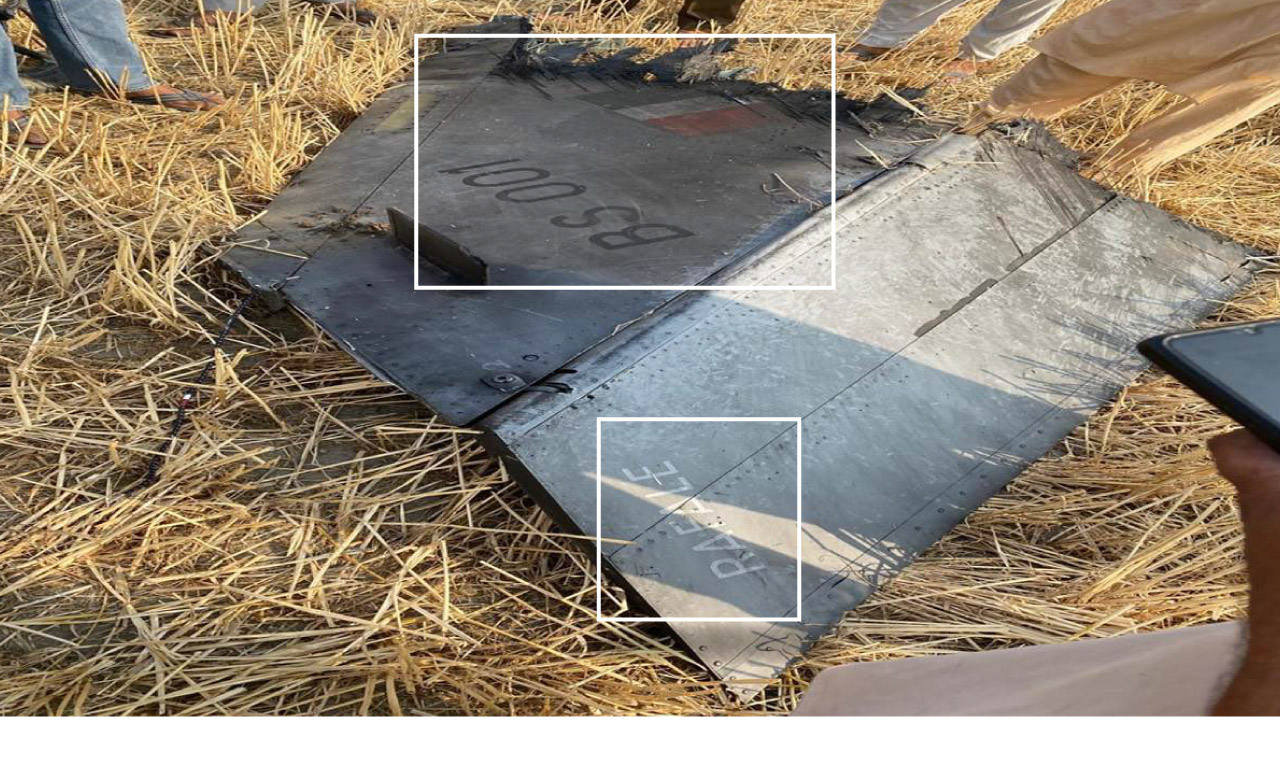
The word “Rafale” is stenciled in white on the vertical stabilizer in one image of the wreckage, alongside the letters “BS 001” and an Indian flag. The markings matched those on the vertical stabilizer of an Indian air force Rafale seen in images posted online in 2021.

Indian flag and serial number

“Rafale” marking

Image widely shared on X shows what experts said was a vertical stabilizer of a Rafale aircraft.


The Post could not independently geolocate the images of the wreckage, which were said to have been taken near the village of Akalia Khurd in Punjab, about 45 miles from India’s border with Pakistan. But they did not appear to have been posted online before Wednesday, and local reports said Indian military authorities had responded to a crash in the area and collected the wreckage. One farmer was killed by a postcrash blast after being the first to reach the site, the Indian Express reported.

Other photos taken in Wuyan, a village in Indian-administered Kashmir about 80 miles from the Pakistani border, showed what all three experts agreed was an external fuel tank belonging to a Mirage 2000, an older fighter aircraft also manufactured by Dassault that entered Indian military service in the 1980s.

Mirage 2000

external fuel tank

Image: Sharafat Ali/Reuters


Reuters

Fuel tanks can be jettisoned in response to a mechanical failure or combat damage, or to make a jet more maneuverable in battle, so are not on their own proof of a crash. But just a quarter-mile away, eyewitnesses reported a plane crashing into a primary school soon after the Indian strikes began. Part of a jet engine is visible within the flaming wreckage of the school in a video posted the night of the attack, according to Ball and the French airpower expert, which suggests an aircraft went down there.

Another video, posted Thursday by the school on Facebook, showed schoolgirls picking up fallen tree limbs and commentators expressing hope it would be rebuilt.

“These missile launch rails are attached to the aircraft, and it being on the ground, along with the large fire in the background indicates a crash likely occurred,” Ball said.

The Post identified an apparent third crash site in Akhnoor, in Indian-administered Kashmir, based on videos and news reports from the day, but it was not possible to determine what type of aircraft was in the wreckage from the available visuals.

Pakistani Prime Minister Shehbaz Sharif said Pakistani planes never entered Indian territory and only shot down the Indian aircraft after they had “delivered their payload.”

Arzan Tarapore, a research scholar focusing on Indian military strategy at Stanford University, said India’s silence on the planes was unsurprising.

“The Indian government during a crisis is typically very guarded about operational details,” he said. “It’s harder to be restrained and control the trajectory of the crisis if you admit to severe losses.”

Sushant Singh, a Yale University lecturer and former Indian military official, said the lack of comment from New Delhi has also allowed Pakistan to “claim a win, and maybe that could be an off-ramp” for escalation.🔺

Putin and Xi cast themselves as defenders of world order


Xi attends Russia's Victory Day parade at Moscow's Red Square

By Xinhua May 09, 2025 Global Times

Chinese President Xi Jinping on Friday attended a grand parade here at the Red Square marking the 80th anniversary of the victory in the Soviet Union's Great Patriotic War.

Leaders from more than 20 countries and international organizations are invited to the event. 

China, Russia to shoulder special responsibility amid rising unilateralism

By Xinhua May 09, 2025

Chinese President Xi Jinping and Russian President Vladimir Putin sign a joint statement on further deepening the China-Russia comprehensive strategic partnership of coordination for a new era after their talks at the Kremlin in Moscow, Russia, May 8, 2025. (Photo: Xinhua)

In the face of the countercurrent of unilateralism and the act of power politics and bullying in the world, China will work with Russia to shoulder the special responsibility as major countries of the world and permanent members of the UN Security Council, Chinese President Xi Jinping said Thursday.

Xi made the remarks while holding talks with Russian President Vladimir Putin during his state visit to Russia.

The two leaders exchanged in-depth views on China-Russia relations and major international and regional issues, reaching consensus on unwaveringly deepening strategic coordination and promoting the stable, healthy and high-level development of China-Russia relations. They also called for promoting the correct historical perspective on World War II (WWII), maintaining the authority and status of the United Nations, and safeguarding international justice and fairness.

ROBUST TIES

In recent years, China-Russia ties have enjoyed stable, healthy and high-level development thanks to joint efforts from both sides, Xi said, hailing long-term good-neighborly friendship and mutually beneficial cooperation as distinct features of bilateral ties.

The political mutual trust between the two countries has grown ever deeper, the bond of practical cooperation ever stronger, while people-to-people exchanges and local interactions have flourished with increasing vitality, Xi said, noting that China-Russia relations have grown more confident, stable and resilient in the new era.

Xi said that history and reality have fully proved that continuing to develop and deepen China-Russia relations is integral to carrying forward the friendship between the two peoples from generation to generation, adding that it is an inevitable choice for both sides to achieve mutual success and promote their own development and revitalization.

It is also the call of the times for safeguarding international fairness and justice and promoting the reform of the global governance system, Xi said.

Noting that this year marks the 80th anniversary of the victory in the Chinese People's War of Resistance against Japanese Aggression, the Soviet Union's Great Patriotic War and the World Anti-Fascist War, Xi said that 80 years ago, peoples of China and Russia made tremendous sacrifices and won great victories, making remarkable historic contributions to maintaining world peace and the cause of human progress.

China will work with Russia to take a clear stand to jointly promote the correct historical perspective on WWII, safeguard the authority and status of the United Nations, firmly defend the victory of WWII, resolutely defend the rights and interests of China, Russia and the vast number of developing countries, and promote an equal and orderly multipolar world and a universally beneficial and inclusive economic globalization, Xi said.

CLOSER COOPERATION

The two heads of state also received briefings from respective department leaders of the two countries regarding bilateral cooperation across various sectors.

Xi pointed out that China and Russia should stick to the general course of cooperation and fend off external disruptions, so as to solidify the foundation for stable cooperation and ensure stronger momentum for progress.

The two countries should tap into the resource endowments of both countries and complementary advantages of their industrial systems, and expand high-quality and mutually beneficial cooperation in such fields as economy, trade, energy, agriculture, aerospace and artificial intelligence, Xi said.

The two countries should take the synergy between the Belt and Road Initiative and the Eurasian Economic Union as a platform to build a high-standard connectivity pattern, he said, adding that the two countries should fully unleash the potential of the China-Russia Years of Culture, strengthen cooperation in education, film, tourism, sports and local areas, and promote deep-rooted people-to-people connectivity.

The two countries should closely coordinate and cooperate on multilateral platforms such as the United Nations, the Shanghai Cooperation Organization and BRICS, unite the Global South, uphold true multilateralism, and steer the right direction of global governance reform, Xi added.

Xi emphasized that China is comprehensively advancing the building of a strong country and the great cause of national rejuvenation through Chinese modernization, and that China possesses both the resolve and confidence to overcome all risks and challenges.

No matter how the external environment changes, China will firmly handle its own affairs well, Xi said, adding that China stands ready to work with Russia to shoulder the special responsibilities bestowed by the times, safeguard the global multilateral trading system and keep the industrial and supply chains stable and unimpeded, and make greater contributions to promoting the development and rejuvenation of the two countries and upholding international fairness and justice.

For his part, Putin said that the Russia-China relations are based on mutual equality and respect, not targeting any third party and not affected by any temporary incidents.

Unswervingly promoting the development of Russia-China relations and expanding mutually beneficial cooperation are Russia's strategic choices, Putin said, adding that the Russian side firmly adheres to the one-China principle and has always supported China's position on the Taiwan question.

Russia is ready to maintain close high-level exchanges with China, strengthen practical cooperation in such fields as trade, investment, energy, agriculture, science and technology, deepen people-to-people and cultural exchanges in education, culture, youth, tourism and other areas, and expand the connotations of the Far East region cooperation.

Imposing high tariffs is senseless and illegal, and will only backfire, Putin said, adding that the two sides should enhance coordination and cooperation within multilateral frameworks such as the United Nations, the Shanghai Cooperation Organization and BRICS, support the process toward a multipolar world, jointly oppose unilateralism, reject the abuse of sanctions, resist bloc confrontation, and safeguard the common interests of the international community.

Noting that both Russia and China made great sacrifices in the World Anti-Fascist War, Putin said that under the strong leadership of the Communist Party of China, the Chinese people fought bravely and achieved a great victory in the War of Resistance Against Japanese Aggression, making significant contributions to the victory of WWII.

During the arduous years of war, Russia and China supported each other and forged a profound friendship, laying a solid foundation for the development of bilateral relations, Putin said, adding that both sides should safeguard the authority of the United Nations and international law, preserve the correct historical narrative on WWII, uphold international fairness and justice, and work together to create a brighter future for both countries and the world.

SAFEGUARDING INTERNATIONAL FAIRNESS, JUSTICE

On the same day, when jointly meeting the press with Putin after their talks at the Kremlin, Xi said that China and Russia should take a clear stand and coordinate comprehensively to make new and greater contributions to promoting the development and rejuvenation of the two countries and safeguarding international fairness and justice.

In the face of the changes of the world, of the times and of historical significance, China and Russia should keep a firm grasp on the development direction of bilateral ties and the general trend of the development of human society, Xi said.

Noting that his talks with Putin were in-depth, cordial and fruitful, Xi said he and Putin reached many important new consensus, signed a joint statement on further deepening China-Russia comprehensive strategic partnership of coordination for a new era and witnessed the exchange of multiple bilateral cooperation documents, which injected new impetus into the development of China-Russia relations.

Xi said that China and Russia must uphold long-standing friendship from generation to generation and remain true friends forged through trials and tribulations. Eighty years ago, in the face of brutal aggression of militarism and Nazism, the Chinese and Russian peoples stood united, fighting side by side against a common enemy and writing a remarkable and heroic chapter in history, he said.

The great friendship forged between the two peoples through the trials of war and bloodshed has laid a solid foundation for the high-level development of bilateral relations, Xi said, adding that the two countries should deepen political mutual trust, enhance strategic coordination and advance bilateral ties toward a more mature and resilient future.

Xi noted that the two countries should uphold fairness and justice and defend the international order. China and Russia, as main theaters of Asia and Europe in WWII, have made decisive contributions to the victory of the World Anti-Fascist War and laid a solid foundation for the establishment of the post-war international order, he said.

As forces for stability, progress and development in the international community, China and Russia should continue to firmly stand together, resolutely safeguard the UN-centered international system and the international order underpinned by international law, and continuously promote an equal and orderly multipolar world, said Xi.


Xi holds talks with Putin

Chinese President Xi Jinping held talks on Thursday with Russian President Vladimir Putin.

Xi arrived on Wednesday to pay a state visit to Russia and attend the celebrations marking the 80th anniversary of the victory in the Soviet Union's Great Patriotic War.

At Kremlin talks, Putin and Xi cast themselves as defenders of world order

By Dmitry Antonov May 8, 2025

Russian President Vladimir Putin shakes hands with his Chinese counterpart Xi Jinping during a welcoming ceremony before their talks at the Kremlin in Moscow, Russia, May 8, 2025. REUTERS/Evgenia Novozhenina/Pool

Summary

  • Putin says both countries stand together against 'neo-Nazism'
  • In swipe at US, Xi says they will counter 'bullying'
  • Kremlin seeks boost from visit of powerful ally
  • Xi is star guest at lavish World War Two commemorations

MOSCOW, May 8 (Reuters) - Russian President Vladimir Putin thanked Chinese President Xi Jinping for joining celebrations to mark 80 years since the "sacred" victory over Adolf Hitler in World War Two, and said the two countries stood together now against "neo-Nazism".

Xi's presence at this week's anniversary celebrations provides an important boost for the Kremlin leader, who has portrayed his war in Ukraine as a struggle against modern-day Nazis from the start.

The Reuters Tariff Watch newsletter is your daily guide to the latest global trade and tariff news. Sign up here.

Ukraine and its allies reject that characterisation as a grotesque falsehood, accusing Moscow of conducting an imperial-style invasion.

"The victory over fascism, achieved at the cost of enormous sacrifices, is of lasting significance," Putin told Xi on Thursday.

"Together with our Chinese friends, we firmly stand guard over historical truth, protect the memory of the events of the war years, and counteract modern manifestations of neo-Nazism and militarism."

Xi said the two countries, as world powers and permanent members of the U.N. Security Council, would work together to counter "unilateralism and bullying" - an implied reference to the United States.

He said they would "jointly promote the correct view of the history of World War Two, safeguard the authority and status of the United Nations, resolutely defend the rights and interests of China, Russia and the vast majority of developing countries, and work together to promote an equal, orderly, multipolar, and inclusive economic globalisation".

The two men spoke after approaching each other along a red carpet from opposite ends of one of the Kremlin's most opulent halls and shaking hands in front of the cameras. Each greeted the other as "dear friend".

POWERFUL GUEST

Xi is the most powerful of more than two dozen foreign leaders who are visiting Moscow this week to mark Thursday's 80th anniversary of the end of World War Two - a celebration of huge significance for Putin.

Domestically, it offers him a chance to rally Russians in remembrance of a historic feat that is central to the country's national identity. The Soviet Union lost 27 million people in World War Two, including many millions in Ukraine, which was also devastated.

On the world stage, Putin aims to cast himself alongside Xi as a defender of the international order, and to demonstrate that years of Western sanctions have failed to isolate Russia.

Putin last week announced a unilateral three-day ceasefire in the war with Ukraine, beginning on Thursday. Ukraine has not committed to abide by it, calling it a ruse by Putin to create the impression he wants to end the war. Instead, it has declared its willingness to join a ceasefire lasting at least 30 days.

Both countries are under pressure from U.S. President Donald Trump to reach a peace deal, and Washington has threatened repeatedly to walk away from talks unless there is clear progress.

Ukraine targeted Moscow with drones for three days earlier this week, but the skies above the capital were calm on Thursday. With so many foreign leaders present, any attacks during the May 9 events could embarrass Putin and would likely draw a tough response from Moscow.

A Ukrainian military spokesperson told Reuters that Russian troops had continued to conduct assaults in several areas on the eastern front, despite the ceasefire. The air force said Russian aircraft had launched guided bombs on the Sumy region of northern Ukraine three times.

But the air force also said there had been no Russian missiles or drones in Ukrainian airspace since the Kremlin-sponsored ceasefire kicked in.

Chinese troops will take part in Friday's military parade on Red Square, the centrepiece of the commemorations. Ukraine's Foreign Ministry on Tuesday urged countries not to send their militaries to participate, saying it would go against some countries' declared neutrality in the war.

Xi has called for talks to end the conflict in Ukraine and has accused the U.S. of stoking it with weapons supplies to Kyiv. Ukrainian President Volodymyr Zelenskiy has in the past urged him to try to persuade Putin to halt the war.

Xi, whose country is locked in a tariff war with the United States, is expected to sign numerous agreements to deepen the "no limits" strategic partnership that Russia and China signed in 2022, less than three weeks before Putin sent his army into Ukraine.

China is Russia's biggest trading partner and has thrown Moscow an economic lifeline that has helped it navigate Western sanctions. China buys more Russian oil and gas than any other country.

Reporting by Dmitry Antonov in Moscow, Kyiv and Beijing newsroom and Maxim Rodionov, Filipp Lebedev and Alexander Marrow in London, writing by Mark Trevelyan

Thursday, May 08, 2025

Pakistan's jet brought down two Indian fighter aircraft, US officials say

China's J-10 fighter jets from the People's Liberation Army Air Force August 1st Aerobatics Team perform during a media demonstration at the Korat Royal Thai Air Force Base, Nakhon Ratchasima province, Thailand, November 24, 2015. REUTERS/Athit Perawongmetha/File Photo

Reuters Exclusive: Pakistan's Chinese-made jet brought down two Indian fighter aircraft, US officials say

By Saeed Shah and Idrees Ali May 8, 2025 Reuters

Summary

  • US officials confirm Pakistan used Chinese J-10 jets against Indian aircraft
  • India has not acknowledged loss of planes
  • Pakistan claims downing five Indian planes, including three Rafale jets

ISLAMABAD/WASHINGTON, May 8 (Reuters) - A top Chinese-made Pakistani fighter plane shot down at least two Indian military aircraft on Wednesday, two U.S. officials told Reuters, marking a major milestone for Beijing's advanced fighter jet.

An Indian Air Force spokesperson said he had no comment when asked about the Reuters report.

The performance of a leading Chinese fighter jet against a Western rival is being closely watched in Washington for insights into how Beijing might fare in any showdown over Taiwan or the wider Indo-Pacific.

One U.S. official, speaking on condition of anonymity, said there was high confidence that Pakistan had used the Chinese-made J-10 aircraft to launch air-to-air missiles against Indian fighter jets - bringing down at least two.

Another official said at least one Indian jet that was shot down was a French-made Rafale fighter aircraft.

Both officials said Pakistan's F-16 aircraft, made by Lockheed Martin (LMT.N), opens new tab, were not used in the shootdown.

Delhi has not acknowledged the loss of any of its planes and instead said it carried out successful strikes against what it said was "terrorist" infrastructure inside Pakistan.

World powers from the U.S. to Russia and China have called for calm in one of the world's most dangerous, and most populated, nuclear flashpoint regions.

In France, Rafale manufacturer Dassault Aviation (AM.PA), opens new tab and the MBDA (AIR.PA), opens new tab, (BAES.L), opens new tab, (LDOF.MI), opens new tab consortium, which makes the Meteor air-to-air missile, could not immediately be reached for comment on a public holiday.

While Reuters reported on Wednesday that three Indian planes went down, citing local government officials in India, this marks the first Western confirmation that Pakistan's Chinese-made jets were used in the shootdowns.

Pakistan’s Defense minister, Khawaja Muhammad Asif, told Reuters on Thursday that the J-10 was used to shoot down three French-made Rafale planes, which were newly acquired by India.

Altogether, Pakistan says it downed five Indian planes in air-to-air combat.

CLOSELY EYING

The Rafale and the model of the J-10 used by Pakistan are both considered generation 4.5 fighter jets, placing them at the leading edge of combat aircraft.

Western analysts and defense industry sources said the live use of some of the advanced weapons that could be deployed in future major power conflicts would be scrutinized in minute detail, but emphasized it was too early to draw firm conclusions.

"Air warfare communities in China, the U.S. and a number of European countries will be extremely interested to try and get as much ground truth as they can on tactics, techniques, procedures, what kit was used, what worked and what didn't," said Douglas Barrie, senior fellow for military aerospace at the International Institute for Strategic Studies.

Social media posts highlighted the face-off between China's PL-15 air-to-air missile against the Meteor, produced by European missile group MBDA (AIR.PA), opens new tab(BAES.L), opens new tab(LDOF.MI), opens new tab.

But the analysts and sources said crucial details were unclear including whether Meteors were carried or how they may have been deployed.

"At the moment it's not possible to judge anything. We know so little," a Western defense industry source said.

Nuclear-armed India and Pakistan have fought three major wars, as well as numerous smaller conflicts.

Blasts rang out across the city of Jammu in Indian Kashmir late on Thursday during what Indian military sources said they suspected was a Pakistani drone attack across the region on the second day of clashes between the neighbors.

Pakistan said earlier on Thursday it shot down 25 drones from India overnight, while India said its air defenses had stopped Pakistani drone and missile attacks on military targets.

Reporting by Saeed Shah in Islamabad and Idrees Ali in Washington; Additional reporting by Tim Hepher in Paris and Shivam Patel in New Delhi; Editing by Don Durfee and Matthew Lewis


'If I can help, I'll be there': Trump


'If I can help, I'll be there': Trump offers to mediate India-Pakistan row

Prateek Shukla New Delhi : May 08 2025

US President Donald Trump has called for calm and dialogue between India and Pakistan amid rising tensions, expressing hope that the two nuclear-armed neighbours will resolve their differences peacefully.

Speaking to reporters, Trump said, “I want to see them work it out.” He added, “Hopefully they can stop now,” urging both sides to de-escalate the situation.

Reiterating his past offers to mediate between the two countries, Trump stated, “If I can help, I will be there.” 

A day ago, Trump reacted to India's military strikes on terror infrastructure inside Pakistan, describing the situation as "a shame" and urging both countries to de-escalate. "They've been fighting for a long time. They've been fighting for many, many decades and centuries, actually, if you really think about it,” Trump said when asked about the attacks between India and Pakistan.

When asked if he has any message for the countries, he said “No, I just hope it ends very quickly.”

Operation Sindoor: Doval spoke to Marco Rubio

Indian Armed Forces launched precision airstrikes early on Wednesday as part of Operation Sindoor, targeting terror infrastructure in Pakistan and Pakistan-occupied Kashmir in response to the terror attack in Pahalgam.

The operation focused on nine specific sites connected to the planning and coordination of cross-border attacks on Indian soil. 

Soon after the airstrikes, National Security Advisor Ajit Doval spoke to US NSA and Secretary of State Marco Rubio to update him on the measures undertaken, according to a statement from the Indian Embassy in Washington DC.

Significantly, top US leaders, including Trump, offered support to India after the April 22 attack in which 26 people were killed. American officials did not directly blame Pakistan.

India strikes Pakistan: How world leaders reacted to India's Operation Sindoor

Tuesday, May 06, 2025

Pakistan downs 2 Indian jets as retaliation

Pakistan downs 2 Indian jets as retaliation for late-night strikes at 5 sites: state media

The Dawn May 6, 2025 

Sanaullah Khan | Dawn.com | AFP | Reuters | Nadir Guramani 

DG ISPR says child killed, mosque targeted in Bahawalpur, two civilians killed in Kotli, vows "Pakistan will respond to this at a time and place of its own choosing"; Trump calls India actions a "shame".

The Pakistan military has brought down two Indian jets in retaliation for late-night strikes by its neighbouring country launched after midnight at the sites of Kotli, Bahawalpur, Muridke, Bagh and Muzaffarabad, state media reported.

The same was confirmed by Information Minister Attaullah Tarar, who said that the response is ongoing, but did not share operational details.

“We shot down two Indian planes and we are responding to Indian aggression right now as we speak,” he told British broadcaster Sky News.

Inter-Services Public Relations (ISPR) Director General Lt Gen Ahmed Sharif Chaudhry said three Pakistanis were killed and 12 were injured in “cowardly” missile strikes by India in Kotli, Bahawalpur, Muridke, Bagh and Muzaffarabad after midnight for which retaliation by the military was already under way.

The strikes come as tensions have been escalating intensely between the two countries in the wake of a militant attack in occupied Kashmir’s Pahalgam.

Key highlights:

  • India launches late-night strikes at sites of Kotli, Bahawalpur, Muridke, Bagh and Muzaffarabad
  • Three Pakistanis killed, 12 injured, mosques targeted
  • Two Indian jets downed in military retaliation
  • Indian brigade headquarters, Indian checkpost along Line of Control destroyed
  • Flights on ground put on hold while all inbound, outbound flights diverted to Karachi
  • National Security Committee meeting summoned at 10am
  • Trump terms India’s actions a “shame”

A statement by state broadcaster PTV News, quoting security sources, said: “Pakistani forces are giving a befitting reply to Indian aggression. According to initial reports, the Pakistan Air Force has shot down two enemy aircraft. All Pakistani Air Force aircraft are safe. Pakistan armed forces are giving a befitting reply to the enemy’s aggression.”

PTV reported that Pakistan had also destroyed an Indian brigade headquarters in a retaliatory strike. It did not specify the location of the retaliatory strike.

A post from the broadcaster said that India is being given a “befitting response” at multiple locations.

PTV additionally reported that an Indian checkpost in the Dudhnial sector along the Line of Control was destroyed in a missile strike.

“Pak forces are responding to the naked aggression of the enemy,” the broadcaster said, citing security sources.

Appearing on British broadcaster Sky News around 2:45am, Tarar said Pakistan’s response is ongoing, but did not share operational details.

When asked about the potential for escalation, Tarar said it “is an evolving situation”.

He reiterated that Pakistan was expecting an attack by India and said that “they would be the aggressor”.

“We offered an investigation into the whole Pahalgam episode, we wanted a fair and transparent investigation. But … India, without evidence, has targeted civilians, women and children. India had no right to do that,” he added.

“As the minister for information, I have occupied a seat of responsibility,” Tarar said. “I have taken an oath and I will give you verified information.”

When asked why India blamed Pakistan for the Pahalgam attack, Tarar replied: “This area (Pahalgam) is a good 200 kilometres from the Line of Control. The FIR was filed in 10 minutes, but police arrived after one and a half hours.”

Tarar accused India of “running away” from an investigation into the Pahalgam attack and accused India’s governing party of “wanting a reason to attack Pakistan”.

“We have a high morale and we will respond to Indian aggression,” he said.

“India has no evidence whatsoever to link Pakistan to this incident,” he stressed. “India has attacked civilians … without any justifiable cause and because we have the right to self-defence, we will defend our country, we will respond.”

Questioned about terrorists found hiding in Pakistan in the past, including Al-Qaeda mastermind Osama bin Laden, Tarar rejected the allegations and reiterated that Pakistan was facing terrorist attacks “every second week”.

“If you’re talking about the history — the Soviet invasion, the cold war — then that’s a different story,” he said.

Tarar also maintained that the US had thanked Pakistan for its efforts in the war against terrorism and “for the good fight we are fighting”.

“India will now face Pakistan’s very fierce response, because we are never the aggressors,” he said.

Referring to Pahalgam, Tarar said India “is questioning its own government”.

“They have no evidence, they have no facts and they ran away from the investigation which Pakistan had offered,” the minister added. They attacked our civilians, they attacked our mosque today, they attacked five localities. Pakistan will now respond and will respond very, very effectively.

“Our desire for peace should not be mistaken for weakness,” he said.

Speaking to ARY News at 1:06am, DG Chaudhry said: “Some time ago from now, the cowardly enemy India launched air strikes on Subhanullah mosque in Bahwalpur’s Ahmed East area, Kotli and Muzaffarabad at three places from the air.

“All of our air force jets are airborne. This cowardly and shameful attack was carried out from within India’s airspace. They were never allowed to come and intrude into the space of Pakistan.”

He noted: “Let me say it unequivocally: Pakistan will respond to this at a time and place of its own choosing. This heinous provocation will not go unanswered.”

When questioned about potential casualties, DG ISPR said that damage assessments are ongoing and that he would provide more information at a later point.

“This temporary happiness that India has achieved with this cowardly attack will be replaced with enduring grief.”

Shortly after, he provided a draft of the damage assessment while speaking on Geo News.

He said Kotli, Bahawalpur’s Ahmedpur East, Bagh, Muzaffarabad and Muridke were struck, according to the draft assessment.

“In Ahmedpur East, we have information about the martyrdom of a child and 12 people injured,” DG Chaudhry said. “Two civilians were martyred in Kotli,” he further said.

“We know that a mosque was struck [in Ahmedpur]; ordinance landed on a house near it,” he added. “Parents and a child are stuck and being rescued.”

The DG ISPR said that a mosque in Kotli was also attacked. “These attacks on mosques indicate the RSS Hindutva ideology, as they have targeted mosques,” he said.

In Muzaffarabad, a missile landed on the road. It did not cause any damage, but a further assessment is being carried out, he said.

“I want to tell you that Pakistan’s retaliation is underway on the ground and in the air.”

A post on X by state broadcaster PTV News, quoting security sources, said Pakistan has begun its retaliatory action.

“In the cowardly attack, one innocent child has been martyred so far, while one woman and one man are seriously injured. India targeted innocent Pakistanis in a cowardly attack under the cover of night,” the statement said.

Defence Minister Khawaja Asif told ARY News that civilian areas were attacked.

“The attacks were carried out on civilian areas,” Asif said, adding that the “cowards” attacked from their own airspace. “They never left their house. Let them come out, we will respond fittingly.”

When asked about Pakistan’s decisions, Asif replied that Pakistan will retaliate.

“We will give a far greater response than their own strike,” the minister said. “Not only did they attack civilians but they did it from their own airspace.”

On Geo News, Asif clarified that the strikes were launched from within India’s airspace.

“Women and children have been martyred in civilian areas. India is claiming it was targeting terrorist camps,” he said. “There is no such thing, international media can visit the targets so that India’s lies are exposed. We are offering international media to come wherever attacks have happened.”

The defence minister further said: “They don’t have the courage to attack us in our airspace, and they are firing on women and children. Mosques have been destroyed.”

He vowed that “we will give a befitting response,” he said. “They will immediately receive their due.”

Multiple loud explosions were heard in Azad Jammu and Kashmir close to the mountains around the city of Muzaffarabad after midnight, multiple Reuters witnesses said.

After the explosions, the city’s power was blacked out, the witnesses said.

Confirming the development, the Indian government said: “A little while ago, the Indian armed forces launched Operation Sindoor” and hit infrastructure in Pakistan and AJK from which it alleged “terrorist attacks against India have been planned and directed”.

“Our actions have been focused, measured and non-escalatory in nature. No Pakistani military facilities have been targeted. India has demonstrated considerable restraint in selection of targets and method of execution,” it said in the statement.

(To be continued)

India says it attacked Pakistan, Pakistani Kashmir

 Pic: A city view of Muzaffarabad in Pakistan-administrated Kashmir, May 7, 2025. REUTERS/Stringer

India says it attacked Pakistan, Pakistani Kashmir

By Reuters May 6, 2025

MUZAFFARABAD, Pakistan/NEW DELHI, May 7 (Reuters) - India said it attacked nine sites in Pakistan and Pakistani Kashmir on Wednesday where strikes against it had been planned, and Pakistan reported at least three people died and 12 were injured, according to an initial assessment.

The offensive occurred amid heightened tensions between the nuclear-armed neighbours in the aftermath of an attack on Hindu tourists in Indian Kashmir last month.

Pakistan said India launched missiles at three places, but an Indian government statement did not detail the nature of the strikes.

"A little while ago, the Indian armed forces launched ‘OPERATION SINDOOR’, hitting terrorist infrastructure in Pakistan and Pakistan-occupied Jammu and Kashmir from where terrorist attacks against India have been planned and directed," the Indian statement said.

"Our actions have been focused, measured and non-escalatory in nature. No Pakistani military facilities have been targeted. India has demonstrated considerable restraint in selection of targets and method of execution," it said.

A Pakistani military spokesman told broadcaster Geo that Pakistan's response was under way, without giving details. The spokesman said five places were hit including two mosques and reported three deaths and 12 people injured.

After the explosions, power was blacked out in Muzaffarabad, the capital of Pakistani Kashmir, witnesses said.

Witnesses and one police officer at two sites on the frontier in Indian Kashmir said they heard loud explosions and intense artillery shelling as well as jets in the air.

India blamed Pakistan for the violence last month in which 26 men were killed and vowed to respond. Pakistan denied that it had anything to do with the killings and said that it had intelligence that India was planning to attack.

After India's strikes, the Indian army said in a post on X on Wednesday: "Justice is served."

Reporting by Asif Shahzad, Gibran Peshimam, Ariba Shahid in Pakistan; Writing by YP Rajesh; Editing by Cynthia Osterman


காலநிலை அறிவிப்பு-பேராசிரியர் நா.பிரதீபராஜா

https://www.facebook.com/Piratheeparajah 03.12.2025 புதன்கிழமை பிற்பகல் 3.30 மணி விழிப்பூட்டும் முன்னறிவிப்பு இன்று வடக்கு மற்றும் கிழக்கு ம...