SHARE

Wednesday, January 22, 2025

China’s Sinopec asks 200 more acres for Sri Lanka refinery

China’s Sinopec asks 200 more acres for Sri Lanka refinery

Wednesday January 22 Economy Next


ECONOMYNEXT –

China’s Sinopec has asked for 200 acres more land for its planned 3.7 billion dollar refinery expected to be built in Hambantota, Foreign Minister Vijitha Herath said.


Sri Lanka had originally offered 500 acres of land for the project, he said.

Sri Lanka had inked an agreement in Beijing during President Anura Kumara Dissanayake’s visit aiming to resolve remaining issues within a month.


The refinery had tax and water issues to be solved.


Sri Lanka originally offered land for a 100,000 barrels per day refinery when expressions of interest were called.


Sinopec got the deal after Vitol Asia, the other shortlisted party, pulled out.

However, Sinopec wanted to double the capacity, then Energy Minister Kanchana Wijesekera said.


The refinery expected to sell 10 percent of its output domestically but there was no obligation by the government to buy, he said.

Sri Lanka has agreed to clear remaining issues with the refinery project within one month, when President Anura Kumara Dissanayake visited China recently, Minister Herath told reporters Wednesday⍐

Govt looks to India in Trincomalee, turns to China in Hambantota in oil refinery push


FILE - Sri Lankan port workers hold a Chinese national flag to welcome Chinese research ship Yuan Wang 5, bristling with surveillance equipment, as it arrives in Hambantota International Port in Hambantota, Sri Lanka, on Aug. 16, 2022.

Govt looks to India in Trincomalee, turns to China in Hambantota in oil refinery push

 KELUM BANDARA   23 January 2025  Daily Mirror

Colombo, January 23 (Daily Mirror) - Hot on the heels of signing an agreement with China’s Sinopec for an oil refinery in Hambantota, the government is planning to establish a similar facility in Trincomalee with the help of India if willing, a Minister said yesterday.

During the visit of President Anura Kumara Dissanayake to China recently, the agreement was signed for an investment of US $ 3.7 billion with Sinopec which is a leading petroleum and petrochemical company in the world.

Delivering remarks to the press, Foreign Affairs Minister Vijitha Herath said yesterday that it would be an oil refinery project primarily meant for the export market, and a landmass of 500 acres adjacent to the Hambantota port would be earmarked for it.

Referring to the proposed multi- product petroleum pipeline between Sri Lanka and India, the Minister said the two sides had agreed to discuss such a project. However, he said the government is planning for an oil refinery in Trincomalee in eastern Sri Lanka, and will do it with India if it is ready for such cooperation. The United Arab Emirates (UAE) is also expected to play a role in this project, according to the joint statement.

Already, in the joint statement signed between India and Sri Lanka after the President’s last month visit to New Delhi, the development of Trincomalee Tank Farms as a regional energy and industrial hub has been envisaged.

The government has already decided to develop the Trincomalee oil tank farm through Trinco Petroleum Terminal Ltd which is a joint venture between Lanka Indian Oil Company and Ceylon Petroleum Corporation (CPC).

Out of 99 tanks in Trincomalee, 14 are run by LIOC. According to the agreement signed during the time of Mr. Udaya Gammanpila as the Subject Minister of the Gotabaya Rajapaksa government, the CPC is required to develop 35 tanks and the remaining 50 tanks jointly by the CPC and LIOC through this venture.

Energy Minister Kumara Jayakodi recently promised to press ahead with this project. 

“SJB and UNP should agree on an electoral pact”: Digambaram

  • India should not be alienated as they are our closest neighbours and they have been helpful to us
  • We called for an electricity tariff reduction in Parliament
  • The NPP came out with all these propositions while being in opposition to the estate workers, now they are silent 
  • One has to ask whether the construction of the new refinery will help decrease fuel prices for Sri Lankans
  • There is corruption in state institutions from the top to the bottom. 

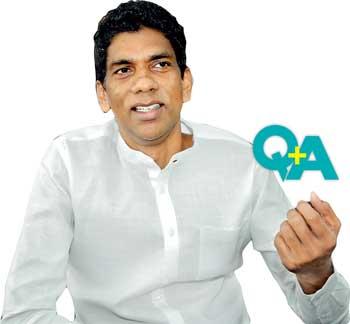
Tamil Progressive Alliance (TPA) MP Palani Digambaram, spoke to Daily Mirror regarding the current political developments and stressed that both Samagi Jana Balawegaya (SJB) and United National Party (UNP) should get into an electoral pact. He also stressed that a balanced foreign policy without favouring one country over the other is crucial. 

Following are excerpts from the interview: 

Much is talked about the President’s recent visit to China and the agreements signed by both countries. What are your views in this regard? 


To put it in plain words, a nation’s foreign policy should be balanced. You cannot be more favourable towards one nation. For example:- if the Sri Lankan government favours China more than other nations, a host of other countries could be sidelined. In our case, India, the USA, Japan, and Korea might be alienated. 

India should not be alienated as they are our closest neighbours and they have been helpful to us, in fact, it was India that came to our rescue when we were bankrupt. The Government should remember this fact. 

Sri Lanka has signed an agreement with a Chinese company to set up an oil refinery in Hambantota, What are your comments on this? 

One has to wonder, how Sri Lanka could benefit from the proposed oil refinery that will be constructed in Hambantota, Will that help in decreasing fuel prices within Sri Lanka? One has to look into the facts.

Q What do you think of the government’s performance during its first 100 days? 

The NPP government promised a lot. They promised to bring the wrongdoers to book. They vowed to uncover the mastermind behind the Easter Sunday attacks, who was behind Thajudeen’s killing and also the perpetrators behind the murder of Journalist Lasantha Wickrematunge. People expect these answers from the government. Since the people’s mindsets have changed, They are prepared to give only a single chance to any government unlike in the past. The NPP government may not get another chance. 

Is the rice issue still to be settled in your opinion? 

Yes, the NPP pledged not to import rice while in the opposition. However, they did import rice after coming into power. 

What do you think of the Clean Sri Lanka programme? 

It is a good programme. It is good to clean up garbage and keep the cities clean. However, one should remember that state institutions should be cleaned too. There is corruption in state institutions from the top to the bottom. 

Your party has been lobbying for an increase in salaries for Estate Workers. What do you expect from this government? 

This government said the daily wage for estate workers should be increased up to Rs. 2000. They said estate sector workers should be granted land. They came out with all these propositions while being in opposition. However, now the NPP is silent about it. 

The government has said it will implement a pay hike in this year’s budget. What do you have to say about that?

We are waiting to see what the government will propose in the budget. 

The Government has decided to reduce electricity tariffs. Any comments on this? 

That is something which the opposition has won for the people. We called for a tariff reduction in Parliament. 

There is talk of SJB and UNP political marriage. You have anything to say to this?

Both Samagi Jana Balawegaya (SJB) and the United National Party (UNP) should get into an electoral pact.  We have been lobbying for it for some time. If SJBers are asked to accept the elephant symbol and if UNPers are asked to accept the telephone symbol will not serve any purpose. The NPP would not have won the Presidential election if UNP and SJB fielded a common candidate⍐.  

The journey of Victor Ivan….From making bombs till the pen nib exploded!


Journalist Victor Ivan is perhaps one of the greatest examples of a person braving all odds and a partial disability to achieve lofty goals and most importantly leave an indelible mark in his chosen profession, the field of media. There were other faces to his personality; he was an activist, political analyst and an author. More than anything else, he was a thorn in the flesh to most governments of his time. If the English media had Lasantha Wickremathuge, the Sinhala media had Victor Ivan. But there was a difference between the two. Most rebels, like Lasantha, probably knew that they wouldn’t have natural deaths. Victor got the opportunity to close his eyes peacefully when the time came to bid farewell to this ‘world’; a place which he wished to earnestly put in order through his writings. The legendary personality passed away on January 19, 2025. He was 75 years old at the time of his death.

He pried into the lives of the corrupt politicians and exposed them. He was a force in this little island when he made ‘Ravaya’- an alternative newspaper – a sort-after publication. There are stories that he had troubled times when financial struggles made paying the salaries of journalists who worked for him unthinkable. But this shrewd man made arrangements to keep journalists in the profession and roll out Ravaya from the printing press to ensure the publication continuously hit the newspaper stands. Those arrangements he made were frowned upon by his critics, but taking help to run his newspaper didn’t change this man into a ‘softie’, who meekly follows government guidelines to put out a tamed publication. 

His pet subject was politics. His close colleagues remember him as a provincial leader of the JVP who had the ability to quickly and convincingly put his opinion on the table; whether delivering a speech or during rare moments when discussion was encouraged during the insurgent uprisings. We cannot forget the fact that Victor was tasked with the duty of making bombs during the insurgency. It was one of the experiments while making a bomb that cost the flexibility in his hands dearly. In the eyes of the people who stood by the principles of religion and democracy, Victor wasn’t a good man. But later in life he reformed. Literature about this legend reveals that ‘his intellectual pursuits were greatly influenced by the work of Bertrand Russell and Mahatma Gandhi and this reflected in both his professional and personal life’. This is great for a man who closely followed the careers of politicians as his profession and wrote about a breed which never reformed or got rid of their childish ways of being greedy for fame, money and power. Politicians could take a cue from Victor about changing for the better.


Politicians fear the man who they cannot change or convert into their line of thinking. True, Victor helped Chandrika Kumaratunga to assume political power in 1994. The problem with lawmakers is that they use journalists to assume power and then turn against them when the same scribes start critisising the regime. Victor’s answer to this was a book he penned under the name ‘Queen of deceit’ (Chaura Rajina) - a publication which exposes all the wrongdoings of President Kumaratunga. Through the book he gave a strong message to all lawmakers; don’t mess with journalists/writers!

Victor was intelligent enough to realise, early as a youth, that the JVP insurgency was a ‘foolish dream’. He then left the party and joined mainstream politics. His first attempt at engaging in full time politics was when he contested from the LSSP ticket in Galle for the provincial Council elections. He lost. But what made him a winner was that he had embraced neutral thinking. That was a time when the JVP ideology was converting minds of the youth with ease and planting the seeds of destruction. This is a past even which the present JVP led NPP hierarchy refuses to throw into the dustbin of politics. 

Victor’s change from being a rebel to a reformer was genuine. Rights activist Sunanda Deshappriya in a tribute (Shared on Facebook on 19-1-2025) penned on Victor writes: “When Victor started Ravaya, he invited me and said ‘come on board and write. There is room for pieces where opinion may differ”. This is the society which we must create; a society which learns to accommodate others with opposing views. Deshapriya, in this piece of writing, states that while contributing to the Ravaya newspaper, he could write pieces which even contradicted what Victor Ivan was writing. 

This writer had a brief telephone conversation with Victor many years ago when the latter’s son -Athula Russell- was playing competitive chess in Sri Lanka. Athula, arguably at that time, which was in early 2000, was the man to beat in chess, in Sri Lanka. There was something about Athula; just like his father. Athula had created some controversy in a chess tournament (he was hitting the table with his hand and not the button of the chess clock which is used to monitor the duration of chess games) hence the need for arbitors at the tournament to step in and offer a solution. Now in chess the arbitors are the players in the tournament themselves and Victor had an issue understanding this. So he got journalist, author and former employee of the Ravaya newspaper Manjula Wediwardene to speak to me and I explained the procedure. The good thing about that episode was that both these men were very intelligent and understood matters fast. There was nothing vindictive in the newspaper the next day regarding the issue at the tournament. The beauty is that the intelligent person becomes a blotting paper and goes into listening mode when he knows that he doesn’t know and accepts that he must learn what he doesn’t know, fast. 

These days I’m reading content from his coffee table book ‘Paradise in tears’- which is a photo essay about Sri Lanka covering a period from 1800 to 1994. He also wrote many other books and even touched on the caste system prevailing in Sri Lanka through two books; one being ‘The revolt in the temple’ and the other being ‘Caste family and politics’. Victor had his journalism net well spread in society and found interesting titbits which he turned into content after much research. 

What were Victor’s thoughts during death? This is such an interesting question for this scribe, but with regard to Victor, no one knows. Sunanda Deshapriya in his piece on Victor writes: “We might not agree with his politics. We don’t have to believe in all his ideologies. We are not enlightened beings”. Victor was reformed to be an accommodating man, if not an enlightened being. Maybe his fiery personality didn’t allow him to be transformed into a personality that had no ‘ego’. That would have been ‘death’ coming to him before he physically died. We know that Victor, till the time of his death, was vocal and critical about the wrongdoings in the system and the flaws of any government. The opinion he formed had weight. But his life experiences probably tuned his mind to a frequency to let go eventually and make life as light as a feather. Go well ‘legend’. You have etched your signature in journalism so profoundly that it should remain for a very long time.⍐

காலநிலை அறிவிப்பு-பேராசிரியர் நா.பிரதீபராஜா

https://www.facebook.com/Piratheeparajah 03.12.2025 புதன்கிழமை பிற்பகல் 3.30 மணி விழிப்பூட்டும் முன்னறிவிப்பு இன்று வடக்கு மற்றும் கிழக்கு ம...