SHARE

Thursday, October 17, 2024

Israel complicates election’s final stretch, an issue Democrats hoped would fade

 Israel complicates election’s final stretch, an issue Democrats hoped would fade

Benjamin Netanyahu’s escalating assaults in Gaza and Lebanon have become a growing vulnerability for Kamala Harris amid her bid for the presidency.

By John Hudson
Yasmeen Abutaleb
Mohamad El Chamaa
 and 
Missy Ryan

President Joe Biden and Vice President Kamala Harris hoped the ongoing violence in the Middle East might simmer below the surface in the final weeks of the presidential race, but fresh Israeli military offensives are making that virtually impossible, U.S. officials and campaign aides say. 

Secretary of State Antony Blinken on Sept. 27 in
New York. (Stephanie Keith/Getty Images)

Prime Minister Benjamin Netanyahu has set the Gaza Strip ablaze with a renewed bombing campaign and launched a ground invasion into Lebanon alongside aerial strikes in Beirut aimed at annihilating the militant group Hezbollah. He is expected to order an imminent attack on Iran’s military facilities in response to its missile strike on Israel this month.


The rapid escalation has tied the Biden administration in knots, resulting in the United States first calling for an immediate cease-fire in Lebanon only to reverse that policy nine days later and openly endorse Israel’s ground offensive.


The whiplash has caused confusion and consternation among Washington’s European and Arab allies who are pushing for the United States to restrain its closest ally in the Middle East. But administration officials remain loath to pick a public fight at such a tenuous moment politically.


“They clearly want to avoid any public confrontation with Netanyahu over Lebanon or Gaza that could result in blowback from Israel’s supporters before the election,” said Frank Lowenstein, a Biden ally and former Middle East negotiator in the Obama administration.


“At the same time, they are sensitive to losing critical Arab American votes in key swing states if their rhetoric leans too far in Israel’s direction,” he added.


The administration has issued statements in response to recent incidents that have drawn international backlash, including Israel’s attacks on U.N. peacekeepers in Lebanon; its deadly bombing of Gaza’s al-Aqsa hospital, which engulfed nearby tent camps in flames; and a U.N. report indicating no food has entered northern Gaza in nearly two weeks. Yet those remarks have been carefully calibrated to avoid portraying a sharp break with Netanyahu.


The latest opportunity to do so came Tuesday, when Israeli media published the contents of a confidential letter from Secretary of State Antony Blinken and Defense Secretary Lloyd Austin urging Israel to allow more humanitarian aid into Gaza or face potential restrictions on U.S. military assistance. Within hours of the letter’s disclosure, spokespeople for the White House and State Department clarified that it “was not meant to be taken as a threat” and that no action would be taken in the next 30 days — pushing any potential punitive action until after the election. They declined to say if weapons restrictions were even on the table.


This account of the Biden administration’s handling of ballooning violence in the Middle East during the election’s final weeks is based on interviews with more than two dozen officials from the United States, Europe and the Middle East as well as Harris’s campaign. The dynamic they conveyed is of an improvisational White House that has followed Israel’s lead into a widening regional war while only marginally influencing Netanyahu’s actions. Some spoke on the condition of anonymity to discuss their observations.


The war’s spread has alarmed the Harris campaign, which sees the images of dead civilians as complicating her path to victory in key swing states with sizable Arab American and Muslim populations.

“It’s a huge concern. It comes down to people saying, ‘I can’t support anyone who supports a genocide,’” a person who advises the campaign said.


Israel denies that its military operations in Gaza constitute genocide.


Vice President Kamala Harris and Israeli Prime Minister Benjamin Netanyahu appear before
a meeting in Washington in July. (Julia Nikhinson/AP)

‘Look at our track record’


The Biden administration contends that critics underestimate the impact it has had in reducing the scale of Israel’s invasion into Lebanon, increasing the flow of humanitarian aid into Gaza and preventing a full-scale war with Iran. Officials say they are constantly working to dissuade Netanyahu from bombing Beirut and scale back his planned counterattack on Iran, which some fear could include strikes on nuclear or oil facilities, a prospect that could upend the global economy.


“Look at our track record of intervening to get humanitarian assistance in,” State Department spokesman Matthew Miller told reporters Tuesday. “When we have seen the results not measure up to the standards that we expect, we have intervened with them.”


But according to the administration’s own assessment, the amount of aid delivered to Gaza has dropped by more than 50 percent since the spring. In Lebanon on Wednesday, Israeli airstrikes resumed near Beirut’s southern suburb, hitting what the Israeli military called an underground weapon storage facility used by Hezbollah. Other Israeli strikes in southern Lebanon hit government buildings in Nabatieh, killing at least six people, including the mayor.


Israeli officials say they will not kowtow to the United States about targets in Lebanon, where more than 1,700 people have been killed and 1.2 million displaced since fighting intensified in mid-September. “We will continue to hit Hezbollah mercilessly in all parts of Lebanon — also in Beirut,” Netanyahu said.


No final decision has been made about targets to strike in Iran, Israeli officials say, but an attack is expected in the coming days.


In Gaza, most U.S. officials concede the two sides will not reach a cease-fire-hostage deal by the end of the year. That process was bogged down amid demands from Hamas about prisoner exchanges and Israel on keeping its troops along the Gaza-Egypt border.


The dilemma has caused current and former officials to reflect on how Washington could have avoided the quagmire.


Andrew Miller, who recently stepped down as the State Department’s top official for Israeli-Palestinian issues, said the United States was too quick to accept Israel’s expanding operations without understanding their scope.

“What we did had the effect of endorsing Israel’s military campaign before understanding whether Israel had a viable exit strategy,” he said in an interview. “I don’t think there’s anyone in the administration who could say with a straight face Israel had a clearly defined end-state.”


Inside the Harris campaign, concerns are particularly acute in Michigan, home to one of the nation’s largest Arab American and Muslim populations, with about 300,000 people who claim ancestry from North Africa or the Middle East.


Polls show Harris and her Republican opponent, former president Donald Trump, effectively tied there and in other battleground states that will decide the election. Harris’s clearest path to victory is in the “Blue Wall” states of Michigan, Pennsylvania and Wisconsin, and she has few paths to the presidency without winning the Wolverine State, where she is holding five events in three days this week.


When Harris first entered the race, her advisers hoped the fact that she had distinguished herself from Biden by speaking more forcefully about Palestinian suffering would help win over a sizable segment of Arab American and Muslim voters who are angry over the administration’s support of Israel.


But winning their support has become more difficult as Israel’s military campaign has intensified with U.S. backing.


Israeli officials say the assaults are needed to prevent another Oct. 7, the day in 2023 that Hamas-led fighters killed 1,200 people in Israel and took more than 250 hostage. The American political calendar is not a factor in the sequencing of the war, an Israeli official told The Washington Post. “The timing of strikes is solely determined by operational considerations, nothing else,” the official said.


The botched cease-fire


Despite a year’s worth of failed efforts to end hostilities in Lebanon and Gaza, U.S. officials saw their last best opportunity during the U.N. General Assembly in New York late last month.


Biden’s envoy, Amos Hochstein, had been holding calls with Lebanese negotiators in Beirut into the early hours of the morning on Sept. 26 as he consulted with Israeli officials in New York on the language of a cease-fire statement.


Eventually, U.S. and French officials received enough positive signals from Israeli and Lebanese counterparts to release a joint U.S.-French statement calling for a 21-day cessation of hostilities. U.S. officials touted the statement to reporters as a “breakthrough.” The optimists in Biden’s inner circle thought a cease-fire in Lebanon could open a backdoor to one in Gaza, ending hostilities just before the election.


Diplomats discussed the details of a possible U.N. Security Council resolution, including semantics like whether to use the word “cease-fire” or “truce,” a Western diplomat said.


Meanwhile, Netanyahu instructed his armed forces to “continue fighting at full force” in remarks that embarrassed U.S. officials who leaned on the prime minister’s top aide, Ron Dermer, to issue a statement in support of the cease-fire discussions.


French and Lebanese officials believed the various sides were close to entering a truce while U.S. officials said they were still days away from implementing an agreement due to discrepancies, including rules for Hezbollah and Israeli troops movements.


Then on Sept. 27, a fleet of Israeli F-15s dropped dozens of bombs on a building in the southern suburbs of Beirut, killing Hezbollah leader Hasan Nasrallah and his top aides. The attack eliminated one of Israel’s most ruthless foes, a dominant political and military figure in Lebanon for decades. It also killed any chance for the U.S.-France cease-fire proposal.

“It all went up into thin air,” the Western diplomat said.


Israeli officials said that Netanyahu was never interested in a cease-fire and that a miscommunication occurred between the White House and the prime minister’s office. U.S. officials say the prime minister changed his mind, either as a result of pressure from his right-wing cabinet or upon receiving actionable intelligence about Nasrallah’s whereabouts.


The next phase


Sensing an opportunity to build on the decapitation of Hezbollah’s leadership, Netanyahu authorized a ground invasion of Lebanon on Oct. 1 to destroy the infrastructure the group used to fire rockets into Israel.

In a televised address, Netanyahu said the people of Lebanon could oust Hezbollah or suffer the fate of Gaza, where more than 42,000 Palestinians have been killed, according to local health authorities. “You have an opportunity to save Lebanon before it falls into the abyss,” Netanyahu said.


Privately, administration officials were outraged and said Netanyahu’s threats risked uniting Lebanon’s fractured society against the invasion. “He’s an unbelievably flawed messenger,” a senior U.S. official said.

But Biden and his top advisers agreed with Netanyahu’s premise that the weakening of Hezbollah could be exploited to reshape Lebanon’s politics and appoint a new president. A limited incursion was backed by Blinken, Hochstein, Austin, Middle East coordinator Brett McGurk and White House national security adviser Jake Sullivan, said officials familiar with the matter.


But like with other Israeli promises, the mission expanded, including major bombardments of towns and villages involving civilian casualties that U.S. officials say they strongly oppose.


Analysts are skeptical that the lofty goals of the United States and Israel in Lebanon are achievable before Biden leaves office.


“I don’t think there’s enough time left to accomplish that,” said Andrew Miller, the former State Department official. “At the most, you could potentially see the appointment of a new president, but even that’s going to be extraordinarily difficult.⍐”

Wednesday, October 16, 2024

தினப்பொறி 18- அதிகாரப் பகிர்வு தேவையில்லை-ஜே.வி.பி


EU-GCC summit- Qatar urges ceasefires in Israel’s wars in Gaza, Lebanon


Qatar urges ceasefires in Israel’s wars in Gaza, Lebanon at EU-GCC summit

Qatar’s Sheikh Tamim bin Hamad Al Thani also calls for lasting solution to the Israeli-Palestinian conflict.

Qatar’s emir has called for ceasefires in Israel’s wars in Gaza and Lebanon and stressed the importance of establishing a Palestinian state at a meeting with European Union leaders in Brussels, Belgium.

The 27-nation EU is seeking to work more closely with the Gulf Cooperation Council (GCC) – which brings together Bahrain, Kuwait, Oman, Qatar, Saudi Arabia and the United Arab Emirates – in addressing conflicts in both the Middle East and Ukraine.

In opening remarks at the first EU-GCC summit on Wednesday, Qatar’s Sheikh Tamim bin Hamad Al Thani outlined the need for creating a “sovereign and independent” Palestinian state existing side by side with Israel. He also called for a ceasefire in Israel’s ongoing wars in Gaza and Lebanon.

“The destructive war waged by Israel today on Palestine and Lebanon made war crimes as something normal. That is something that we cannot accept,” Al Thani said.

“We need a settlement for these conflicts. We need to find a solution to the Palestinian cause on the basis of international legitimacy and of the 1967 borders … A ceasefire would be a first step before a serious round of negotiations for a definite solution to the Palestinian cause.”

The summit comes more than a year after Israeli launched its assault on Gaza after the Palestinian group Hamas led an attack on southern Israel, killing at least 1,139 people, mostly civilians, according to an Al Jazeera tally based on official Israeli statistics, and seized around 250 others as hostages.

Israel’s war on Gaza has killed more than 42,400 people, mostly women and children, according to Palestinian authorities, and displaced more than 90 percent of the territory’s 2.3 million residents, many more than once.

Meanwhile, the Lebanese armed group Hezbollah has been exchanging cross-border fire with Israel for more than a year, saying it is acting in response to Israel’s devastating ground and air assault on Gaza.

Israel’s military last month drastically escalated the fighting with Hezbollah, targeting several senior leaders in the organisation, expanding Israel’s bombardment across Lebanon and sending ground troops into the country’s south.

At least 1,350 people have been killed in Lebanon since Israel escalated its attacks last month, according to Lebanese authorities.

European Commission President Ursula von der Leyen warned against an escalation of the war in the Middle East and called for an immediate ceasefire in Gaza and Lebanon.

“Russia’s war against Ukraine and the Hamas-led terrorist attack against Israel on October 7 have fundamentally undermined regional security in Europe and the Gulf,” she said.

“We need to do all in our power and mobilise all our diplomatic skills to stop the extremely dangerous escalation with now Iran launching a massive ballistic attack against Israel, or Houthis attacking our ships,” she added.

Al Jazeera’s Hashem Ahelbarra, reporting from the summit, said the opening remarks from the leaders gave a sense of how the spiralling violence in the Middle East was becoming an “urgent” issue for the international community.

“If this continues, it could further deteriorate into a wider confrontation that could draw the Iranians into a vicious cycle of tit for tat with the Israelis. That could be the moment where the international community would have zero leverage to contain the situation,” he said.

The presence of Saudi Arabia’s de facto ruler, Saudi Crown Prince Mohammed bin Salman – confirmed at the last minute – heightened expectations about the push from the GCC side for a two-state solution.

“The year 2002 was the date when the Saudis launched the Arab Peace Initiative, which calls for all the Arab nations to recognise Israel in exchange for Israelis accepting an independent Palestinian state, [the] same statement reiterated by the emir of Qatar,” said Ahelbarra.

Russia-Ukraine war another priority

Russia’s war on Ukraine was also expected to dominate the meetings, with the EU attempting to garner international support to isolate Russia.

While views differ on Russia’s invasion of Ukraine – in particular, the implementation of Western sanctions and the EU’s push to punish Iran for bolstering Moscow’s war effort – there was some hope of closer cooperation on that front.

“I’m confident that we can work together and rely on you to stop this illegal Russian war,” von der Leyen told Gulf leaders.

Though Brussels wants the GCC partners to agree to stronger language on Russia’s military assault, it is not expecting them to fully adopt its position in blaming Moscow.

Al Thani’s opening speech made a brief reference to the conflict on European soil.

“As far as the Ukraine-Russia war is concerned, the GCC position is based on international law principles and the Charter of the United Nations, which preserves the sovereignty of states, their territorial integrity and the noninterference in internal affairs of states,” the emir said.

Talks at the summit are also expected to touch on trade and investment cooperations and visa liberalisation. 

Tuesday, October 15, 2024

India's moment is hurt by interference label

 India's moment is hurt by interference label

Deepening Canada-India standoff seen as a short-term boost for Modi, Trudeau

 Deepening Canada-India standoff seen as a short-term boost for Modi, Trudeau

NEW DELHI/OTTAWA, Oct 15 (Reuters) - The prime ministers of India and Canada could benefit politically in the short term from the unprecedented expulsion of top diplomats from each country, analysts said on Tuesday.
Canada kicked out six Indian diplomats on Monday, linking them to the murder of a Sikh separatist leader and alleging a broader effort to target Indian dissidents in Canada. India retaliated by telling six Canadian diplomats to leave.
Although the tit-for-tat move sent bilateral relations skidding to a new low, Narendra Modi and Justin Trudeau are unlikely to mind too much. Both leaders are in their third terms and face political challenges.
Analysts suggested the move could bolster Modi's image as a hawk on national security.
"I think people will see the government of India standing up to intimidation and coercive measures applied by a developed country," said Harsh Vardhan Shringla, India's former foreign secretary. "The public will strongly back Prime Minister Modi and the government."
In a June election, Modi suffered a setback when his Bharatiya Janata Party unexpectedly lost its majority. In his weakened position, Modi is forced to rely on regional allies to form a coalition government.
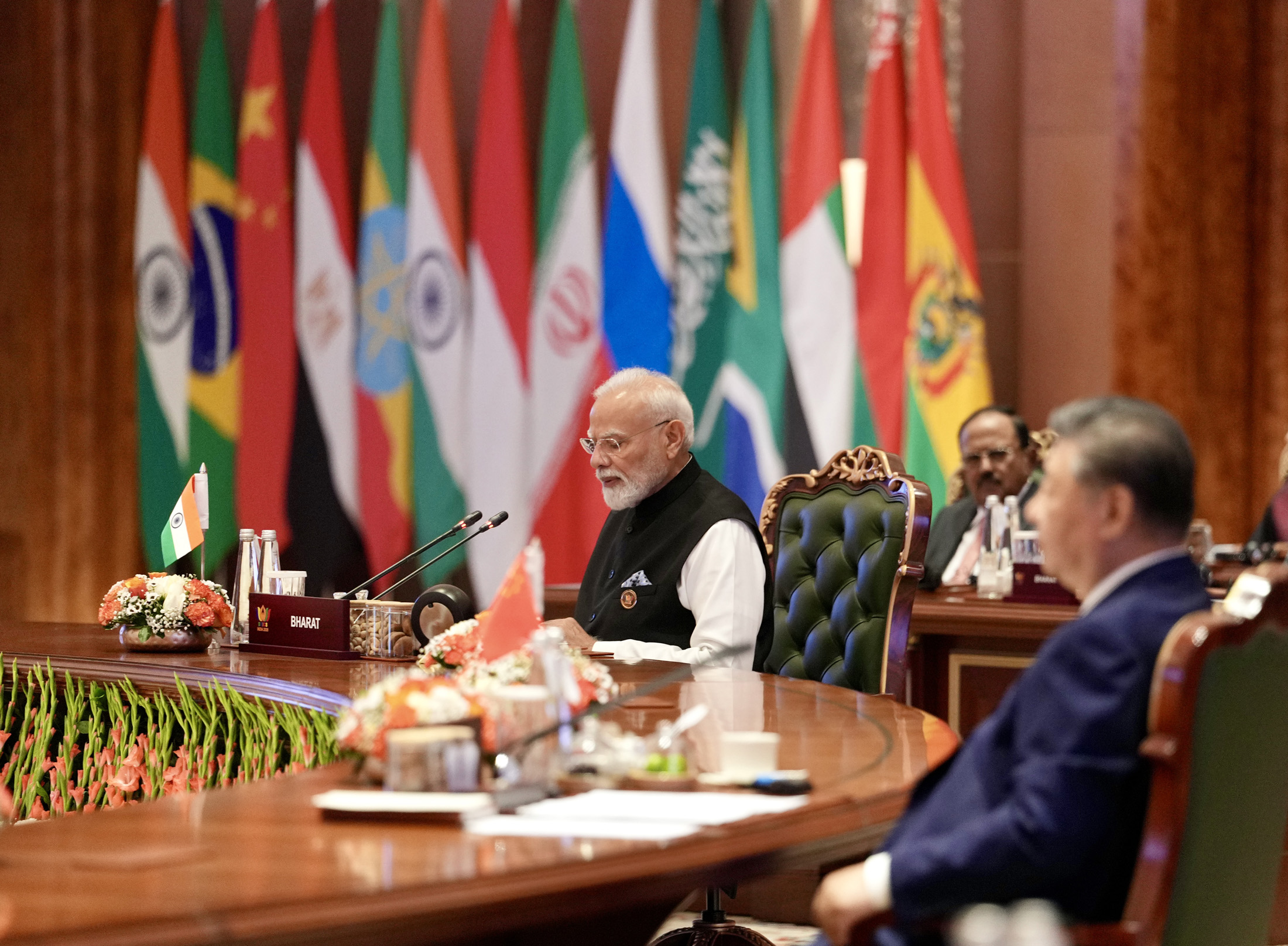
Indian Prime Minister Narendra Modi welcomes Canada Prime Minister Justin Trudeau upon his arrival at Bharat Mandapam convention center
for the G20 Summit, in New Delhi, India, Saturday, Sept. 9, 2023. Evan Vucci/Pool via REUTERS/File Photo

Canada is home to the highest population of Sikhs outside their home state of Punjab, or about 2% of Canada's population. Demonstrations in recent years to carve a separate homeland have irked India's government, which regularly accuses Canada of harboring separatists.
Harsh Pant, foreign policy head at the New Delhi-based Observer Research Foundation think tank, said the more Trudeau targeted India, the better it was for Modi.
"(He is seen as) a leader of a country standing up for the territorial integrity and sovereignty of a nation. ... That someway encapsulates why Modi and his popularity will not be dented," he said.
For Trudeau, whose Liberal Party is trailing far behind in the polls for a national election that must be held by October 2025, the news took the spotlight off a supposed effort by unhappy legislators to urge him to quit and let a new leader take over.
"There will be time to talk about internal party intrigue at another moment," he told reporters when asked about the matter on Sunday.
"Right now, this government and indeed all parliamentarians should be focused on standing up for Canada's sovereignty, standing against interference and looking to be there to support Canadians in this difficult moment."
The leaders of both Canada's left-leaning opposition parties, whose support Trudeau needs to keep his minority government alive, said they backed the expulsions.
But Cristine de Clercy, professor of politics at Trent University in Peterborough, said any bump for Trudeau would likely be brief.
"You could say, yes, the short-term upside is to displace headlines," she said. "The list of domestic issues that he has to address is so much longer and more complicated than this single incident in a faraway country."
The politically influential Sikh community has backed the Liberals and other parties in recent years. At least one leader said he welcomed the expulsions but did not expect the dispute to impact domestic politics.
"It shows that the government is actually holding India to account, which is actually their job," said Moninder Singh, a spokesperson for the nonprofit B.C. Gurdwaras Council which represents Sikh institutions in the province⍐.

India says no auction of satellite spectrum after Musk decries move


India says no auction of satellite spectrum after Musk decries move


By Aditya Kalra and Munsif Vengattil

NEW DELHI, Oct 15 (Reuters) - India's government on Tuesday said it will allot spectrum for satellite broadband administratively and not via auction, hours after Elon Musk criticized the auction route being sought by rival billionaire Mukesh Ambani as "unprecedented".
In what is seen as a battle between billionaires, the methodology of awarding spectrum for satellite services in India - a market set to grow 36% a year to reach $1.9 billion by 2030 - has been a contentious issue since last year.
Musk's Starlink argues administrative allotment of licences is in line with a global trend, while India's Reliance, led by billionaire Mukesh Ambani, says an auction is needed to ensure a level playing field and as there are no provisions in Indian law on how individuals can be provided satellite broadband services.
Telecoms Minister Jyotiraditya Scindia said during a New Delhi event that the spectrum will be allocated administratively in line with Indian laws, and its pricing worked out by the telecom watchdog.
"If you do decide to auction it, then you will be doing something which is different from the rest of the world," he said.
On Sunday, Reuters was first to report that Reliance had challenged the Indian telecom regulator's consultation process that signals home satellite broadband spectrum should be allocated, not auctioned, calling for it to start again.
The minister's comment will come as a shot in the arm for Musk, who following the Reuters story wrote on X late on Monday that any decision to auction "would be unprecedented".
"This spectrum was long designated by the ITU as shared spectrum for satellites," Musk said, referring to the International Telecommunication Union, a U.N. agency for digital technology.
India is a member of the ITU and signatory to its treaty that regulates satellite spectrum and advocates that allocation must be done "rationally, efficiently and economically" as it is a "limited natural resource".
Sunil Mittal, co-chair of global satellite group Eutelsat, which has partnered with India's telecom operator Bharti Airtel, voiced support for the auction route on Tuesday.
"Satellite companies who have ambitions to come into urban areas, serving elite retail customers, just need to take the telecom licenses like everybody else... they need to buy the spectrum as telecom companies buy," Mittal, who is also the chair of Airtel, said at the New Delhi event.
Earlier in 2023, both Eutelsat unit OneWeb and Airtel had voiced concerns about auctioning the spectrum in their submissions to the Indian government.
Musk's Starlink and some global peers like Amazon's Project Kuiper back an administrative allocation, saying spectrum is a natural resource that should be shared by companies.⍐

Govt. to reconsider Adani wind power project, AG tells court

Govt. to reconsider Adani wind power project, AG tells court
Published  on 2024/10/15 By AJA Abeynayake The Island

The Attorney General informed the Supreme Court yesterday that the Cabinet of Ministers has decided to reconsider matters related to the wind power project in Wedithalathivu, Mannar, proposed by India’s Adani Green Energy. This update was presented during a hearing on Fundamental Rights petitions seeking to invalidate the Cabinet approval for the proect. Deputy Solicitor General Avanthi Perera, representing the Attorney General, stated that the Cabinet plans to re-evaluate the facts surrounding the project on November 7, 2024, and will determine the future of the initiative at that time. She noted that the current interim Cabinet made this decision and requested an extension to finalize their stance, which will be communicated by the new Cabinet to be formed after the upcoming General Election. Perera emphasized that the current position regarding the project would remain unchanged in the interim.

The petitioning parties, who accepted the facts presented by the Deputy Solicitor General, sought permission from the bench of judges to revise their petitions due to changes in the respondents with the formation of the new government. The Supreme Court granted this request.

Additionally, the Court ordered that any government observations related to the project be submitted by January 31, 2025. The Fundamental Rights petitions were filed by five parties, including the Centre for Environmental Justice, who argue that the proposed wind farm poses significant threats to ecological biodiversity and the safety of migratory birds⍐.

How Nato is preparing for war in the Arctic

How Nato is preparing for war in the Arctic  Nordic nations hope US fixation on Greenland will spur alliance to catch up with years of Russi...